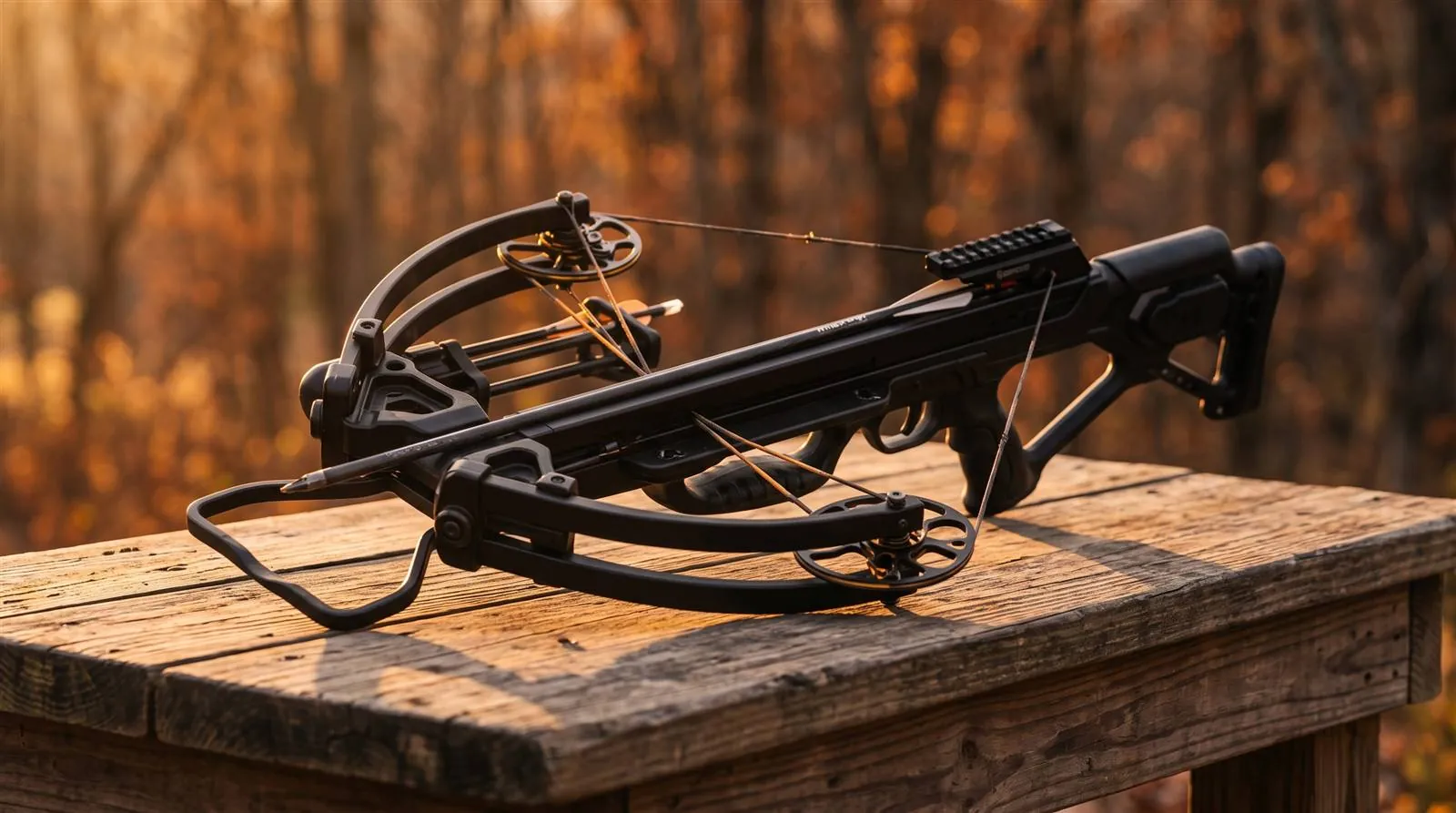
What Is Trajectory (Bolt Drop)?
The curved path a bolt follows after release, falling under gravity so it lands lower the farther it travels.

Trajectory (Bolt Drop): definition
Also called: bolt drop, arrow drop, bolt trajectory, arrow trajectory, drop
Trajectory is the path a bolt takes from the rail to the target. From the moment it leaves the string, gravity pulls it downward, so the path is a curve rather than a straight line. Bolt drop is the amount the bolt has fallen below the line of the bore at a given distance.
Time in the air is what drives drop. A slower bolt takes longer to cover the same distance, so gravity has longer to act on it. That is why a heavier bolt shot from the same crossbow, which leaves at a lower FPS, lands lower at 40 yards than a lighter one. The bolt also loses speed to air drag as it travels, so drop grows faster at longer ranges than a simple speed figure suggests.
Because the scope sits above the rail, the line of sight and the bolt path cross. When you zero at 20 yards, you are choosing the distance where the curve meets your aiming point. A multi-dot or BDC reticle adds aiming points below that for longer distances, and each is calibrated for a speed range, because a different bolt speed produces a different curve.
Drop in a vacuum (no-drag simplification)
Drop (feet) ≈ 16.1 × t², where t (seconds) = distance (feet) ÷ speed (feet per second)
Simplified example that ignores air drag: a bolt at 400 fps covering 40 yards (120 feet) takes 120 ÷ 400 = 0.3 seconds. Drop ≈ 16.1 × 0.3 × 0.3 = 1.45 feet, about 17 inches below the bore line. At 300 fps the same distance takes 0.4 seconds, and drop ≈ 16.1 × 0.16 = 2.58 feet, about 31 inches. Real bolts slow down in flight, so actual drop is larger than these figures.
Why Trajectory matters
Drop is why distance judgment matters. A bolt that hits the aiming point at 20 yards will land well below it at 40 yards, and misjudging the range by a few yards at longer distances moves the impact more than the same error close in. Knowing your bolt's curve is part of shooting ethically and safely, with a backstop that covers misses.
It also explains why changing bolts or tips means re-checking your zero. A heavier bolt, a heavier tip or a different crossbow changes speed, and a change in speed changes where every aiming point lands. The bolt drop chart lets you compare the effect of different speeds before you head to the range, but your own shooting at known distances is the final check.
How to read it on a spec sheet
- Manufacturers rarely list drop directly. Start from the listed FPS and remember it is usually measured with a lighter bolt than many people shoot.
- If a scope lists a speed range for its reticle, check that your actual bolt speed falls inside it.
- Read published drop charts as a guide for a specific speed and bolt weight, not as a promise for your setup.
- Compare drop figures only at the same zero distance. A chart zeroed at 20 yards and one zeroed at 30 yards are not comparable.
- Remember that downrange speed is lower than launch speed, so long-range figures depend on how much speed the bolt keeps.
Common mistakes
- Assuming a reticle marked for 20, 30 and 40 yards is correct without shooting each distance with your bolts.
- Changing to heavier bolts or tips and not re-checking the aiming points.
- Using the vacuum formula as an exact answer. It ignores drag and underestimates real drop.
- Guessing range at longer distances, where a small distance error produces a large vertical miss.
- Comparing drop charts that use different zero distances or bolt weights.
Check your real drop
- Zero your scope at the distance the manual recommends, usually 20 yards, with the bolts and tips you will actually shoot.
- Measure out 30, 40 and further distances with a tape or rangefinder rather than pacing.
- Shoot a small group at each distance using the matching aiming point.
- Note how far each group lands from the aiming point and adjust the scope speed setting if it has one.
- Write the results down and repeat after any change of bolt, tip or crossbow.
Frequently Asked Questions
What is bolt drop?
Bolt drop is the distance a bolt falls below its original line of travel because of gravity. It grows with time in flight, so it increases with distance and is larger for slower bolts than for faster ones from the same setup.
Why do heavier bolts drop more?
From the same crossbow, a heavier bolt leaves at a lower speed, so it spends longer in the air over any distance. Gravity acts for that longer time, which produces more drop. The heavier bolt often carries more momentum, so it is a trade-off.
How much does a crossbow bolt drop at 40 yards?
It depends on speed, bolt weight, drag and your zero distance. A no-drag estimate for a 400 fps bolt gives roughly 17 inches below the bore line at 40 yards, but real figures are larger. Shoot your own setup at a measured 40 yards to know.
Why does my BDC reticle not match my bolts?
Multi-dot and BDC reticles are calibrated for a speed range. If your bolts are heavier or lighter than the setup the scope assumes, the dots will land high or low. Many crossbow scopes have a speed dial to adjust for this; check your manual.
Does a faster crossbow have a flatter trajectory?
Generally yes. A faster bolt spends less time in the air over a given distance, so it drops less. The difference between aiming points shrinks, which makes small range errors less costly, though bolt weight and drag still matter.
Does the vacuum formula give accurate drop?
No. It is a simplification that ignores air drag, so it underestimates drop, especially at longer distances. It is useful for understanding why speed matters, but real figures come from shooting your own bolts at measured distances.
Do I need to re-zero after changing tips?
You should check it. A heavier or lighter tip changes total bolt weight and speed, which moves the point of impact, especially at longer ranges. Shoot a group at your zero distance and at your longer aiming points to confirm.
Keep learning
Guides that use this term
- GuideHow to Sight In a Crossbow ScopeSight in a crossbow scope in six numbered steps: safe range setup, bore-sighting, a 20-yard zero, click math, longer-range checks and fixes.Read the guide
- GuideCrossbow Speed: How Fast Is a Bolt (FPS)How fast a crossbow bolt travels: chronographed speeds from pistol to flagship, what changes bolt speed, and why speed and kinetic energy differ.Read the guide
- GuideHow to Choose a Crossbow Scope in 7 StepsHow to choose a crossbow scope: match the reticle to your bolt speed, then compare magnification, eye relief, focal plane and illumination with our checklist.Read the guide
Related terms
- FPS (Feet Per Second)The speed of a bolt as it leaves the crossbow in feet per second, usually rated with one specific bolt weight.
- BDC ReticleA BDC reticle adds aiming marks below the centre, each matched to a distance at a stated bolt speed, so you hold the right mark instead of guessing holdover.
- Zeroing (Sighting In)Zeroing is adjusting a scope so the bolt lands where the reticle points at a chosen distance, and it is the foundation of every other aiming mark.
- ReticleThe reticle is the pattern of lines, dots or marks inside a scope that you place on the target, and its design decides how you account for bolt drop.
- Kinetic EnergyThe energy a bolt carries, in foot-pounds, calculated from its weight in grains and its speed in feet per second.
- GrainThe unit used to weigh crossbow bolts and tips, where 7,000 grains equal one pound, so a 400-grain bolt weighs about 0.9 ounce.
Browse the gear
Definitions are general information. Manufacturer figures vary, so follow your crossbow's manual and verify local laws with the relevant authority.