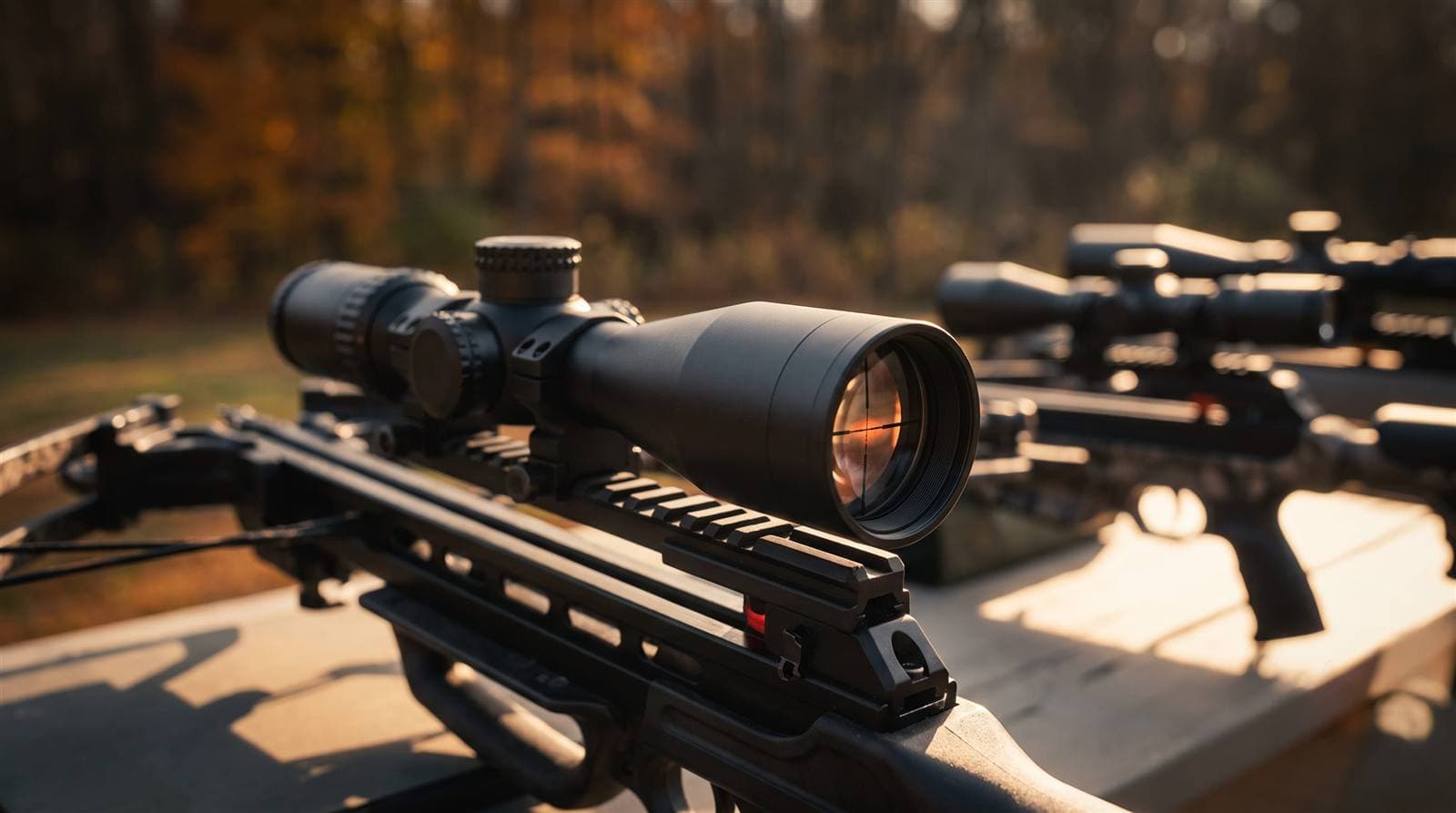
What Is Reticle?
The reticle is the pattern of lines, dots or marks inside a scope that you place on the target, and its design decides how you account for bolt drop.
Reticle: definition
Also called: crosshair, aiming points, hold marks, reticle pattern
A reticle is the aiming pattern you see through a scope. It may be a plain crosshair, a duplex crosshair with thick outer lines, a series of dots, or a more complex pattern with several stacked aiming points. Traditional reticles are etched on glass; digital scopes draw the reticle on a screen.
On crossbows the choice of reticle shapes your shooting method. A plain crosshair has one aim point, and you hold over by judgement for longer shots. A BDC reticle prints extra marks at set distances for a stated bolt speed, and a digital or rangefinding scope moves a single aim point for the measured distance.
Reticles are described by their subtension, which is how much angle each mark covers. Where the reticle sits in the tube, front or rear, determines whether that subtension changes with zoom, and that is the topic of focal plane.
Reticle styles in the scopes we have reviewed
| Scope | Reticle | Marks |
|---|---|---|
| CVLIFE 3-9x40 | Plain crosshair | One aim point; holdover left to you |
| TruGlo 4x32 Compact | BDC, dual-colour illuminated | Calibrated for 20 to 50 yards |
| Vortex Crossfire II 2-7x32 | XBR-2, red/green illuminated | Hold marks 20 to 100 yards, 40-yard zero |
| TenPoint RangeMaster 100 | Dots, crosshairs, chevrons | Nine marks, 20 to 100 yards |
| TenPoint EVO-X Marksman Elite | Etched glass drop-compensation | Nine references, 20 to 100 yards |
| Garmin Xero X1i | Digital illuminated aim point | Updates automatically with range |
Why Reticle matters
The reticle is where the scope meets ballistics. A good match means each mark corresponds to a real distance for your bolt speed; a poor match gives confident but wrong aim points.
It also affects clutter. More marks give more distances but more to read quickly, and some reviewed nine-mark designs take practice before they feel natural.
Illumination, line thickness and colour decide how visible the reticle is in dim light or against dark backgrounds.
How to read it on a spec sheet
- Look for the speed band the reticle is calibrated for, such as 380–505 FPS or 300–550 FPS, and compare it with your crossbow’s rated speed.
- Note the zero distance the marks assume, for example a 40-yard zero.
- Check which marks are illuminated. On one reviewed scope the longest-range chevrons are not lit, which matters at dusk.
- Find the focal plane. It tells you at which magnification the marks are valid.
- A speed adjustment feature means you can tune the reticle to your own bolt speed within a range.
Common mistakes
- Trusting printed distances without confirming them on target with your bolt and tip.
- Using the marks at a magnification different from the one they were designed for.
- Choosing the busiest reticle. Simpler patterns are faster to read under pressure.
- Skipping a chronograph reading when buying a scope calibrated to a narrow speed band.
- Treating the lowest mark as a guaranteed hit zone. Confirm every distance at the range.
Verifying a reticle on the range
- Note your crossbow’s actual bolt speed if you can measure it, and compare with the reticle’s stated band.
- Zero at the distance the reticle assumes, as in how to sight in a crossbow scope.
- Shoot a group at each distance using the matching mark and record where each lands.
- Mark any distances that land off, and note them on a card for the crossbow.
- Repeat after any change in bolt weight or tip.
In my testing
My protocol zeroes the scope and then shoots over a chronograph at a stated bolt weight, so the reticle is checked against measured speeds. For the TenPoint RangeMaster 100 all nine illuminated aiming points tracked point of impact across 380–505 FPS on my test crossbows, and the Vortex hold marks matched chronographed drop once calibrated. How I test.
See it in our reviews
- TenPoint RangeMaster 100 — rated 4.6/5
- Vortex Crossfire II 2-7x32 — rated 4.6/5
- EVO-X Marksman Elite — rated 4.7/5
- TruGlo 4x32 Compact Scope — rated 4.3/5
Frequently Asked Questions
What is a reticle in a scope?
The reticle is the aiming pattern you see through the scope, such as a crosshair, dots or stacked marks. You place it on the target, and its calibration decides where the bolt lands relative to that point.
What is the best reticle for a crossbow?
It depends on how you shoot. A BDC pattern suits quick shots at set distances, a plain crosshair suits those who prefer to hold over by judgement, and a rangefinding scope suits those who want measured aim points.
What does a BDC reticle do?
It adds aiming marks below the centre that correspond to longer distances for a stated bolt speed. Hold the matching mark on the target instead of estimating holdover, then confirm each mark on the range.
What is an illuminated reticle?
It is a reticle that lights up in red or green so it stays visible in low light or against dark backgrounds. Brightness is usually adjustable, and some designs light only certain marks.
Can I use a reticle with a different crossbow?
Only if your bolt speed falls within its stated range and you re-verify the marks. Marks are built for a speed band, so a very different crossbow shifts where every mark hits.
What is reticle subtension?
Subtension is the angle a reticle mark covers, usually in MOA. It tells you how large a mark is at a given distance. Whether it changes with zoom depends on the focal plane.
Why do some reticles have chevrons and dots?
Different shapes distinguish distances so you can tell marks apart quickly. The reviewed nine-mark design uses three dots, three crosshairs and three chevrons, which groups marks into short, mid and long distance sets.
Keep learning
Guides that use this term
- GuideBest Crossbow Scopes of 2026Best crossbow scopes of 2026: eight reviewed picks from budget optics to laser rangefinding models, plus how to choose magnification, reticle and eye relief.Read the guide
- GuideHow to Sight In a Crossbow ScopeSight in a crossbow scope in six numbered steps: safe range setup, bore-sighting, a 20-yard zero, click math, longer-range checks and fixes.Read the guide
Related terms
- BDC ReticleA BDC reticle prints extra aiming marks below the centre, each matched to a distance for a stated bolt speed, so you hold the matching mark instead of guessing holdover.
- Focal Plane (FFP vs SFP)Focal plane describes where the reticle sits in the scope: a first focal plane reticle scales with zoom, while a second focal plane reticle stays the same size.
- Illuminated ReticleAn illuminated reticle lights its aiming marks, usually in red or green with adjustable brightness, so they stay visible in low light and against dark backgrounds.
- ScopeAn optical sight mounted on a crossbow rail that magnifies the target and places a reticle on it so you can aim with repeatable precision.
- MOA (Minute of Angle)MOA is an angular unit of 1/60 of a degree that spans about 1.047 inches per 100 yards and measures scope adjustments and group size.
- Zeroing (Sighting In)Zeroing is adjusting a scope so the bolt lands where the reticle points at a chosen distance, and it is the foundation of every other aiming mark.
Browse the gear
Definitions are general information. Manufacturer figures vary, so follow your crossbow's manual and verify local laws with the relevant authority.