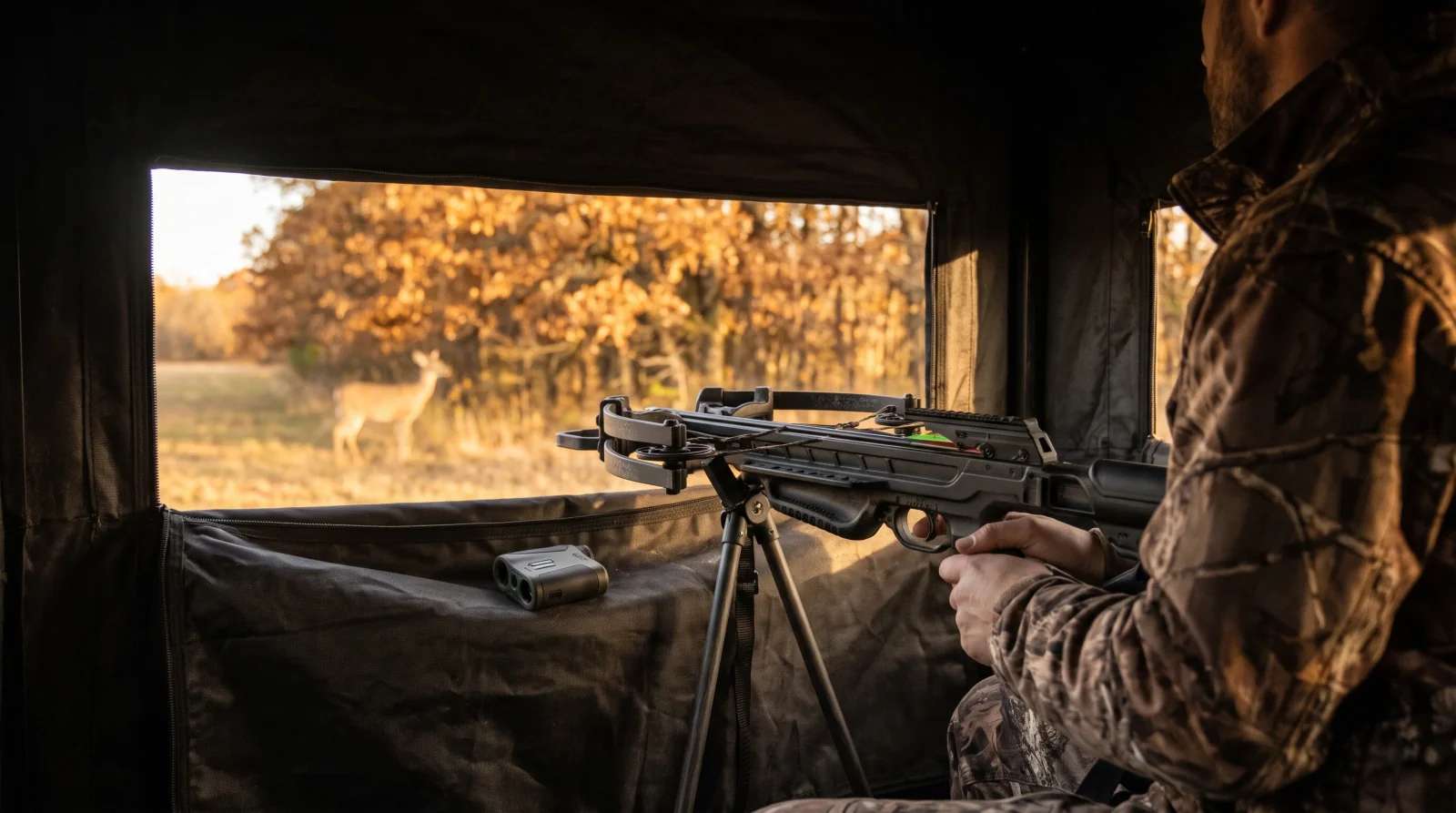
How far can a crossbow shoot? There are three honest answers: how far a bolt can fly, how far a crossbow can hit a target, and how far you should shoot at a deer. Only the last one matters in the woods, and it is much shorter than the "100-yard scope" on the box suggests.
This page is the distance chapter of our crossbow hunting guide, which covers stands, scouting and the season as a whole.
How Far Can a Crossbow Shoot? Three Different Answers
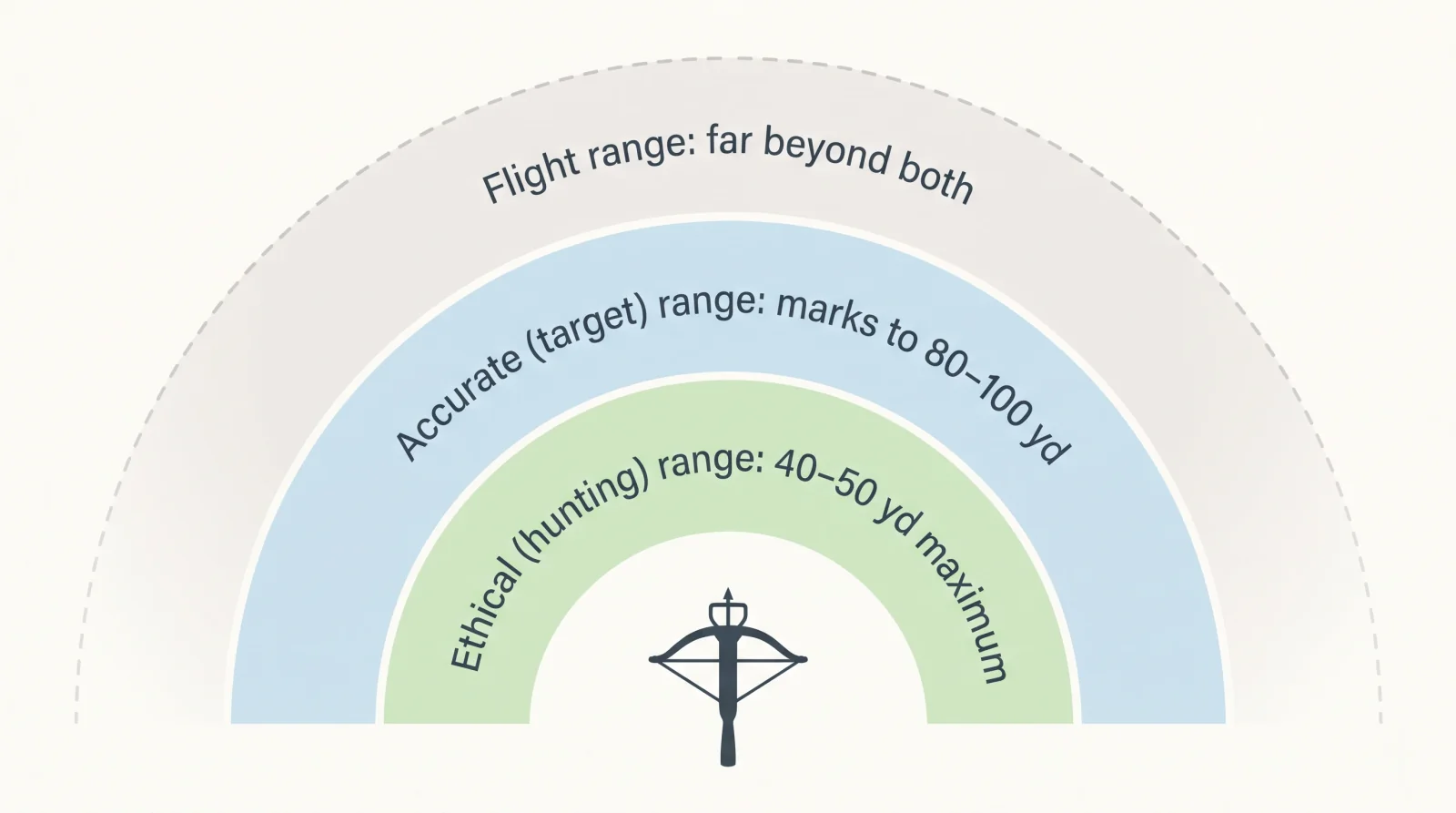
Bowhunting.com's Justin Zarr splits the question into three categories: maximum range, confidence, and ethical distance. The same split clears up most arguments about crossbow range, because people quoting "100 yards" and "40 yards" are usually answering different questions.
The hunting answer is a crossbow's effective range: the farthest distance at which you can reliably put a broadhead through a deer's heart and lungs. It belongs to the shooter and the conditions, not to the crossbow.
| Range type | What it means | Typical figure | Who sets it |
|---|---|---|---|
| Flight range | How far a bolt travels before it lands | Far past any hunting or target distance; no maker we checked publishes one | Physics: speed, launch angle, bolt weight |
| Accurate (target) range | How far you can group bolts on a paper or foam target | Reticle marks run to 80–100 yards on scopes we review | The scope's calibration and your skill on a calm range |
| Ethical (hunting) range | How far to shoot at a live deer | 40–50 yards as a published maximum; most hunters lower | You, the deer and the day's conditions |
Maximum Flight Distance
No crossbow maker we checked publishes a maximum flight distance, and our bolt drop chart tool models 10 to 60 yards only, so we do not print a flight figure. What matters is plain: a bolt launched at even a slight upward angle keeps travelling long after it passes your target.
TenPoint's blog puts the rifle comparison bluntly: "That does not mean that a crossbow is effective out to 200 yards like some rifles are." The safety consequence is the one rifle hunters already know. Shoot only with a solid backstop, know what is beyond the deer, and never shoot at an animal on a skyline.
Our crossbow safety rules guide covers backstops, range checks and what to do before every shot, so the full procedure is not repeated here.
How Far Can a Crossbow Shoot Accurately?
On a target, modern crossbows reach well past hunting distances, and makers say so. TenPoint states the TenPoint TX Ultra 29.5 "can hold 3-inch groups at 100 yards", and claims "70% tighter groups at 100 yards" for the TenPoint TRX Ultra. Both are TenPoint's claims about its own crossbows.
TenPoint's own FAQ is more cautious about where those groups belong. It describes its Multi-Line scope as allowing target shooting "out to 50-yards" and its RangeMaster Pro and 3X Pro-View 3 scopes "out to 60-yards", then adds: "we do not recommend shooting your crossbow at distances further than 50-yards."
The scope is what sets a crossbow's target reach, through its reticle, the pattern of aiming marks you see over the target.
Most scopes in the table below use a BDC reticle: a set of hold marks, each matched to a distance for a stated speed band. The table lists the rated reach of each optic we review.
| Optic | Aiming marks or ranging | Speed band | Note | Buy |
|---|---|---|---|---|
| Ravin Crossbow Scope | 20–100 yard reticle | FPS adjustment | Built for Ravin crossbows | Check price on Amazon |
| Ravin R29X crossbow | Included scope with 30–100 yard reticles | Crossbow rated 450 FPS with a 400-grain bolt | Crossbow package | Check price on Amazon |
| TenPoint RangeMaster 100 | 9 aiming points out to 100 yards | 380–505 FPS | Speed setting matches the reticle to your crossbow | Check price on Amazon |
| EVO-X Marksman Elite | Nine aiming references, 20 to 100 yards | 380–550 FPS | Speed-adjustable | Check price on Amazon |
| Vortex Crossfire II 2-7x32 | XBR-2 hold marks, 20 to 100 yards, for a 40-yard zero | Not listed in our review | Second focal plane: marks true only at 7x | Check price on Amazon |
| Garmin Xero X1i | Aim points auto-calibrated out to 80 yards | Up to 650 FPS | Rangefinding | Check price on Amazon |
| Burris Oracle X | Laser rated to 200 yards on a deer-sized target, 500 yards reflective; 5-yard minimum | Not listed in our review | Rangefinding | Check price on Amazon |
| TenPoint Vision HD | Laser rated for 5 to 1,100 yards | Not listed in our review | Rangefinding; 30-yard factory default zero | Check price on Amazon |
Marks to 100 yards tell you what the reticle is calibrated for on a target. They say nothing about what is ethical on a deer. Buckmasters adds a practical limit on seeing that far: "most crossbow scopes carry only 3X magnification", so a deer at long range is a small, uncertain picture even at full magnification.
Drop, Speed and Energy by Distance
Speed is the input that moves every figure below. Typical rated speeds for pistol, recurve and compound models are in our explainer on how fast a crossbow shoots, which also covers what raises and lowers them.
We ran four common rated speeds, in FPS, through the same drag model our bolt drop chart uses. The bolt weighs 400 grains, and drop is in inches below the aim point.
Bolt drop by distance (inches low)
Modelled with our bolt drop chart's drag model: 400-grain bolt, zero at 20 yards, 1.5-inch scope height, level shot, no wind. These are model outputs, not field readings.
| Launch FPS | 30 yd | 40 yd | 50 yd | 60 yd |
|---|---|---|---|---|
| 300 | 5.8 | 16.5 | 32.4 | 53.9 |
| 350 | 4.1 | 11.7 | 23.2 | 38.8 |
| 400 | 3.0 | 8.6 | 17.3 | 29.0 |
| 450 | 2.2 | 6.5 | 13.2 | 22.3 |
Remaining speed, energy and flight time
Same model and setup. Each cell is remaining FPS, energy in ft-lbs and time since launch in seconds.
| Launch FPS | 30 yd | 40 yd | 50 yd | 60 yd |
|---|---|---|---|---|
| 300 | 268 · 64 · 0.32 s | 258 · 59 · 0.43 s | 249 · 55 · 0.55 s | 240 · 51 · 0.67 s |
| 350 | 313 · 87 · 0.27 s | 301 · 81 · 0.37 s | 290 · 75 · 0.47 s | 280 · 70 · 0.58 s |
| 400 | 357 · 113 · 0.24 s | 344 · 105 · 0.32 s | 332 · 98 · 0.41 s | 320 · 91 · 0.50 s |
| 450 | 402 · 144 · 0.21 s | 387 · 133 · 0.29 s | 373 · 124 · 0.37 s | 359 · 115 · 0.45 s |
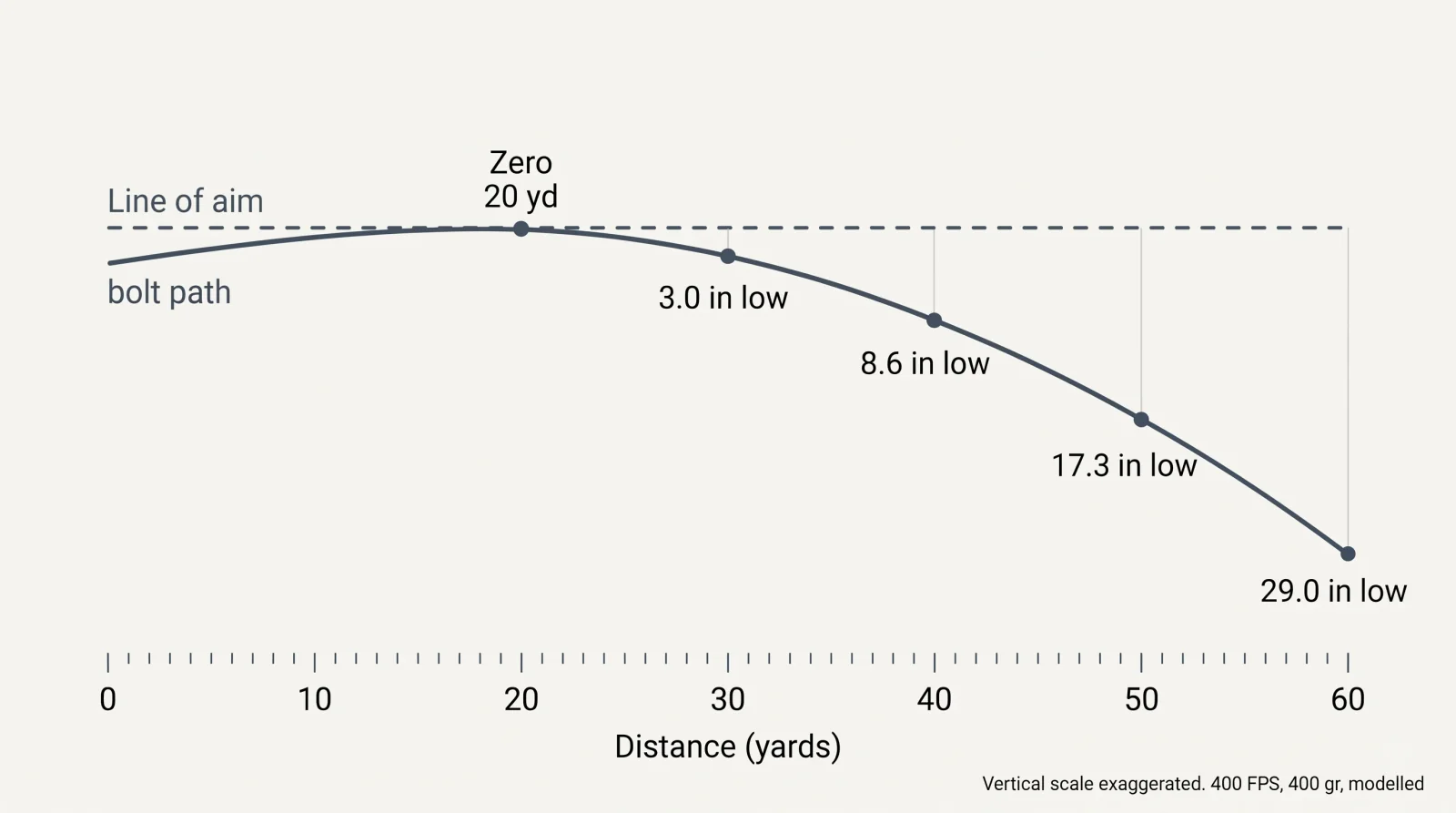
The trajectory bends faster the farther the bolt goes. At every speed in the table, drop from 40 to 60 yards grows more than threefold: 8.6 to 29.0 inches at 400 FPS. A faster crossbow is flatter, but even at 450 FPS the bolt is 22.3 inches low at 60 yards from a 20-yard zero.
Energy is not what limits range. Even at 60 yards the slowest setup in the table still carries 51 ft-lbs of kinetic energy, above the published deer band, which our guide to crossbow FPS needed for deer sets out with its sources. Accuracy, the deer and the conditions run out long before energy does.
Published figures differ from our model. Buckmasters, in an article by TenPoint's Bryan Zabitski, writes that at 100 yards "a 400-grain arrow traveling at 400 feet-per-second will still drop 93-inches (over 7 feet)", and that by 50 yards bolts "can lose up to 15% of their speed and up to 25% of their kinetic energy". Those are Buckmasters' figures, not ours: 100 yards is outside our model, and at 50 yards our model loses more (about 17% of speed and 31% of energy at 400 FPS), so read both as estimates.
Use the bolt drop chart with your own speed, bolt weight and zero to print the same table for your setup.
Why the Ethical Range Is Shorter
A crossbow that groups at 100 yards on a calm range can still miss a deer at 45. Four things shrink the distance: misjudged yardage, the deer's reaction to the shot, wind, and field conditions.
Ranging Error
Guessing the distance is the most common way drop turns into a miss. Using the same model, a deer you judge at 40 yards that is really at 45 takes the hit about 7 inches lower at 300 FPS (16.5 to 23.8 inches of drop), but only about 3 inches lower at 450 FPS (6.5 to 9.5).
Seven inches is enough to move a bolt from the heart and lungs to the brisket or below the chest. A rangefinder removes the guess; range your landmarks before the deer arrives, not as it steps out.
The Deer Hears the Shot
Sound travels at roughly 1,125 feet per second in mild air, so the shot reaches a deer at 40 yards in about 0.11 seconds (calculated). From the speed table, the bolt takes about 0.32 seconds at 400 FPS and 0.43 seconds at 300. A deer that reacts to the sound has a fifth of a second or more to start moving before the bolt arrives.
That reaction is called jumping the string, and the risk grows with distance and with how alert the deer is. For 100 yards, Buckmasters writes: "this nearly half-second gap is enough time for the animal to react and move out of position."
Where to aim on a calm or tense deer, and how much of the chest a crouch moves, is in our guide to crossbow shot placement on deer.
Wind
Buckmasters notes that a bolt "may be pushed a few inches off-course by the wind at 50-yards". Our model has no wind setting, so we give no wind figures, but the effect grows with distance and flight time.
A crosswind can also make a fixed broadhead steer off line.
That steering is called planing, and it is most likely when the head and the fletching are not tuned to each other.
Field Conditions
A target range is flat, bright and calm. A hunt is a cold stand, low light at dawn or dusk, a first shot with no warm-up, and often a steep downward angle from a tree stand.
A broadhead can also hit somewhere different from a practice tip. Bowhunter's 2011 guide by Doug Koenig advises confirming broadhead impact against a field point before the season, practising from stands and at angles, and shooting beyond your hunting distance in practice so the hunting distance feels short.
Crossbow Range for Deer: What the Sources Say
The published guidance agrees closely. Every source we read puts the ceiling at 50 yards or less for deer.
| Source | What it says |
|---|---|
| TenPoint FAQ | "we do not recommend shooting your crossbow at distances further than 50-yards." |
| TenPoint blog (2016) | "As with most vertical bow hunters, effective range for a crossbow is about 40 yards." "With a steady hand and heavier arrow/broad head combination, some hunters might be able to pull off a 50 yard shot." |
| Bowhunting.com (Justin Zarr, 2022) | "we like to recommend 40-50 yards as the maximum ethical shot distance on whitetail-sized game animals." |
| Bowhunter crossbow primer | 40 to 50 yards as the maximum for deer, with most hunters setting a lower personal limit |
Most shots come much closer anyway. TenPoint's blog notes that "The majority of archery shots on whitetail deer in the woods are at 20 yards or less."
We found no state wildlife agency that publishes a yardage limit for crossbow shots at deer. States regulate equipment, seasons and where crossbows may be used; our guide to crossbow hunting laws by state links each state's agency, and it is not legal advice.
How to Set Your Own Limit
Your limit is the distance you can prove, not the one your scope offers. One method that works for rifle hunters moving to a crossbow:
- Zero first. Sight in at the distance your scope's manual names; TenPoint's blog notes, "Our crossbows are bore sighted at 20 yards right here in the factory." The full zeroing procedure is in our guide on sighting in a crossbow scope.
- Check your marks against your real speed. Box speeds are often reached with a lighter bolt than you hunt with; the scope speed matcher tool shows which reviewed scopes are calibrated for your crossbow's speed.
- Practise from the hunting position. Shoot seated, from the stand height you hunt or from shooting sticks, at 10-yard steps, with the broadheads you will hunt with.
- Find your distance. Your limit is the longest distance at which every first bolt of the session lands inside a paper-plate-sized circle, about the size of a deer's vital zone.
- Shorten it for the day. Take off distance for wind, low light, a steep angle, cold hands or an alert deer.
- Range the stand. Note the distance to trees, rocks or fence posts around your stand, so you know your limit on sight without ranging a moving deer.
If you hunt with a slower recurve crossbow, a shorter limit is not a weakness. At 300 FPS the bolt still carries 59 ft-lbs at 40 yards in the table above; the steeper drop is simply a reason to stop sooner.
Does a Faster or Long-Range Crossbow Let You Shoot Farther?
Speed buys a flatter path and a shorter flight, not a longer ethical range. From the tables, going from 300 to 450 FPS cuts drop at 40 yards from 16.5 to 6.5 inches and flight time from 0.43 to 0.29 seconds. The deer, the wind and your skill still set the limit.
Some crossbows are built for distance. Ravin rates the Ravin LR at 450 FPS and 180 ft-lbs, and it ships with a 1-8x24 scope whose adjustable turrets dial for distance instead of using stacked hold marks.
If speed itself is the goal, our fastest crossbows roundup ranks the quickest models we review.
A rangefinding scope reads the distance and gives you an aim point, which removes ranging error. It does not remove wind, the deer's reaction or a shaky rest.
The Garmin Xero X1i gives aim points out to 80 yards, while the Burris Oracle X laser is rated to 200 yards on a deer-sized target. Both reach past any ethical deer distance, so the limit you proved in practice still applies.
Rangefinding, illuminated and fixed-mark optics are compared side by side in our best crossbow scopes roundup, with who each type suits.
Common Mistakes
- Treating reticle reach as hunting range. A mark at 100 yards is a target-range feature.
- Practising only at the zero. Holdovers past 30 yards are where misses happen, so practise there.
- Practising only with practice tips. Confirm where your broadheads land before the season.
- Trusting the box speed for holdovers. Rated speeds are often reached with a lighter bolt than you hunt with, which changes every mark past the zero.
- Shooting with no backstop. A miss keeps going; know where it will land.
- Ranging a deer in the moment. Range landmarks first, so the shot is not delayed while the deer moves.
Frequently Asked Questions
How far can a crossbow shoot accurately?
On a target, many modern crossbows and scopes are built for 80 to 100 yards, and TenPoint claims 3-inch groups at 100 yards for one of its crossbows. On a deer, published guidance puts the maximum at 40 to 50 yards, and most hunters set a shorter limit.
How far can a 400 FPS crossbow shoot?
It can fly far past any hunting distance. For hunting, a 400 FPS crossbow with a 400-grain bolt zeroed at 20 yards drops about 9 inches at 40 yards and 29 at 60 in our model, so it is no exception to the 40 to 50 yard maximum.
Can you shoot a deer at 60 yards with a crossbow?
The bolt carries enough energy, but every source we read sets 50 yards or less as the maximum for deer. At 60 yards drop, ranging error, wind and the deer's reaction to the sound all grow, so a sound hit is far less likely.
Is a crossbow accurate at 100 yards?
On a calm target range, some are: TenPoint claims 3-inch groups at 100 yards for the TX Ultra 29.5, and many scopes carry marks to 100 yards. At that distance a 400 FPS bolt drops about 93 inches by Buckmasters' figures, so it is target shooting, not hunting.
How far does a bolt travel if you miss?
Far past the target. No maker we checked publishes a maximum flight distance, so always shoot with a solid backstop and know what lies beyond the deer.
Does bolt weight change range?
A heavier bolt leaves the crossbow slower, so it drops more at each distance, but it holds its speed a little better and carries more momentum. Use a weight inside your crossbow maker's stated range and confirm your marks with it.
Is a crossbow's range like a rifle's?
No. A rifle bullet is several times faster, so it drops far less and arrives almost instantly. A crossbow is an archery tool with archery distances, which is why TenPoint writes that a crossbow is not "effective out to 200 yards like some rifles are."
What range should a beginner start at?
Start at 20 yards, where most deer shots happen, and extend in 10-yard steps only as every first shot keeps landing in a paper-plate-sized circle from your hunting position.
Bottom Line
A crossbow bolt can fly a long way, a good scope can aim to 100 yards on a target, and a deer should be inside 40 to 50 yards at most, closer for most hunters. Drop more than triples from 40 to 60 yards at every speed in our model, so the yards you misjudge cost more the farther you shoot. Set your limit by proving it from your hunting position, and keep a backstop behind every shot.
Read nextBest crossbows for deer huntingCompare deer crossbows by rated speed, weight and scope, scored on manufacturer specs.Gear mentioned in this guide
Reviews we link to above, highest rated first. Read the full review before you buy.
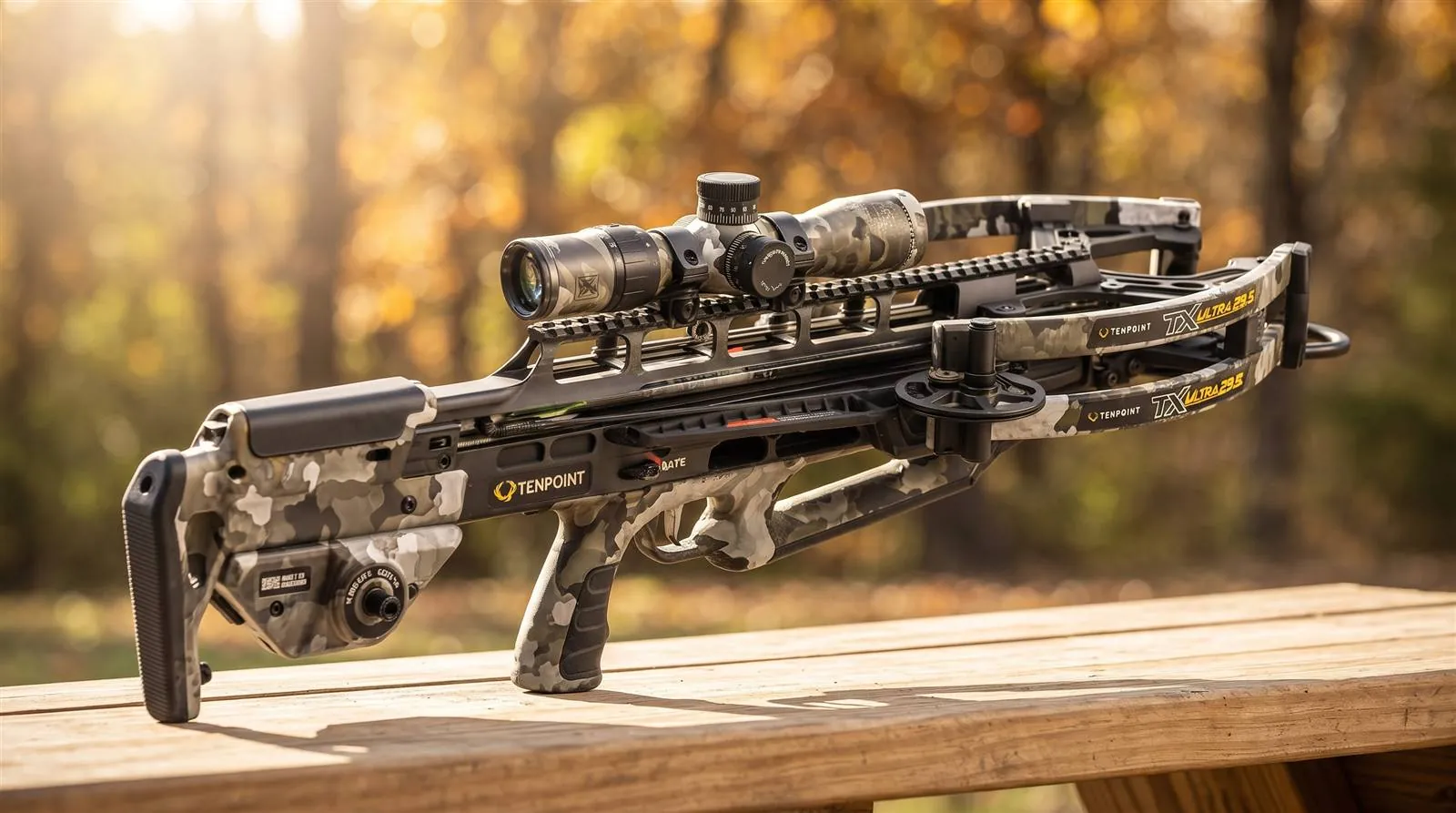
TenPoint TX Ultra 29.5 Review
Forward-draw crossbow rated at 460 FPS with a 6.5-inch cocked width and a 100-yard scope. Speed and range in a 29.5-inch frame.
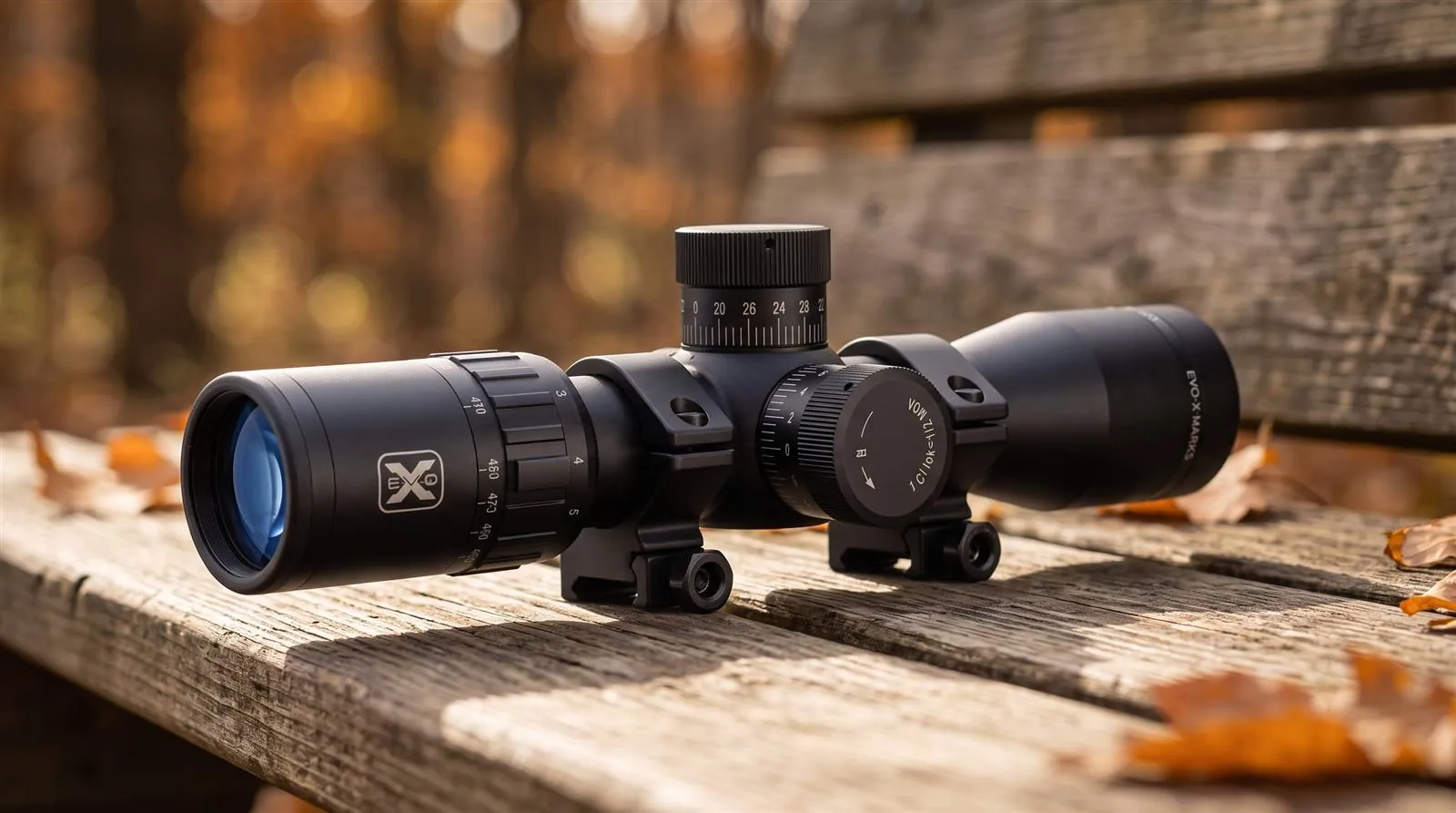
TenPoint EVO-X Marksman Elite Review
A glass-reticle crossbow scope on a 30mm aluminum tube that covers a wide speed band. It offers premium optics without rangefinding electronics.
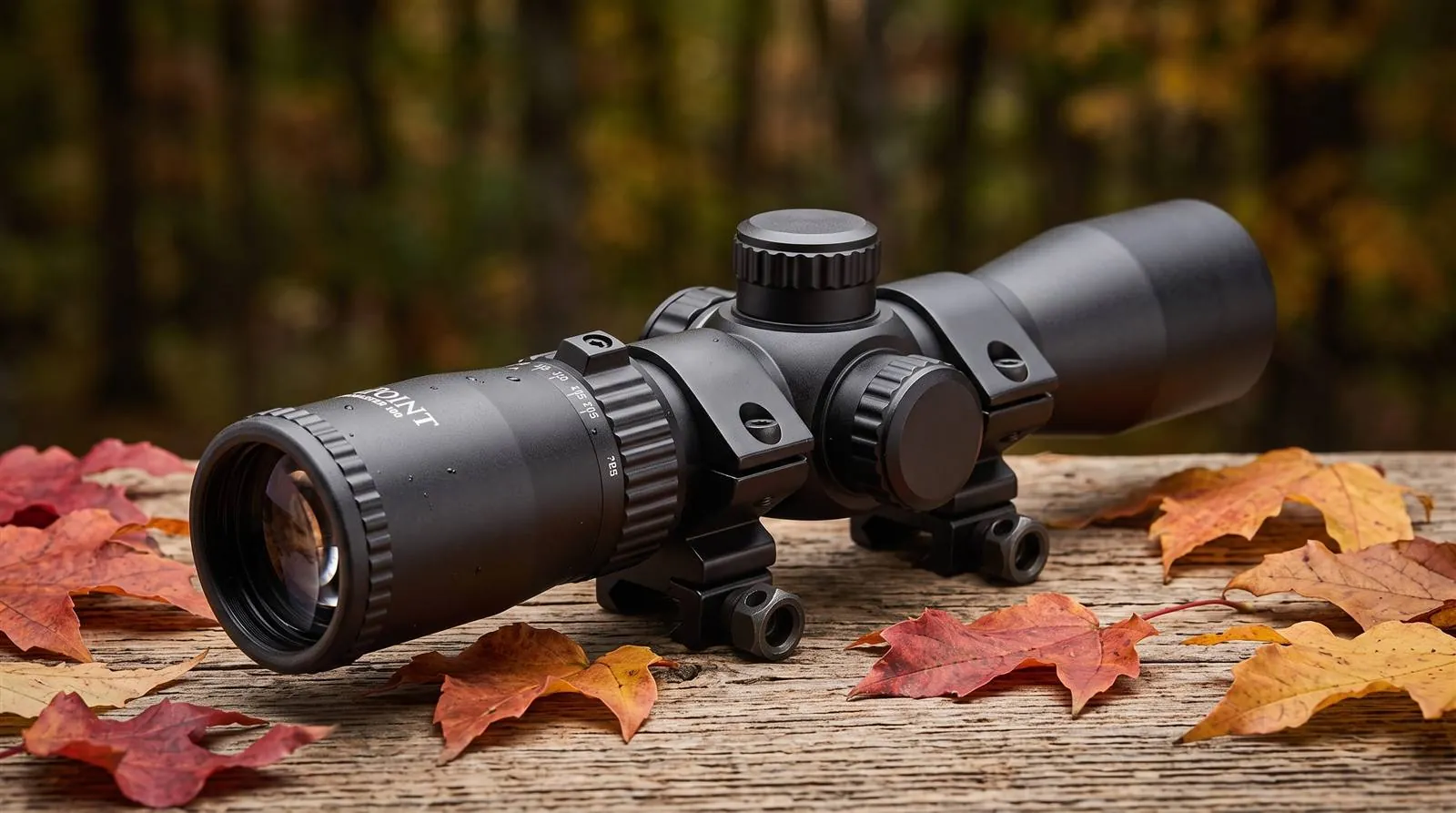
TenPoint RangeMaster 100 Review
An illuminated crossbow scope with nine lit aiming points to 100 yards and a variable speed setting for 380 to 505 FPS. Rings are included.
Ready to compare models? Read our crossbow reviews to see how each one compares.
More in Hunting Laws & Field
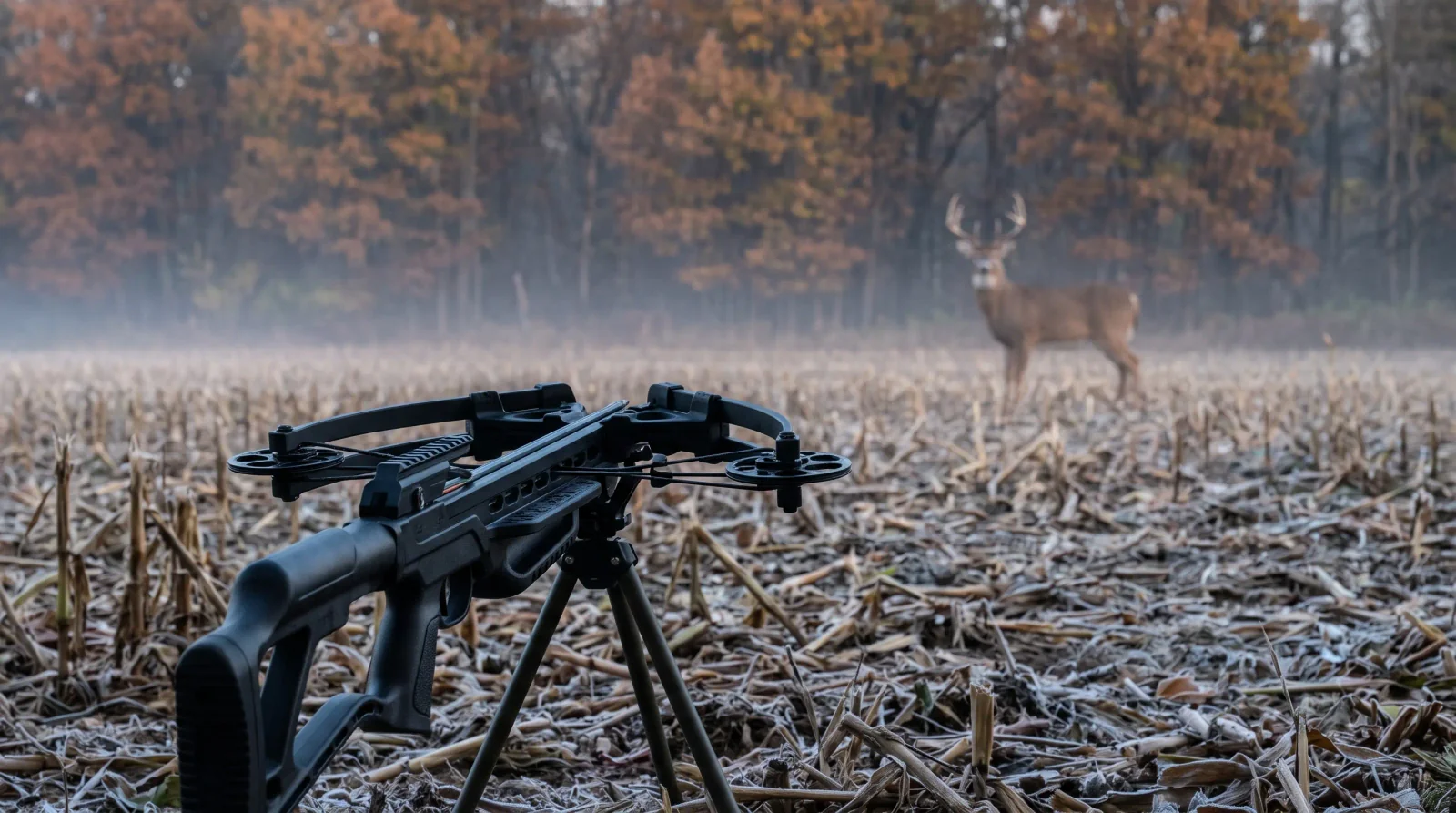
Crossbow FPS Needed for Deer: Kinetic Energy Chart
Why no FPS minimum exists for deer, the published energy guidelines for deer and elk, and a kinetic energy chart by bolt weight and speed.
Read guide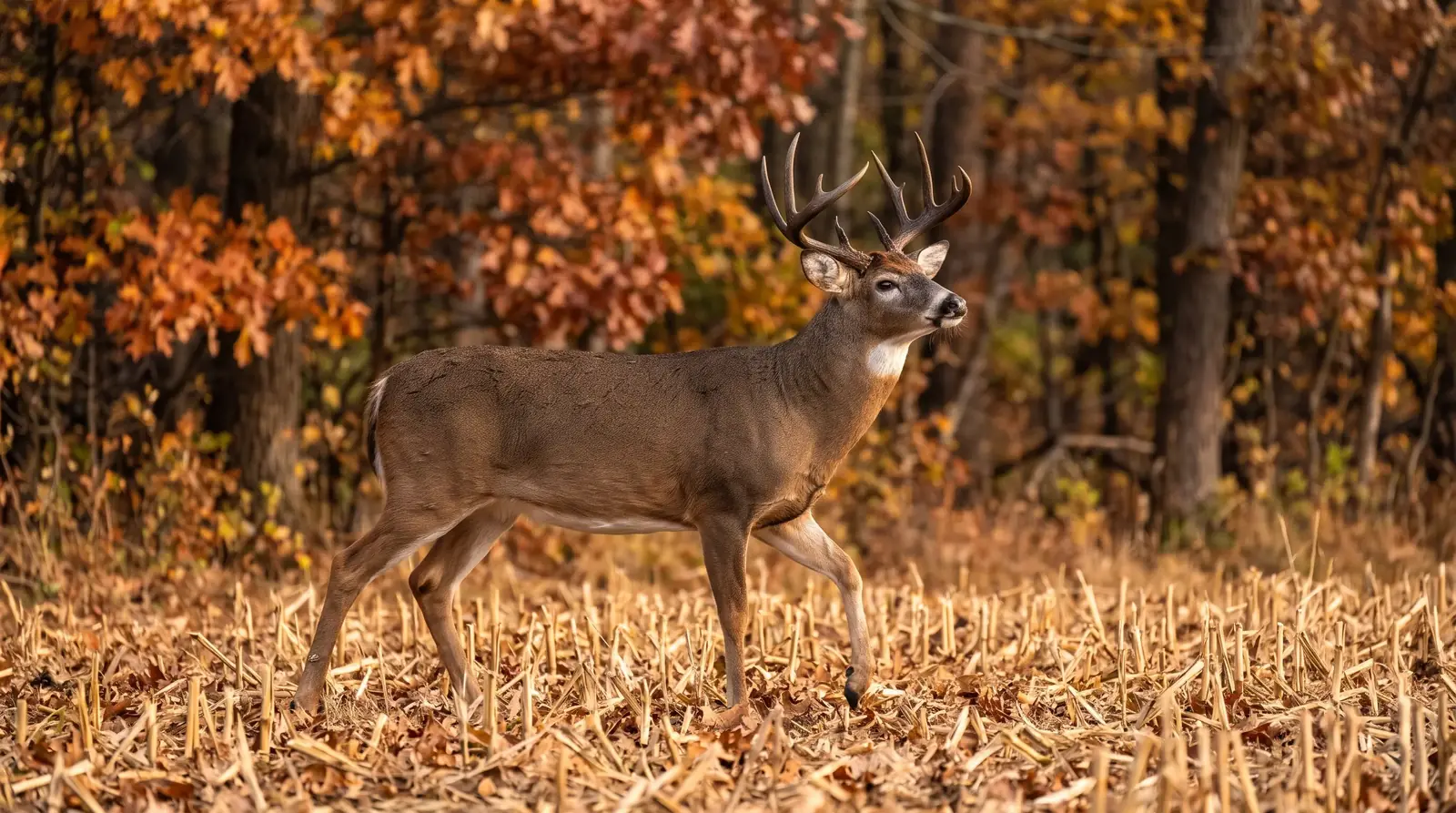
Crossbow Shot Placement on Deer: Every Angle Explained
The vital zone, the take-or-pass call for every angle, tree stand aim points, string jumping, and how long to wait after the shot.
Read guide
Crossbow Hunting Guide: Game, Setup, Shot and Recovery
The crossbow hunting hub: game and energy guidance, legality, pre-season setup, stand or blind, shot placement, tracking, gear and safety.
Read guide