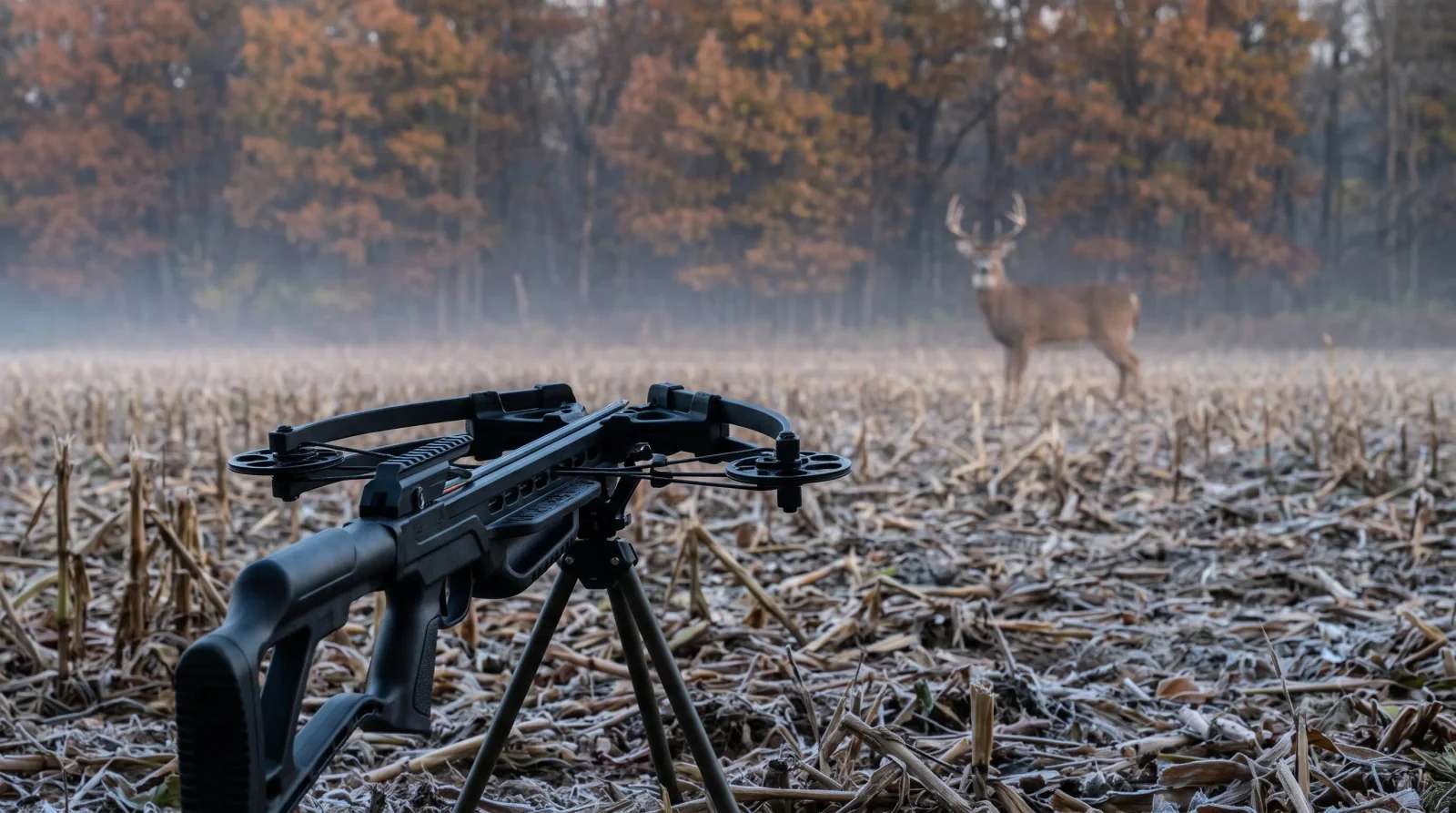
The crossbow FPS needed for deer has no legal minimum, and the energy guidelines hunters quote were written for vertical bows. This page shows what those guidelines say, what speed reaches them with common bolt weights, what real crossbows are rated at, and what decides a clean kill once energy is covered.
It is the energy chapter of our crossbow hunting guide, which covers stands, scouting and the season as a whole.
Crossbow FPS Needed for Deer: Is There a Minimum?
No. We found no state wildlife agency that sets a minimum FPS for deer. Where states regulate crossbows, they set a minimum draw weight and equipment rules, such as broadhead requirements.
A 2013 American Hunter article by Bob Robb described the spread: "While those regulations vary considerably from state to state, the overall range runs from 75 to 125 pounds of draw weight." It added: "With little exception, any crossbow in that range should be adequate to kill a whitetail deer at moderate ranges." The rules for your state are on our guide to crossbow hunting laws by state, which links each state's agency; it is not legal advice.
Speed alone could not work as a rule anyway. The energy a bolt carries depends on its weight in grains as well as its speed, so the same FPS means different energy with a light and a heavy bolt. Typical rated speeds for pistol, recurve and compound models are in our explainer on how fast a crossbow shoots, with what raises and lowers them.
How Much Kinetic Energy Does a Deer Need?
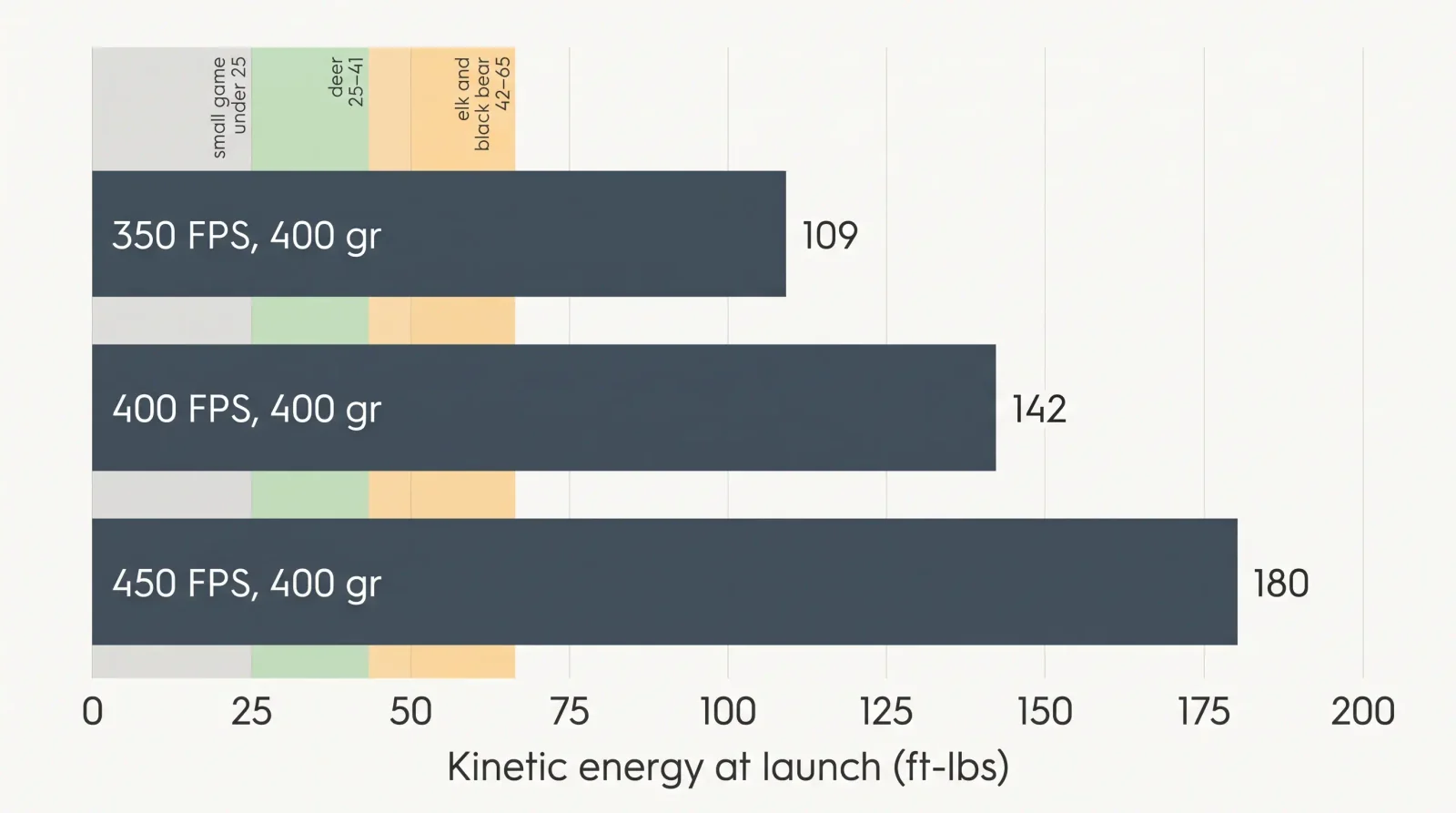
Kinetic energy is the energy a moving bolt carries, in foot-pounds (ft-lbs). Two makers publish the same guideline bands by game class: arrow maker Victory Archery, under the heading "Optimal Bow Hunting Kinetic Energy Range:", and crossbow maker Ballista, on its kinetic energy page for the Hawkwing. Their wording is quoted as written.
| Game class (examples) | Victory Archery | Ballista |
|---|---|---|
| Small game | "Small Game: 25 ft/lbs" | "<25 KE (Small game)" |
| Deer, antelope | "Medium Game (Deer, Antelope): 25-41 ft/lbs" | "25–41 KE (Medium game, deer, antelope)" |
| Elk, black bear | "Large Game (Elk, Black Bear, Boar): 42-65 ft/lbs" | "42–65 KE (Big game, elk, black bear)" |
| Cape buffalo, grizzly | "Big Game (Cape Buffalo, Grizzly Bear): 65+ ft/lbs" | Not listed |
The same bands are republished widely; Bowhunting.com prints them with the line "For example, Easton is one of many sources that make the following recommendation." Easton's own kinetic energy page lists no game bands, so we attribute them to the two makers above.
Two limits apply to these figures. They come from vertical-bow archery, and they describe energy, not a guarantee that a bolt will pass through a deer. We found no state wildlife agency that publishes an energy minimum for deer.
One agency has compared the two weapons directly. Alaska Department of Fish and Game staff, commenting on a 2019 Board of Game proposal, wrote that "Crossbows and bows deliver similar kinetic energy to the target", using a 420-grain bolt at about 300 FPS as the crossbow example.
What About Elk and Black Bear?
Both makers put elk and black bear in the 42 to 65 ft-lb band. A 2017 Deer & Deer Hunting article by Bob Robb gives a similar figure: "many bowhunters believe that for elk- sized game the minimum should be about 60 foot-pounds of initial K.E."
Every compound in the maker-figures table below lists 92 ft-lbs or more at launch, above the 65 ft-lb top of that band. For elk, the levers that matter are a heavier bolt inside the maker's stated range, a durable fixed blade head and a shorter distance limit. Our fixed blade hunting broadheads guide compares the designs built for heavy bone and thick hide.
The Kinetic Energy Formula, Worked Through
Kinetic energy in ft-lbs = bolt weight in grains × FPS × FPS ÷ 450,240. Deer & Deer Hunting's 2017 article gives the same formula: "Mass x Velocity-squared divided by 450,240."
A worked example with a published figure: the Ravin R29X is rated at 450 FPS with a 400-grain arrow. 400 × 450 × 450 ÷ 450,240 comes to about 180 ft-lbs, the same 180 ft-lbs Ravin lists.
Speed counts twice in the formula because it is squared. Raising speed by 10 percent raises energy by about 21 percent, while adding 10 percent to bolt weight at the same speed adds 10 percent. Our kinetic energy calculator tool runs the formula for your own bolt weight and speed, and adds momentum.
Some publishers divide by 450,800 instead, which gives slightly lower numbers. We use 450,240, as our calculator does.
Crossbow Kinetic Energy Chart by Bolt Weight and Speed
Every value below is calculated at launch from the formula above, rounded to the nearest ft-lb. Read across a row only to compare bolts at one speed: on one crossbow a heavier bolt flies slower, as TenPoint's paired ratings in the maker-figures table show.
| Speed (FPS) | 350 gr | 400 gr | 425 gr | 450 gr | 500 gr | 550 gr |
|---|---|---|---|---|---|---|
| 250 | 49 | 56 | 59 | 62 | 69 | 76 |
| 275 | 59 | 67 | 71 | 76 | 84 | 92 |
| 300 | 70 | 80 | 85 | 90 | 100 | 110 |
| 325 | 82 | 94 | 100 | 106 | 117 | 129 |
| 350 | 95 | 109 | 116 | 122 | 136 | 150 |
| 375 | 109 | 125 | 133 | 141 | 156 | 172 |
| 400 | 124 | 142 | 151 | 160 | 178 | 195 |
| 425 | 140 | 160 | 170 | 181 | 201 | 221 |
| 450 | 157 | 180 | 191 | 202 | 225 | 247 |
| 475 | 175 | 200 | 213 | 226 | 251 | 276 |
| 500 | 194 | 222 | 236 | 250 | 278 | 305 |
Every cell in this chart is above the 25 to 41 ft-lb deer band; the lowest, 250 FPS with a 350-grain bolt, is about 49 ft-lbs.
How Fast a Bolt Must Fly to Reach Each Band
This table turns the formula around: the launch speed at which each bolt weight reaches the edges of the deer and elk bands. Each value is a calculated launch speed; energy at the target is lower.
| Bolt weight | 25 ft-lbs | 41 ft-lbs (top of deer band) | 42 ft-lbs | 65 ft-lbs (top of elk band) |
|---|---|---|---|---|
| 350 gr | 179 FPS | 230 FPS | 232 FPS | 289 FPS |
| 400 gr | 168 FPS | 215 FPS | 217 FPS | 270 FPS |
| 450 gr | 158 FPS | 203 FPS | 205 FPS | 255 FPS |
| 500 gr | 150 FPS | 192 FPS | 194 FPS | 242 FPS |
With a 400-grain bolt, a crossbow needs about 270 FPS at launch to reach the top of the elk band, and the chart above shows about 67 ft-lbs at 275 FPS. Anything above that is margin, and the margin is what absorbs energy lost in flight, a hard angle and broadhead drag.
What Real Crossbows Are Rated At
These are the makers' own figures for eight crossbows we review. Where TenPoint lists two arrows, both pairs are shown, with the first figure for the first arrow.
| Crossbow | Type | Rated speed | Maker's energy figure (ft-lbs) | Arrow weight for the rating | Buy |
|---|---|---|---|---|---|
| Barnett Recruit XP | Compound | 350 FPS | 92 | Not stated | Check price on Amazon |
| Wicked Ridge Invader M1 | Compound | 390 / 380 FPS | 125 / 131 | 370 / 410 gr | Check price on Amazon |
| TenPoint Titan X | Compound | 400 / 380 FPS | 146 / 143 | 410 / 445 gr | Check price on Amazon |
| Barnett Hyper Whitetail 410 | Compound | 410 FPS | 142 | 380 gr (speed rating) | Check price on Amazon |
| Ravin R29X | Compound | 450 FPS | 180 | 400 gr | Check price on Amazon |
| TenPoint TX Ultra 29.5 | Compound | 460 / 440 FPS | 193 / 189 | 410 / 440 gr | Check price on Amazon |
| TenPoint TRX Ultra | Compound | 515 / 495 FPS | 242 / 240 | 410 / 440 gr | Check price on Amazon |
| Excalibur Mag Air | Recurve | 305 FPS | Not listed | Not stated | Check price on Amazon |
TenPoint lists energy as "fp ke" and Barnett as "lbs"; Ravin writes "ft-lbs". All three are foot-pound figures, and each matches the formula above (calculated: 380 grains at 410 FPS is about 141.9 ft-lbs against Barnett's 142; 410 grains at 400 FPS is about 145.7 against TenPoint's 146).
The slowest-rated compound crossbow in the table, the Barnett Recruit XP at 350 FPS, still lists 92 ft-lbs, more than twice the 41 ft-lb top of the deer band. Barnett does not state the arrow weight behind that figure.
The Excalibur Mag Air recurve crossbow is rated at 305 FPS, and Excalibur publishes no energy figure or arrow weight for it. To estimate it, read the chart between its 300 and 325 FPS rows with your own bolt weight: a 400-grain bolt sits between 80 and 94 ft-lbs there.
Energy differs between crossbows of similar size mainly because of draw weight and power stroke, the distance the string pushes the bolt. A longer stroke or heavier draw generally stores more energy for the bolt to carry.
Where the Guidelines Do Bite: Pistol Crossbows and Light Bolts
The bands matter at the bottom end. The EK Archery Adder lists "26.23 FT-LBS" with a 205-grain bolt at 240 FPS from its 130 lb limbs, which falls inside the deer band on paper. EK presents the Adder through target and tactical shooting drills and does not describe it as a hunting crossbow.
A pistol crossbow like this sits at the floor of a band written for heavy arrows from vertical bows, with no margin for distance, angle or bone. Whether a pistol-grip crossbow is legal for big game also varies by state; our guide to pistol crossbow laws explains how states treat them.
What Matters More Than FPS for a Clean Kill
Once launch energy clears the band, these things decide whether a deer goes down quickly.
- Bolt weight inside the maker's range. A heavier bolt flies slower from the same crossbow. Its launch energy changes little, up or down slightly: TenPoint lists 146 then 143 ft-lbs for the Titan X and 125 then 131 for the Invader M1 with the heavier arrow. Its momentum is higher. Easton puts the difference this way: "Momentum can be thought of as the ability to put that power to work, penetrating the target."
- Never below the minimum weight. A bolt lighter than the maker's stated minimum can act like a dry fire and damage the crossbow or injure you. Our guide on how to choose crossbow bolts covers weight limits and the speed trade-off.
- A sharp broadhead that flies with your field points. A broadhead that hits away from your field points wastes all the energy in the world. Our guide on crossbow broadhead tuning shows how to get both to the same point of impact.
- The right head for deer. Fixed blades and mechanical heads both kill deer; our best crossbow broadheads roundup compares the designs for deer.
- Shot placement and angle. No amount of energy fixes a bolt outside the vital zone. Our guide to crossbow shot placement on deer gives the aim point for every angle and when to pass.
- Distance. Deer & Deer Hunting's 2017 article explains that a bolt slows "due to both gravity and air resistance", so energy at the deer is lower than the launch figure and the bolt drops more the farther it flies. Our bolt drop chart tool shows how far your bolt falls at each distance.
Your effective range is the farthest distance at which you can keep every bolt in the vitals from a hunting position. Set it from your own practice on a 3-D target, not from the crossbow's energy figure. Our guide on crossbow range compares maximum and ethical distances.
Does More Speed Help at All?
Some. A faster bolt has a flatter trajectory and reaches the deer sooner, which leaves less room for a ranging error and less time for a deer to react. Our fastest crossbows roundup ranks the models rated at 400 FPS or more for readers who want that.
The costs are real too. Higher speed usually comes with more noise and vibration, a heavier draw and a higher price. A loud shot gives a deer more reason to start jumping the string, dropping or turning as the sound arrives, though a faster bolt also gives it less time to do so. The flight-time arithmetic is in the speed explainer linked above.
How to Check Your Own Setup
- Find the maker's rated speed and the arrow weight behind it, on the maker's product page or in the manual.
- Weigh your own bolt with the broadhead and nock fitted, in grains.
- If your bolt is heavier than the rating arrow, expect a lower speed. Use the maker's second figure where one is published; TenPoint lists two.
- Put your bolt weight and the speed into the kinetic energy calculator.
- Compare the result with the band table above, then set a distance limit you can hold on a 3-D target from a hunting position.
Decision Guide: Is Your Crossbow Enough for Deer?
| Your situation | Verdict | Next step |
|---|---|---|
| Full-size compound rated 330 FPS or more, bolts inside the maker's range | Yes. A 400-grain bolt at 325 FPS already carries about 94 ft-lbs | Focus on the broadhead and shot placement |
| Recurve rated around 300 FPS | Yes, at moderate distances. A 400-grain bolt at 300 FPS carries about 80 ft-lbs | Check your bolt weight in the chart row |
| Elk or black bear | Yes on launch energy. A 400-grain bolt at 300 FPS carries about 80 ft-lbs against the 65 ft-lb top of the band | Heavier bolt inside the range, fixed-blade head, shorter distance limit |
| Pistol crossbow | Not a deer tool | Check the pistol crossbow laws; use it for targets |
| Bolt below the maker's minimum weight | Never | Risk of dry-fire damage; use a bolt inside the range |
Calculated values in this table come from the chart above. If you are weighing an easier-cocking or lower-draw recurve because of a shoulder or back, the chart shows that a slower crossbow is not a compromise on energy for deer: at 300 FPS a 400-grain bolt still carries about 80 ft-lbs, nearly twice the 41 ft-lb top of the deer band.
Common Mistakes
- Buying FPS for deer. Any setup in the chart clears the deer band; the extra money buys trajectory, not a cleaner kill.
- Comparing energy figures without the bolt weight. A figure means little until you know the arrow behind it, as the paired TenPoint ratings show.
- Going below minimum bolt weight to gain speed. It risks damage like a dry fire.
- Treating launch energy as impact energy. Every figure on this page is at launch; the bolt arrives with less.
- Using a bow-era chart to justify a pistol crossbow. Sitting at the floor of a band is not the same as being suited to deer.
- Assuming the guideline is a law. The bands are maker guidance; states regulate draw weight and equipment.
Frequently Asked Questions
How many FPS do you need to kill a deer with a crossbow?
There is no legal FPS figure for deer. Every full-size crossbow in our table of maker figures is enough at sensible distances, because energy depends on bolt weight as well as speed: a 400-grain bolt reaches the published deer band at about 168 to 215 FPS.
Is 300 FPS enough for deer?
Yes. A 400-grain bolt at 300 FPS carries about 80 ft-lbs at launch by the standard formula, roughly twice the top of the 25 to 41 ft-lb deer band. Bolt flight, broadhead and shot placement matter more.
Is a 350 FPS crossbow good for deer?
Yes. A 400-grain bolt at 350 FPS carries about 109 ft-lbs at launch by the formula, and the Barnett Recruit XP, rated at 350 FPS, lists 92 ft-lbs.
How much kinetic energy do you need to kill a deer?
Arrow maker Victory Archery and crossbow maker Ballista both list 25 to 41 ft-lbs for deer-size game. Those bands come from vertical-bow archery; the compound crossbows in our table of maker figures list 92 to 242 ft-lbs at launch.
How much kinetic energy do you need for elk with a crossbow?
The same two makers list 42 to 65 ft-lbs for elk and black bear, and a 2017 Deer & Deer Hunting article says many bowhunters believe about 60 ft-lbs is the minimum for elk. Use a heavier bolt inside the maker's range, a fixed-blade head and a shorter distance limit.
Is 400 FPS or more overkill for whitetail?
It does no harm to the deer, but it is not needed for energy. The trade-offs are more noise, a heavier draw and a higher price; the gains are a flatter trajectory and a shorter flight time.
Do heavier bolts kill better than faster ones?
A heavier bolt flies slower from the same crossbow, so its launch energy changes little, but its momentum is higher, which helps penetration. Stay inside the maker's minimum and maximum bolt weights, and choose the weight your broadheads fly best with.
Do states require a minimum FPS or energy for crossbows?
We found no state wildlife agency that publishes an energy minimum for deer, and no FPS rule. States set minimum draw weights and equipment rules instead; check the crossbow hunting laws by state guide on this site and your state agency.
Can a pistol crossbow kill a deer?
A pistol crossbow is not a deer tool. The EK Archery Adder lists about 26 ft-lbs, at the floor of the deer band with no margin, and whether a pistol-grip crossbow is legal for big game varies by state.
Does kinetic energy drop with distance?
Yes. Gravity and air resistance slow the bolt, so it arrives with less energy than it left with. Launch figures, including every chart on this page, overstate what reaches the deer.
Bottom Line
No law sets a crossbow FPS minimum for deer, and every compound in the maker-figures table lists 92 ft-lbs or more against a published deer band of 25 to 41. Spend your attention on a bolt inside the maker's range, a broadhead that flies true, shot placement and a distance you can hold.
Read nextBest crossbows for deer huntingCompare crossbows for deer on the specs that matter after energy: weight, width, cocking and price.Gear mentioned in this guide
Reviews we link to above, highest rated first. Read the full review before you buy.
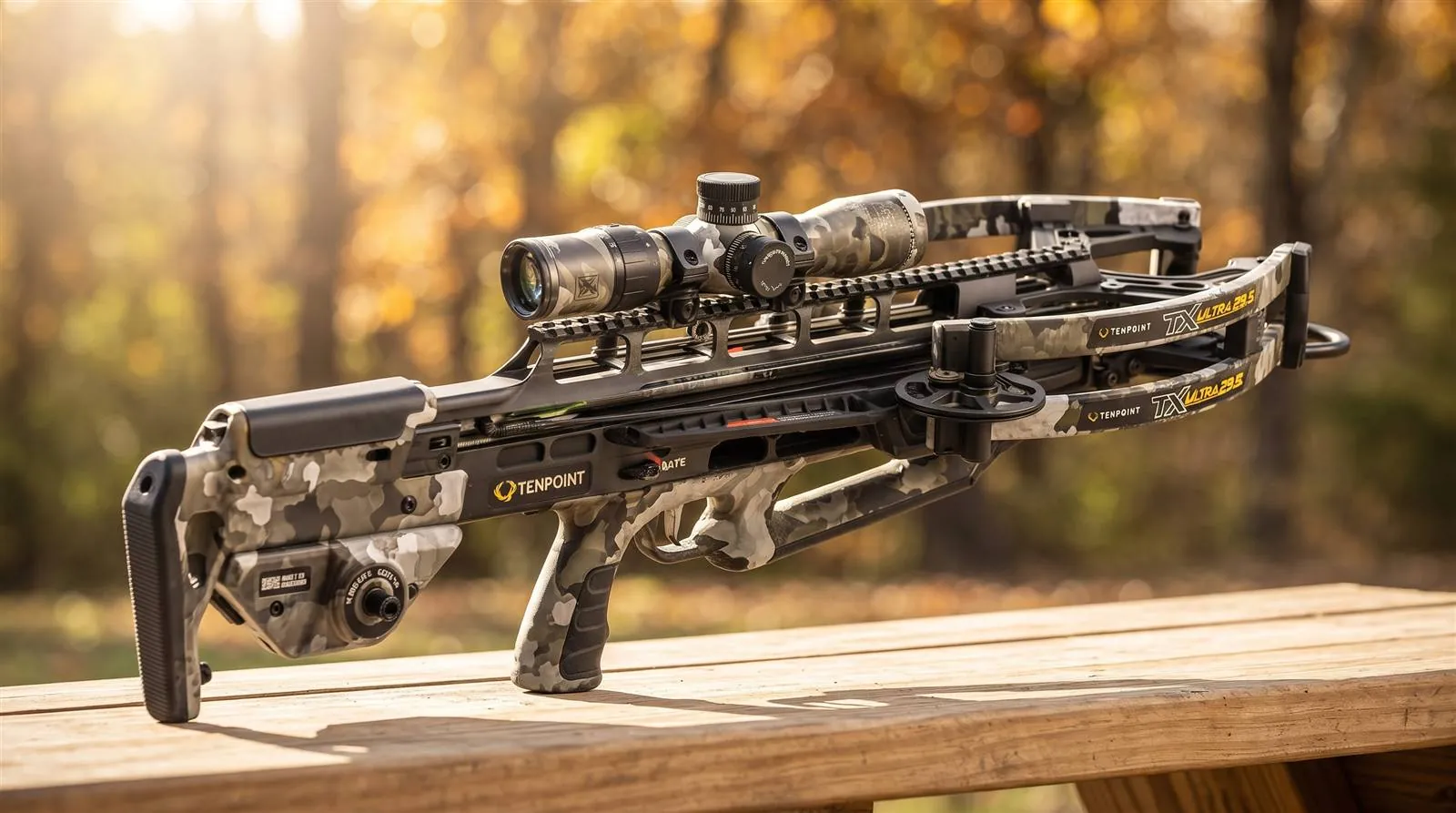
TenPoint TX Ultra 29.5 Review
Forward-draw crossbow rated at 460 FPS with a 6.5-inch cocked width and a 100-yard scope. Speed and range in a 29.5-inch frame.
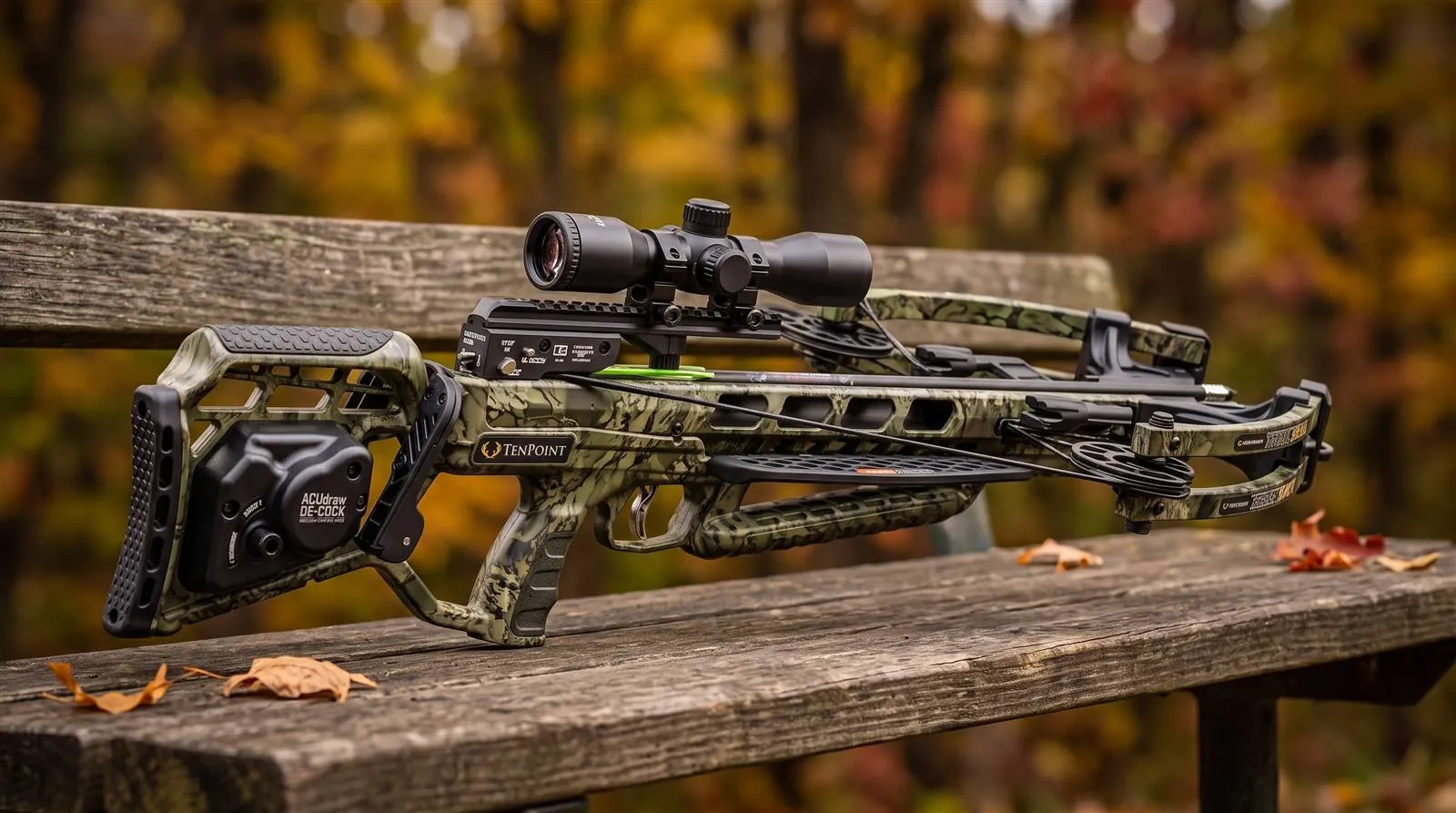
TenPoint Titan X Review
Mid-priced compound crossbow rated at 400 FPS, with integrated cocking and a controlled de-cocking system. A good first TenPoint.
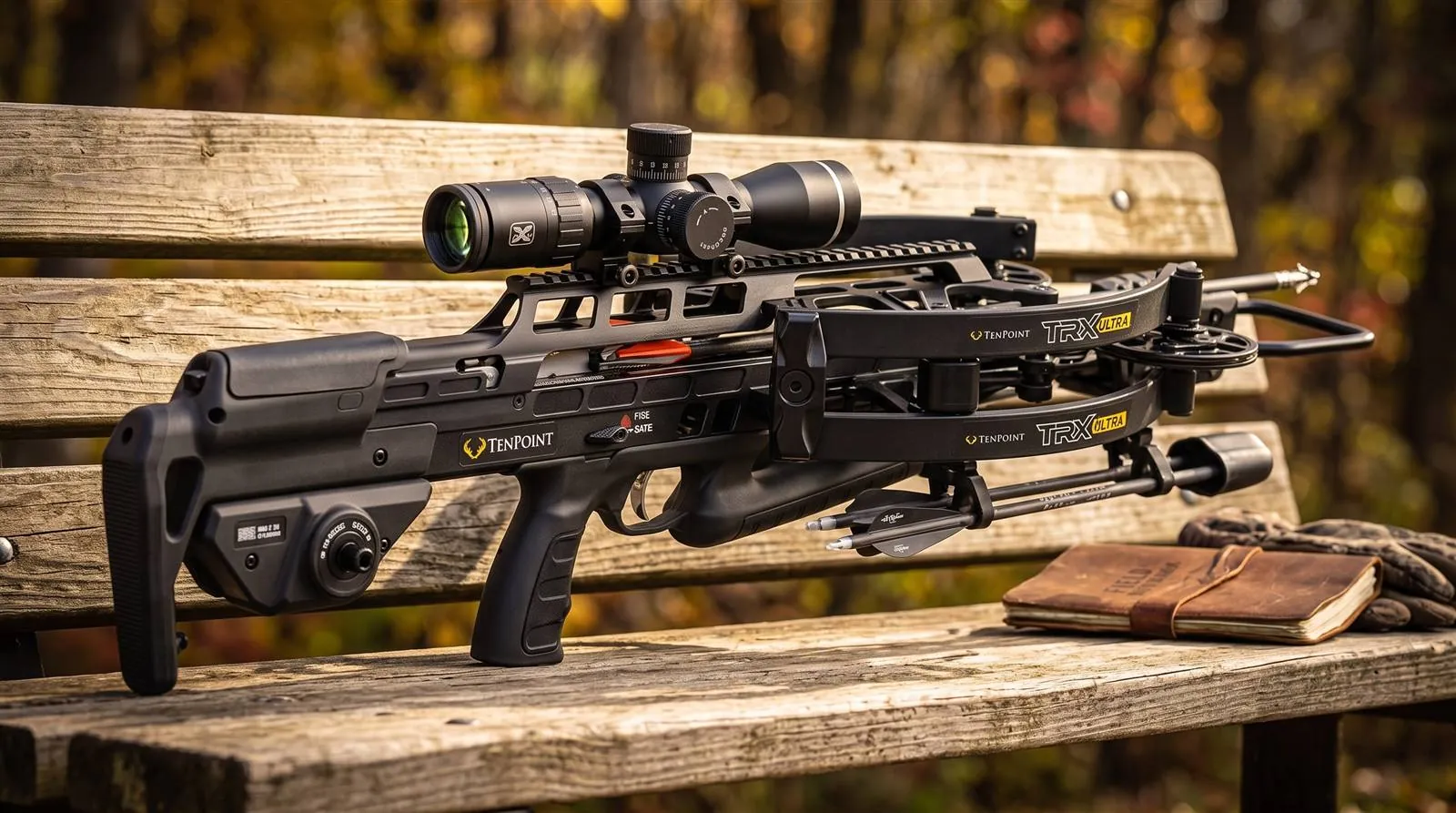
TenPoint TRX Ultra Review
TenPoint rates it at 515 FPS and claims 70% tighter groups at 100 yards. A flagship price that suits a narrow group of long-range buyers.
Ready to compare models? Read our crossbow reviews to see how each one compares.
More in Hunting Laws & Field
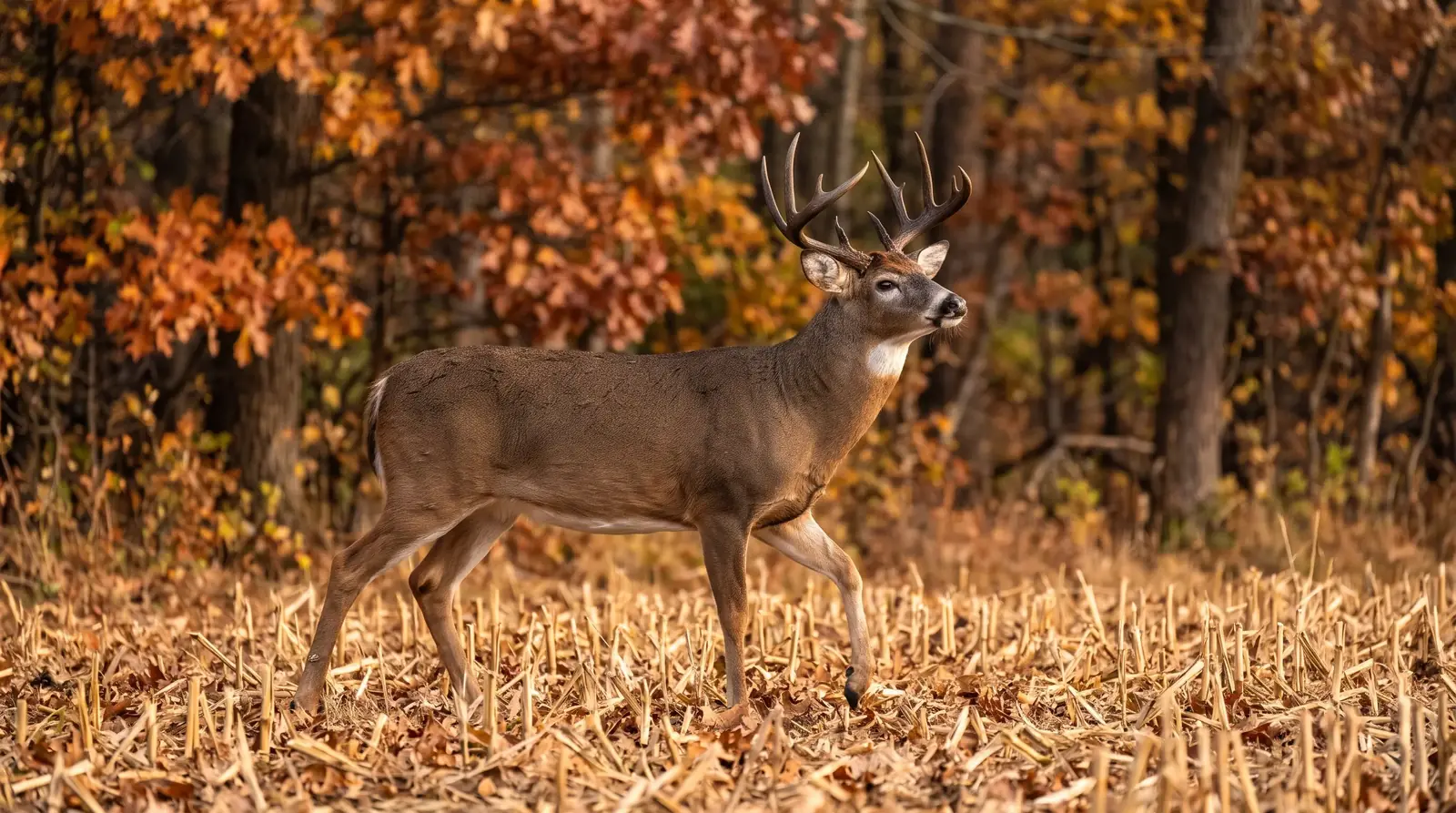
Crossbow Shot Placement on Deer: Every Angle Explained
The vital zone, the take-or-pass call for every angle, tree stand aim points, string jumping, and how long to wait after the shot.
Read guide
How to Hunt Deer With a Crossbow: A Season Plan
A step-by-step whitetail plan for crossbow hunters, from sight-in and stand or blind setup to season timing, the shot and the first minutes after it.
Read guide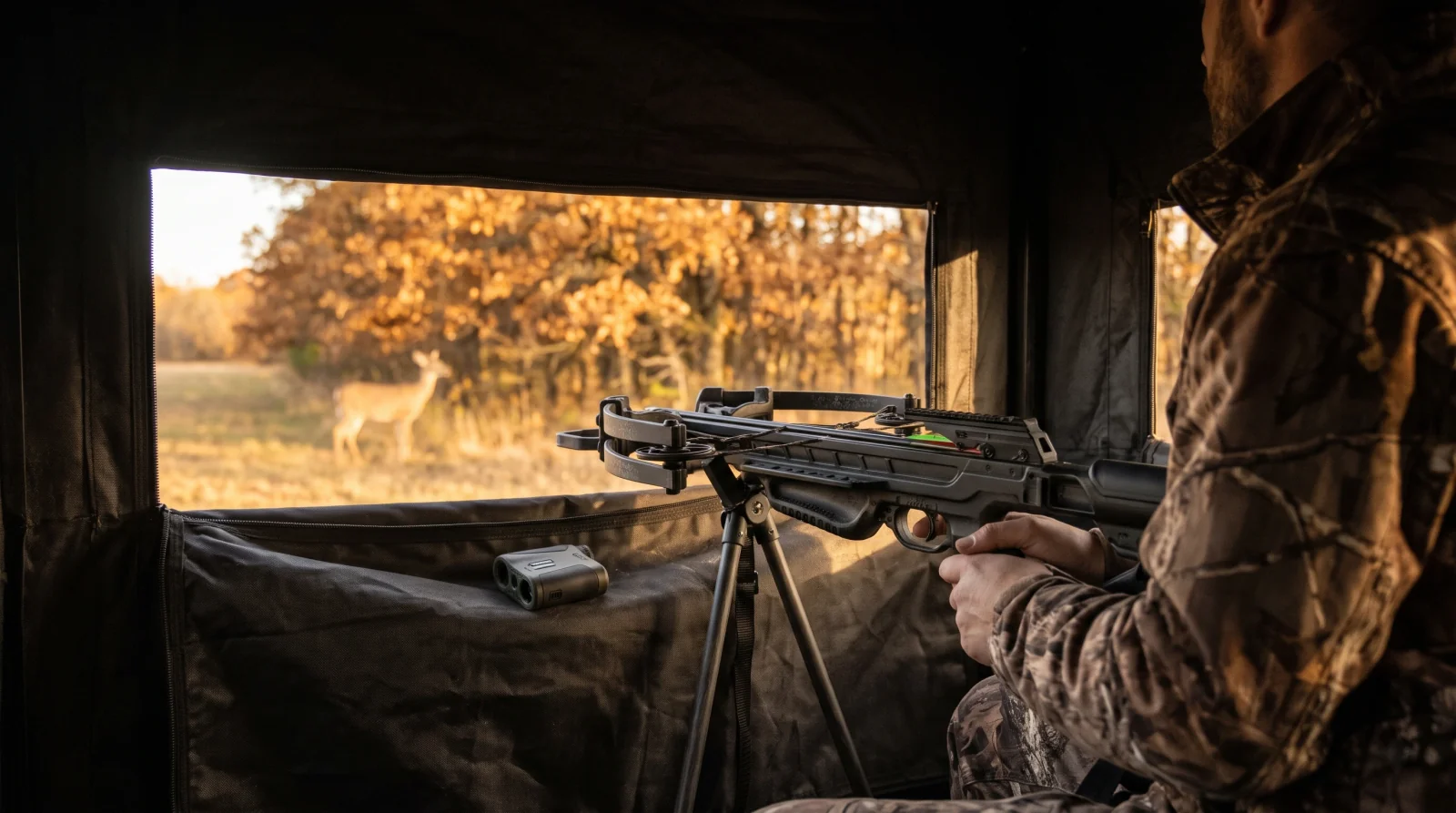
How Far Can a Crossbow Shoot? Max vs Ethical Range
Flight range, target range and ethical range for deer, with modelled drop, energy and flight time at 30 to 60 yards and a method for setting your limit.
Read guide