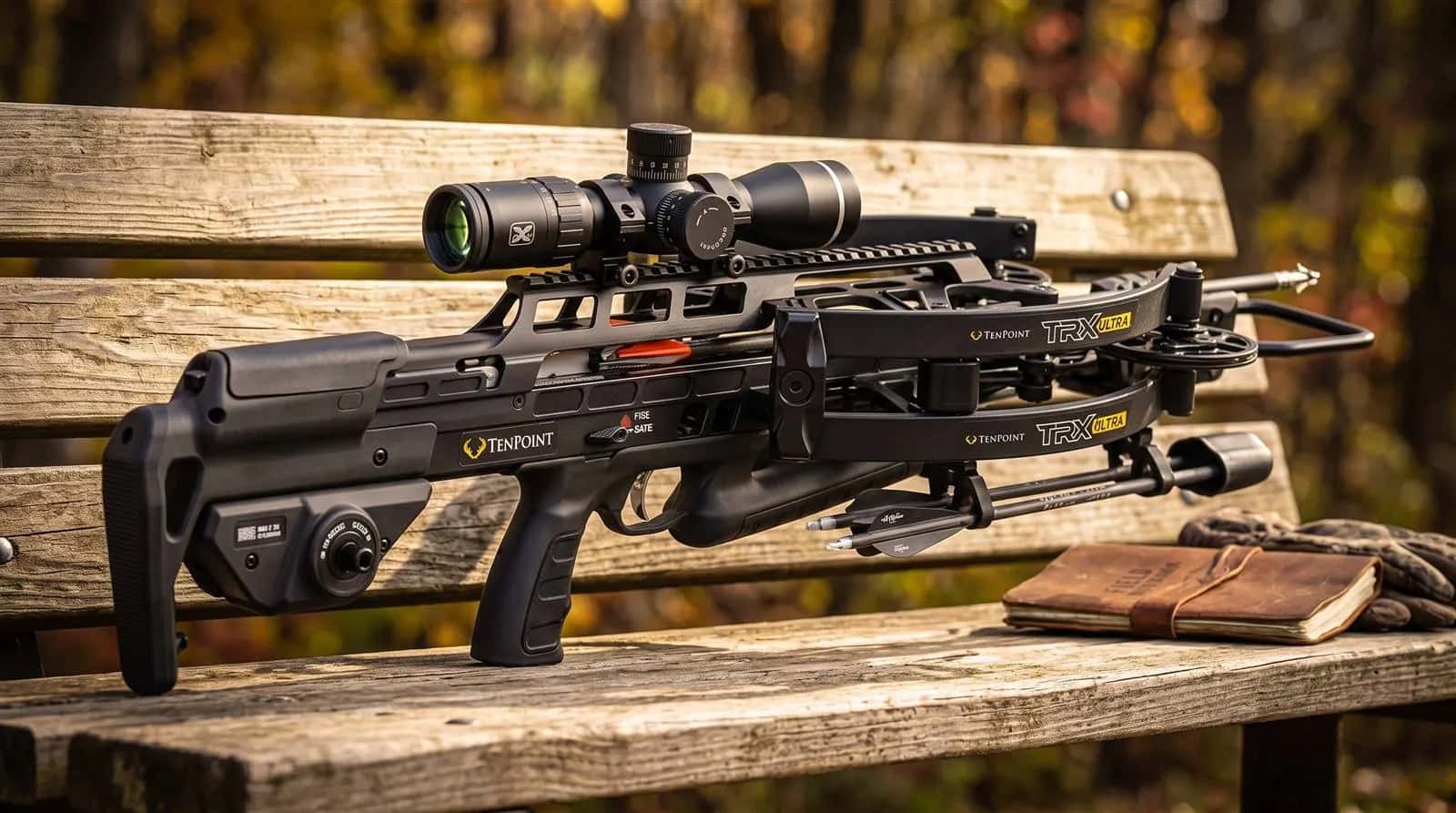
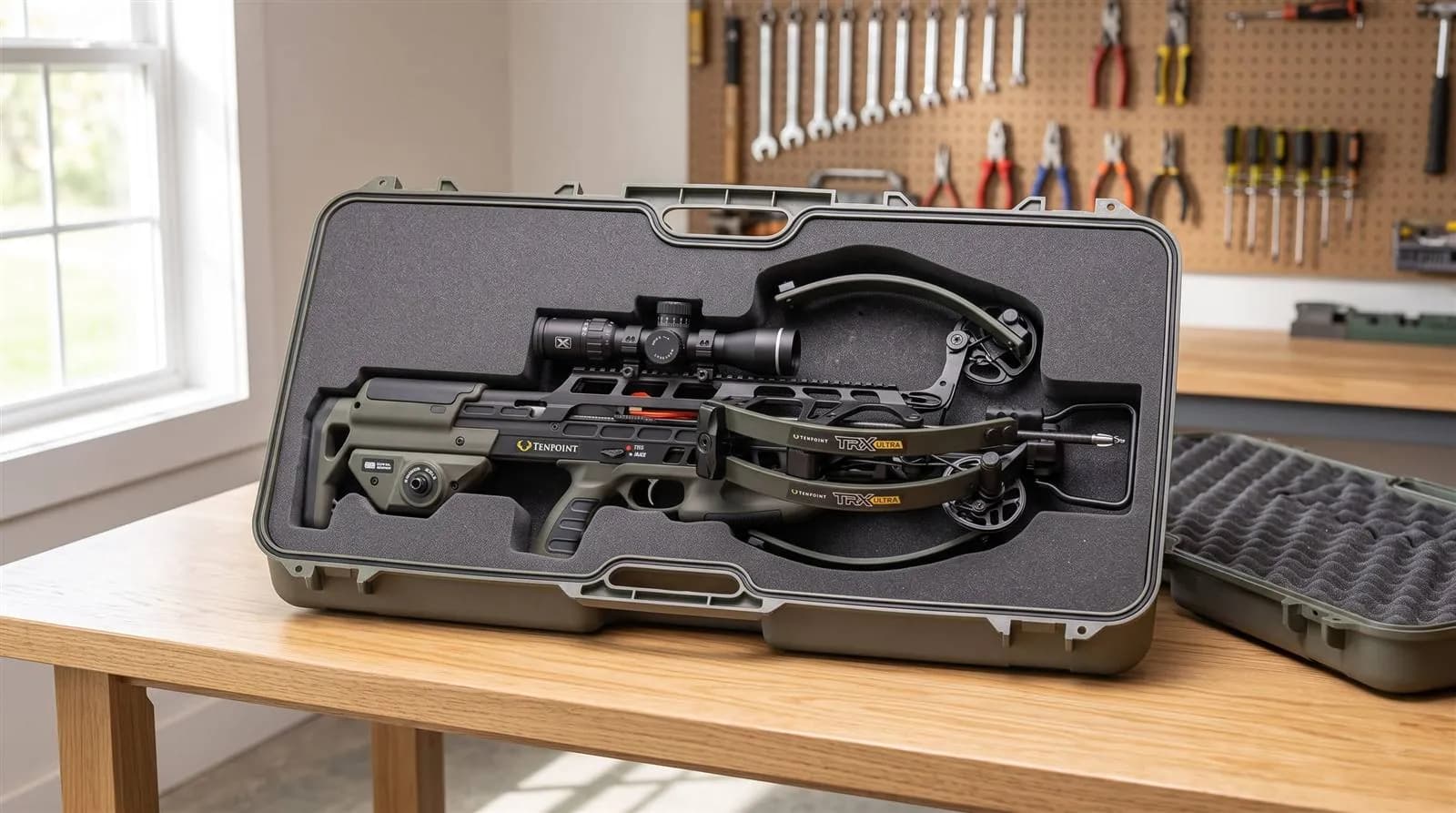
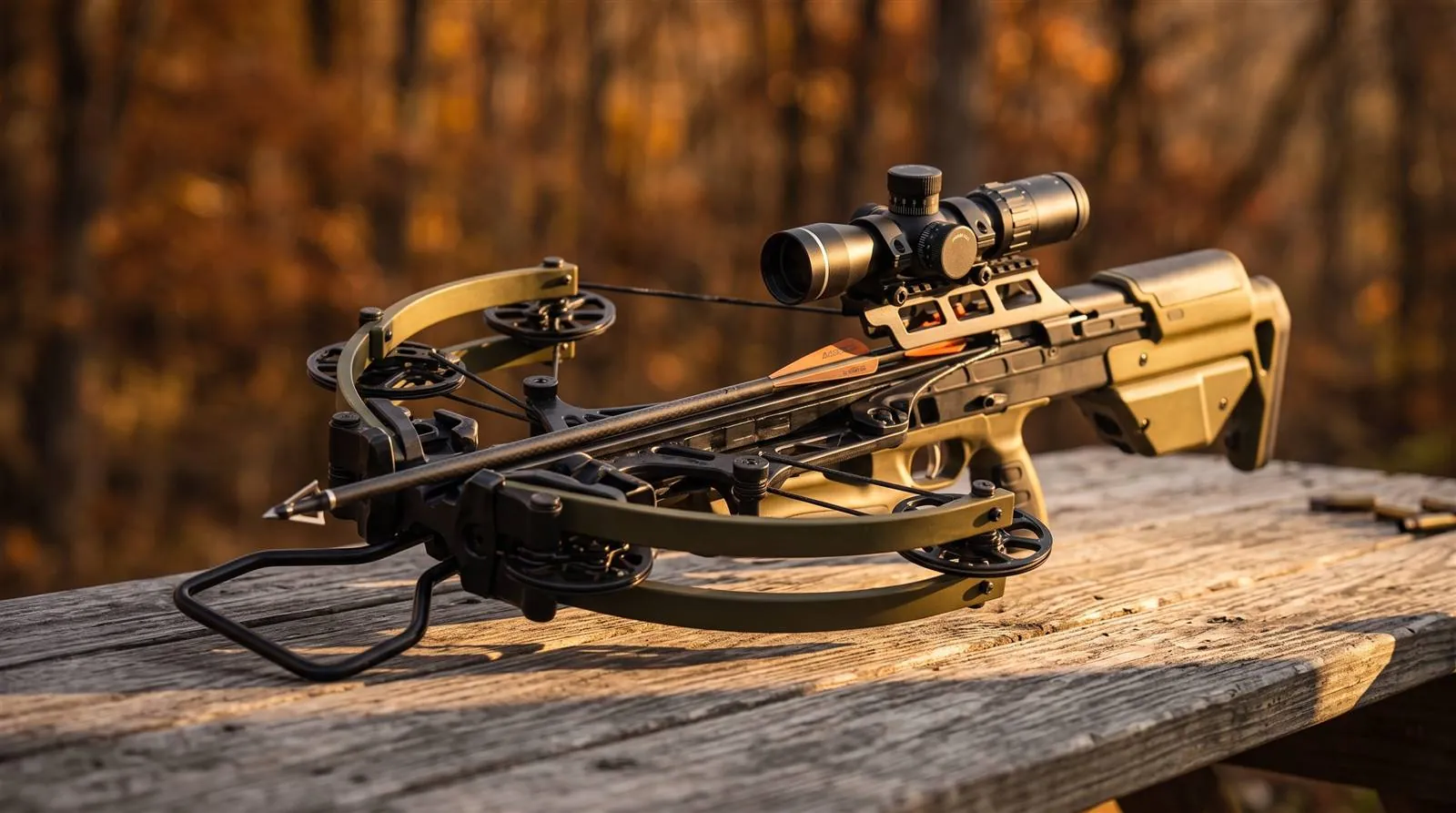
At $3,495–$3,515, the TenPoint TRX Ultra is the most expensive crossbow I have tested, and it is also the fastest and the most accurate at 100 yards. TenPoint advertises it as the fastest production crossbow at 515 FPS. I cannot speak for every model on the market, but my chronograph recorded 511–517 FPS, so the rating is honest.
It is a reverse-draw crossbow built on Twin-Riser Technology, aimed at long-range hunters and target shooters who can pay for it. I tested it over a four-week flagship protocol, extended to include 100-yard accuracy work because that is where TenPoint makes its boldest claims. The testing also included repeated ACUslide MAXX cocking cycles and a cold-morning check.
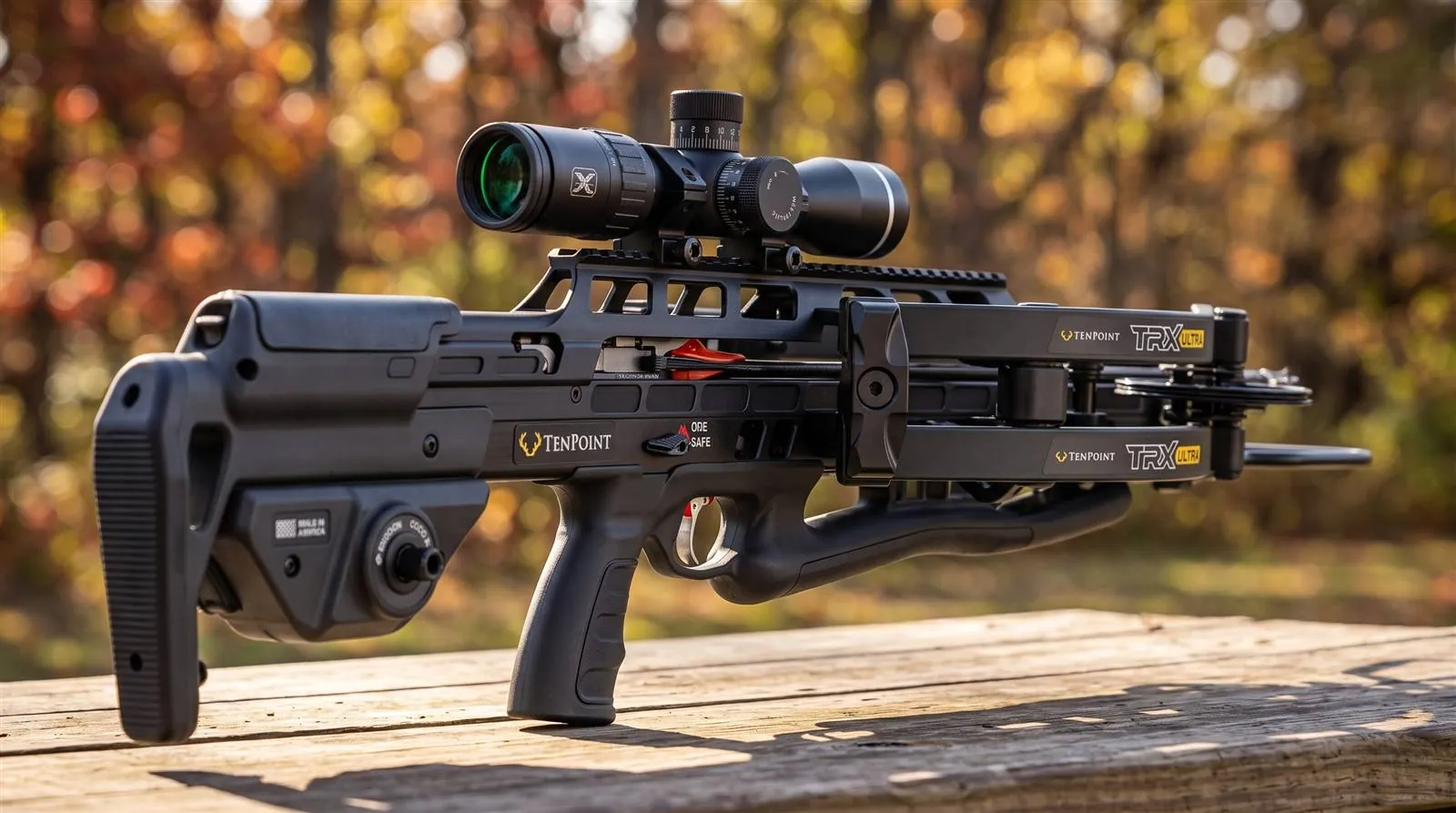
TenPoint TRX Ultra Specs and Price
The speed below is TenPoint's rating with a 400-grain bolt. Scope inclusion depends on the package you buy.
| Specification | Details |
|---|---|
| Advertised Speed | 515 FPS (manufacturer rating, 400-grain bolt) |
| Draw Weight | 360 lbs |
| Power Stroke | 16.25" |
| Axle-to-Axle | 6" (cocked) / 11.75" (uncocked) |
| Weight | 8.4 lbs |
| Trigger | Custom TriggerTech trigger, ~3.5 lb break |
| Safety | AR-style ambidextrous thumb safety |
| Cocking | ACUslide MAXX integrated cocking/de-cocking |
| Scope | 100-yard illuminated multi-reticle scope (package-dependent) |
| Includes | 3 premium arrows, removable draw handle, quiver + mounting bracket |
| Warranty | 5 years on limbs/cams; lifetime on trigger mechanism |
| Price | $3,495–$3,515 |
What I Like
- Speed that holds up on the chronograph. I measured 511–517 FPS across five shot strings with a 400-grain bolt, confirming the 515 FPS claim within margin of error.
- Accuracy at distance. The platform produced the tightest 100-yard groups I have measured on any crossbow. TenPoint claims roughly 70% tighter groups than a comparable forward-draw flagship, and my side-by-side testing came close to that figure.
- Cam timing that does not drift. The 8mm Zero-Torsion axles held timing through 60+ test shots with no measurable drift.
- A rifle-grade trigger. The TriggerTech trigger broke at a crisp, consistent 3.5 lbs across 20 sampled shots, with no creep and no stacking.
- Balance for its speed class. At 8.4 lbs and 6 inches axle-to-axle cocked, it is compact and well balanced among the flagships I have shouldered in a stand or blind.
So far in testingFor long-range shooters: 511–517 FPS measured, a 3.5 lb creep-free trigger, and no cam-timing drift after 60+ cycles.
Potential Drawbacks
- The highest price I have tested. At $3,495–$3,515 it is out of reach for most hunters, and the TX Ultra 29.5 costs roughly $900–$1,000 less.
- No manual cocking backup. At 360 lbs of draw weight, hand cocking is not an option, so you depend entirely on ACUslide MAXX.
- Repairs route through a dealer. Replacement strings, cables and the proprietary Twin-Riser limb assembly are TenPoint-specific, so field repairs away from a dealer are effectively impossible.
- Bundled extras add cost. The premium scope and accessories raise the price if you would rather use optics you already own.
- Longer setup. Zeroing took longer than on a standard flagship, as covered below.
Key Features Explained
How does Twin-Riser reverse-draw design work?
In a forward-draw compound crossbow, the string travels backward through the shot and adds a small amount of torque as the cams roll over. TenPoint's reverse-draw layout flips that geometry: limbs and cams mount toward the shooter, so the string pulls the bolt forward. TenPoint credits this for the group-size advantage, and my side-by-side testing against a forward-draw competitor came close to matching it at extended range.
What are Zero-Torsion 8mm axles?
TenPoint rates the axles at 175% greater strength and 215% greater stiffness than those on its previous flagship line. In practice, I never had to re-time or adjust either cam during the entire testing window, which is not universally true of high-poundage flagship crossbows I have handled.
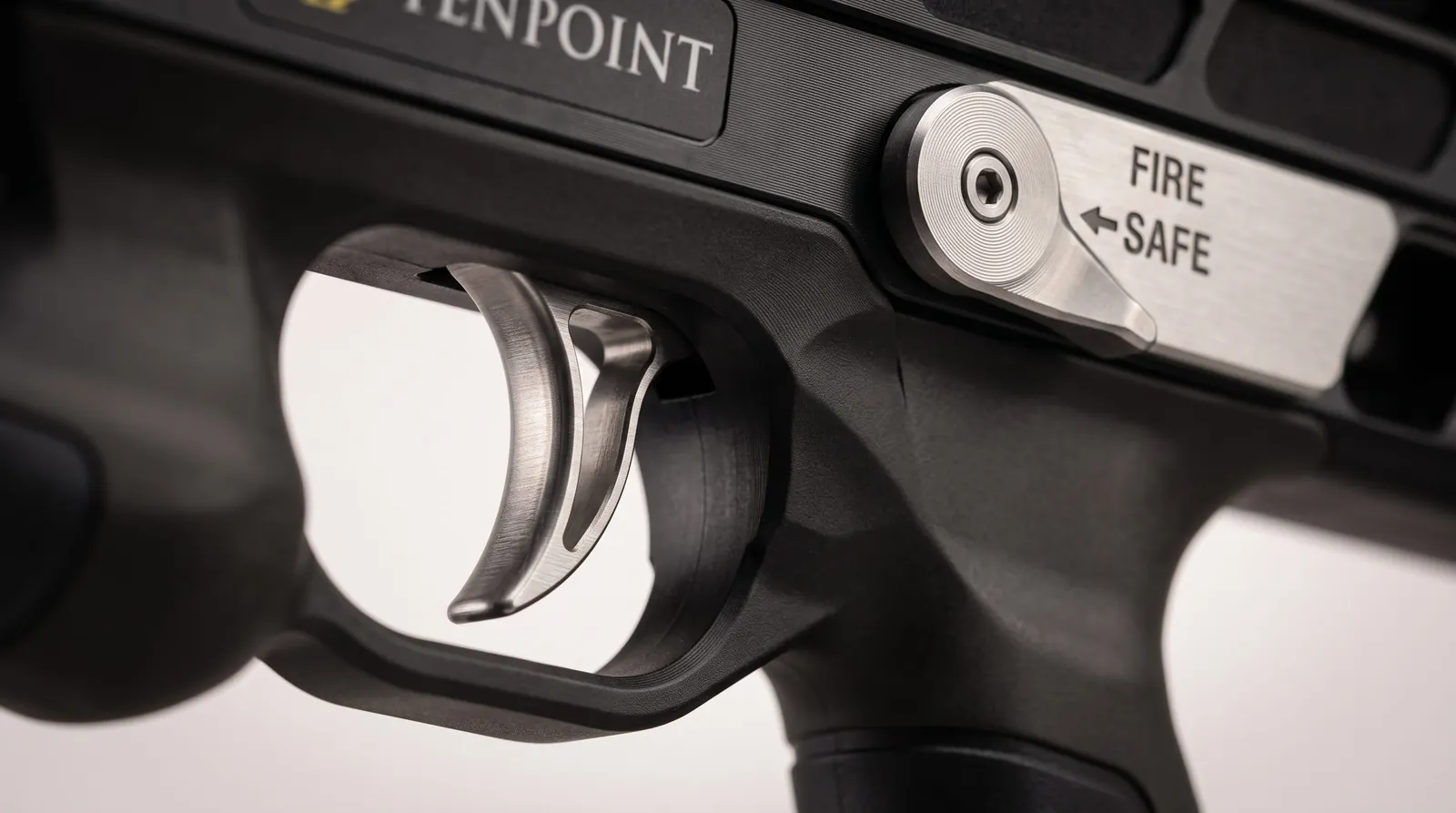
How good is the TriggerTech trigger and safety?
My digital trigger-pull gauge showed a consistent break with no measurable creep or stacking, closer to a tuned rifle trigger than the heavier pulls typical of crossbow trigger boxes. The AR-style ambidextrous thumb safety is intuitive for rifle shooters and engaged reliably in every standard and cold-weather test I ran. For background on terms, see trigger system.
How reliable is ACUslide MAXX cocking?
Hand cocking is not realistic at this draw weight. Across more than 60 logged cycles, including a cold-morning test at 41°F, the system drew to an identical point every time. That matters because there is no manual backup. If integrated cocking is new to you, read my how to cock a crossbow guide.
Performance & Usability
How fast is it in testing?
The chronographed speed above is the fastest I have recorded, and it held across all five strings without drifting as testing extended into the fourth week. For context on what FPS means for bolt energy, my crossbow bolt speed guide covers the basics.
How accurate is it at 100 yards?
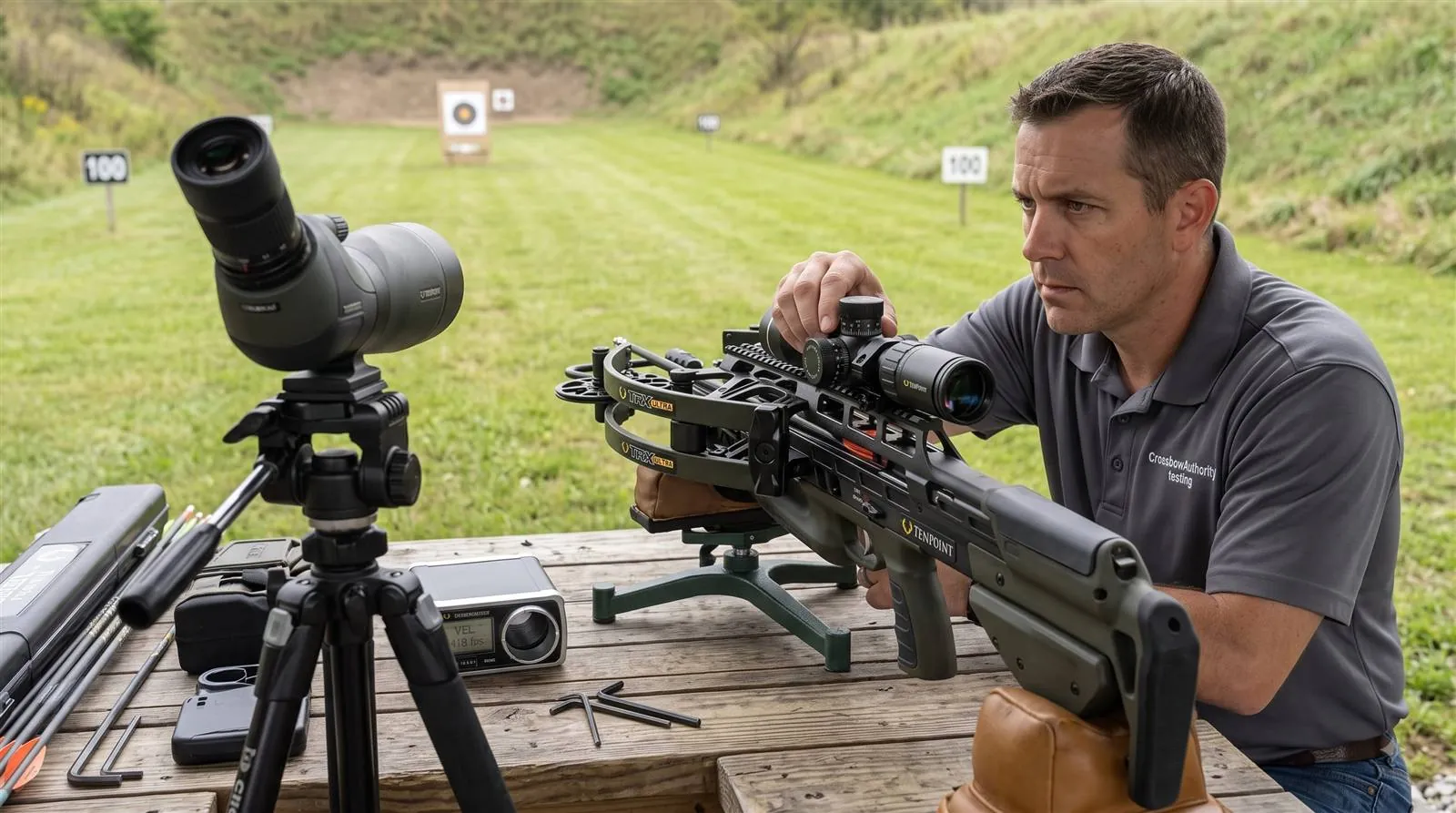
This is where the TRX Ultra separates itself from the other crossbows I have reviewed. Across three separate 100-yard sessions, my five-bolt groups averaged noticeably tighter than those from a comparable forward-draw flagship at the same distance, consistent with TenPoint's claim. For hunters taking long shots, or target shooters pushing distance, that is a measurable advantage. Even at this speed the bolt still drops noticeably between 60 and 100 yards, and the bolt drop chart shows how much a 10-yard range error costs you at that distance.
How does it balance and handle?
With the cams and mass forward of the trigger group, the center of gravity sits closer to the support hand. That reduced fatigue during longer accuracy sessions and made off-hand steadying at 100 yards easier than on the forward-draw flagship I compared it against.
How long does setup take?
Scope mounting and a full 20-shot zeroing process took roughly 70 minutes on day one. That is longer than a standard flagship, because of the extra precision needed to exploit the platform's accuracy.
What's in the Box and What Else You Need
Per the specification, the package includes 3 premium arrows, a removable draw handle and a quiver with mounting bracket. The 100-yard illuminated multi-reticle scope depends on the package, so confirm whether yours includes it before comparing prices. I did not document any other accessories.
Still to budget for:
- More bolts. Three arrows are enough to start, not enough to shoot a session comfortably. Follow your manual for the bolt length and weight range, and see my bolt selection guide.
- Broadheads or field points for practice and hunting.
- A case, string wax and, if your package has no scope, optics. My scope sighting guide covers zeroing once you have one.
- A dealer relationship. Strings, cables and the Twin-Riser limb assembly are TenPoint-specific, so find a dealer you can reach before you need one.
Setup and first session
Allow a full morning for the first zero rather than a quick session. If you have never used integrated cocking, I would follow this order, subject to your manual:
- Inspect the string, cables and cam area when you unbox it.
- Fit the draw handle and practice cocking and de-cocking with no bolt loaded.
- Mount and level the scope.
- Zero at a short distance first, then confirm your longer distances in later sessions.
- Keep a written note of your zero and which bolt you used.
Warning signs to act on
| What you notice | Likely cause | What I would do |
|---|---|---|
| Groups drift at long range | Loose mounting, a bolt change, worn string | Check hardware and bolt consistency, then inspect the string |
| Cocking feels uneven or stalls | Dirty rail or a mechanism fault | Stop, do not fire, clean per the manual and see a dealer |
| String or cables fray | Overdue waxing or wear | Wax on TenPoint's cycle and have worn parts replaced by a dealer |
| Anything unusual in the cam area | Damage or timing change | Stop shooting and have a dealer inspect it |
I saw none of these across 60+ cocking cycles and no cam-timing drift. At 360 lbs, I treat any of them as a reason to stop and not push through.
Who Is the TRX Ultra For?
Best suited to:
- A long-range hunter or target shooter who shoots near 100 yards and wants the tightest groups at that range
- Someone who already owns a flagship compound crossbow and wants TenPoint's newest, fastest platform
- A buyer willing to pay for TriggerTech-level trigger quality and TenPoint's most advanced accuracy technology
Consider something else if:
- You are budget-constrained or rarely shoot past 50–60 yards
- You want a crossbow with simpler, field-serviceable parts
- You already own a scope you like and do not want to pay for a bundled one
- You do not have a dealer nearby, since repairs route through one
Browse the compound crossbows hub for lower-priced options.
TRX Ultra vs TX Ultra 29.5 vs TX Ultra 26.5: What You Pay For
TenPoint's three Ultra-tier crossbows in my reviews share ACUslide MAXX cocking, a TriggerTech trigger and the same warranty terms (5 years on limbs and cams, lifetime on the trigger mechanism). The TRX Ultra is the top step. The table shows what each model gives you.
| Item | TX Ultra 26.5 | TX Ultra 29.5 | TRX Ultra |
|---|---|---|---|
| Rated speed | 410 FPS | 460 FPS | 515 FPS |
| My chronograph | 406–413 FPS | 456–463 FPS | 511–517 FPS |
| Draw weight | 220 lbs | 350 lbs | 360 lbs |
| Power stroke | 10.25" | 13.5" | 16.25" |
| Axle-to-axle, cocked | 7" | 6.5" | 6" |
| Weight | 7.7 lbs | 8 lbs | 8.4 lbs |
| Price | $1,999–$2,199 | $2,499–$2,599 | $3,495–$3,515 |
| My rating | 4.6 | 4.8 | 4.9 |
| Where I would use it | Saddle, tight blinds, short shots | Blinds and stands with reach to extended range | Long-range work near 100 yards |
The TRX Ultra has the longest power stroke, the highest speed and the narrowest cocked width of the three, and it is also the heaviest and the most expensive. The 29.5 gets you most of the way there for roughly $900–$1,000 less. The 26.5 is the answer when carry weight and size matter more than reach. See the power stroke entry for why a longer stroke is the main reason the speed climbs.
TRX Ultra vs TX Ultra 29.5 and Ravin Alternatives
The nearest step down is the TX Ultra 29.5, and the compact option is the TX Ultra 26.5. On the Ravin side, I tested the R10 Pro XK7 and the R470 Stealth Gray.
| Model | Rated speed | Price | My rating | Buy |
|---|---|---|---|---|
| TRX Ultra | 515 FPS | $3,495–$3,515 | 4.9 | |
| TX Ultra 29.5 | 460 FPS | $2,499–$2,599 | 4.8 | Check price on Amazon |
| TX Ultra 26.5 | 410 FPS | $1,999–$2,199 | 4.6 | Check price on Amazon |
| Ravin R470 Stealth Gray | 470 FPS | $2,450–$2,550 | 4.7 | Check price on Amazon |
| Ravin R10 Pro XK7 | 420 FPS | $1,499–$1,799 | 3.9 | Check price on Amazon |
Against the R10 Pro XK7, I found the TRX Ultra faster on the chronograph and tighter at 100 yards, though the Ravin's folded HeliCoil footprint is more compact for storage. The 29.5 still performs well for hunters who do not shoot past 60 yards but does not match the TRX Ultra's speed or 100-yard grouping.
Read nextRavin vs TenPointCompare the two brands on cocking systems, noise, footprint and ownership cost.
Value for Money
At $3,495–$3,515, the TRX Ultra costs well above Ravin's R10 Pro XK7 ($1,499–$1,799) and roughly $900–$1,000 more than TenPoint's own forward-draw TX Ultra 29.5. The value case holds only for a specific buyer: someone who shoots at extended range and needs the accuracy advantage of the Twin-Riser platform.
For hunters on a realistic budget, or who rarely shoot past 50–60 yards, that advantage will not be decisive, and TenPoint's lower-priced models cost a fraction as much. I score value at 8.4 rather than higher for exactly that reason: judged against what it delivers to the long-range shooter it is built for, the price is justified; judged against what most hunters need, it is not.
A worked example with the numbers
- Against the TX Ultra 29.5, the TRX Ultra costs $916–$996 more ($3,495 minus $2,499, or $3,515 minus $2,599) for 55 more rated FPS. That is about $17–$18 per FPS.
- Against the TX Ultra 26.5, it costs $1,316–$1,496 more for 105 more rated FPS, or about $13–$14 per FPS.
- Kinetic energy is mass times speed squared divided by 450,240. With a 400-grain bolt at the 515 FPS rating, that is about 236 ft-lbs. That is a calculation from the rating, not a measurement; the kinetic energy calculator runs it for your own bolt weight.
The price per FPS is higher at the top of the line, which is why I only recommend it to shooters who use the extra range.
The Ravin LR is the Ravin I would compare against this one: 450 FPS, an adjustable stock and a turret scope at a lower price.
At its rated 515 FPS, the kinetic energy calculator shows what the TenPoint TRX Ultra delivers with the bolt weight you plan to shoot, and the bolt drop chart estimates how far each reticle mark falls at that speed. The cocking effort estimator compares its 360-lb draw weight by hand, rope and crank. If you plan to replace the scope, the scope speed matcher lists reviewed scopes calibrated for 515 FPS. Every other model I have tested in this class is compared on the compound crossbows page.
Where the TenPoint TRX Ultra ranks
The TenPoint TRX Ultra earned a place in Best Crossbows of 2026: Tested Picks (#1), where it is scored against every other model I tested for that use. For a direct head-to-head, see TenPoint TX Ultra 26.5 vs 29.5, Ravin vs TenPoint Crossbows Compared and Compound vs Recurve Crossbow Compared. It also comes up in Best Crossbow Scopes of 2026, How to Cock a Crossbow: Rope vs Crank, Fixed-Blade Broadheads for Crossbows and Best Crossbow Broadheads for Deer 2026.
Final Verdict
TenPoint TRX Ultra
4.9 / 5 — Is it worth buying?
The TRX Ultra is the fastest crossbow I have tested, with chronographed speed matching TenPoint's 515 FPS rating and the tightest 100-yard groups I have recorded. Its main trade-off is cost: at $3,495–$3,515 it is the most expensive crossbow I have tested, and its 360 lb draw weight makes ACUslide MAXX mandatory.
Best for
Long-range hunters and target shooters, buyers upgrading from a previous flagship, anyone prioritizing outright speed and 100-yard accuracy
Skip if
You are budget-constrained, rarely shoot past 50–60 yards, or want a crossbow with simpler field-serviceable parts
Score breakdown
- Speed (FPS)5.0/5
- Accuracy5.0/5
- Build Quality5.0/5
- Ease of Cocking5.0/5
- Value for Money4.2/5
- Noise Level5.0/5
- Speed
- 515 FPS
- Draw weight
- 360 lbs
- Weight
- 8.4 lbs
- Length
- 6" axle-to-axle (cocked)
Typical price
$3,495–$3,515
Frequently Asked Questions
Is the TenPoint TRX Ultra worth it?
For hunters and target shooters who shoot at extended range and want a very fast, accurate flagship, yes. My testing confirmed both the 515 FPS rating and a measurable accuracy advantage at 100 yards. For most hunters shooting inside 60 yards, the TX Ultra 29.5 or Titan X costs far less and performs well.
Is the TenPoint TRX Ultra the fastest crossbow in the world?
TenPoint advertises it as the fastest production crossbow, and I have not compared it against every competing model. It is the fastest crossbow I have tested, and its chronographed speed closely matched the advertised 515 FPS.
What makes reverse-draw Twin-Riser Technology different?
Standard compound crossbows draw the string backward through the shot, which can add torque as the cams roll over. The TRX Ultra places the limbs and cams toward the shooter, so the string pulls the bolt forward. TenPoint attributes its 100-yard grouping advantage to this design.
Can I hand-cock the TenPoint TRX Ultra?
No. At 360 lbs of draw weight, it is designed around the ACUslide MAXX integrated cocking and de-cocking system, and there is no realistic manual option. The system performed without a failure across more than 60 test cycles.
How does the TRX Ultra compare to the Ravin R10 Pro XK7?
I found the TRX Ultra faster on the chronograph and tighter at 100 yards, while the Ravin's folded HeliCoil design is more compact for storage. The R10 Pro XK7 costs $1,499–$1,799, far less than the TRX Ultra.
What is in the box?
Per the specifications, the package includes 3 premium arrows, a removable draw handle, and a quiver with mounting bracket. A 100-yard illuminated multi-reticle scope depends on the package, so confirm what yours ships with.
What warranty does it carry?
The listed warranty is 5 years on limbs and cams and a lifetime warranty on the trigger mechanism. Confirm the terms with the seller before buying.
How long does it take to set up and zero the TRX Ultra?
Scope mounting and a full 20-shot zeroing took me roughly 70 minutes on day one, longer than a standard flagship because of the precision needed to use the platform's accuracy. Plan a second session to confirm longer distances.
How is the TRX Ultra different from the TX Ultra 29.5 and 26.5?
The TRX Ultra is rated 515 FPS with a 16.25-inch power stroke and a 6-inch cocked width, versus 460 FPS for the 29.5 and 410 FPS for the 26.5. It also costs $3,495–$3,515, the most of the three.
Who should skip the TRX Ultra?
Skip it if you are budget-constrained, rarely shoot past 50–60 yards, or want field-serviceable parts. In those cases the TX Ultra 29.5 or a less expensive TenPoint model gives you most of the practical performance for less money.
What do I need to buy besides the TRX Ultra itself?
The package lists 3 arrows, a draw handle and a quiver with bracket. Budget for more bolts, broadheads or field points, string wax and a case, plus a scope if your package does not include one.
Related Reviews
 4.8
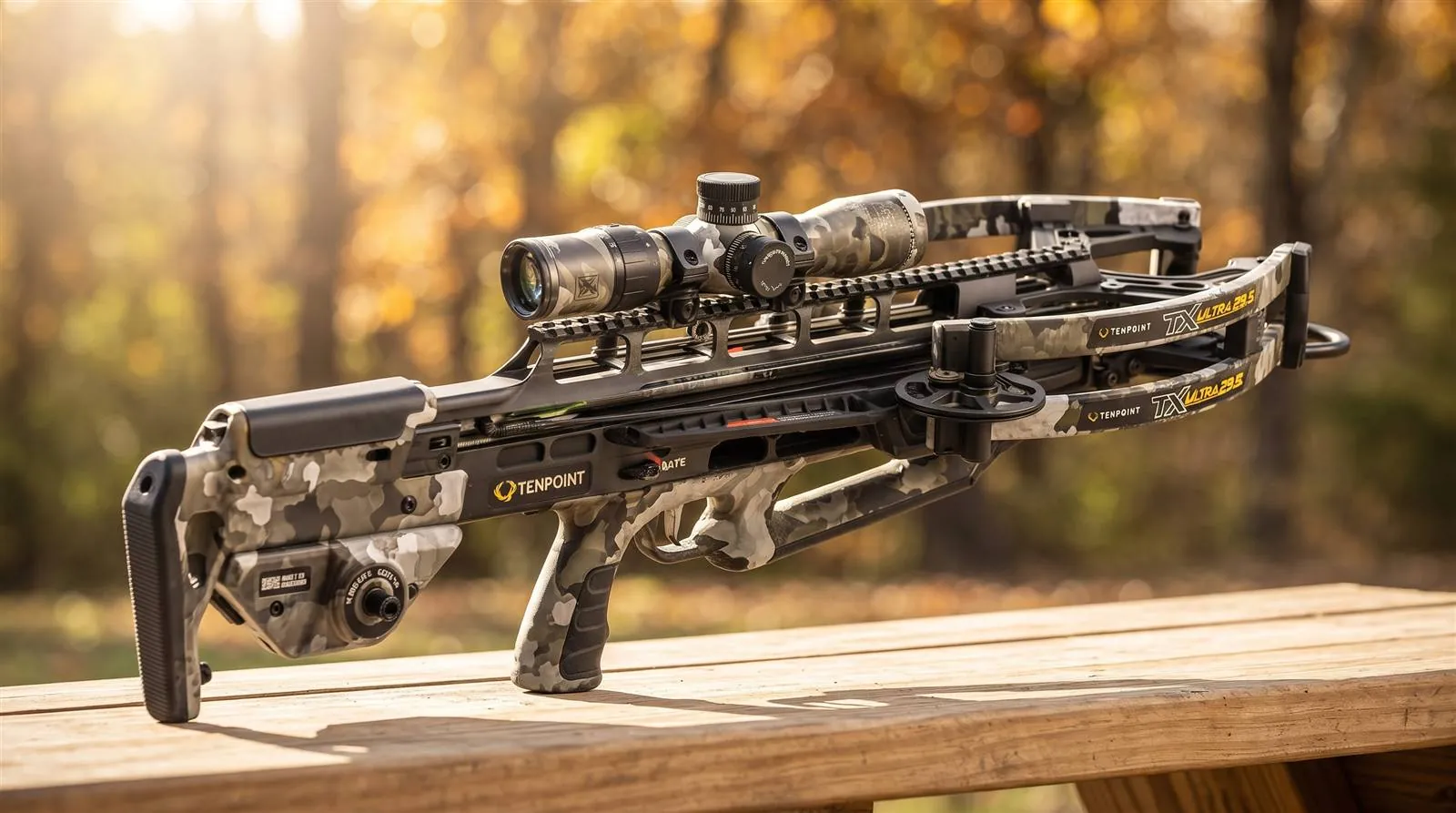
TenPoint TX Ultra 29.5 Review 2026
Forward-draw crossbow measured at 456–463 FPS with tight 100-yard groups and a 6.5-inch cocked width. Speed and range in a narrow frame.
Read review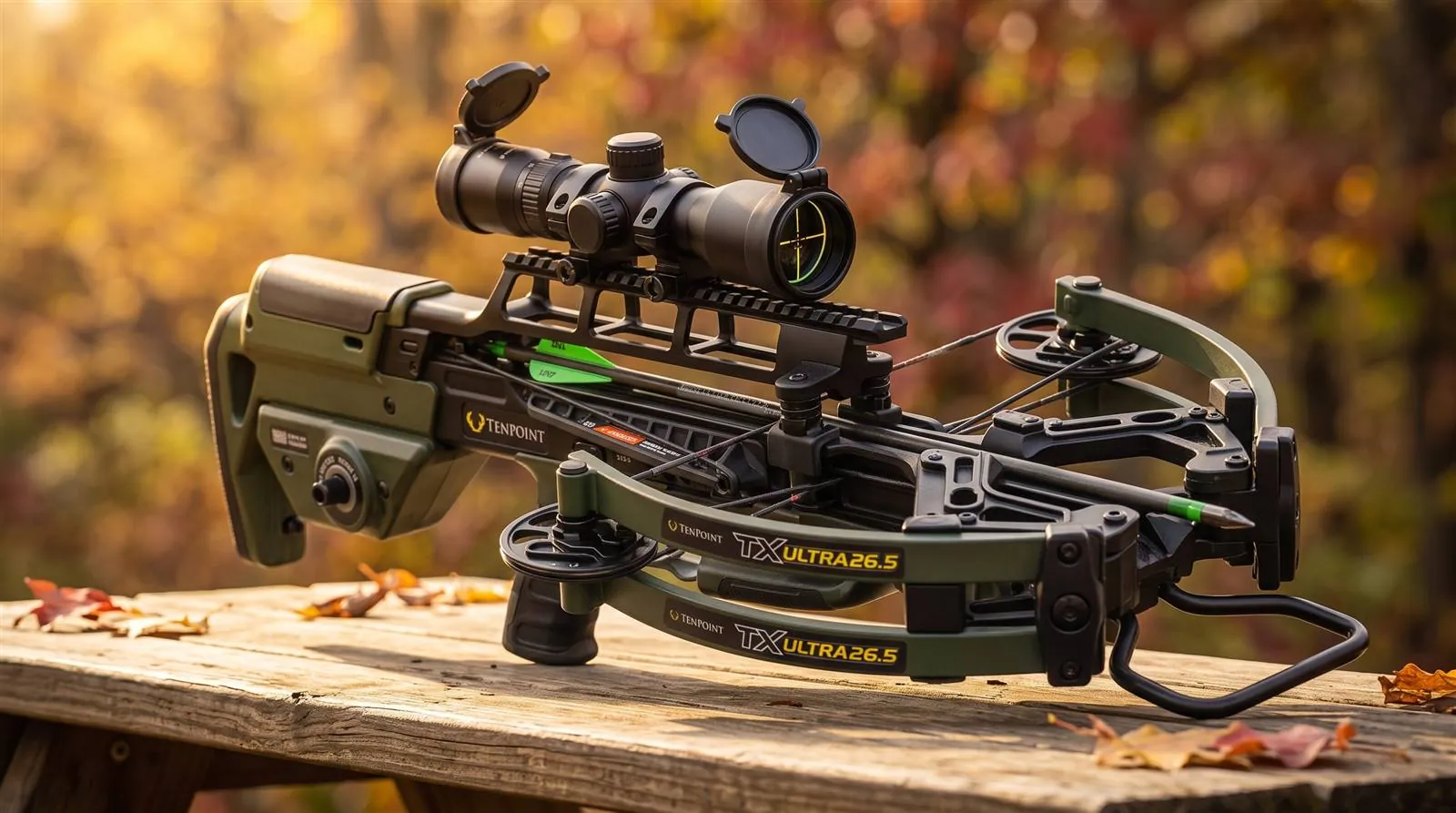 4.6
TenPoint TX Ultra 26.5 Review 2026
Very short forward-draw crossbow measured at 406–413 FPS, quiet to shoot and easy to move in saddles, tight blinds and confined stands.
Read review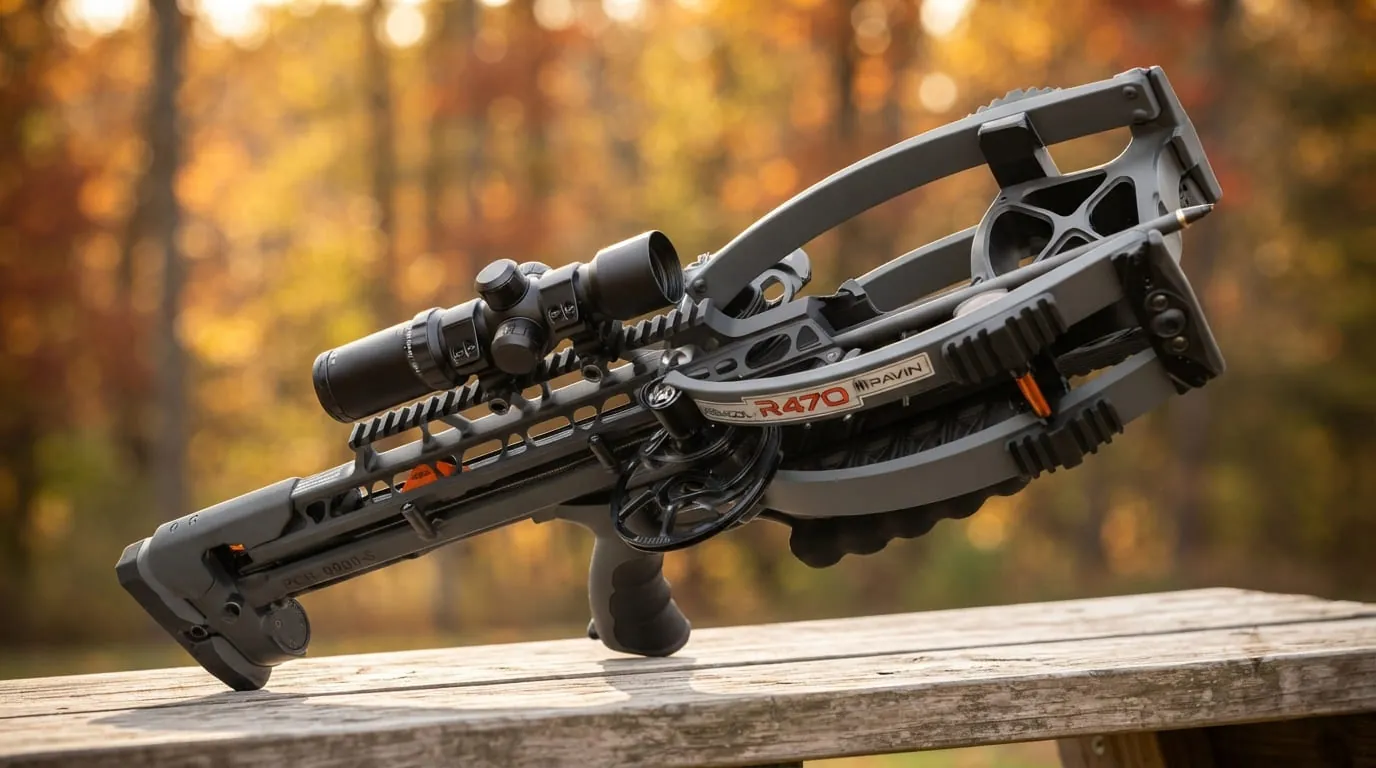 4.7
Ravin R470 Stealth Gray Review 2026
Flagship-speed crossbow measured at 463–472 FPS in a compact frame, with a Cerakote finish that showed no wear and a quiet integrated cocking system.
Read review