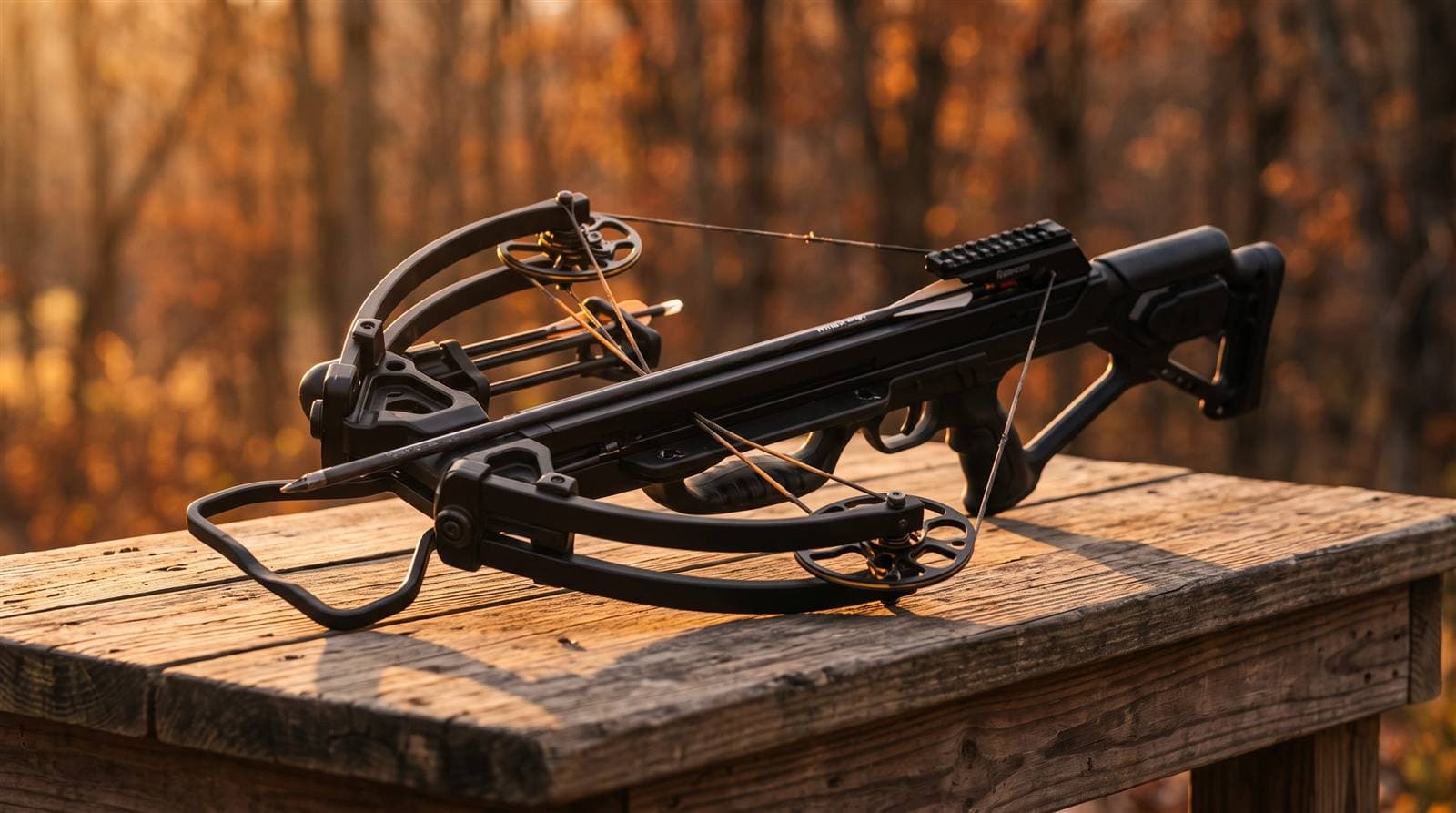
What Is String and Cables?
The bowstring that drives the bolt and the cables that link the cams on a compound crossbow, wear parts that need regular inspection, waxing and timely replacement.
String and Cables: definition
Also called: crossbow string, bowstring, cables, string set, string and cable set
The string is the cord that is drawn back to the string latch and then thrown forward to push the bolt. On a compound crossbow there are also cables that run between the cams and anchor the system, so the limbs are loaded evenly. A recurve usually has only a string.
Both parts are made from high-strength synthetic fibre strands twisted or wound into a rope, with a wrapped section called the serving at the points that touch the latch, rail and cam grooves. The serving protects the strands from abrasion. Strings and cables are sold as matched sets because their lengths are tuned to the crossbow.
These are consumable parts. They stretch, fray and dry out with use, and a worn string can change the point of impact, reduce speed and in the worst case fail. The TRX Ultra review notes that its strings and cables are TenPoint-specific, so replacement runs through the maker or a dealer.
String and cable inspection signs
| Sign | Likely cause | Action |
|---|---|---|
| Fuzzy fibres or frays | Abrasion against rail or latch | Wax, inspect, replace if strands are broken |
| Separated or loose serving | Wear or age | Have it serviced |
| Dry, chalky look | Lack of wax | Apply recommended string wax |
| String sits off-centre | Stretch or cam issue | Dealer inspection |
| Kinks or flat spots | Storage under load or damage | Replace per manual |
Why String and Cables matters
The string is the part that actually moves the bolt, and any inconsistency in it shows up on target. A well-kept string supports steady speed and groups, while a worn one introduces variation and risk.
Strings and cables protect the limbs. A snapped string can release stored energy suddenly, so inspection and replacement on schedule is a safety habit, not just upkeep.
How to read it on a spec sheet
- Check the stated replacement interval, which is usually given in months or in number of shots.
- Look at whether strings and cables are sold as a matched set and who is allowed to install them.
- Note the string wax or lubricant the maker recommends.
- See whether the warranty covers strings or treats them as wear items.
- Find the service route: dealer, mail-in or owner-installed with a press.
Common mistakes
- Skipping waxing until the string looks dry.
- Using household lubricant or the wrong wax on the string.
- Replacing only the string when the manual calls for a matched set.
- Continuing to shoot with visibly frayed strands or damaged serving.
- Attempting installation without a press when one is required.
A string and cable check routine
- Uncock and unload and place the safety on before touching the strings.
- Run your fingertips lightly along the string and cables, feeling for fuzz or rough spots.
- Look closely at the serving where it meets the latch, rail and cam grooves.
- Check that the string sits centred and straight on the rail.
- Apply wax as your manual specifies and wipe off excess.
- Record the date and shot count, and schedule replacement by the manual's interval.
See it in our reviews
- TenPoint TRX Ultra — rated 4.9/5
- Excalibur Mag Air — rated 3.4/5
Frequently Asked Questions
How often should I replace my crossbow string?
Follow your manual. Makers commonly specify an interval in time or shot count, and you should replace sooner if you see fraying, serving separation or the string no longer sits correctly.
What is the difference between the string and the cables?
The string is drawn back and drives the bolt. The cables link the cams or limb tips on a compound crossbow to share the load. Recurves normally have a string only.
Do I need to wax a crossbow string?
Most makers advise waxing at regular intervals to reduce abrasion and moisture damage. Use the wax your manual recommends, apply it lightly and wipe off any excess.
Can I replace a crossbow string myself?
Some designs allow it with a press and correct instructions, but many require a dealer. If the manual says dealer service, follow it, because incorrect installation can affect safety and accuracy.
How do I know my string is worn out?
Look for fuzzy or broken strands, dryness, flat spots, loosened serving and a string that no longer centres. Any of these means it needs attention before you shoot again.
Does a worn string reduce speed?
It can, because stretch and damage change how consistently energy transfers to the bolt. Measure with a chronograph if you want to confirm, and replace worn strings regardless.
Can I use any string on my crossbow?
No. Strings and cables are made to a specific length and construction for each model. Use only the parts the manufacturer specifies for your crossbow.
Keep learning
Guides that use this term
- GuideHow to Maintain a CrossbowHow to maintain a crossbow: string waxing, rail and moving-part lubrication, bolt inspection, storage, and when to see a technician.Read the guide
- GuideCrossbow Safety Rules for BeginnersCrossbow safety rules for beginners: finger placement, never dry-firing, safe cocking and de-cocking, range etiquette and storage habits that prevent injury.Read the guide
- GuideHow to Cock a Crossbow: Rope vs CrankHow to cock a crossbow step by step with a rope or crank, why hand cocking rarely works, and the mistakes that cause uneven strings and injuries.Read the guide
Related terms
- ServingThread wrapped tightly around the string at high-wear points to protect the fibres from abrasion and hold the nocking area together.
- String WaxA wax applied to the string and cables to reduce fraying, slow moisture uptake and keep the fibres lubricated.
- CamThe shaped wheel at each limb tip of a compound crossbow that the string and cables run over, creating let-off and a smoother, more efficient release of energy.
- String LatchThe catch in the rail that holds the drawn string at full draw and releases it when the trigger is pulled, and one of the most safety-critical parts.
- LimbThe flexible arm on each side of a crossbow that stores energy when the string is drawn and releases it to push the bolt forward.
- Dry FireReleasing the string with no bolt on it, which sends the stored energy into the crossbow itself and can cause serious damage.
Browse the gear
Definitions are general information. Manufacturer figures vary, so follow your crossbow's manual and verify local laws with the relevant authority.