The best reverse-draw crossbow puts a long power stroke inside a short, narrow frame, and that is the whole reason to pay extra for one. Mounting the limbs with the cams out front and the string travelling back toward the shooter lets a crossbow stay under 29 inches long and around 6 to 8 inches wide when cocked without giving up speed. The catch is price, weight in some models and, on a few, proprietary bolts.
I chose four reverse-draw crossbows from the models I have reviewed, from TenPoint's $3,500 flagship to a Killer Instinct package under $700. Every rating, price and spec here comes from the individual reviews, so the numbers match each product page. Three of the four were reviewed hands-on; the Killer Instinct NEO-X review is built from listed specifications, and I say so where it matters.
What Is a Reverse-Draw Crossbow?
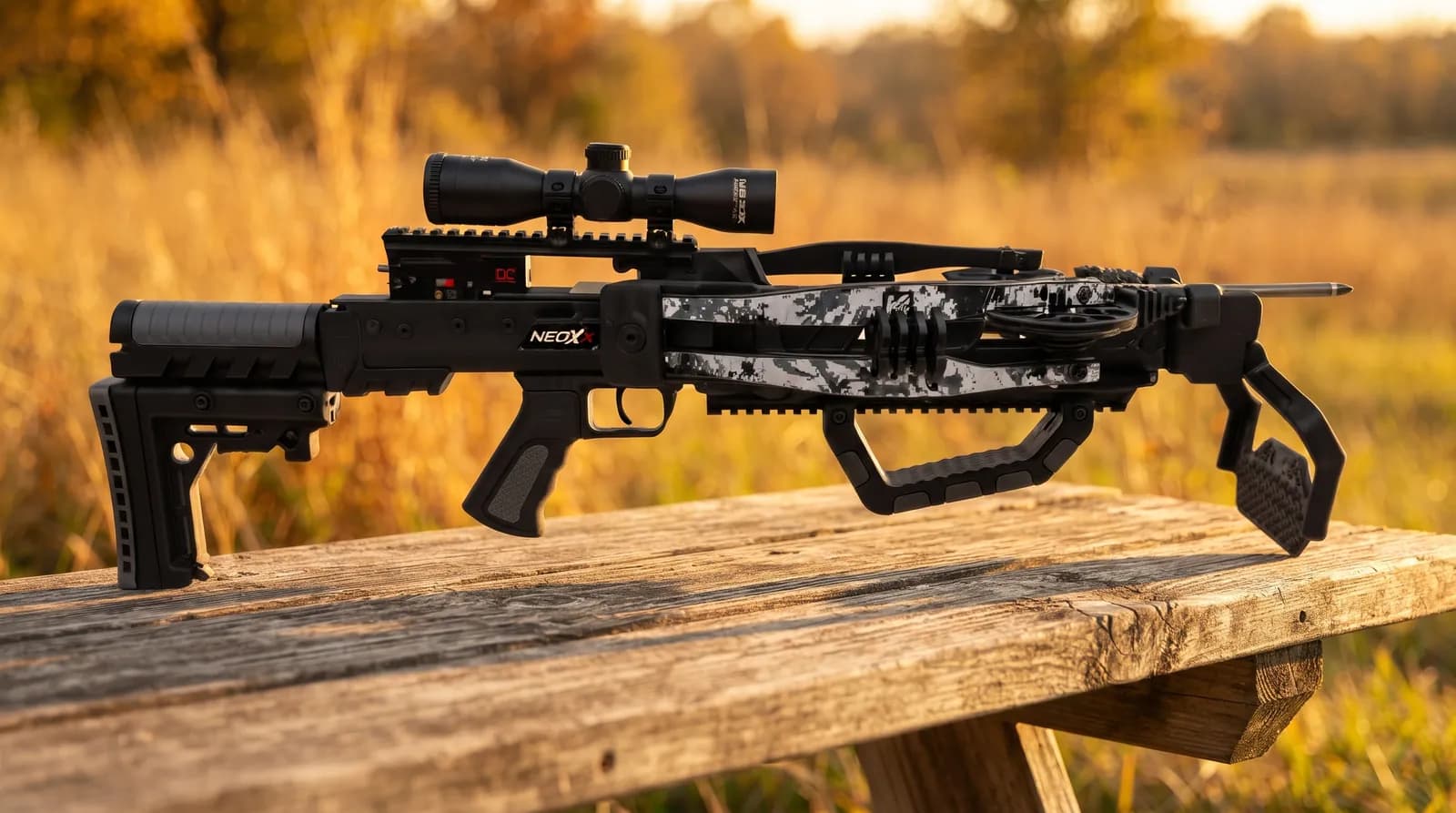
A reverse-draw crossbow mounts its limbs with the tips pointing back toward the shooter and the cams set forward of them. On a conventional forward-draw crossbow, the riser and limbs sit at the front of the rail and the string is pulled back from there. Flipping the layout means the string starts further forward and travels further before release.
That longer travel is the power stroke, and it is what stores energy. A reverse-draw crossbow can reach a 13.5-inch to 16.25-inch power stroke in a frame that a forward-draw design would need several more inches to match. It also moves the mass back toward your hands, so the crossbow feels balanced rather than nose-heavy when you hold it at the ready.
Reverse-draw vs forward-draw at a glance
| Factor | Reverse-draw | Forward-draw |
|---|---|---|
| Power stroke for a given length | Longer | Shorter |
| Overall length | Often under 29 inches | Usually 32–34 inches |
| Balance | Closer to the grip | More weight toward the front |
| Price | Usually higher | Wider range, including budget models |
| Bolts | Some models need specific lengths | Usually standard 20- or 22-inch |
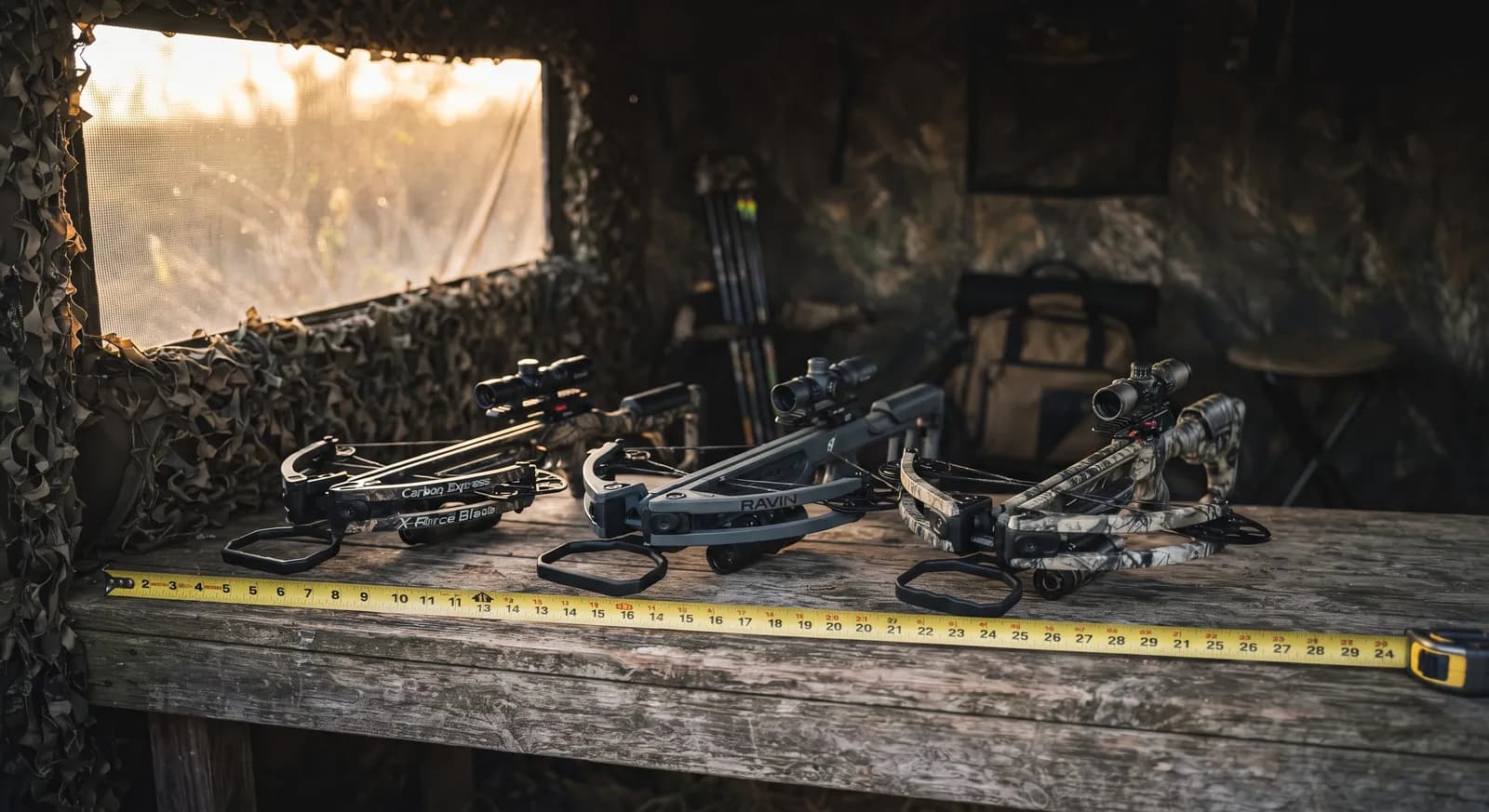
The best compact crossbows guide covers narrow forward-draw options too, if length is not your main constraint.
How I Chose the Best Reverse-Draw Crossbows
I judged each pick on the things a reverse-draw layout is supposed to deliver, and on the costs it adds:
- Overall length and cocked axle-to-axle width. These decide whether the crossbow swings freely in a blind or stand.
- Speed and energy. Measured where I chronographed it, rated where I did not. A reverse-draw crossbow should not give up speed for its size.
- Cocking and de-cocking. Short, fast crossbows often carry 300 lb or higher draw weights, so the cocking system matters more than usual.
- Carry weight and balance. A short crossbow is not always a light one.
- Bolt compatibility. Some reverse-draw models only shoot one bolt length.
Every hands-on pick follows the same chronograph, accuracy and cocking protocol described in our testing methodology.
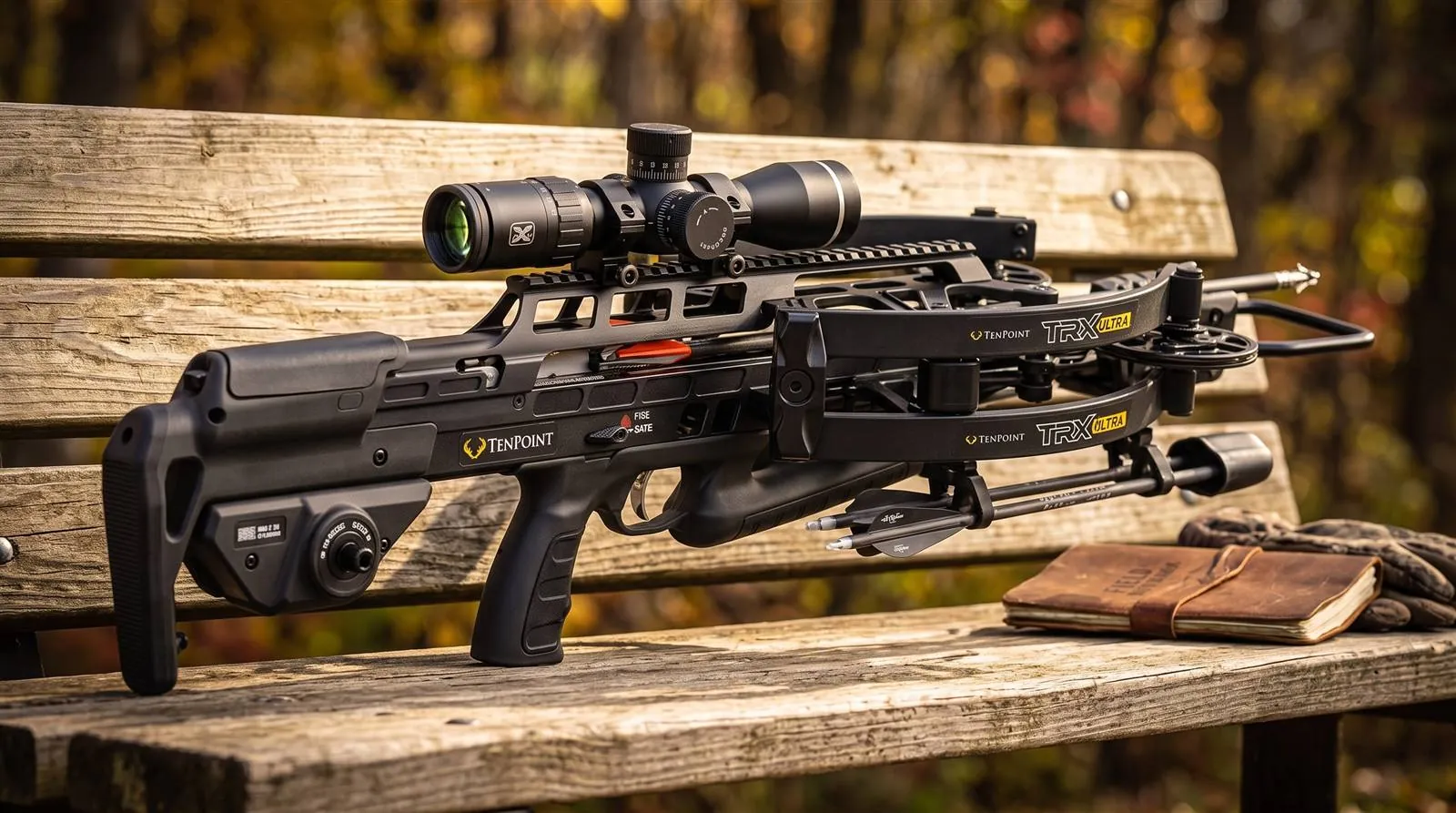
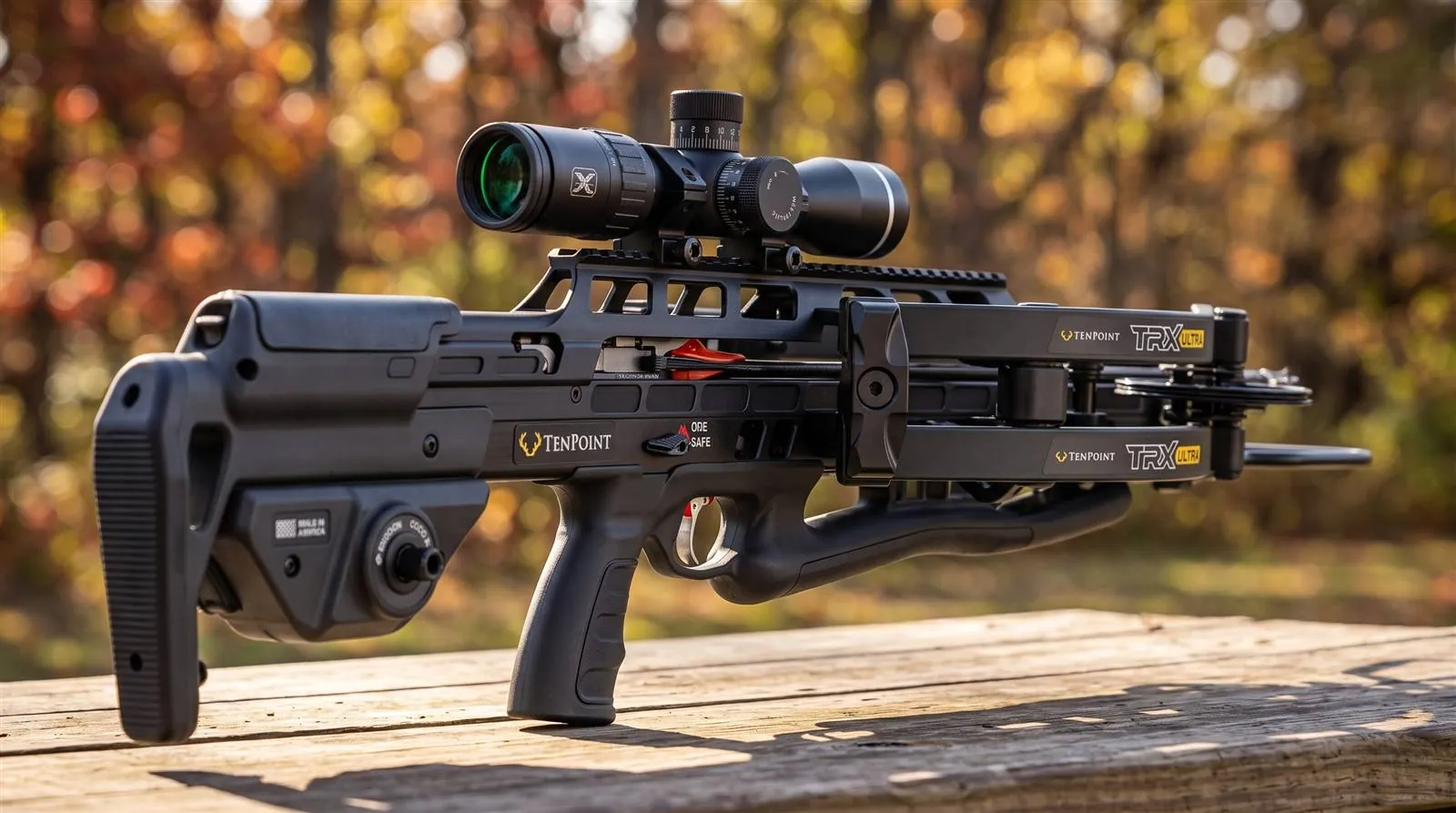
Best Reverse-Draw Crossbow Overall: TenPoint TRX Ultra
The TRX Ultra is the fastest crossbow I have tested. TenPoint rates it at 515 FPS, and my chronograph recorded 511–517 FPS with a 400-grain bolt, so the rating is honest. Its reverse-draw Twin-Riser layout produces a 16.25-inch power stroke with a 6-inch cocked width, and it shot the tightest 100-yard groups I have recorded on any crossbow.
The ACUslide MAXX system cocks and de-cocks the 360 lb draw weight with little effort, and the TriggerTech trigger breaks at about 3.5 lbs. The warranty covers limbs and cams for 5 years and the trigger mechanism for life.
The trade-offs are price and weight. At $3,495–$3,515 it costs more than three times the Phantom De-Cock, and at 8.4 lbs it is the heaviest pick here. If you rarely shoot past 50–60 yards, most of what you pay for goes unused.
- Chronograph testing measured 511–517 FPS across five shot strings with a 400-grain bolt, confirming TenPoint's 515 FPS factory claim within margin of error
- The reverse-draw Twin-Riser Technology platform produced the tightest 100-yard groups I've measured on any crossbow to date — TenPoint claims roughly 70% tighter groups than a comparable forward-draw flagship, and my side-by-side testing came close to that figure
- The 8mm Zero-Torsion axles held cam timing perfectly through 60+ test shots with zero measurable drift, something I couldn't say for several competitors at this price point
- At $3,495–$3,515, this is the most expensive crossbow I've ever tested, putting it firmly out of reach for the vast majority of hunters
- 360 lbs of draw weight is not hand-cocking territory under any circumstances — you are entirely dependent on the ACUslide MAXX system working correctly
- Replacement strings, cables, and the proprietary Twin-Riser limb assembly are TenPoint-specific parts, so field repairs away from a dealer are effectively impossible
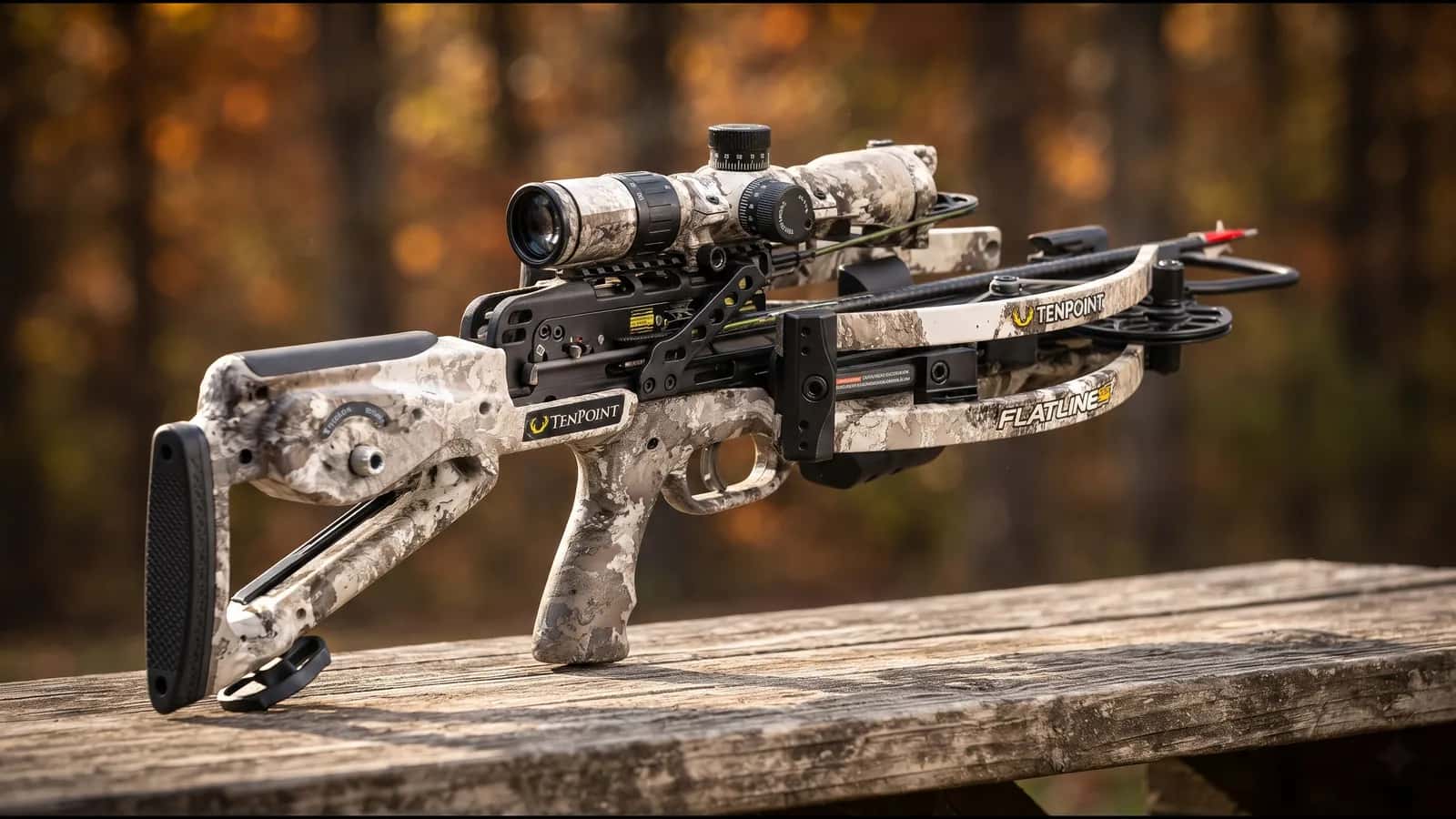
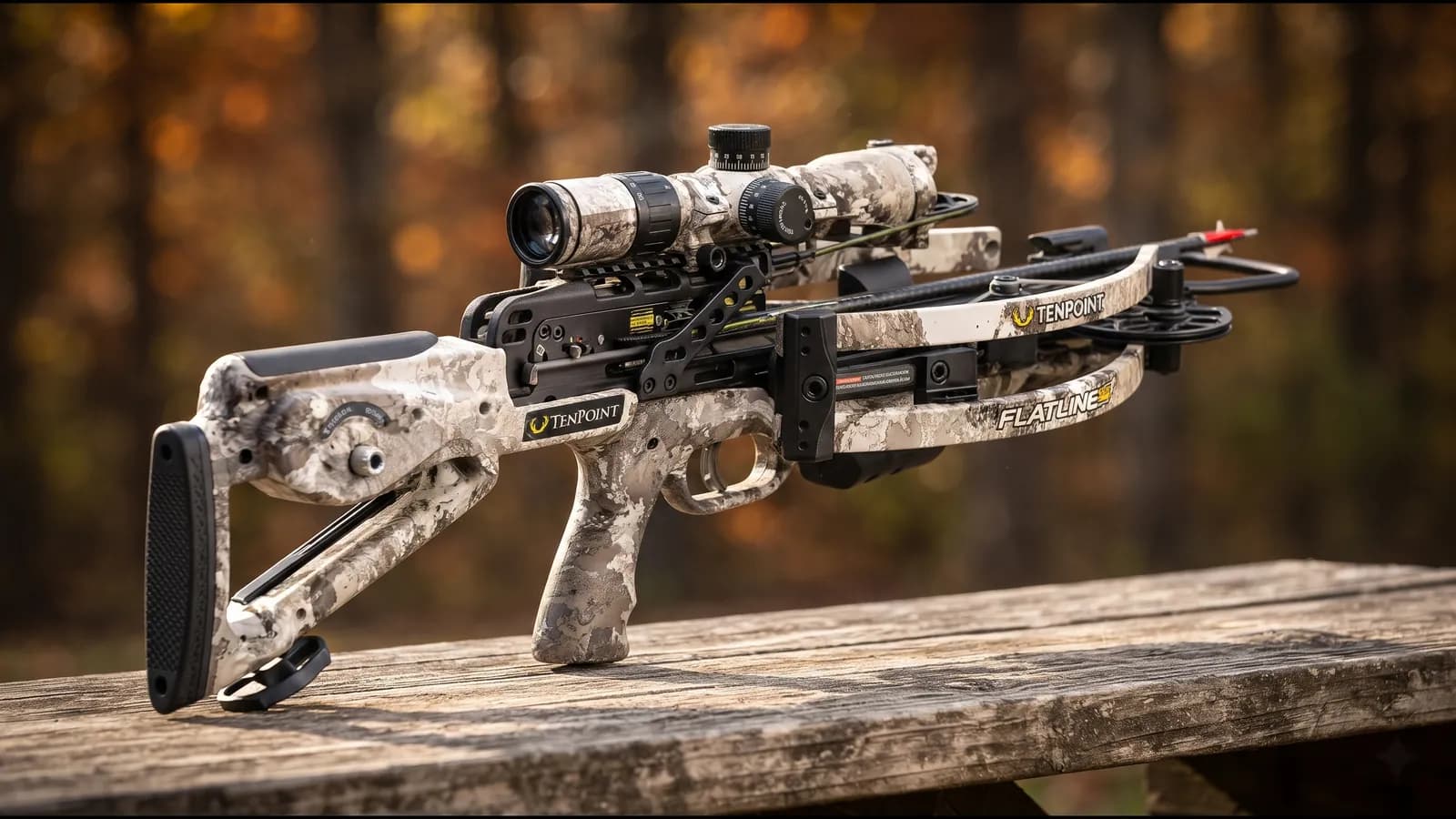
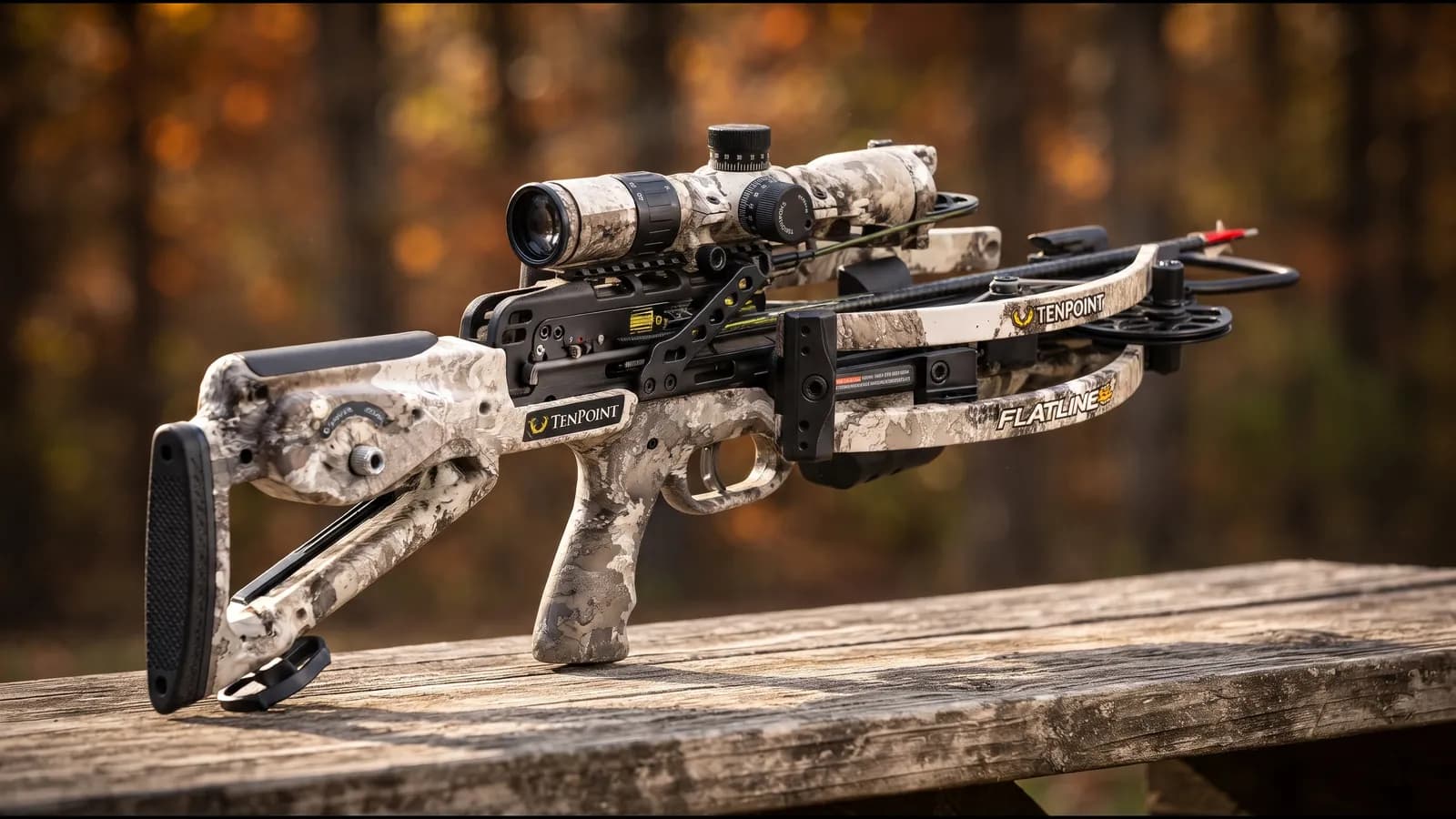
Best for Blinds and Stands: TenPoint Flatline 460
At 26.5 inches long and 7.5 inches wide cocked, the Flatline 460 is the shortest crossbow in this guide. TenPoint rates it at 460 FPS and 193 ft-lbs from a 13.5-inch power stroke and 300 lb draw weight. In my blind and ladder-stand handling drills, it swung through tight spaces without the limbs catching.
The ACUslide crank cocks and de-cocks the 300 lb draw with little effort, and the S1 two-stage trigger breaks cleanly at 3.5 lbs. An integrated string stop helps calm the shot.
The one real catch is that it shoots TenPoint's 16-inch EVO-X CenterPunch16 bolts only, so standard 20- or 22-inch bolts will not work. Six are included, but every replacement has to be the same type.
- Rated at 460 FPS and 193 ft-lbs with the included 410-grain bolt, from a crossbow only 26.5 inches long
- The 7.5-inch cocked width swung between blind windows in my handling drills without catching a limb on the fabric
- ACUslide cocks and de-cocks the 300-lb draw without a discharge target, and holds the handle if your hand slips
- At $2,099–$2,299 it is a premium purchase, priced well above mid-tier crossbows like the Titan X De-Cock
- The 16-inch bolt system ties you closely to TenPoint's own arrows; standard 20- and 22-inch bolts will not carry over
- At 7.5 lbs before scope, quiver and bolts, it is not a light crossbow for long walks
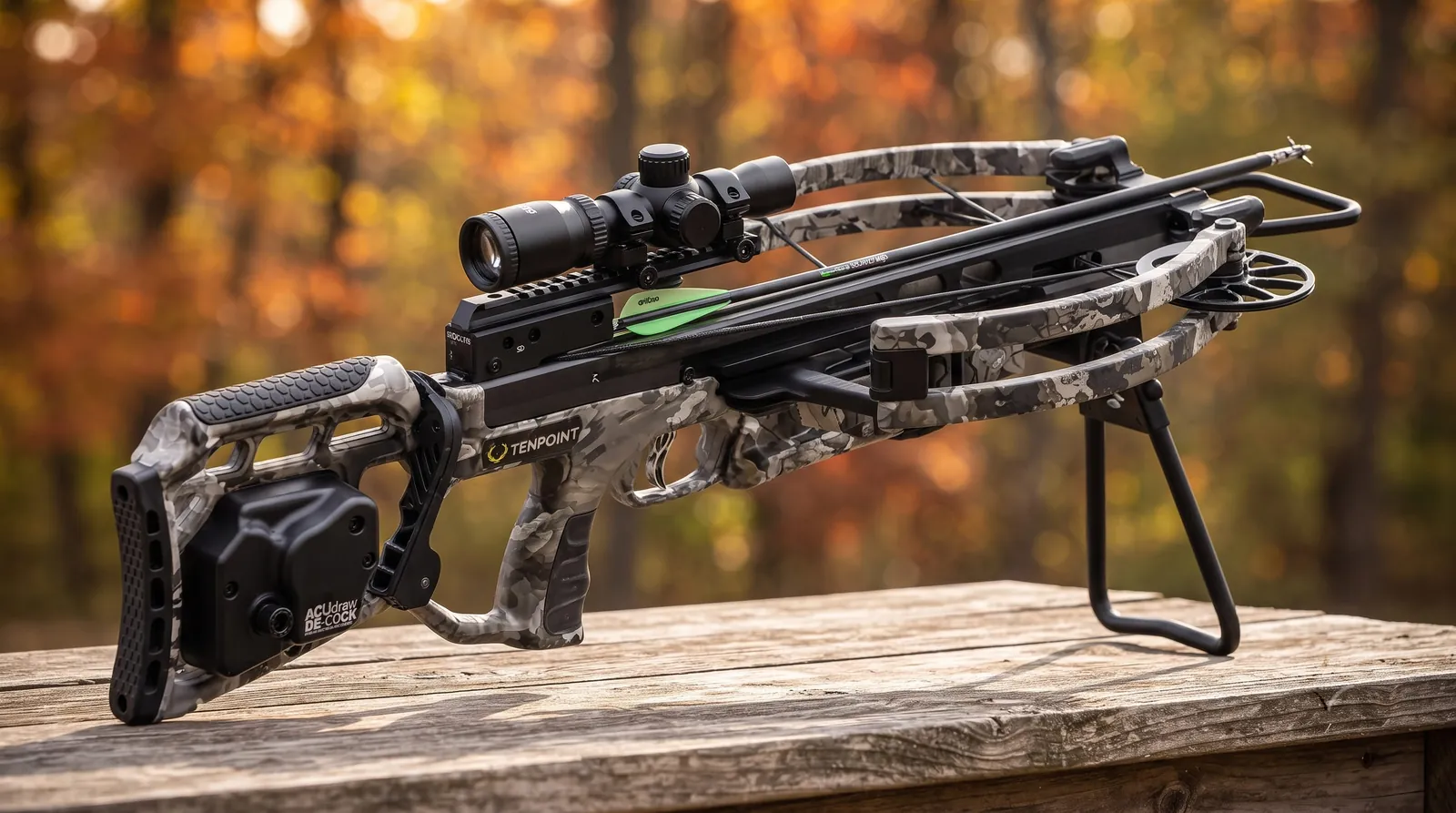
Best Value Reverse-Draw: TenPoint Phantom De-Cock
The Phantom De-Cock brings TenPoint's reverse-draw layout to $999–$1,099. It is 28.5 inches long, 8.4 inches wide cocked and 7.4 lbs, which TenPoint describes as its lightest reverse-draw model. It is the lightest pick here.
TenPoint rates it at 400 FPS and 146 ft-lbs with the included 410-grain Pro Elite 400 arrow. Published chronograph tests averaged about 390 FPS, so expect real-world speed a little under the rating. The ACUdraw De-Cock crank lowers the string without firing a bolt, and the package includes the Pro-View 400 lighted scope.
It is wider and slower than the Flatline 460, and its 220–230 lb draw weight is listed differently by different sellers. For most hunters at normal distances, though, it delivers most of the reverse-draw advantage for about half the Flatline's price.
- At 7.4 lbs and 28.5 inches overall, TenPoint describes it as its lightest reverse draw crossbow, and the short length suits blinds and tight spaces
- The ACUdraw De-Cock system provides a controlled way to lower the string without firing a bolt into a target
- TenPoint rates it at 400 FPS and 146 ft-lbs of kinetic energy with the included Pro Elite 400 carbon arrow (410 grains)
- At $999–$1,099, it sits well above entry-level packages such as the Barnett Hyper Whitetail 410
- Published chronograph tests put it at an average of about 390 FPS, slightly under the 400 FPS rating, so expect real-world speed to land a little below the headline figure
- The 400 FPS rating applies to a 410-grain arrow; TenPoint lists 380 FPS with the heavier 445-grain CenterPunch HPX
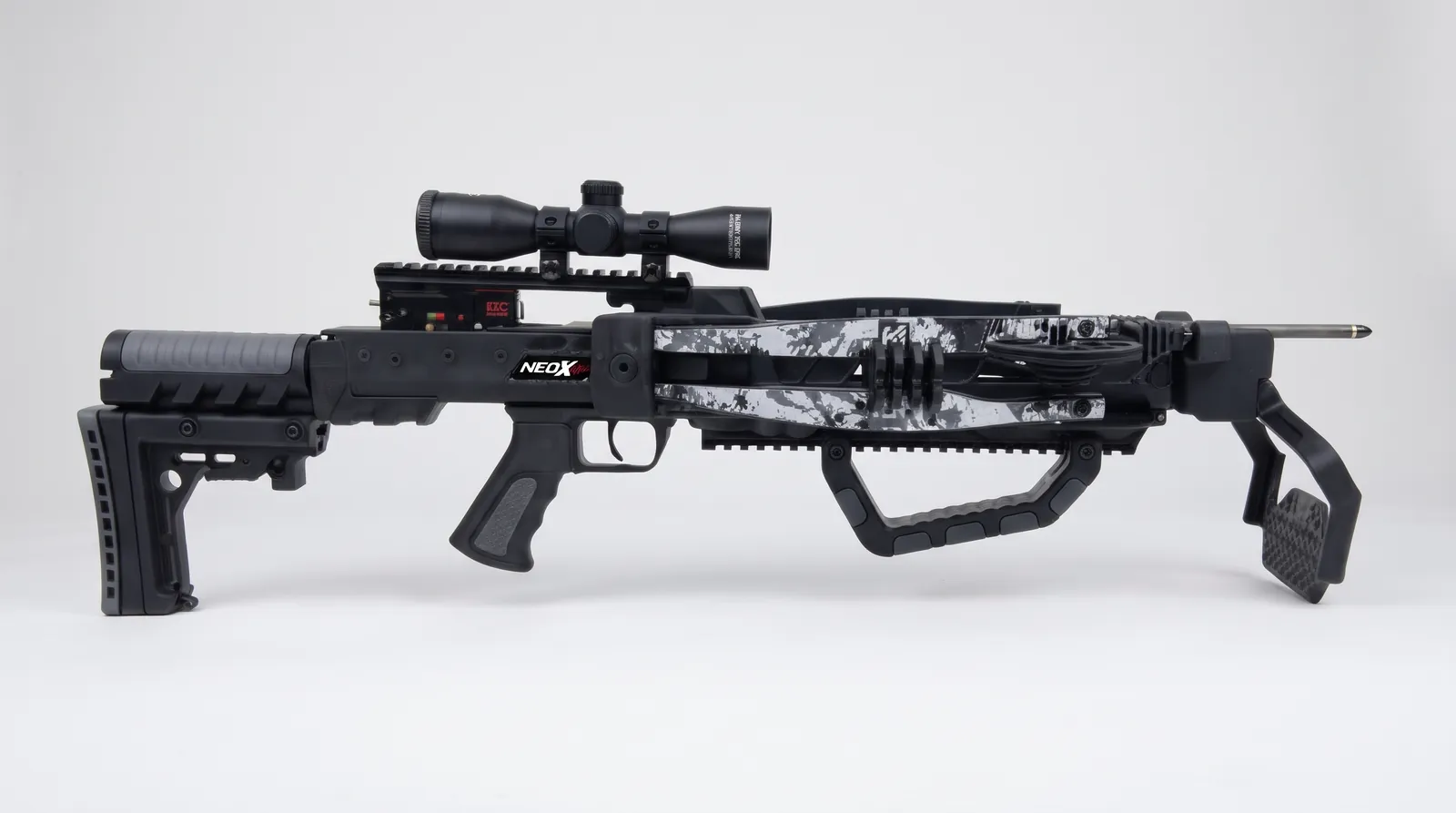
Best Reverse-Draw Crossbow Under $700: Killer Instinct NEO-X
The NEO-X is the only reverse-limb crossbow I have reviewed under $1,000. At $649–$699 it is 28 inches long and 6.75 inches wide cocked, rated at 415 FPS from a 15-inch power stroke and 195 lb draw weight. Its DC Triggerbox lets you de-cock by hand without firing a bolt or adding a crank.
This pick comes from a specification-based review, not my own range testing, so its speed and accuracy are listed figures rather than measurements. The listed 141.53 ft-lbs fits a lighter bolt than the 390-grain bolts in the package, so expect slightly less speed with them.
The compromises are an 8.2 lb weight and rope-only cocking: there is no crank in the box. Hand de-cocking also asks for a careful routine every time.
- Rated at 415 FPS from a 15-inch power stroke and 195 lb draw weight, figures that match mid-priced compounds
- DC Triggerbox lets you de-cock by hand without firing a bolt or adding a crank
- 6.75-inch cocked axle-to-axle width and a 28-inch overall length make it one of the most compact crossbows on this site
- 8.2 lbs is heavy for a crossbow this short, and the weight sits in a compact frame
- Only a sled rope cocker is included; there is no crank in the box
- Only two bolts in the standard package against a three-arrow quiver
Compare All Four Reverse-Draw Crossbows
The first table covers speed, draw weight, weight, price and rating, with a link to each review.
Swipe sideways to compare →
| Product | Speed | Draw | Weight | Price | Rating | Buy |
|---|---|---|---|---|---|---|
| TenPoint TRX Ultra | 515 FPS | 360 lbs | 8.4 lbs | $3,495–$3,515 | 4.9 / 5 | Check price on Amazon |
| TenPoint Flatline 460 | 460 FPS | 300 lbs | 7.5 lbs | $2,099–$2,299 | 4.6 / 5 | Check price on Amazon |
| TenPoint Phantom | 400 FPS | — | 7.4 lbs | $999–$1,099 | 4.5 / 5 | Check price on Amazon |
| Killer Instinct NEO-X | 415 FPS | 195 lbs | 8.2 lbs | $649–$699 | 4.1 / 5 | Check price on Amazon |
The second compares the features that set reverse-draw crossbows apart.
| Crossbow | Cocked width | Power stroke | Cocking and de-cocking | Bolts |
|---|---|---|---|---|
| TenPoint TRX Ultra | 6" | 16.25" | ACUslide MAXX crank | Package arrows |
| TenPoint Flatline 460 | 7.5" | 13.5" | ACUslide crank | 16" only |
| TenPoint Phantom De-Cock | 8.4" | 16" | ACUdraw De-Cock crank | 410-grain arrows |
| Killer Instinct NEO-X | 6.75" | 15" | Rope cocker, hand de-cock | 20" bolts |
The TRX Ultra is the only pick with measured speed (511–517 FPS). The others show listed ratings, and published tests put the Phantom De-Cock at about 390 FPS.
Which Reverse-Draw Crossbow Should You Buy?
- You shoot long range and want the most accuracy money can buy: the TenPoint TRX Ultra.
- You hunt tight blinds or stands and want the shortest frame with a crank: the TenPoint Flatline 460.
- You want reverse-draw handling and crank de-cocking for about $1,000: the TenPoint Phantom De-Cock.
- Your budget stops at $700: the Killer Instinct NEO-X, if you accept rope cocking and a spec-based review.
Who should skip each pick
| Pick | Skip it if |
|---|---|
| TenPoint TRX Ultra | You rarely shoot past 60 yards, or $3,500 is more than you want to spend |
| TenPoint Flatline 460 | You want standard 20- or 22-inch bolts, or your budget is under $1,000 |
| TenPoint Phantom De-Cock | You want measured speed at or above 400 FPS |
| Killer Instinct NEO-X | You want a crank, a lighter carry or hands-on test data before you buy |
Reverse-Draw Crossbow Pros and Cons
The advantages
- More power stroke per inch. The four picks run 13.5 to 16.25 inches of power stroke in frames of 26.5 to 28.5 inches.
- Better balance. With the limbs set back, the balance point sits nearer the grip, which helps when you hold the crossbow at the ready.
- Narrow cocked widths. Three of the four are 7.5 inches or narrower cocked, which helps the limbs clear blind windows and tree trunks.
The drawbacks
- Price. The only reverse-draw crossbow I have reviewed under $1,000 is the NEO-X; TenPoint's start at about $1,000.
- Weight does not drop with length. Short frames need strong risers and heavy limbs, so three picks weigh 7.5 lbs or more.
- Bolt limits. The Flatline 460 shoots 16-inch bolts only. Check the manual for the length and minimum weight before buying spares.
- High draw weights. The TenPoint picks run 220 to 360 lbs, so you rely on the built-in crank. Learn the system before the season.
What About Ravin Crossbows?
Ravin crossbows are often cross-shopped with reverse-draw models because they are just as narrow, but they are not reverse-draw. They are forward-draw crossbows that use HeliCoil cams to keep very short limbs narrow when cocked. If width and speed matter more to you than the limb layout, these three are worth comparing with the picks above.
| Crossbow | Overall length | Cocked width | Measured speed | Weight | Price | My rating | Buy |
|---|---|---|---|---|---|---|---|
| Ravin R26X | 26" | 5.75" | 395–403 FPS | 6.5 lbs | $1,999–$2,199 | 4.7 | Check price on Amazon |
| Ravin R29X | 29" | 6" | 444–454 FPS | 6.75 lbs | $2,499–$2,999 | 4.8 | Check price on Amazon |
| Ravin R470 Stealth Gray | 33.6" | 6" | 463–472 FPS | 6.9 lbs | $2,450–$2,550 | 4.7 | Check price on Amazon |
Ravin R26X: shorter and lighter than any pick here
At 26 inches long, 5.75 inches cocked and 6.5 lbs, the R26X is shorter, narrower and lighter than every reverse-draw crossbow in this guide. Its integrated Silent Cocking system brings felt effort down to about 12 lbs. The cost is energy: a 9.5-inch power stroke limits it to about 142 ft-lbs, well below the Flatline 460's rated 193 ft-lbs.
Ravin R29X: the closest rival to the Flatline 460
The R29X measured 444–454 FPS with about 180 ft-lbs and held 60-yard groups inside 2 inches. It is 2.5 inches longer than the Flatline 460 but narrower when cocked and 0.75 lbs lighter, so it suits hunters who want more width clearance than length savings.
Ravin R470 Stealth Gray: speed in a narrow but full-length frame
The R470 measured 463–472 FPS and cocks to 6 inches wide, but at 33.6 inches overall it is a full-length crossbow. Choose it for speed and width at a lower price than the TRX Ultra, not for a short frame.
Ravin crossbows use Ravin's own bolts and nocks, and repairs go through Ravin dealer service, so factor those costs in as you would the Flatline 460's 16-inch bolts. For a brand-level comparison, read Ravin vs TenPoint.
Reverse-Draw vs Forward-Draw: Which Should You Choose?
The layout decision comes down to where you hunt and what you are willing to pay. Use these rules to decide before comparing individual models, or read the full forward-draw vs reverse-draw crossbow comparison.
Choose a compact reverse-draw crossbow if length is the constraint
If you hunt from a small pop-up blind, a saddle or a cramped tree stand, overall length decides whether you can swing onto a deer that appears off to one side. A compact reverse-draw crossbow is the only realistic way to get under about 29 inches without dropping to a slow, short power stroke. The Flatline 460 at 26.5 inches and the NEO-X at 28 inches are the shortest options in this guide.
Choose a forward-draw crossbow if only width matters
If your limbs clip the window frame but the stock has plenty of room, a narrow forward-draw crossbow solves the problem for less. The Killer Instinct Logix 435 cocks to the same 6.75 inches as the NEO-X, but at 33.75 inches long it is a full-length crossbow. It is cheaper and shoots standard bolts, but it will not fit a tight swing arc.
Weigh the running costs
A reverse-draw crossbow that takes proprietary bolts costs more every time you replace one, and a built-in crank is one more system to keep clean. Forward-draw crossbows are usually simpler to service. If you shoot a lot of practice bolts, price a dozen spares for each model on your shortlist.
A quick test before you buy
Sit in your blind or stand with a tape measure and check the arc you can swing through while seated. If a 33-inch crossbow clears it, you do not need to pay the reverse-draw premium for length alone.
Common Mistakes When Buying a Reverse-Draw Crossbow
- Buying for length when width is the real problem. If your limbs only clip the blind window, a narrow forward-draw crossbow can solve it for less. Measure the space you hunt in first.
- Ignoring the bolt requirement. A reverse-draw crossbow that shoots one proprietary bolt length changes your running costs. Price a dozen spares before you buy.
- Assuming short means light. The TRX Ultra is 8.4 lbs and the NEO-X 8.2 lbs. If you walk far to your stand, weight may matter more than length.
- Skipping de-cocking practice. Crank de-cocking is simple, but hand de-cocking with a trigger system like the NEO-X's DC Triggerbox needs a firm grip and a set routine. Practise with an unloaded crossbow, and read how to de-cock a crossbow safely.
- Paying for speed you will not use. Inside 40 yards, the difference between 400 and 515 FPS matters far less than practice. The kinetic energy calculator shows what you actually gain at your bolt weight.
Reverse-Draw Crossbow Care
A reverse-draw crossbow needs the same basic care as any compound, with a little extra attention to the cocking system:
- Keep the rail and the crank track clean and lubricated as the manual directs. How to maintain a crossbow covers the routine.
- Inspect the string and cables before each session. On a short frame the string angle is sharper at full draw, so wear shows sooner near the cams.
- Store it uncocked. Use the crank or de-cock system rather than firing into a target at the end of a session.
- Shoot only bolts that meet the manual's length and minimum weight, because a bolt that is too light can damage the crossbow.
Frequently Asked Questions
What is the best reverse-draw crossbow?
The TenPoint TRX Ultra, if budget is not a constraint. It measured 511–517 FPS on my chronograph, shot the tightest 100-yard groups I have recorded and cocks to 6 inches wide, but it costs $3,495–$3,515.
Are reverse-draw crossbows better than forward-draw crossbows?
They are better at fitting a long power stroke into a short, balanced frame, which suits blinds and stands. Forward-draw crossbows are usually cheaper and take standard bolts, so neither layout is better for every hunter.
Are reverse-draw crossbows more accurate?
The layout helps balance, and the TRX Ultra shot the tightest long-range groups I have measured. At normal hunting distances, though, trigger quality, bolt consistency and practice decide accuracy more than the limb layout does.
Are reverse-draw crossbows harder to cock?
They often carry high draw weights, from 195 lbs on the NEO-X to 360 lbs on the TRX Ultra. The TenPoint picks include a crank that makes cocking easy, while the NEO-X relies on a rope cocker.
What is the cheapest reverse-draw crossbow you reviewed?
The Killer Instinct NEO-X at $649–$699. It is 28 inches long and 6.75 inches cocked with a hand de-cock trigger, but its review is based on listed specifications rather than my own testing.
Do reverse-draw crossbows need special bolts?
Some do. The Flatline 460 shoots 16-inch CenterPunch16 bolts only, while the other picks ship with standard-length arrows. Always check the manual's bolt length and minimum weight before you buy spares.
Why are reverse-draw crossbows more expensive?
Packing a long power stroke into a short, narrow frame takes stronger risers, more complex cams and usually a built-in crank. Those parts cost more to make, which is why most models in this guide start near $1,000.
Is a reverse-draw crossbow good for beginners?
It can be, if the cocking system is easy. The Phantom De-Cock's crank makes it a reasonable first reverse-draw crossbow, but beginners on a budget may get more from the options in best crossbows for beginners.
Are Ravin crossbows reverse-draw?
No. Ravin crossbows are forward-draw designs that use HeliCoil cams to keep very short limbs narrow, which is why the R26X cocks to 5.75 inches wide. They compete with reverse-draw models on width and handling, but the limb layout is different.
Final Recommendation
If you can justify it, the TenPoint TRX Ultra is the best reverse-draw crossbow I have tested, with measured speed and long-range accuracy no other pick matches. For most blind and stand hunters, the Flatline 460 is the better buy: shorter, lighter and easy to cock, as long as you accept 16-inch bolts. The Phantom De-Cock delivers the reverse-draw layout and crank de-cocking for about $1,000, and the Killer Instinct NEO-X is the option under $700.
For every size and budget, see our best crossbows guide, or browse all compound crossbows.
Read nextMatch the crossbow to the shooterReverse-draw crossbows often carry very high draw weights. See how draw weight and cocking aids fit different shooters.More in Best Crossbows
Best Compact Crossbows 2026, Tested
The narrowest crossbows we have tested, ranked by cocked width, weight and speed, from the Ravin R26X to budget narrow options for blinds and treestands.
Read guide
Best Crossbows for Deer Hunting 2026
Deer hunting crossbows ranked on accuracy at real hunting ranges, kinetic energy, noise and de-cocking, with a budget pick and a compact ground-blind pick.
Read guide
Best Crossbows for Beginners 2026
Beginner crossbows chosen for easy cocking, safety features and complete kits, from a $219 recurve to an integrated-crank compound.
Read guide