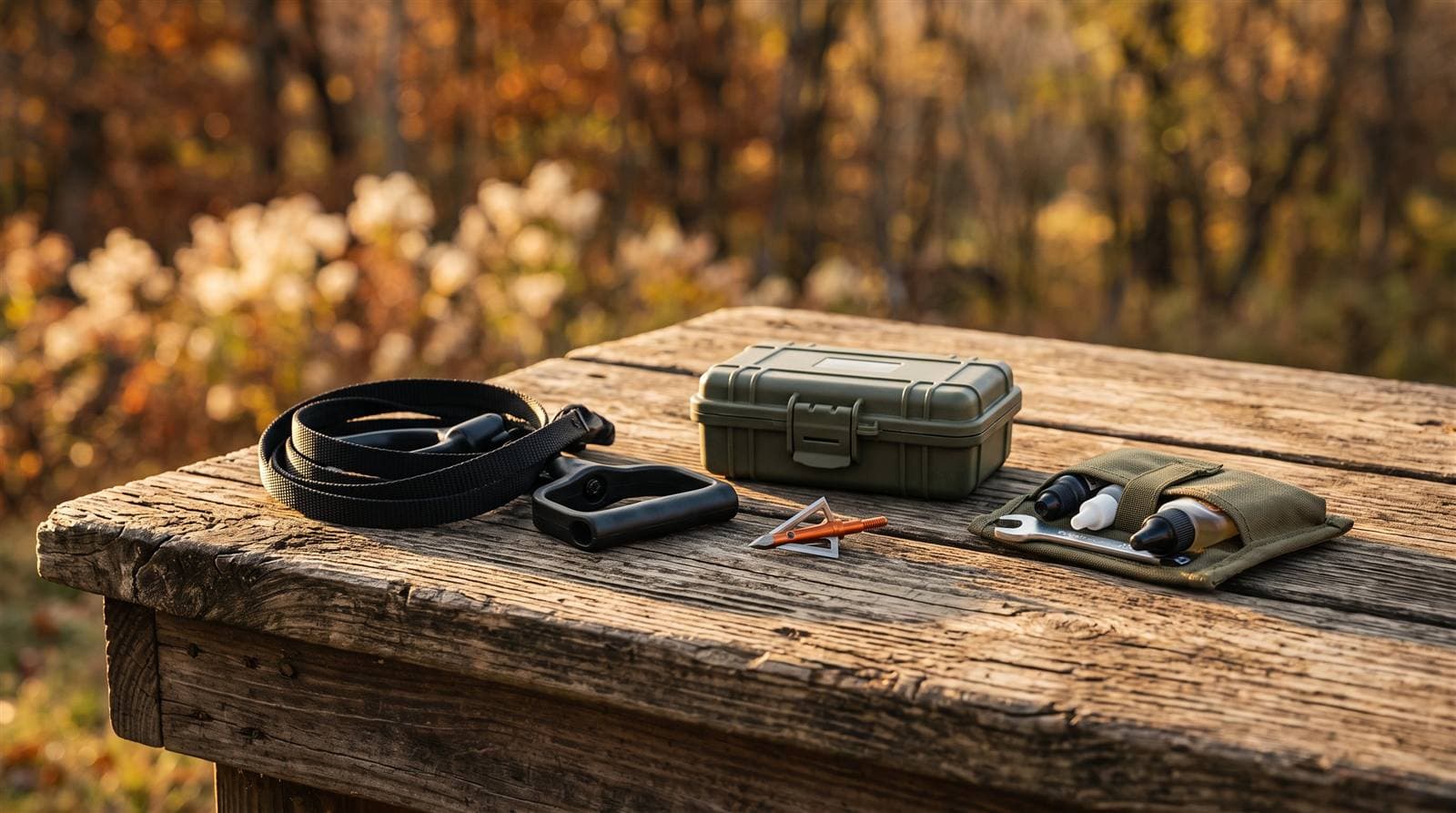
What Is De-Cocking?
Safely releasing a crossbow stored energy without a normal shot, using the method the manufacturer approves.
De-Cocking: definition
Also called: de-cock, uncocking a crossbow, unloading a crossbow, de-cocking system, de-cock mechanism
De-cocking means taking a cocked crossbow back to its resting state without firing a bolt at a target. A cocked crossbow holds its full draw weight for as long as it stays cocked, with or without a bolt and with or without the safety on. Most outings end with at least one cocked crossbow and no shot, so a safe way out is part of owning one.
There are two approved routes. The first is an integrated De-Cock mechanism, where the cocking aid runs in reverse and lowers the string under control. The second is a discharge procedure your manufacturer specifically allows, usually a properly seated bolt fired into a target designed to stop it. If your manual does not describe a method, do not improvise.
De-cocking is not the same as dry firing. Releasing the string with no bolt is the damaging event described under dry fire. The full procedure sits in our guide on how to de-cock a crossbow safely, which defers to your manual throughout.
Approved routes versus unsafe ones
| Route | What happens | Status |
|---|---|---|
| Integrated De-Cock system | Mechanism lowers the string under control, no bolt leaves | Preferred where fitted; follow the model sequence |
| Discharge into a rated target | Seated bolt fired into a target built to stop it, with a safe backstop | Only where the manual allows it |
| Release with no bolt | Dry fire; energy goes into the crossbow | Not acceptable |
| Shooting into the ground or an unrated backstop | Uncertain stopping and ricochet or pass-through risk | Not acceptable |
| Improvised method | Anything the manufacturer does not describe | Not acceptable |
Why De-Cocking matters
A cocked crossbow is a stored-energy device and should be handled like a loaded firearm. Decide your unloading method before you cock, not after the light fades.
The method you choose also shapes equipment choice. An integrated system means no backstop, no bolt spent and no walk to retrieve it, which is a fair reason to weigh De-Cock features when buying.
Done wrongly, it injures people or damages the limbs and string. Done by the manual, it is routine.
How to read it on a spec sheet
- Look for the words De-Cock, de-cocking system or ACUdraw De-Cock in the product name or feature list, and confirm it in the manual.
- Read the manual section on unloading before you buy or first cock the crossbow.
- Note whether a rated target or special bolt is required for a discharge method.
- Check whether a hand-cocking backup exists. Some very heavy crossbows depend on the mechanism alone.
Common mistakes
- Releasing the string with no bolt, or letting the string go by hand.
- Shooting into the ground or an unrated backstop to empty the crossbow.
- Using a hunting broadhead for the discharge instead of a bolt reserved for the job.
- Skipping the manual and assuming the sequence matches another model.
- Leaving a crossbow cocked overnight or in a vehicle.
Before you cock: a de-cocking plan
- Find the unloading section of your manual and read it through.
- Confirm whether your crossbow has an integrated De-Cock system.
- If you rely on discharge, confirm the manual allows it and carry a target rated for your crossbow and a bolt reserved for the job.
- Confirm you can see a safe backstop and that no one is in the line of fire.
- Follow the manual sequence exactly, without hurrying.
- Confirm the string is fully at rest and the safety is on before storing the crossbow.
In my testing
In the Titan X De-Cock review I logged more than 40 full cock and de-cock sequences with no failed or inconsistent cycle. The Titan X De-Cock needed roughly 5 lbs of felt effort at 190 lbs of draw weight. My notes cover that integrated system only, and your own crossbow may differ, so follow your manual. How I test.
See it in our reviews
- TenPoint Titan X De-Cock — rated 4.5/5
- Wicked Ridge Invader M1 — rated 4.4/5
- TenPoint Phantom De-Cock — rated 4.5/5
Frequently Asked Questions
What does de-cocking a crossbow mean?
It means taking a cocked crossbow back to its resting state without a normal shot at a target. It is done with a built-in De-Cock system or a discharge procedure your manufacturer specifically approves.
How do I de-cock a crossbow safely?
Follow the method in your manual: an integrated De-Cock sequence, or an approved discharge into a rated target. If your manual describes neither, contact the manufacturer or a dealer. Our full guide covers both routes.
Can I just pull the trigger without a bolt?
No. That is a dry fire, and it can crack limbs, break the string and throw parts. A bolt must be seated, and any discharge must follow the manufacturer approved method.
Is it safe to leave a crossbow cocked?
Not as a habit. A cocked crossbow stores full energy all the time and stresses the string and limbs. Plan your unloading before you cock, and treat a cocked crossbow like a loaded firearm.
Do all crossbows have a De-Cock system?
No. It is a feature on specific models, such as the TenPoint Titan X De-Cock and the Wicked Ridge Invader M1 De-Cock. Check the manual for your model rather than assuming one exists.
Why not shoot into the ground to unload?
The stopping distance and what lies beneath are uncertain, and a bolt can bounce, break or pass through. If the manual allows discharge, use a target made to stop that bolt with a clear backstop.
What bolt should I use for a discharge?
Use a bolt your manual allows, kept for the purpose, and avoid a hunting broadhead. Many owners keep one field-point style bolt for this job. See our guide on how to choose crossbow bolts for shaft basics.
When should a de-cock system be serviced?
If it behaves oddly, binds, skips or sounds different, stop using it and contact the manufacturer or a qualified technician. Do not carry on with a mechanism you do not trust.
Keep learning
Guides that use this term
- GuideHow to De-Cock a Crossbow SafelyHow to de-cock a crossbow safely: integrated De-Cock systems, manual-approved discharge into a rated target, and the mistakes that cause injury.Read the guide
- GuideCrossbow Safety Rules for BeginnersCrossbow safety rules for beginners: finger placement, never dry-firing, safe cocking and de-cocking, range etiquette and storage habits that prevent injury.Read the guide
- GuideHow to Cock a Crossbow: Rope vs CrankHow to cock a crossbow step by step with a rope or crank, why hand cocking rarely works, and the mistakes that cause uneven strings and injuries.Read the guide
Related terms
- Cocking AidA rope or crank device that reduces the effort needed to draw the string and helps it seat evenly in the latch.
- Crank Cocking DeviceA geared, hand-turned mechanism that winds the string back to the latch with low, steady effort, built in or detachable.
- Dry FireReleasing the string with no bolt on it, which sends the stored energy into the crossbow itself and can cause serious damage.
- Draw WeightThe peak force, in pounds, needed to draw the string to the latch, which sets cocking effort and is one input to speed and energy.
- String LatchThe catch in the rail that holds the drawn string at full draw and releases it when the trigger is pulled, and one of the most safety-critical parts.
- Safety SwitchA manual control that blocks the trigger from releasing the string, and which many crossbows engage automatically when cocked.
Browse the gear
Definitions are general information. Manufacturer figures vary, so follow your crossbow's manual and verify local laws with the relevant authority.