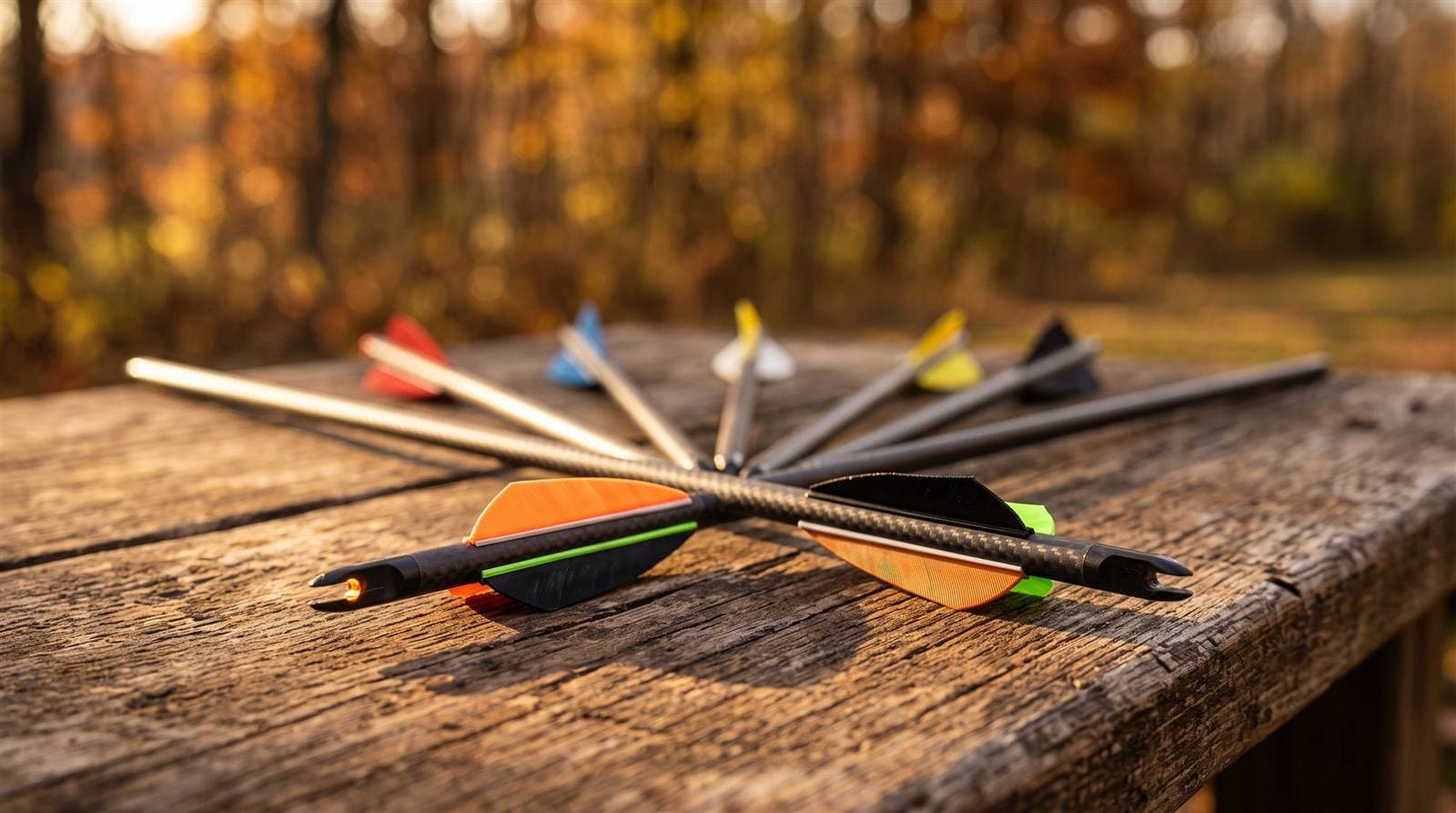
What Is Field Point?
A non-bladed practice tip that threads into a bolt insert and matches broadhead weight for target shooting.
Field Point: definition
Also called: practice tip, target point, practice point, bullet point
A field point is a bladeless, usually bullet-shaped tip that screws into the insert at the front of a bolt. It is made for practice and target shooting, and it is safer to handle and retrieve from a target than a bladed tip. Common weights are 100 and 125 grains, and the REEGOX review lists a removable 125-grain target point.
The point of a field point is predictability. It lets you check your scope zero and your form without risking a bladed head, and it gives you a baseline to compare with a broadhead. If you plan to hunt, the field point should match the broadhead in weight so that the two are as close as possible in flight.
Field points also vary in construction. Some are one-piece steel, some are aluminum and some are removable tips that thread into a collar. All of them still depend on a straight thread and a tight fit in the insert.
Matching tip weights
Weight change = new tip grains − old tip grains
Swapping a 100-grain field point for a 125-grain tip adds 25 grains, so a 400-grain bolt becomes 425 grains. Heavier bolts are slower, so check your zero and your crossbow minimum and maximum weights.
Field point versus broadhead for practice
| Factor | Field point | Broadhead |
|---|---|---|
| Purpose | Practice and zeroing | Hunting use where legal |
| Handling | No blades to manage | Blades require careful handling and retrieval |
| Cost | Low per tip | Higher; the Nemesis is $49–$79 for three |
| Flight | Baseline reference | Must be checked against the field point |
| Wear | Dulls slowly | Blades and locks need inspection |
Why Field Point matters
Practice with a tip that behaves like the one you will hunt with. Mismatched weights move your point of impact, and you may learn that only in the field. Matching the weight of a field point to a broadhead is the simplest way to keep your zero.
Field points also protect your equipment and your targets. Bladed tips damage targets quickly and are harder to pull out safely, so a practice tip saves money and reduces risk when you shoot many bolts in a session.
How to read it on a spec sheet
- Check the weight in grains and compare it with the broadhead you plan to use.
- Look at the thread size and make sure it matches your insert.
- Note whether the tip is fixed or removable. Removable tips let you swap heads on the same bolt.
- Check the material. Steel tends to last longer, aluminum is lighter.
- Read the bolt weight as inclusive of the tip it names, for example 400 grains with a 100-grain field tip.
Common mistakes
- Practicing with a field point lighter or heavier than your broadhead and assuming your zero holds.
- Over-tightening a tip until it damages the insert.
- Reusing a tip with bent or damaged threads.
- Shooting into a target not rated for crossbow speed, which can damage both target and bolt.
- Ignoring wear. A burred tip can change flight slightly.
Compare field point and broadhead flight
- Zero your scope with the field point at your shortest chosen distance.
- Shoot a five-bolt group at that distance and record where it lands.
- Swap to your chosen broadhead at the same weight, and shoot another five-bolt group.
- Measure the distance between the centres of the two groups.
- Adjust your sighting or choose a different broadhead if the difference is too large for your purpose.
In my testing
In my broadhead reviews I compare the broadhead's flight with field points from the same crossbow at matched distances. The Nemesis and the R102 both flew like my field points in those tests. How I test.
See it in our reviews
- Reegox Crossbow Bolts — rated 3.9/5
- Ravin R133 Lighted Arrows — rated 4.5/5
- TenPoint Nemesis Broadhead — rated 4.6/5
Frequently Asked Questions
What is a field point on a crossbow bolt?
It is a practice tip without blades that screws into the insert at the front of the bolt. You use it to practice, zero your scope and check your form without the handling risks and cost of a broadhead.
What weight field point should I use?
Match the field point to the weight of the broadhead you plan to use, within the bolt weight limits in your manual. Many tips are 100 or 125 grains, and the R133 is listed with a 100-grain field tip.
Do field points fly like broadheads?
They can, but not always. A mechanical or fixed-blade head may fly slightly differently, so confirm with a group at your distances and adjust if needed. Matching weight makes the two closer.
Can I hunt with field points?
Field points are made for practice, and many jurisdictions have rules about legal hunting tips. Verify with your local wildlife authority and use equipment that your rules and the maker instructions allow.
How tight should a field point be?
Snug by hand is usually enough, then check it stays tight. Over-tightening can damage the insert. Follow the maker instructions for your bolt and tip, and re-check before each session.
How long do field points last?
It depends on materials and what you shoot into. Replace a tip that is bent, burred or has damaged threads, and avoid hard backstops. Check the tip regularly for wear and keep a few spares.
Keep learning
Guides that use this term
- GuideHow to Sight In a Crossbow ScopeSight in a crossbow scope in six numbered steps: safe range setup, bore-sighting, a 20-yard zero, click math, longer-range checks and fixes.Read the guide
- GuideHow to Choose Crossbow BoltsChoose crossbow bolts in six steps: match rated length and minimum weight, then compare FOC, nocks, tips and tolerances using a spec table.Read the guide
- GuideBest Crossbow Bolts of 2026Best crossbow bolts of 2026: six reviewed picks from budget 12-packs to premium weight-matched carbon, plus how to choose weight, length, FOC and nocks.Read the guide
Related terms
- BoltThe projectile a crossbow shoots: a short carbon or aluminum shaft with a nock, vanes and a tip, often called an arrow.
- InsertThe threaded fitting at the front of a bolt shaft that accepts field points and broadheads.
- BroadheadA bladed hunting tip that screws into a bolt insert, built as a fixed-blade or mechanical head and checked against a field point.
- GrainThe unit used to weigh crossbow bolts and tips, where 7,000 grains equal one pound, so a 400-grain bolt weighs about 0.9 ounce.
- Zeroing (Sighting In)Zeroing is adjusting a scope so the bolt lands where the reticle points at a chosen distance, and it is the foundation of every other aiming mark.
- FOC (Front of Center)The percentage of a bolt’s length by which its balance point sits ahead of the geometric midpoint, a measure of front-weighting.
Browse the gear
Definitions are general information. Manufacturer figures vary, so follow your crossbow's manual and verify local laws with the relevant authority.