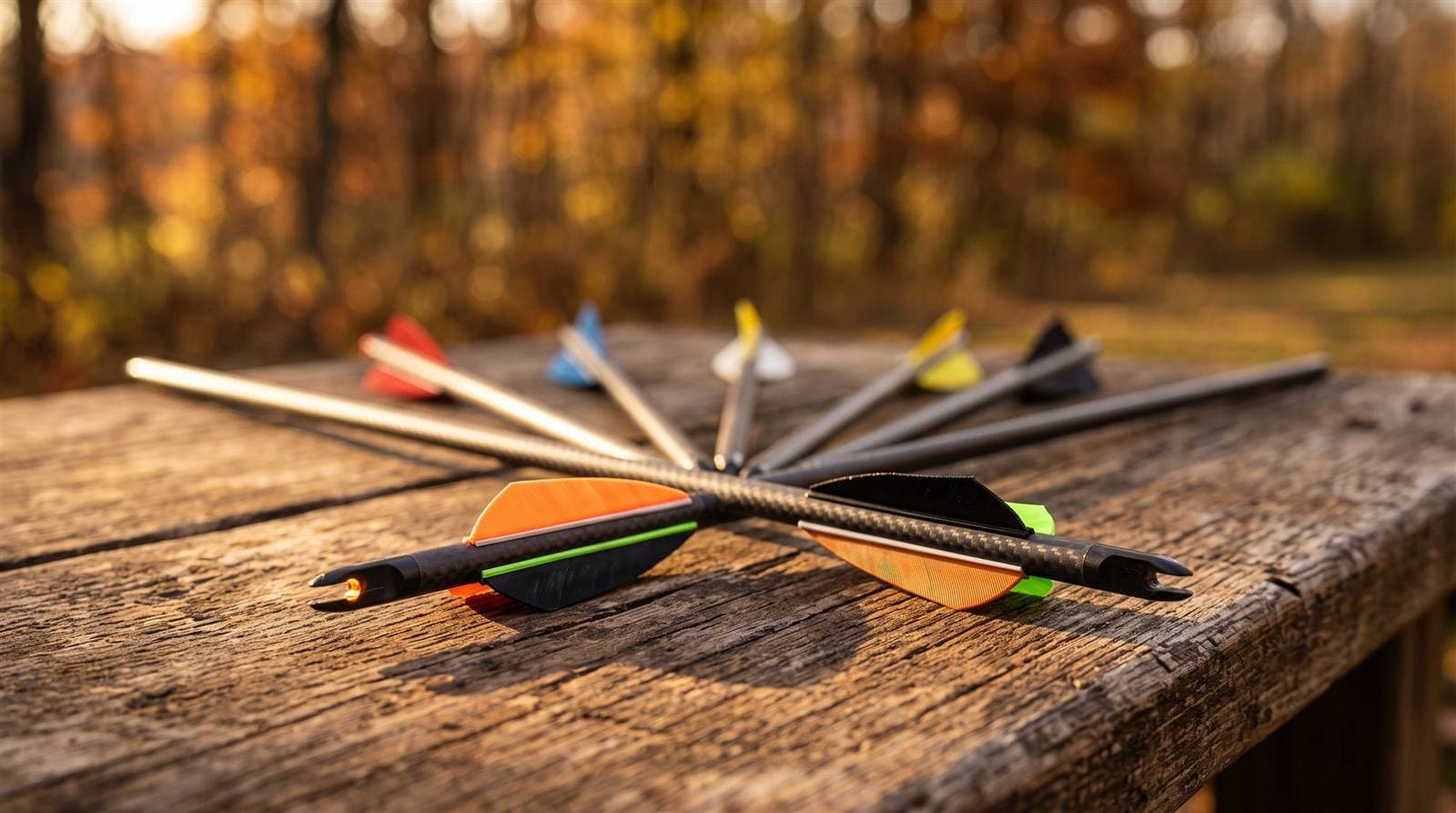
What Is Insert?
The threaded fitting at the front of a bolt shaft that accepts field points and broadheads.
Insert: definition
Also called: bolt insert, point insert, broadhead insert, threaded insert, outsert
An insert is a small threaded fitting glued or pressed into the front of a bolt. It reinforces the shaft end and provides the threads that a field point or broadhead screws into. Most are aluminum, which keeps the weight low and the threads strong.
The thread size is what matters when you shop. Many tips use a common standard thread, and the REEGOX review lists 8-32 UNC for its removable 125-grain target points. If the insert and the tip use different threads, they will not fit and should never be forced.
Inserts also affect weight and balance, because they sit right at the front of the bolt. A heavier insert raises FOC and total weight slightly, so it is worth including in your calculations when you compare bolts.
Insert checks at a glance
| Check | What you want | What to avoid |
|---|---|---|
| Thread | Matches the tip you plan to use | Cross-threading or forcing a tip that does not match |
| Seating | Flush, firmly bonded, no movement | Any rotation, rattle or gap |
| Shaft end | Square and undamaged | Splintering or cracks around the insert |
| Material | Aluminum or manufacturer specified | Mixing parts not listed as compatible |
| Weight | Included in the stated bolt weight | Adding parts that push the bolt over its limit |
Why Insert matters
The insert holds the tip. If it comes loose, the tip can loosen, and a loose tip or insert changes flight and can be unsafe. Bolts in our reviews with aluminum inserts showed no looseness across repeated recoil, but a cracked shaft end or a worn thread is a reason to retire the bolt.
It is also a compatibility gatekeeper. A broadhead that does not suit your insert threads, or one that shifts how the bolt aligns with the shaft, can cause erratic flight. Check the thread type and the maker's compatibility notes before you buy tips.
How to read it on a spec sheet
- Look for the thread size in the listing, such as 8-32 UNC, and match it to the tips you intend to use.
- Check whether the insert is included, glued, or a separate part you must install.
- Note any "outsert" wording. An outsert fits over the shaft end rather than inside it, and it changes the tip it pairs with.
- Read the stated weight as inclusive of the insert, and note the tip it assumes.
- Look for compatibility lines naming broadheads or field points that the maker supports.
Common mistakes
- Forcing a tip into a mismatched thread. This damages the threads and the shaft end.
- Over-tightening a tip. Snug is enough; follow the maker instructions.
- Ignoring a loose insert because the bolt still flies. Retire it.
- Gluing an insert with the wrong adhesive or alignment. Use the maker procedure.
- Mixing insert types in one set and changing balance without noticing.
Check an insert and tip fit
- Hold the bolt and check the insert for any movement or gaps.
- Thread in a tip by hand until it seats, without force.
- Spin the bolt on a flat surface and watch the tip for wobble.
- Look at the shaft end around the insert for hairline cracks.
- Repeat for every bolt in the set and retire any that fail.
In my testing
During the R133 recoil testing I checked the aluminum threaded inserts and nock bushings for looseness or cracking after repeated shots, and in my sample none loosened. How I test.
See it in our reviews
- Ravin R133 Lighted Arrows — rated 4.5/5
- Reegox Crossbow Bolts — rated 3.9/5
Frequently Asked Questions
What is an insert on a crossbow bolt?
It is a threaded fitting set into the front of the shaft. It reinforces the shaft end and gives you threads for a field point or broadhead. Most inserts are aluminum, and they are normally glued or pressed in.
What thread size do crossbow bolt inserts use?
It depends on the product. Our REEGOX review lists 8-32 UNC for its tips. Always check the listing and match the thread of your tip to your insert rather than assuming a standard.
What is the difference between an insert and an outsert?
An insert sits inside the shaft end, while an outsert fits over it. They change which tips fit and how weight is distributed, so use the type your bolt was designed for and the tips the maker lists.
Can I change my inserts to adjust weight?
Sometimes, but it is a bolt modification that changes weight and balance. Check your crossbow minimum and maximum weights, follow the bolt maker guidance and re-check your zero after any change.
How do I know if an insert is loose?
Look for movement, a gap at the shaft end, a rattle or a tip that will not stay tight. A loose insert means retiring the bolt, since gluing it back is not always safe or consistent.
Do broadheads fit every insert?
No. A broadhead must match the insert thread and be on the maker's list for your bolt. Check compatibility, thread and weight, and test it against your field points before use.
Keep learning
Guides that use this term
- GuideHow to Choose Crossbow BoltsChoose crossbow bolts in six steps: match rated length and minimum weight, then compare FOC, nocks, tips and tolerances using a spec table.Read the guide
- GuideBest Crossbow Bolts of 2026Best crossbow bolts of 2026: six reviewed picks from budget 12-packs to premium weight-matched carbon, plus how to choose weight, length, FOC and nocks.Read the guide
- GuideBest Crossbow Broadheads for Deer 2026Best crossbow broadheads for deer hunting: two reviewed mechanical heads compared, plus how to choose by speed rating, cutting diameter and kinetic energy.Read the guide
Related terms
- BoltThe projectile a crossbow shoots: a short carbon or aluminum shaft with a nock, vanes and a tip, often called an arrow.
- Field PointA non-bladed practice tip that threads into a bolt insert and matches broadhead weight for target shooting.
- BroadheadA bladed hunting tip that screws into a bolt insert, built as a fixed-blade or mechanical head and checked against a field point.
- FOC (Front of Center)The percentage of a bolt’s length by which its balance point sits ahead of the geometric midpoint, a measure of front-weighting.
- NockThe rear end of a crossbow bolt that engages the string, available in flat, half-moon, capture and lighted styles.
- GrainThe unit used to weigh crossbow bolts and tips, where 7,000 grains equal one pound, so a 400-grain bolt weighs about 0.9 ounce.
Browse the gear
Definitions are general information. Manufacturer figures vary, so follow your crossbow's manual and verify local laws with the relevant authority.