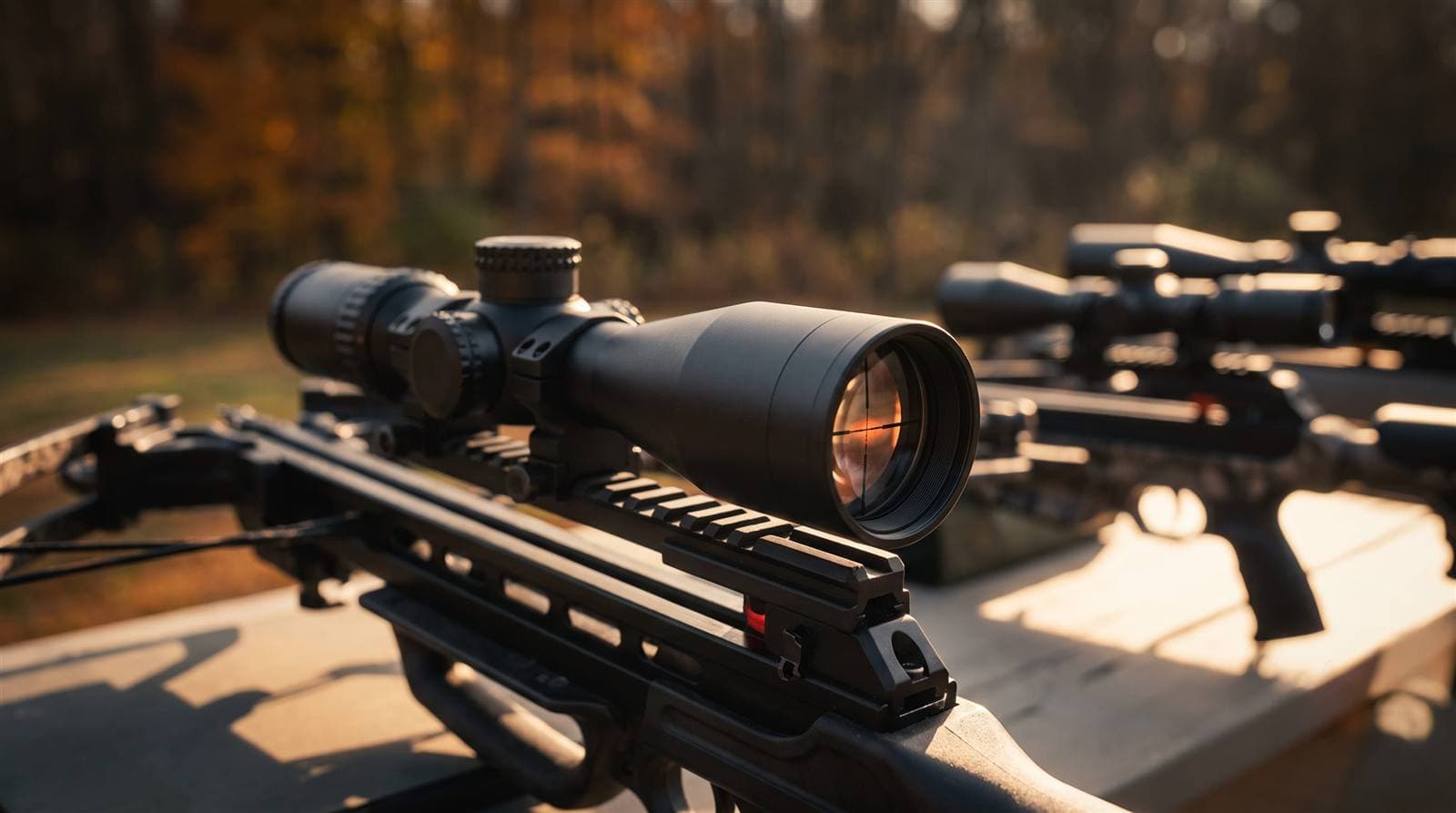
What Is Zeroing (Sighting In)?
Zeroing is adjusting a scope so the bolt lands where the reticle points at a chosen distance, and it is the foundation of every other aiming mark.
Zeroing (Sighting In): definition
Also called: sighting in, sight-in, zero, zero distance, boresighting
Zeroing means adjusting the scope’s windage and elevation until the bolt’s point of impact matches the aim point at a chosen distance. That distance is the zero distance. Every other mark on a BDC reticle, and every holdover you apply, is measured from the zero.
The process is the same in outline for every scope: fire a group from a stable rest, measure where the group sits relative to the aim point, convert the offset to clicks using the scope’s MOA value, adjust the turrets, and confirm with a second group. The detailed steps are in our guide on how to sight in a crossbow scope.
A zero is only valid for the setup it was made with. Changing the bolt weight, tip weight, string, nock or scope mounting shifts the point of impact, so the zero should be re-checked after any change. Many reticles state a zero distance, such as the 40-yard zero on the Vortex Crossfire II.
Clicks from a measured offset
clicks = offset in inches ÷ (1.047 × distance in yards ÷ 100 × click value in MOA)
At 20 yards with 1/4 MOA clicks, each click moves impact 1.047 × 0.2 × 0.25 = about 0.05 inches. A 1 inch low group needs roughly 1 ÷ 0.052 = about 19 clicks. At 40 yards with 1/2 MOA clicks, each click is about 0.21 inches, so a 1 inch offset needs about 5 clicks.
Common zero distances and what they suit
| Zero distance | Typical use | Trade-off |
|---|---|---|
| 20 yards | Initial rough zero, indoor or short ranges | Coarse for longer marks; easy to start with |
| 30 yards | General close-range hunting or backyard | Good compromise for short-range shots |
| 40 yards | Used by the Vortex XBR-2 reticle | Marks above and below depend on the speed |
| 50 yards | Longer practice distance | Needs more careful shooting setup |
Why Zeroing matters
A scope that is not zeroed can look precise on the target while being consistently wrong. Zeroing converts group tightness into accuracy.
The zero is also the reference for hold marks. If your crossbow is zeroed at a different distance than the reticle assumes, every mark is shifted.
Zeroing is where bad habits show up. Inconsistent rest, grip or cheek weld spreads the group and makes the adjustment unreliable.
How to read it on a spec sheet
- Spec sheets sometimes state “zero at 40 yards” or similar. That is the distance the printed marks assume.
- Reticle instructions list the speed range for which the zero and marks are valid.
- If a scope says “auto-calibrated”, it still needs a verification group at one distance.
- Click value, such as 1/4 or 1/2 MOA, tells you how finely you can set the zero.
- Turret caps hide the adjusters on many scopes; remove them as the manual directs.
Common mistakes
- Zeroing from an unstable rest. Group centre moves with every wobble.
- Chasing single bolts instead of a group. Adjust from the centre of a five-bolt group.
- Zeroing with field points, then hunting with broadheads, without checking that they land together.
- Moving turrets the wrong way. Read the direction arrows and confirm on target.
- Forgetting to lock or replace turret caps after the final adjustment.
A short zeroing routine
- Choose a safe range with a proper backstop and follow your crossbow’s safety rules from the manual.
- Shoot a first group of three to five bolts from a stable rest at 20 yards.
- Measure the offset from the aim point and convert it to clicks with the formula above.
- Adjust windage first, then elevation, and shoot another group.
- Move to your zero distance, confirm, then check other distances. Details: how to sight in a crossbow scope.
In my testing
Every review starts by zeroing the scope before I shoot strings over the chronograph and five-bolt groups at fixed distances, measured centre to centre. In the scope reviews I also noted whether the zero held; the TruGlo 4x32 and the EVO-X Marksman Elite showed no zero shift across their durability and recoil testing. How I test.
See it in our reviews
- Vortex Crossfire II 2-7x32 — rated 4.6/5
- TruGlo 4x32 Compact Scope — rated 4.3/5
Frequently Asked Questions
What does it mean to zero a crossbow scope?
It means adjusting the scope so the bolt lands at the point the reticle is aimed at, at a chosen distance. That distance is the zero, and other aiming marks are measured from it.
What distance should I zero a crossbow at?
Many people start at 20 yards and finish at the distance their reticle assumes, such as 30 or 40 yards. Use the distance stated in your scope’s instructions if it gives one.
How many shots does it take to sight in a crossbow?
It varies. A common approach is a group of three to five bolts, an adjustment, and another group. Expect several rounds, then a confirmation group at your zero and other distances.
Do I need to re-zero after changing bolts or broadheads?
Yes, check it. Changes in bolt weight, tip or fletching can shift impact, and broadheads sometimes land differently from field points. Confirm before relying on the zero.
Should I adjust windage or elevation first?
Either works, but many shooters correct windage first so the group lines up vertically, then correct elevation. Make each adjustment and shoot again to confirm.
Why does my group keep moving after I adjust?
Common causes are a loose mount or ring, an unstable rest, an inconsistent hold, or a damaged bolt or string. Fix those before more turret adjustment.
Is boresighting the same as zeroing?
No. Boresighting is a rough alignment to get on paper before live shooting. Zeroing is the live-fire adjustment that sets the final point of impact.
Keep learning
Guides that use this term
- GuideHow to Sight In a Crossbow ScopeSight in a crossbow scope in six numbered steps: safe range setup, bore-sighting, a 20-yard zero, click math, longer-range checks and fixes.Read the guide
- GuideCrossbow Safety Rules for BeginnersCrossbow safety rules for beginners: finger placement, never dry-firing, safe cocking and de-cocking, range etiquette and storage habits that prevent injury.Read the guide
- GuideHow to Maintain a CrossbowHow to maintain a crossbow: string waxing, rail and moving-part lubrication, bolt inspection, storage, and when to see a technician.Read the guide
Related terms
- ScopeAn optical sight mounted on a crossbow rail that magnifies the target and places a reticle on it so you can aim with repeatable precision.
- Windage and ElevationWindage is the left-right scope adjustment and elevation is the up-down one, each moved in clicks of a set MOA value to bring the point of impact onto the aim point.
- MOA (Minute of Angle)MOA is an angular unit of 1/60 of a degree that spans about 1.047 inches per 100 yards and measures scope adjustments and group size.
- ReticleThe reticle is the pattern of lines, dots or marks inside a scope that you place on the target, and its design decides how you account for bolt drop.
- BDC ReticleA BDC reticle prints extra aiming marks below the centre, each matched to a distance for a stated bolt speed, so you hold the matching mark instead of guessing holdover.
- Dry FireReleasing the string with no bolt on it, which sends the stored energy into the crossbow itself and can cause serious damage.
Browse the gear
Definitions are general information. Manufacturer figures vary, so follow your crossbow's manual and verify local laws with the relevant authority.