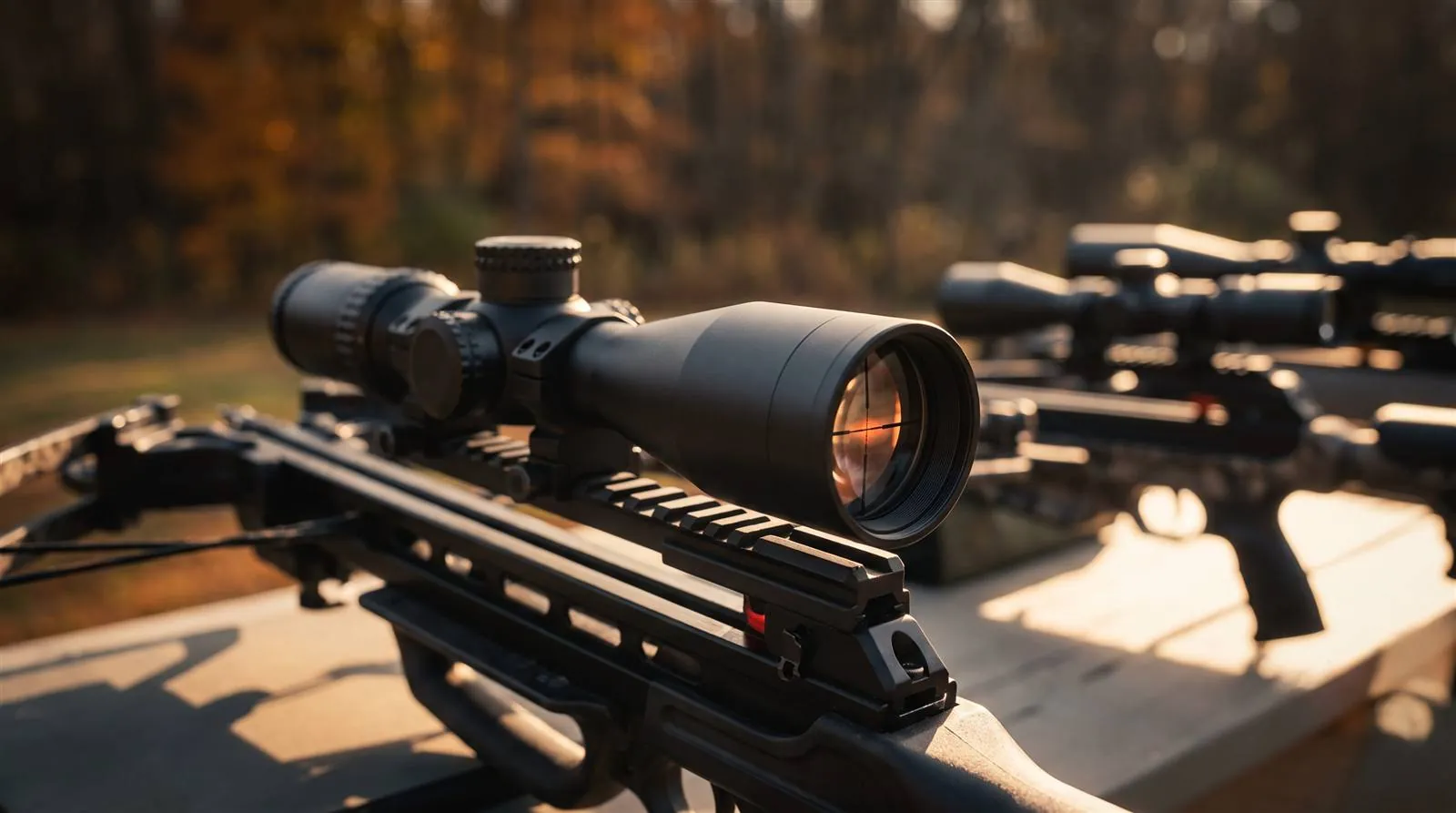
Crossbow MOA (Minute of Angle) in plain terms
Crossbow MOA (Minute of Angle) meaning: MOA is an angular unit of 1/60 of a degree that spans about 1.047 inches per 100 yards and measures scope adjustments and group size.
Also called: minute of angle, minutes of angle, MOA per click, click value
MOA, or minute of angle, is one sixtieth of a degree. Because it is an angle, the distance it covers grows with range: at 100 yards one MOA is about 1.047 inches, at 50 yards about 0.52 inches, and at 20 yards about 0.21 inches. Many people round it to one inch per 100 yards, which is close enough for field talk but slightly off for careful arithmetic.
Scope turrets are graduated in fractions of an MOA. A click value of 1/4 MOA moves the point of impact about 0.26 inches per click at 100 yards; 1/2 MOA moves it about 0.52 inches. The same unit is used to describe precision: a group expressed in MOA can be compared across different distances.
The unit is angular, so it scales in a straight line. Double the distance and the same number of MOA covers double the inches, which is the idea behind the windage and elevation arithmetic used when you zero the scope.
Inches covered by an MOA value
inches = MOA × 1.047 × (distance in yards ÷ 100)
A 1.5 inch group at 50 yards is 1.5 ÷ (1.047 × 0.5) = about 2.9 MOA. For turret clicks, the inches per click table applies the same formula.
Group size converted to MOA (worked numbers)
Arithmetic from the formula above, not test results. The same group in inches is a different MOA at each distance.
| Group size | Distance | Group in MOA |
|---|---|---|
| 1 in | 20 yards | about 4.8 MOA |
| 1 in | 40 yards | about 2.4 MOA |
| 1.5 in | 50 yards | about 2.9 MOA |
| 2 in | 100 yards | about 1.9 MOA |
Why it matters
MOA lets you translate what you see on a target into a turret correction. If your group is 2 inches left at 40 yards, you can calculate how many clicks to move rather than guessing.
At crossbow distances the numbers are small. A 1/2 MOA click is about a fifth of an inch at 40 yards, which is fine control for hunting-size targets but coarse if you are comparing very tight groups.
It also gives a fair way to compare accuracy claims. A group quoted in MOA can be checked against the distance it was shot at, so a 2 MOA group at 100 yards is a different claim from a 2 inch group at 20 yards.
How to read it on a spec sheet
- On a turret or spec sheet, “1/4 MOA per click” means each click shifts impact about 0.26 inches at 100 yards.
- Do not apply 100-yard numbers at short range without scaling. At 20 yards the same click is one fifth as large.
- Total adjustment range is also quoted in MOA and tells you how far you can move the reticle before running out of travel.
- Some scopes use milliradians instead. They are a different angular unit, so convert before comparing clicks.
- A figure of 1.047 inches is the precise value at 100 yards; “one inch” is a rounding.
Common mistakes
- Assuming one click equals one inch. It equals a fraction of an MOA scaled to distance.
- Forgetting that true distance matters. Zeroing at 20 yards and then applying 100-yard click math gives the wrong correction.
- Mixing MOA and mil adjustments when following a guide written for the other unit.
- Judging accuracy from a single group. One group does not establish an MOA figure.
- Reading tracking quality from the click count alone. Clicks must also return to zero after being moved.
Turning a group offset into clicks
- Shoot a five-bolt group at your chosen distance and measure how far its centre sits from the aim point, in inches.
- Convert distance to hundreds of yards, for example 40 yards is 0.4.
- Divide the offset in inches by 1.047 × that figure to get MOA needed.
- Divide MOA by the click value, such as 0.5, to get clicks.
- Move the turret, shoot again, and confirm. See how to sight in a crossbow scope.
See it in our reviews
- Vortex Crossfire II 2-7x32 — rated 4.5/5
- TruGlo 4x32 Crossbow Scope — rated 4.2/5
- TenPoint RangeMaster 100 — rated 4.5/5
Frequently Asked Questions
How many inches is 1 MOA?
One MOA is about 1.047 inches at 100 yards. It scales with distance, so at 50 yards it is about 0.52 inches and at 20 yards about 0.21 inches. People often round to one inch per 100 yards.
What does 1/4 MOA per click mean?
Each click moves the point of impact one quarter of an MOA, which is about 0.26 inches at 100 yards. At 20 yards one click moves impact only about 0.05 inches, so more clicks are needed for the same inch correction.
Is 1/2 MOA per click good for a crossbow?
It is common and workable. At typical crossbow distances a 1/2 MOA click is around a fifth of an inch at 40 yards, fine enough for sighting in on hunting-size targets. Finer clicks mostly help with very tight group chasing.
How do I calculate MOA from group size?
Divide the group size in inches by 1.047 and by the distance in hundreds of yards. A 1.5 inch group at 50 yards is 1.5 ÷ (1.047 × 0.5), about 2.9 MOA. Measure centre to centre of the furthest holes.
What is the difference between MOA and mil?
Both are angular units. A milliradian is larger, about 3.44 MOA, and scopes use one or the other for turrets and reticles. Do not mix them: use the unit printed on your scope.
Does MOA change with magnification?
Turret MOA does not depend on magnification, but reticle subtensions can. On a second focal plane reticle, printed marks match their rated value only at one power. See focal plane.
Why does my scope not move the stated amount?
Real scopes can deviate slightly from their stated click value, and the actual distance you zeroed at also matters. Shoot a test group, measure the shift, and use that as your working click value.
Related guides
Guides where moa shapes a real choice.
Definitions are general information. Manufacturer figures vary, so follow your crossbow's manual and verify local laws with the relevant authority.