What Is Windage and Elevation?
Windage is the left-right scope adjustment and elevation is the up-down one, each moved in clicks of a set MOA value to bring the point of impact onto the aim point.
Windage and Elevation: definition
Also called: turrets, turret clicks, click value, windage adjustment, elevation adjustment
Elevation moves the point of impact up or down; windage moves it left or right. Both are controlled by turrets on the scope, either capped screw-down adjusters or external knobs. Each click moves the impact by a fixed angle, the click value, usually 1/4 or 1/2 MOA.
The movement in inches depends on distance. Using the 1.047 inches per 100 yards figure, a 1/4 MOA click moves impact about 0.26 inches at 100 yards, about 0.13 inches at 50 yards, and about 0.05 inches at 20 yards. That is why sighting in at a short distance takes many more clicks than the same correction at long range.
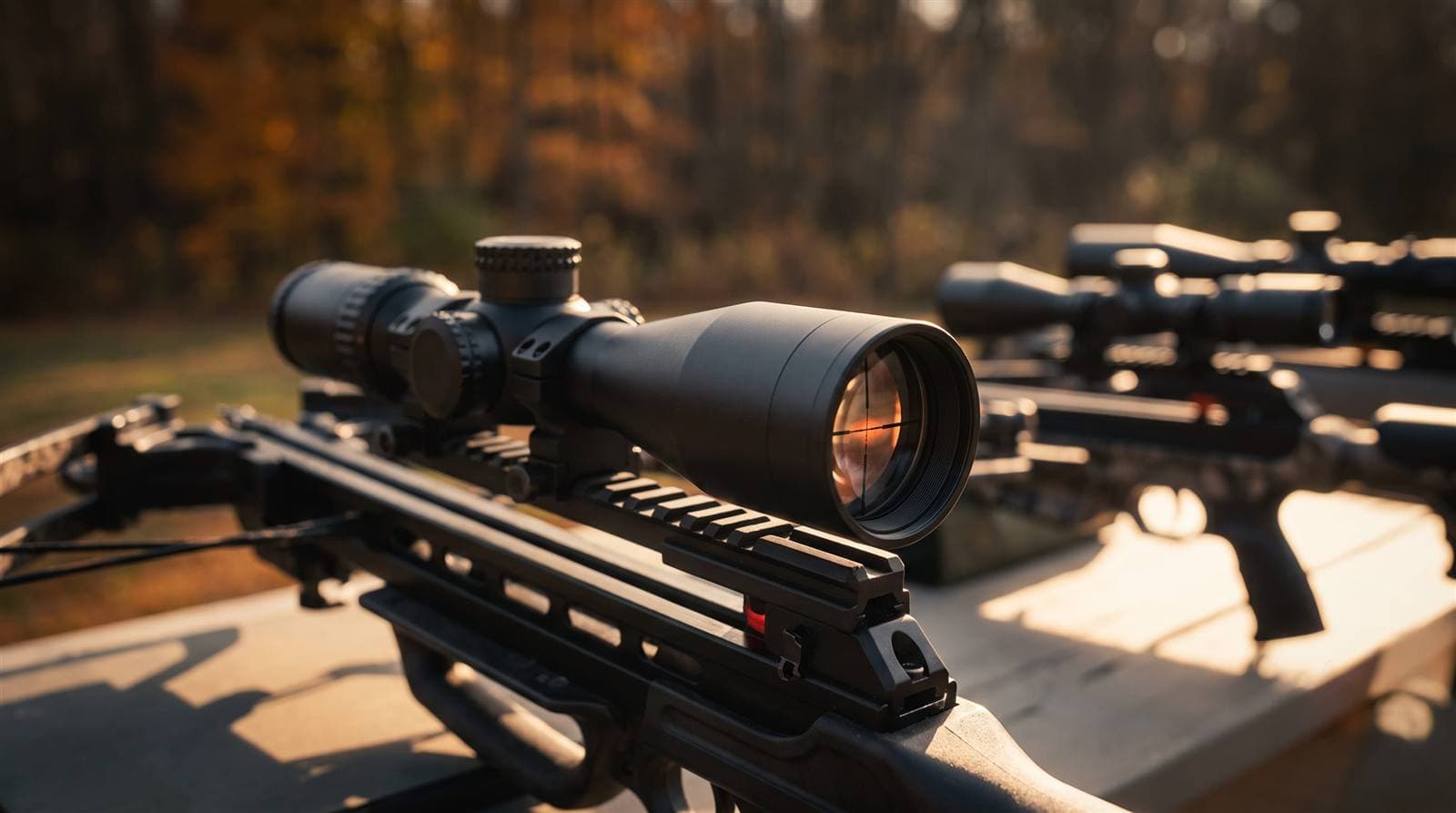
Turret styles differ. The TruGlo 4x32 uses 1/4 MOA fingertip adjusters under screw-down caps. The Vortex Crossfire II and TenPoint RangeMaster 100 use 1/2 MOA clicks. The TenPoint EVO-X Marksman Elite has external micro-adjustable turrets that adjust by hand without tools. Whichever style, the aim is to zero the scope and then leave the turrets alone.
Click arithmetic
inches per click = click value (MOA) × 1.047 × distance (yards) ÷ 100
A 1/2 MOA click at 40 yards moves impact 0.5 × 1.047 × 0.4 = about 0.21 inches. If a group sits 1.05 inches left at 40 yards, you need about 1.05 ÷ 0.21 = 5 clicks of right windage.
Inches moved per click by click value and distance
| Distance | 1/4 MOA click | 1/2 MOA click | 1 MOA click |
|---|---|---|---|
| 20 yards | 0.05 in | 0.10 in | 0.21 in |
| 30 yards | 0.08 in | 0.16 in | 0.31 in |
| 40 yards | 0.10 in | 0.21 in | 0.42 in |
| 50 yards | 0.13 in | 0.26 in | 0.52 in |
| 100 yards | 0.26 in | 0.52 in | 1.05 in |
Why Windage and Elevation matters
Turrets are how the measured group offset becomes a correction. Understanding click value lets you make a calculated adjustment instead of a trial-and-error one.
Good tracking matters. Clicks should move impact by the stated amount and return to the original zero when reversed, otherwise adjustments cannot be trusted.
Turret type changes how you work. Capped turrets protect the zero from accidental movement, while exposed turrets allow quick changes but can be knocked.
How to read it on a spec sheet
- Find click value in the specification: 1/4 MOA, 1/2 MOA or 1 MOA.
- Look for total adjustment range, which limits how far you can move from centre.
- Directional arrows on the turret show which way to turn to move impact.
- Check whether turrets are capped or exposed, and whether tools are needed.
- Note any reset feature, such as a zero stop, if the scope has one.
Common mistakes
- Applying 100-yard click values at short range. At 20 yards a 1/4 MOA click is only about 0.05 inches.
- Turning turrets the wrong way because the arrow was misread.
- Adjusting from one bolt rather than the centre of a group.
- Running out of travel because the rail or mount is not aligned. Mount the scope level first.
- Using turrets to chase every shot. Fix technique before clicking.
Making a windage and elevation correction
- Shoot a group of at least three bolts from a stable rest at your chosen distance.
- Measure the centre of the group relative to the aim point, left-right and up-down, in inches.
- Divide each offset by the inches-per-click figure from the formula or table.
- Turn the turrets by that number of clicks in the direction shown by the arrows. See how to sight in a crossbow scope.
- Shoot a confirmation group, and record the final zero and click count.
In my testing
I check turrets by moving them and returning to zero. On the Vortex Crossfire II 2-7x32 the turrets moved in precise 1/2 MOA increments with no measurable drift after repeated adjustments, and on the TenPoint EVO-X Marksman Elite the external turrets let me dial windage and elevation by hand without tools. How I test.
See it in our reviews
- Vortex Crossfire II 2-7x32 — rated 4.6/5
- EVO-X Marksman Elite — rated 4.7/5
- TruGlo 4x32 Compact Scope — rated 4.3/5
- TenPoint RangeMaster 100 — rated 4.6/5
Frequently Asked Questions
What is the difference between windage and elevation?
Windage moves the point of impact left or right, while elevation moves it up or down. Each is set with its own turret, and together they let you place the group on the aim point.
How many inches does one click move?
It depends on click value and distance. A 1/4 MOA click moves about 0.26 inches at 100 yards and about 0.05 inches at 20 yards. Multiply click value by 1.047 and the distance in hundreds of yards.
How many clicks do I need for a 1 inch correction?
Divide 1 inch by the inches per click at your distance. With 1/2 MOA clicks at 40 yards (about 0.21 inches), that is about 5 clicks. At 20 yards it would take about 10.
Which way do I turn the turret?
Follow the arrows or markings on the turret, which show the direction impact will move. If unsure, make a small test adjustment and shoot to confirm the direction before making larger changes.
Should I adjust windage or elevation first?
Many shooters fix windage first so the group lines up vertically, then fix elevation. Either order works as long as you shoot a confirmation group after each change.
Do I need to lock the turrets after sighting in?
Capped turrets are protected by their caps, so replace them. Exposed turrets can be knocked in transport, so check the zero before use and follow the scope’s manual.
Why does my scope not return to zero?
Poor tracking, loose rings or a damaged scope can cause this. Test by moving the turrets a known number of clicks and back, and shooting groups to check. A scope that cannot return to zero should be replaced or serviced.
Keep learning
Guides that use this term
- GuideHow to Sight In a Crossbow ScopeSight in a crossbow scope in six numbered steps: safe range setup, bore-sighting, a 20-yard zero, click math, longer-range checks and fixes.Read the guide
- GuideBest Crossbow Scopes of 2026Best crossbow scopes of 2026: eight reviewed picks from budget optics to laser rangefinding models, plus how to choose magnification, reticle and eye relief.Read the guide
Related terms
- MOA (Minute of Angle)MOA is an angular unit of 1/60 of a degree that spans about 1.047 inches per 100 yards and measures scope adjustments and group size.
- Zeroing (Sighting In)Zeroing is adjusting a scope so the bolt lands where the reticle points at a chosen distance, and it is the foundation of every other aiming mark.
- ScopeAn optical sight mounted on a crossbow rail that magnifies the target and places a reticle on it so you can aim with repeatable precision.
- ReticleThe reticle is the pattern of lines, dots or marks inside a scope that you place on the target, and its design decides how you account for bolt drop.
- BDC ReticleA BDC reticle prints extra aiming marks below the centre, each matched to a distance for a stated bolt speed, so you hold the matching mark instead of guessing holdover.
- Focal Plane (FFP vs SFP)Focal plane describes where the reticle sits in the scope: a first focal plane reticle scales with zoom, while a second focal plane reticle stays the same size.
Browse the gear
Definitions are general information. Manufacturer figures vary, so follow your crossbow's manual and verify local laws with the relevant authority.