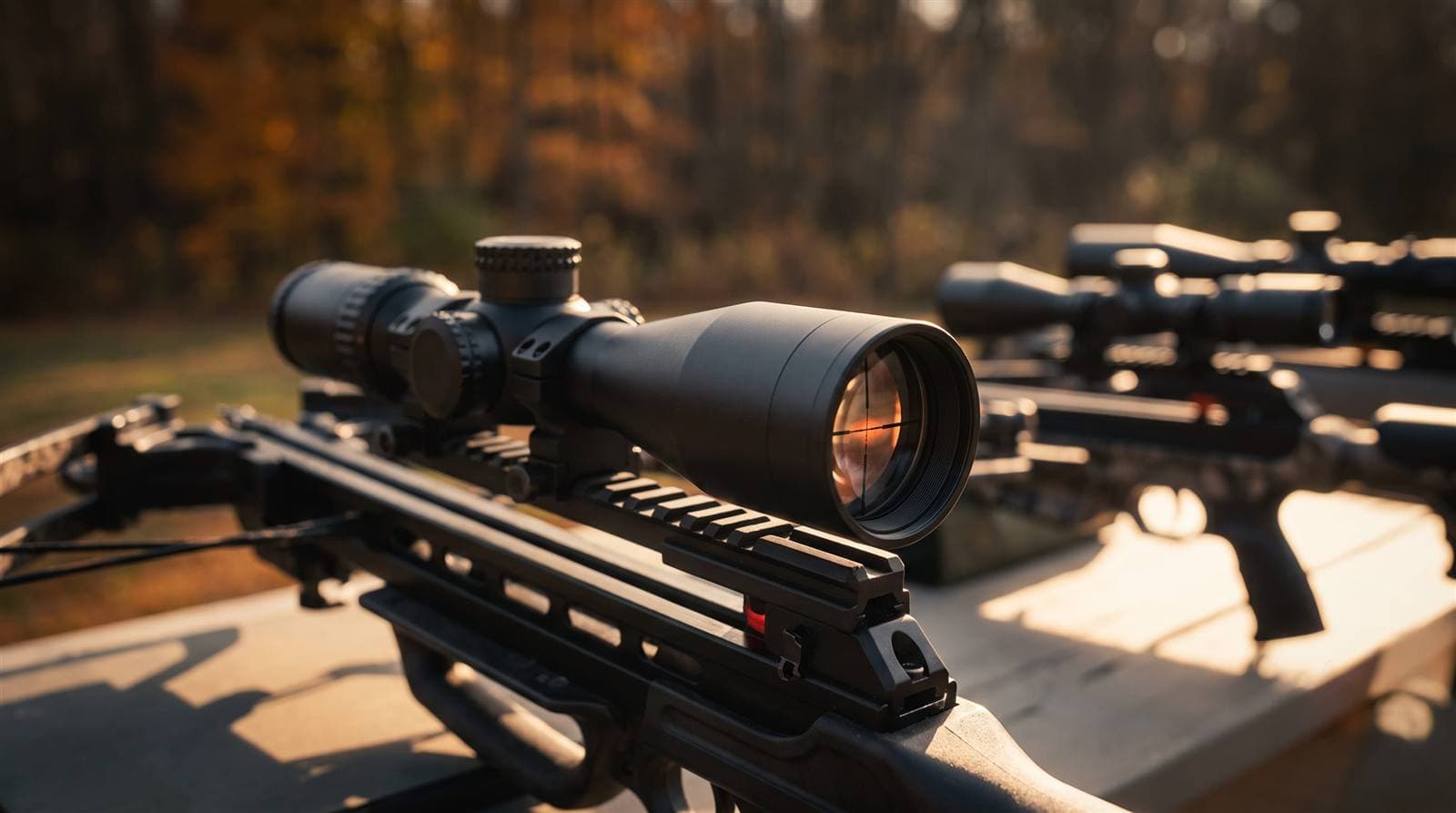
What Is BDC Reticle?
A BDC reticle prints extra aiming marks below the centre, each matched to a distance for a stated bolt speed, so you hold the matching mark instead of guessing holdover.
BDC Reticle: definition
Also called: bullet drop compensating reticle, drop-compensating reticle, multi-dot reticle, ballistic reticle
BDC stands for bullet drop compensation. A BDC reticle has several aiming marks stacked below the main crosshair, and each mark represents the point of aim for a certain distance when the crossbow is zeroed at a certain range. The shooter ranges the target, picks the mark that matches, and aims with that mark rather than the centre.
Crossbow BDC reticles are tied to a bolt speed. They are calculated for a band of speeds, and the marks only line up for crossbows inside it. That is why scopes such as the TenPoint RangeMaster 100 state 380–505 FPS, the TenPoint EVO-X Marksman Elite states 300–550 FPS, and the Vortex Crossfire II assumes a 40-yard zero.
BDC marks do not measure distance. Knowing how far the target is still depends on your estimate or a separate rangefinder, unless you use a rangefinding scope. They also depend on the focal plane: on second focal plane scopes the marks are correct at one magnification only.
BDC and multi-mark reticles from our scope reviews
| Scope | Marks and range | Speed or zero basis |
|---|---|---|
| TruGlo 4x32 Compact | BDC marks, 20 to 50 yards | Narrow 20–50 yard band |
| Vortex Crossfire II 2-7x32 | XBR-2 marks, 20 to 100 yards | 40-yard zero; SFP, use at 7x |
| TenPoint RangeMaster 100 | 9 marks, 20 to 100 yards | 380–505 FPS |
| TenPoint EVO-X Marksman Elite | 9 references, 20 to 100 yards | 300–550 FPS |
| Ravin illuminated scope | Aimpoints 20 to 100 yards, FPS adjustment | Speed-rated by model |
Why BDC Reticle matters
A BDC reticle turns holdover from a mental calculation into a mark you can see. That reduces hesitation and makes quick shots at different distances more repeatable.
It only helps when matched to your crossbow. A crossbow outside the stated speed band will hit high or low at every mark except the zero.
Reticle complexity trades off with speed of reading. Nine marks cover many distances but take practice to learn, and the reviews flag that learning curve.
How to read it on a spec sheet
- Find the speed band and the zero distance. Without both, the marks have no meaning.
- Count the marks and their stated distances; some are illuminated, some are not.
- Check the focal plane and which magnification the marks apply to.
- See whether there is a speed adjustment (as on the Ravin scope) to tune the reticle to your measured speed.
- Compare the longest mark with the distance you will actually shoot, not the maximum on the box.
Common mistakes
- Using BDC marks at a magnification they were not made for on an SFP scope.
- Zeroing at a different distance than the reticle assumes.
- Assuming the marks suit any bolt weight. A noticeably different bolt shifts every mark.
- Memorising distances without confirming each mark at the range.
- Treating the reticle as a licence to take longer shots than you are trained for.
Checking BDC marks against your crossbow
- Record the reticle’s speed band and zero distance from the instructions.
- Zero at that distance using the steps in how to sight in a crossbow scope.
- Set magnification to the setting the marks are valid for.
- Shoot a five-bolt group at each mark’s distance, aiming with that mark.
- Note where any mark lands off, and record a correction card for that crossbow and bolt.
In my testing
My scope reviews compare reticle marks to chronographed bolt drop at a stated bolt weight. The Vortex XBR-2 hold marks matched my chronographed bolt drop closely once calibrated to my test crossbow’s speed, and the TruGlo’s BDC aiming points held accurate zero from 20 to 50 yards once properly sighted in. How I test.
See it in our reviews
- TenPoint RangeMaster 100 — rated 4.6/5
- Vortex Crossfire II 2-7x32 — rated 4.6/5
- TruGlo 4x32 Compact Scope — rated 4.3/5
- Ravin Illuminated Scope — rated 4.3/5
Frequently Asked Questions
What does BDC stand for on a scope?
BDC means bullet drop compensation. On a crossbow it describes a reticle with extra aiming marks below centre, each calibrated for a distance, so you can hold a mark instead of estimating how much to aim high.
Do BDC reticles work for every crossbow?
No. They are calibrated for a speed band and a zero distance, so a crossbow outside that band will hit away from the marks. Check the stated speed range and confirm marks at the range.
How accurate are BDC marks?
They are accurate when your bolt speed, bolt weight and zero match what the reticle assumes. Different tips or bolt weights shift impact, so verify each mark on target rather than relying on the printed distance.
Do I need a rangefinder with a BDC reticle?
You need to know the distance to choose the correct mark. A handheld rangefinder is a common partner; a rangefinding scope builds the distance measurement into the optic itself.
What is the difference between BDC and a plain crosshair?
A crosshair has one aim point and relies on holdover judgement. A BDC reticle has printed marks for set distances. The crosshair is simpler; the BDC is faster if its marks match your crossbow.
Why does magnification matter for BDC marks?
On a second focal plane scope the reticle does not change size with zoom, so its marks only match their stated distances at one power. First focal plane reticles scale with zoom and stay correct.
Can I adjust a BDC reticle for my speed?
Some scopes include a speed adjustment, such as the FPS adjustment on Ravin’s reticle models. Where there is none, you rely on staying inside the stated speed band and verifying each mark.
Keep learning
Guides that use this term
- GuideBest Crossbow Scopes of 2026Best crossbow scopes of 2026: eight reviewed picks from budget optics to laser rangefinding models, plus how to choose magnification, reticle and eye relief.Read the guide
- GuideHow to Sight In a Crossbow ScopeSight in a crossbow scope in six numbered steps: safe range setup, bore-sighting, a 20-yard zero, click math, longer-range checks and fixes.Read the guide
- GuideHow Fast Is a Crossbow Bolt (FPS)How fast a crossbow bolt travels: chronographed speeds from pistol to flagship, what changes bolt speed, and why speed and kinetic energy differ.Read the guide
Related terms
- ReticleThe reticle is the pattern of lines, dots or marks inside a scope that you place on the target, and its design decides how you account for bolt drop.
- Focal Plane (FFP vs SFP)Focal plane describes where the reticle sits in the scope: a first focal plane reticle scales with zoom, while a second focal plane reticle stays the same size.
- ScopeAn optical sight mounted on a crossbow rail that magnifies the target and places a reticle on it so you can aim with repeatable precision.
- Zeroing (Sighting In)Zeroing is adjusting a scope so the bolt lands where the reticle points at a chosen distance, and it is the foundation of every other aiming mark.
- Rangefinding ScopeA rangefinding scope measures the distance to the target with a built-in laser and shows an aim point matched to that distance and, on some models, the shot angle.
- FPS (Feet Per Second)The speed of a bolt as it leaves the crossbow in feet per second, usually rated with one specific bolt weight.
Browse the gear
Definitions are general information. Manufacturer figures vary, so follow your crossbow's manual and verify local laws with the relevant authority.