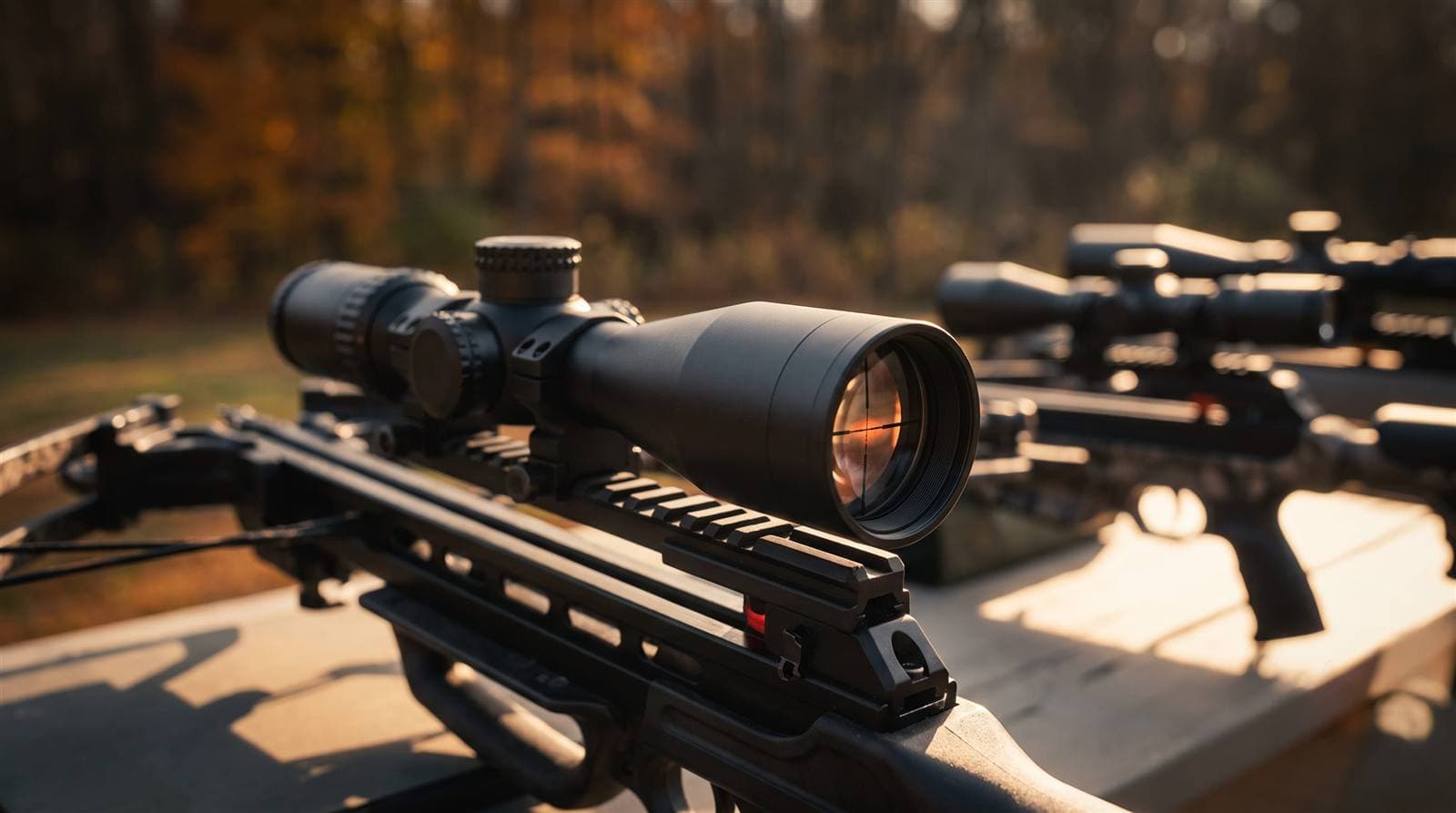
What Is Focal Plane (FFP vs SFP)?
Focal plane describes where the reticle sits in the scope: a first focal plane reticle scales with zoom, while a second focal plane reticle stays the same size.
Focal Plane (FFP vs SFP): definition
Also called: FFP, SFP, first focal plane, second focal plane
A variable-power scope has two places where a reticle can be mounted. In a first focal plane (FFP) scope the reticle is in front of the zoom lenses, so it grows and shrinks with the image. Its marks cover the same amount of target at every magnification. In a second focal plane (SFP) scope the reticle is behind the zoom lenses, so it stays the same apparent size while the image changes.
The practical result is that SFP hold marks are accurate at only one magnification, usually the highest. At other powers the same marks cover a different amount of target, so their printed distances are wrong. FFP marks stay correct throughout the zoom range, but at low power they can look small and thin.
Most crossbow scopes at modest prices are SFP, because it is simpler and keeps the reticle constant and easy to see. The Vortex Crossfire II 2-7x32 is a stated SFP design, and its hold marks apply at 7x. Digital and rangefinding scopes sidestep the issue by recalculating the aim point, which the Burris Oracle X does when you zoom between 2x and 7x.
FFP and SFP compared
| Feature | First focal plane | Second focal plane |
|---|---|---|
| Reticle size with zoom | Scales with the image | Stays the same |
| Hold marks valid | At every magnification | At one power only, often the highest |
| Low-power visibility | Reticle can look thin or fine | Bold and easy to see |
| Typical on crossbow scopes | Less common | Common, as on the Vortex Crossfire II |
| Best suited to | Shooters who change power often | Shooters who stay at one power |
Why Focal Plane matters
If you use hold marks at the wrong magnification on an SFP scope, the bolt will land away from the mark with no warning that anything is wrong. This is a common cause of missed shots at distance.
Focal plane affects how you shoot: SFP means choosing one power and sticking with it; FFP means freedom to zoom.
It also influences price and complexity. FFP reticles often need more careful manufacture, and digital scopes avoid the issue entirely.
How to read it on a spec sheet
- Look for “SFP”, “FFP”, “second focal plane” or “first focal plane” on the spec sheet.
- On an SFP scope, find the magnification at which the marks are calibrated. The Vortex review states 7x.
- If a listing says “magnification compensation”, the scope recalculates aim points as you zoom.
- A fixed-power scope has one image size, so focal plane makes no difference.
- Check the instructions for the exact power setting rather than assuming maximum.
Common mistakes
- Shooting an SFP scope at a lower power than the marks assume.
- Assuming “FFP” means the scope is better. It suits some uses, not all.
- Forgetting to set magnification back to the calibrated setting after scanning at low power.
- Zeroing at one power and hunting at another without checking.
- Reading subtension marks as MOA values at the wrong zoom.
Setting up an SFP scope correctly
- Read the instructions to find the magnification the hold marks are calibrated for.
- Set the power ring to that value and mark it with a dab of tape or note.
- Zero at that power by following how to sight in a crossbow scope.
- Check hold marks at that power at each distance.
- Only zoom out to scan or look, and reset before you aim.
In my testing
I flag the focal plane in reviews because it changes how the scope has to be used. On the Vortex Crossfire II 2-7x32 I recorded that the SFP design means the hold marks are accurate only at 7x, and on the Burris Oracle X the magnification compensation kept the aiming point accurate as I zoomed between 2x and 7x. How I test.
See it in our reviews
- Vortex Crossfire II 2-7x32 — rated 4.6/5
- Burris Oracle X — rated 4.4/5
Frequently Asked Questions
What does SFP mean on a scope?
SFP means second focal plane, where the reticle sits behind the zoom lenses and stays the same apparent size. Its hold marks match their stated distances at one magnification only, usually the highest.
What is the difference between FFP and SFP?
In FFP the reticle scales with magnification, so marks stay correct at any zoom. In SFP the reticle stays constant, so marks are only correct at the calibrated power. FFP suits zoom use; SFP suits one setting.
Which is better for a crossbow, FFP or SFP?
Neither is universally better. SFP is common and simple if you stay at one power. FFP helps if you change magnification and still want marks to be valid. Digital scopes recalculate instead.
At what magnification do I use SFP hold marks?
Use the power the manufacturer states, which is often maximum. For the reviewed Vortex Crossfire II it is 7x. Check your own scope’s instructions and confirm the marks at that setting.
Do fixed-power scopes have a focal plane?
Technically yes, but it makes no practical difference on a fixed-power scope because magnification never changes, so the reticle is always the same size relative to the target image you see.
Can I use low power with an SFP scope?
Yes for scanning or close shots, but the printed hold marks will not match their distances. Use the centre aim point only for close targets, or return to the calibrated power before using the marks.
How do digital scopes deal with focal plane?
They draw and recalculate the aim point electronically, so it can stay accurate at any zoom. The Burris Oracle X, for example, recalculates the aiming point as magnification changes.
Keep learning
Guides that use this term
- GuideBest Crossbow Scopes of 2026Best crossbow scopes of 2026: eight reviewed picks from budget optics to laser rangefinding models, plus how to choose magnification, reticle and eye relief.Read the guide
- GuideHow to Sight In a Crossbow ScopeSight in a crossbow scope in six numbered steps: safe range setup, bore-sighting, a 20-yard zero, click math, longer-range checks and fixes.Read the guide
Related terms
- ReticleThe reticle is the pattern of lines, dots or marks inside a scope that you place on the target, and its design decides how you account for bolt drop.
- MagnificationMagnification is how many times closer the target appears through the scope, written as a number like 4x or a range like 2-7x, and it trades zoom for field of view.
- BDC ReticleA BDC reticle prints extra aiming marks below the centre, each matched to a distance for a stated bolt speed, so you hold the matching mark instead of guessing holdover.
- ScopeAn optical sight mounted on a crossbow rail that magnifies the target and places a reticle on it so you can aim with repeatable precision.
- Rangefinding ScopeA rangefinding scope measures the distance to the target with a built-in laser and shows an aim point matched to that distance and, on some models, the shot angle.
- MOA (Minute of Angle)MOA is an angular unit of 1/60 of a degree that spans about 1.047 inches per 100 yards and measures scope adjustments and group size.
Browse the gear
Definitions are general information. Manufacturer figures vary, so follow your crossbow's manual and verify local laws with the relevant authority.