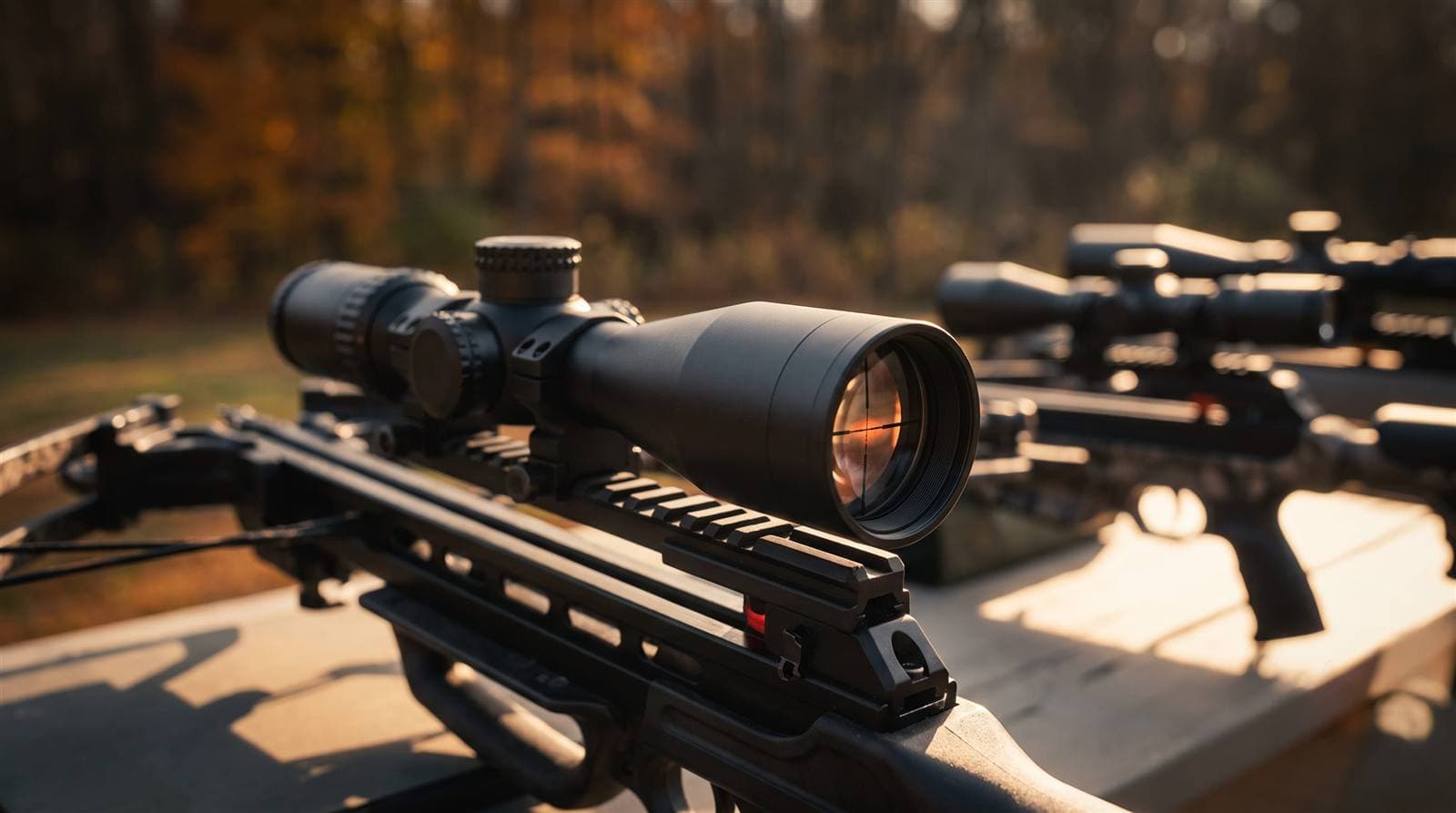
What Is Magnification?
Magnification is how many times closer the target appears through the scope, written as a number like 4x or a range like 2-7x, and it trades zoom for field of view.
Magnification: definition
Also called: zoom, power, variable power, fixed power, objective lens diameter
Magnification tells you how much larger the target looks compared with the naked eye. A 4x scope shows a target four times closer than it really is. A scope written as 3-9x40 is variable power: the zoom ring moves between 3x and 9x, and the 40 is the objective lens diameter in millimetres.
Higher power is not free. It narrows the field of view, magnifies movement and shake, and can shorten eye relief. On a second focal plane scope it also determines whether the printed hold marks are valid. For typical crossbow distances, modest power is often enough.
The objective diameter affects light gathering. A larger objective can transmit more light, but it adds weight and length, and it needs taller rings to clear the barrel and rail.
Exit pupil
exit pupil (mm) = objective diameter (mm) ÷ magnification
A 32mm objective at 4x gives 32 ÷ 4 = 8mm. At 7x it gives 32 ÷ 7 = about 4.6mm. A larger exit pupil gives a brighter image in dim light up to the size of your own pupil.
Magnification in reviewed scopes
| Scope | Magnification | Objective | Type |
|---|---|---|---|
| TruGlo 4x32 Compact | 4x fixed | 32mm | Fixed power |
| Vortex Crossfire II | 2-7x | 32mm | Variable, SFP |
| TenPoint RangeMaster 100 | 2-7x | 32mm | Variable |
| TenPoint EVO-X Marksman Elite | 2-8x | See review | Variable |
| CVLIFE 3-9x40 | 3-9x | 40mm | Variable |
| Garmin Xero X1i | 3.5x fixed | Digital | Fixed digital |
| TenPoint Vision HD | 3-12x | Digital | Digital variable |
| Ravin illuminated scope | 1.5-5x (retailer listings) | Varies | Model dependent |
Why Magnification matters
Too little magnification makes it hard to pick a precise aim point on small targets. Too much narrows the view and makes the picture shake, which can hurt more than it helps.
For crossbows, moderate ranges mean you rarely need maximum zoom. A wide field of view helps with fast target acquisition at short distances.
On SFP scopes, magnification is also a calibration setting. Setting the wrong power gives wrong hold marks.
How to read it on a spec sheet
- A single number is fixed power; a range is variable.
- The second number in a name like 4x32 is the objective diameter in millimetres.
- Check the lowest power for field of view and the highest for detail.
- On SFP scopes, find the power at which the marks are valid.
- Digital scopes list digital zoom, which may behave differently to an optical zoom.
Common mistakes
- Buying the highest zoom number as a proxy for quality.
- Using high power on a close shot and losing the target in the narrow view.
- Forgetting to return to the calibrated power on an SFP scope.
- Ignoring the objective size and rail clearance when mounting.
- Mixing up the objective diameter (32mm) with magnification.
Choosing a power setting
- List the distances you will actually shoot.
- Match the highest power you will use to the farthest of those distances.
- Check the minimum power gives a wide enough view for close shots.
- On an SFP scope, mark the calibrated power on the ring.
- Practise changing power smoothly and re-acquiring the target.
See it in our reviews
- TruGlo 4x32 Compact Scope — rated 4.3/5
- CVLIFE 3-9x40 Scope — rated 4.1/5
- Vortex Crossfire II 2-7x32 — rated 4.6/5
- EVO-X Marksman Elite — rated 4.7/5
Frequently Asked Questions
What does 4x32 mean on a scope?
It means 4 times magnification with a 32 millimetre objective lens. The first number is how much closer the target appears; the second is the front lens diameter, which influences how much light is gathered.
What magnification do I need for a crossbow?
Moderate power is common. Reviewed scopes run from fixed 4x to 2-7x and 3-9x variable. Choose based on the distances you shoot and how much field of view you want.
Is higher magnification better?
Not necessarily. Higher power shows more detail but narrows the field of view and magnifies movement. For short crossbow distances, extra zoom often gives little benefit and can make the target harder to find.
What is the difference between fixed and variable power?
Fixed power has one magnification and is simple and compact. Variable power has a zoom ring so you can adjust, at the cost of more complexity and often more weight.
What is exit pupil?
Exit pupil is the diameter of the light beam leaving the scope, found by dividing the objective by the magnification. A larger exit pupil usually gives a brighter image in dim light.
Does magnification affect the reticle?
On first focal plane scopes the reticle scales with zoom; on second focal plane scopes it stays the same size and the hold marks are valid at one power only.
What is digital magnification?
Digital scopes magnify an image shown on a screen rather than with glass lenses. Check the specification, because image quality and behaviour differ from optical zoom.
Keep learning
Guides that use this term
- GuideBest Crossbow Scopes of 2026Best crossbow scopes of 2026: eight reviewed picks from budget optics to laser rangefinding models, plus how to choose magnification, reticle and eye relief.Read the guide
- GuideHow to Sight In a Crossbow ScopeSight in a crossbow scope in six numbered steps: safe range setup, bore-sighting, a 20-yard zero, click math, longer-range checks and fixes.Read the guide
Related terms
- ScopeAn optical sight mounted on a crossbow rail that magnifies the target and places a reticle on it so you can aim with repeatable precision.
- Focal Plane (FFP vs SFP)Focal plane describes where the reticle sits in the scope: a first focal plane reticle scales with zoom, while a second focal plane reticle stays the same size.
- Eye ReliefEye relief is the distance from the scope’s rear lens to your eye at which you see the full, unclipped picture, and it affects comfort and safety.
- ReticleThe reticle is the pattern of lines, dots or marks inside a scope that you place on the target, and its design decides how you account for bolt drop.
- ParallaxParallax is the apparent shift of the reticle against the target when your eye moves, caused by the target image not sitting on the reticle plane.
- Rangefinding ScopeA rangefinding scope measures the distance to the target with a built-in laser and shows an aim point matched to that distance and, on some models, the shot angle.
Browse the gear
Definitions are general information. Manufacturer figures vary, so follow your crossbow's manual and verify local laws with the relevant authority.