Crossbow Scope in plain terms
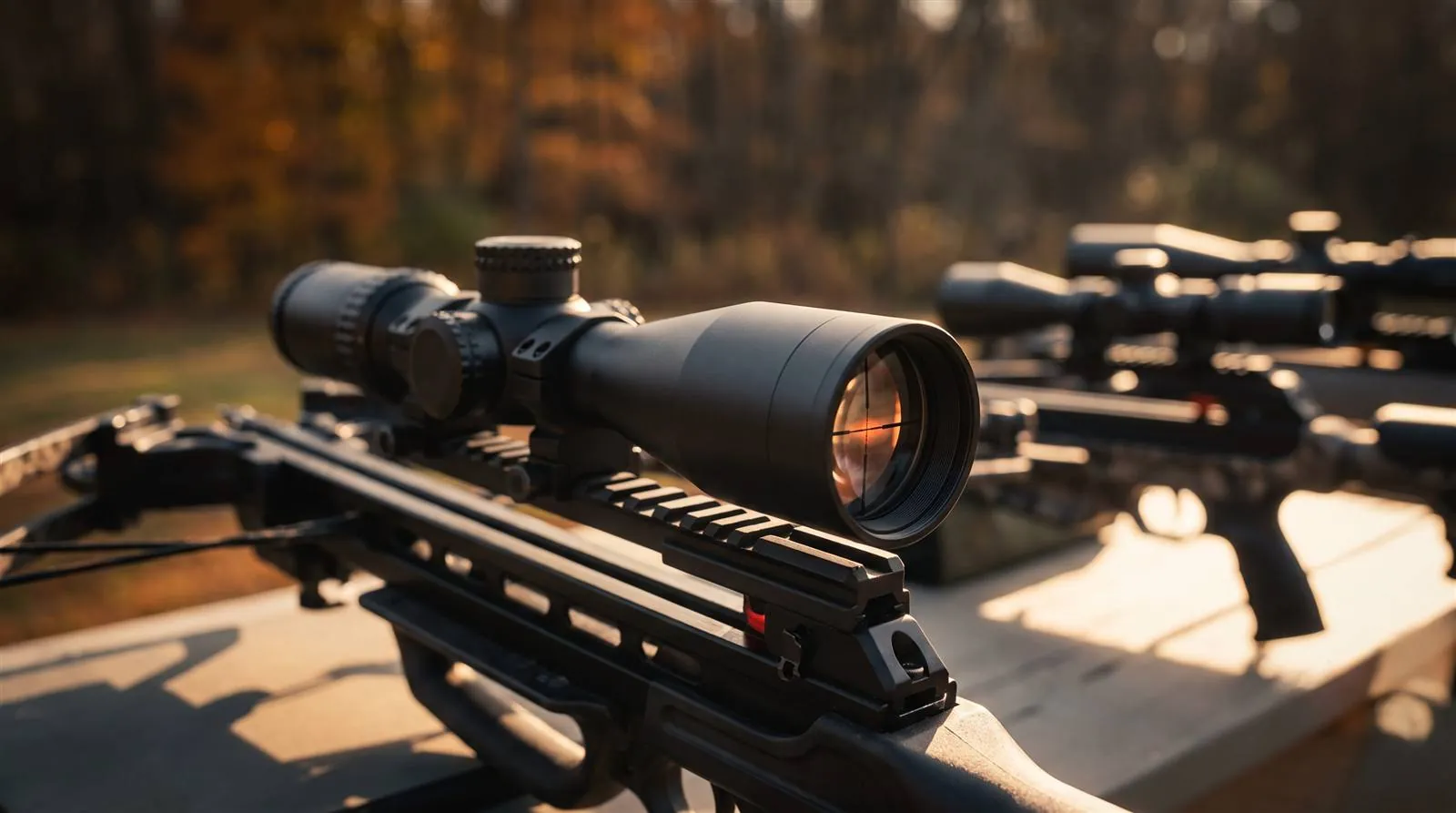
Crossbow Scope meaning: A crossbow scope is an optical sight mounted on the rail that magnifies the target and places a reticle on it so you can aim with repeatable precision.
Also called: crossbow scope, crossbow optic, optical sight, scope sight
A scope is a sealed tube of lenses that sits above the crossbow’s rail and shows you the target with a reticle superimposed on it. The shooter lines the reticle on the spot to be hit, and the scope’s zero tells you where the bolt will land when they do. Most crossbow scopes are 1-inch or 30mm tube designs; some use a digital display instead of glass.
Crossbow scopes differ from firearm scopes in one important way: the reticle is usually built around a crossbow’s bolt drop rather than a rifle’s flat trajectory. Bolts leave the string far slower than a bullet leaves a barrel, so they fall faster, and a crossbow-specific reticle places aiming marks at set distances for a stated speed band. A scope designed for rifles often has only a plain crosshair, which means the shooter has to estimate holdover.
Scope families you will meet on product pages are the plain crosshair scope, the BDC reticle scope with printed hold marks, the illuminated reticle scope, and the rangefinding scope that measures distance for you.
Scope types compared using reviewed scopes
Facts below come from the individual reviews.
| Type | Example | Magnification |
|---|---|---|
| Plain crosshair, variable zoom | CVLIFE 3-9x40 | 3-9x |
| BDC reticle, fixed power | TruGlo 4x32 Compact | 4x |
| Illuminated BDC, kit with rings | Vortex Crossfire II 2-7x32 | 2-7x |
| Illuminated, nine aiming points | TenPoint RangeMaster 100 | 2-7x |
| Glass reticle with turrets | TenPoint EVO-X Marksman Elite | 2-8x |
| Laser rangefinding | Burris Oracle X | 2-7x |
Why it matters
The scope is the part of the system that turns a fast crossbow into an accurate one. A crossbow can group tightly, but if the scope shifts under recoil or the reticle does not match the bolt’s speed, the accuracy never reaches the target.
Because crossbow bolts drop quickly, the reticle design matters as much as the glass. A scope rated for 380–505 FPS crossbows may not suit one outside that band, and several scopes state a speed range for exactly this reason.
Weight and size also change handling. Rated weights of the reviewed scopes run from 11.3 oz for the compact CVLIFE 3-9x40 to 30.8 oz for the laser rangefinding Burris Oracle X, which is a noticeable difference on a crossbow you carry all day.
The scope speed matcher shortlists reviewed scopes calibrated for your crossbow's speed.
How to read it on a spec sheet
- Read the magnification and objective together: 2-7x32 means zoom from 2x to 7x with a 32mm front lens. A larger objective passes more light but adds bulk.
- Check whether the reticle is calibrated for crossbows and for which speed range. Hold marks only work for the stated band.
- Look at eye relief. Crossbow scopes sit forward of the shooter’s eye, and short eye relief can be uncomfortable under recoil.
- Find the adjustment value per click, such as 1/4 or 1/2 MOA, because it tells you how finely you can sight in.
- Note whether rings are included and which rail width they fit. The CVLIFE 3-9x40, for example, ships with 20mm mounts.
- For digital models, check battery type and what happens if the battery runs down, since there is no mechanical fallback on a fully digital display.
Common mistakes
- Buying a scope for its magnification alone. Crossbow shots are short, and a reticle matched to your bolt speed usually matters more than extra zoom.
- Mounting a rifle scope without checking eye relief and rail compatibility on the crossbow.
- Ignoring the speed rating. A scope calibrated for one FPS band gives wrong hold marks on a much faster or slower crossbow.
- Skipping the sight-in after mounting. Every scope needs to be zeroed on the crossbow it rides on.
- Leaving ring screws loose, or over-tightening them and marking the tube. Follow the ring manufacturer’s torque guidance.
Checking a scope before you buy or mount it
- Write down your crossbow’s rated speed and the speed band printed for the scope’s reticle.
- Confirm the rail type and ring size match your crossbow, and that rings are in the box.
- Check eye relief against how you actually hold the crossbow, including seated or from a blind.
- Mount the scope level with the crossbow uncocked and unloaded; follow your crossbow and ring manual.
- Zero it following how to sight in a crossbow scope, then confirm at your other distances.
See it in our reviews
- Vortex Crossfire II 2-7x32 — rated 4.5/5
- TruGlo 4x32 Crossbow Scope — rated 4.2/5
- CVLIFE Scope — rated 4.1/5
- TenPoint RangeMaster 100 — rated 4.5/5
Frequently Asked Questions
Do I need a scope on a crossbow?
No, but most hunters and target shooters use one because it makes aiming at distance far more repeatable. Many crossbows ship with a scope or open sights, and either works if you sight in carefully and know the range you are comfortable at.
Can I use a rifle scope on a crossbow?
Often yes mechanically, but a rifle reticle is not built for crossbow bolt drop, and eye relief can be short. If you do, confirm the rail fit and expect to learn your own holdover marks at each distance.
What magnification is best for a crossbow scope?
Lower to moderate power covers most crossbow shooting. Reviewed examples include fixed 4x and variable 2-7x, which suit the short distances typical of crossbow use. Higher power narrows the field of view and magnifies movement.
What does 2-7x32 mean on a scope?
It means the scope zooms from 2 times to 7 times magnification and has a 32 millimetre objective lens at the front. The first range is the zoom; the last number is the front lens diameter, which influences light gathering.
What is the difference between a BDC reticle and a crosshair?
A crosshair has one aim point; a BDC reticle adds marks for set distances at a stated speed. The BDC reticle entry explains the difference in full.
How often should a crossbow scope be re-zeroed?
Re-check after mounting, after a drop or knock, after a bolt or tip change, and at the start of a season. Treat a scope that will not hold its zero as faulty rather than adjusting around it.
Are expensive scopes worth the money?
It depends on need. A budget scope can hold zero within its limits, while premium models add ranging, angle correction or finer glass. Match the features to how far and in what conditions you actually shoot.
Related guides
Guides where scope shapes a real choice.
 GuideHow to Choose a Crossbow ScopeChoose a crossbow scope in eight steps, from intended use, reticle and magnification to eye relief, illumination, glass and mounting matched to your bolt speed.Read the guide
 GuideBest Crossbow Scopes of 2026 for Every Bolt SpeedCrossbow scopes compared from a budget variable-zoom scope to laser rangefinding and digital models, with reticle, magnification and speed range for each.Read the guide
Definitions are general information. Manufacturer figures vary, so follow your crossbow's manual and verify local laws with the relevant authority.