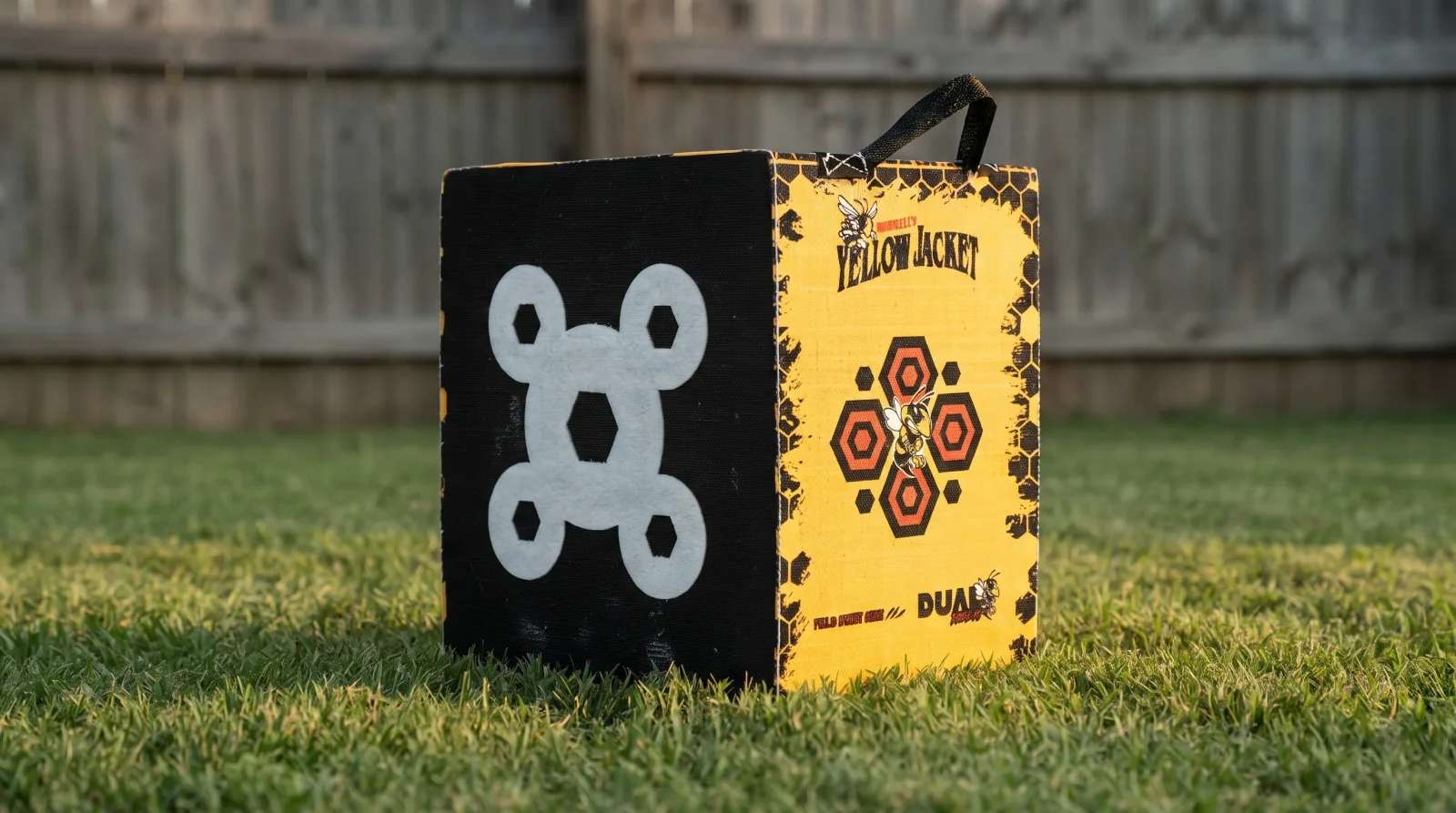
The Morrell Yellow Jacket Dual Threat (model YJ-380) is a layered foam block target that Morrell rates to stop speeds up to 380 FPS, from field points and broadheads alike. It suits a crossbow rated at 380 FPS or less. If your crossbow is rated faster than that, skip it and pick a target rated above your bow's speed.
It measures 16x13x18 inches, has four shooting sides and 32 bullseyes, and carries on a built-in tote handle. Morrell also sells a smaller YJ-350 Dual Threat rated to 350 FPS; we cover the difference below. For the rest of the gear around your bow, our crossbow accessories page groups targets with cocking aids, scopes and bolts.
The score is 4.1 out of 5. It earns credit for taking broadheads and field points in one block, four sides to spread wear and a weather-resistant wrap, and loses ground for a 380 FPS ceiling that rules out faster crossbows and for no published weight.
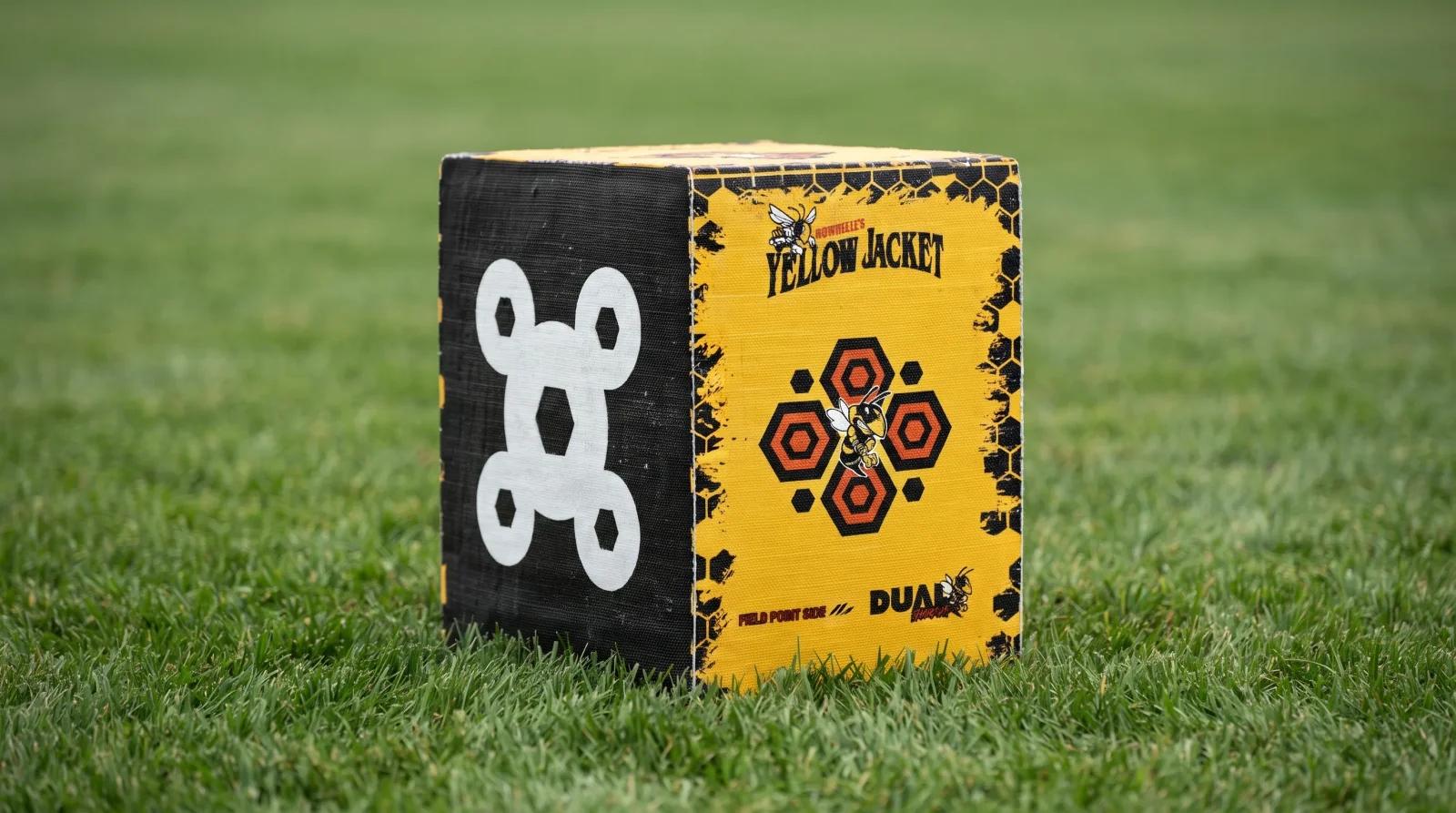
Yellow Jacket Dual Threat Specifications
These are the YJ-380 specifications as Morrell lists them on its product page. The compound and crossbow approval comes from the Amazon listing title.
| Specification | Details |
|---|---|
| Model | Morrell Yellow Jacket YJ-380 Dual Threat |
| Stopping rating | Stops speeds up to 380 FPS |
| Heads | Field points and broadheads |
| Bows | Compound bows and crossbows ("excellent for any type of bow") |
| Foam | Poly-fused cellular foam, completely fused layers |
| Wrap | Polypropylene |
| Shooting sides | 4 |
| Bullseyes | 32 |
| Size | 16x13x18 inches |
| Weather | Weather resistant |
| Carry | E-Z tote carrying handle |
| Weight | Not published |
Who It's For, and Who Should Skip It
A first crossbow, one target. If you have just bought a crossbow rated 380 FPS or less, this block covers the two jobs you need a target for: zeroing the scope with field points and checking that your broadheads hit with them.
Our guide to sighting in a crossbow scope walks through the first session at 20 yards, and a block this size is what most people shoot into for it.
Backyard practice. At 16x13x18 inches with a carrying handle, it moves between the shed and the backyard without a cart, and the weather-resistant build means a damp evening outside does not ruin it. Morrell does not publish its weight, so judge the carry yourself before you buy one for a long walk to a range.
Skip it if your crossbow is rated above 380 FPS. Many current hunting crossbows are rated at 390 to 450 FPS and beyond. A bolt arriving faster than the target's rating can drive deeper, stick harder or pass through, so pick a target rated above your crossbow's speed.
Skip it if you want a replaceable core. Morrell lists no replacement cover or core for the YJ-380, so when the faces are shot out the whole block is replaced.
Which Crossbows It Fits
Morrell's 380 FPS figure is the target's stopping rating: the fastest arrow or bolt the maker says it will stop. Compare it with your crossbow's rated speed, which makers state with a specific bolt weight. The table lists the crossbows we review that sit near the line, with each one's rated speed as the maker states it.
| Crossbow | Rated speed | Within the 380 FPS rating? | Buy |
|---|---|---|---|
| Barnett Explorer XP370 | 370 FPS | Yes | Check price on Amazon |
| Barnett Recruit XP | 350 FPS | Yes | Check price on Amazon |
| Ballista Bat | 340 FPS | Yes | Check price on Amazon |
| Excalibur Mag Air | 305 FPS | Yes | Check price on Amazon |
| Barnett Demun Storm | 290 FPS | Yes | Check price on Amazon |
| Barnett Wildcat CRX | 280 FPS | Yes | Check price on Amazon |
| TenPoint Venom X | 390 FPS | No: pick a higher-rated target | Check price on Amazon |
| Wicked Ridge Invader M1 | 390 FPS | No: pick a higher-rated target | Check price on Amazon |
| TenPoint Titan 400 | 400 FPS | No: pick a higher-rated target | Check price on Amazon |
| Ravin R29X | 450 FPS | No: pick a higher-rated target | Check price on Amazon |
Of the bows above, the Barnett Explorer XP370 is the closest fit at 370 FPS, and the 390 FPS TenPoint Venom X is the first that sits over the line.
Speed is not the whole story. A heavier bolt flies a little slower but carries more kinetic energy, the push that drives it into foam, so a heavy hunting bolt at 370 FPS works the block harder than a light bolt at the same speed.
Our guide on how to choose crossbow bolts explains how bolt weight is chosen.
To see what your own bolt delivers, enter its weight and speed in our crossbow kinetic energy calculator. For how speed and energy relate when you hunt, our guide to crossbow FPS needed for deer puts the numbers in context.
Worth knowingA 4-sided foam block rated to 380 FPS for field points and broadheads. Check your crossbow's rated speed first.
YJ-380 vs YJ-350 Dual Threat
Morrell sells two Dual Threat blocks. The YJ-380 is the one this review covers and the one our Amazon link points to; the same listing also offers the 350 FPS size.
| Item | YJ-380 Dual Threat | YJ-350 Dual Threat |
|---|---|---|
| Stopping rating | Up to 380 FPS | 350 FPS |
| Size (Morrell) | 16x13x18 inches | 16x13x16 inches |
| Offset bullseyes | Not listed | "Offset bullseye technology" listed |
The YJ-350 is 2 inches shorter and rated 30 FPS lower. Of the crossbows in the fit table, the 350 FPS Barnett Recruit XP and anything slower sit within its rating, while the Explorer XP370 needs the YJ-380. If you might move up to a faster crossbow, the 380 gives you more headroom.
Design and Build
Practice targets come in three broad types. A bag target is a fabric shell packed with fill; it stops field points well and lets them out easily, but a broadhead cuts the fabric and fill. A compression target squeezes foam sheets together in a frame, which is common on larger range targets. A layered foam block like the Dual Threat is made of foam sheets fused into one solid piece, and that solid foam is what lets it take broadheads.
Morrell describes the foam as poly-fused cellular foam with completely fused layers, held in a polypropylene wrap. Each of the four sides is a shooting face, and Morrell says the four sides are there for longer target life: when one face wears, you turn the block. With 32 bullseyes spread across those faces, you can move your aim point instead of shooting one spot to pieces.
The E-Z tote handle is the carrying point, and the block is listed as weather resistant.

Field Points vs Broadheads
A field point is the plain, bullet-shaped tip you shoot for practice and sighting in. A broadhead is the bladed hunting head, and it cuts its way into foam instead of pushing it aside. Morrell rates the Dual Threat for both, which is the "dual" in its name.
That matters because a broadhead does not always hit where a field point does. A fixed-blade broadhead can plane off course if the bolt is not tuned, and the only way to know is to shoot it at a target that can take blades. Our guide to crossbow broadhead tuning explains how to compare the two impact points and fix a gap.
Blades wear foam faster than field points, so save broadhead shots for confirming your zero and use field points for volume. A mechanical broadhead may open in the foam, which makes it harder to pull and may damage the blades; a practice head made to match it is the usual stand-in.
If you have not picked your hunting head yet, our best crossbow broadheads roundup compares the heads we review.
Arrow Removal, Durability and Replacement
Morrell makes no claim about how easy bolts are to pull from the YJ-380 or how many shots it lasts, so the points below are general guidance for layered foam blocks, not product claims.
- Pull straight back. Hold the block with one hand and pull the bolt along its own line; twisting widens the hole and can unscrew the point.
- Use a little lubricant. A target lubricant or a wipe of soap on the point and front of the shaft helps on tight foam.
- Spread your aim. Work through the 32 bullseyes and the four sides instead of grouping into one spot.
- Store it out of the sun. Sunlight breaks down foam over time; keep the block in a shed or garage between sessions even though it is weather resistant.
When every face is shot through, the block is done. Morrell sells replacement covers for some other Yellow Jacket targets, but we found none listed for the YJ-380, so plan on buying a new block.
Troubleshooting
| Symptom | Likely cause | Fix |
|---|---|---|
| Bolts pass through or bury to the fletching | Crossbow rated above 380 FPS, or the face is worn out at that spot | Check your crossbow's rated speed against the fit table; move to a fresh bullseye or side |
| Center bullseyes worn while the edges are fresh | All shots on one aim point | Rotate through the 32 bullseyes and turn the block to a new side |
| Bolts are hard to pull | Dense new foam, or a point shot deep | Pull straight, use target lubricant, and shoot from a little farther back if it persists |
| Broadhead blades bent or dull after practice | Blades cut through foam on every shot | Shoot one broadhead to confirm impact, then switch to field points or a matching practice head |
| Broadheads hit away from field points | Bolt or broadhead not tuned | Follow a broadhead tuning routine before blaming the target |
How It Compares With Other Target Types
We do not review other Morrell targets, so the useful comparison is with the other target types you could buy instead. A bag target such as the Delta McKenzie Speedbag is the easiest to pull field points from but is no place for broadheads. A larger range target with a replaceable core suits someone who shoots often and wants to replace the worn insert rather than the whole target. The Dual Threat sits between them: one portable block for both head types, as long as your crossbow is within its 380 FPS rating.
Pros and Cons
Pros
- Rated to stop 380 FPS from field points and broadheads
- Four shooting sides and 32 bullseyes to spread wear
- Fused-layer foam, polypropylene wrap, weather resistant
- Approved for compound bows and crossbows, with a tote handle
Cons
- Not for crossbows rated above 380 FPS
- No published weight
- No replacement core or cover listed for this model
- A compact face for long-range practice
The crossbow calculators cover energy, FOC, bolt drop and cocking effort if you want to check the numbers behind this setup. Every other model reviewed in this class is compared on the crossbow accessories page.
Where the Yellow Jacket Dual Threat ranks
The Yellow Jacket Dual Threat is discussed in Why Your Crossbow Shoots High, Low, Left or Right and How to Choose a Crossbow Scope.
Yellow Jacket Dual Threat Review: Final Verdict
Yellow Jacket Dual Threat
4.1 / 5 — Is it worth buying?
The Yellow Jacket Dual Threat is a practical one-block answer for crossbows rated 380 FPS or less. Speed Rating 4.0/5: 380 FPS covers most entry-level crossbows but not those rated 390 FPS and up. Versatility 4.5/5: field points and broadheads, compound bows and crossbows. Portability 3.5/5: a compact block with a tote handle, but no published weight. Durability Features 4.3/5: four sides, fused layers and a weather-resistant wrap. Value for Money 4.3/5: one target covers sight-in and broadhead practice.
Best for
Owners of a crossbow rated 380 FPS or less who want one target for sight-in and broadhead practice
Skip if
Your crossbow is rated above 380 FPS or you want a replaceable core
Score breakdown
- Speed Rating4.0/5
- Versatility4.5/5
- Portability3.5/5
- Durability Features4.3/5
- Value for Money4.3/5
Frequently Asked Questions
Can a crossbow shoot the Yellow Jacket Dual Threat?
Yes. Morrell rates the YJ-380 to stop speeds up to 380 FPS, and the Amazon listing names it for compound bows and crossbows. Use it with a crossbow rated 380 FPS or less.
What is the difference between the Dual Threat 350 and 380?
The YJ-380 is rated up to 380 FPS and measures 16x13x18 inches. The YJ-350 is rated to 350 FPS, measures 16x13x16 inches and lists offset bullseye technology.
Can I shoot broadheads into it?
Yes. Morrell says it stops field points and broadheads. Blades wear foam faster, so use broadheads to confirm your zero and field points for most of your practice.
Can I leave it outside?
Morrell lists it as weather resistant, so rain during a session is fine. Storing it out of the sun between sessions helps any foam target last longer.
How heavy is the Yellow Jacket Dual Threat?
Morrell does not publish a weight for the YJ-380. It has a built-in tote handle for carrying.
How do I pull arrows out more easily?
Pull straight back along the shaft while holding the block, and use a little target lubricant on the point. Twisting widens the hole and can loosen the point.
Related Reviews
 4.0
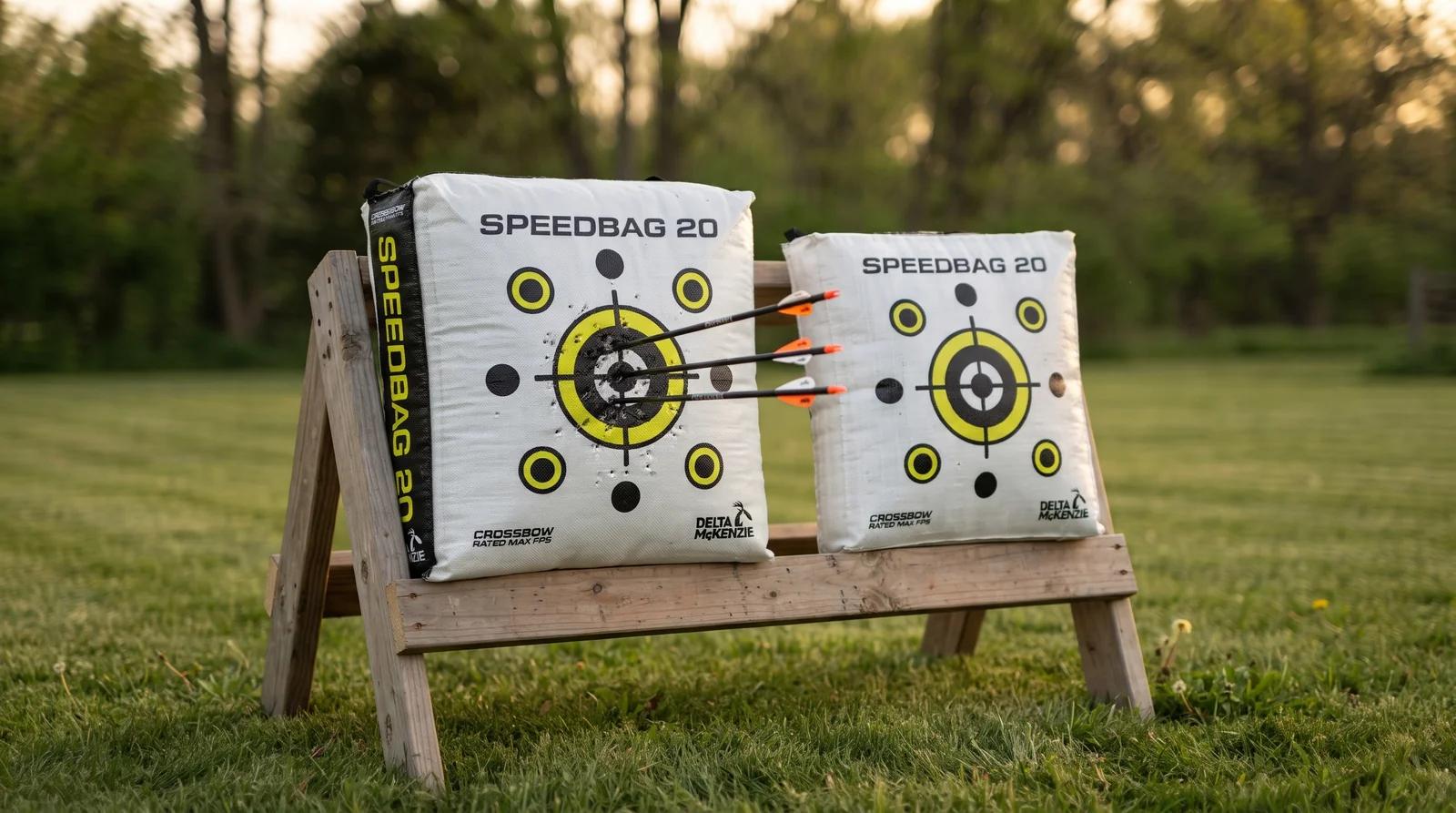
Delta McKenzie Speedbag
Two Speedbag bag targets: 20" rated 450 FPS, 24" Crossbow Max rated 525 FPS, field points only. Which one matches your crossbow.
Read review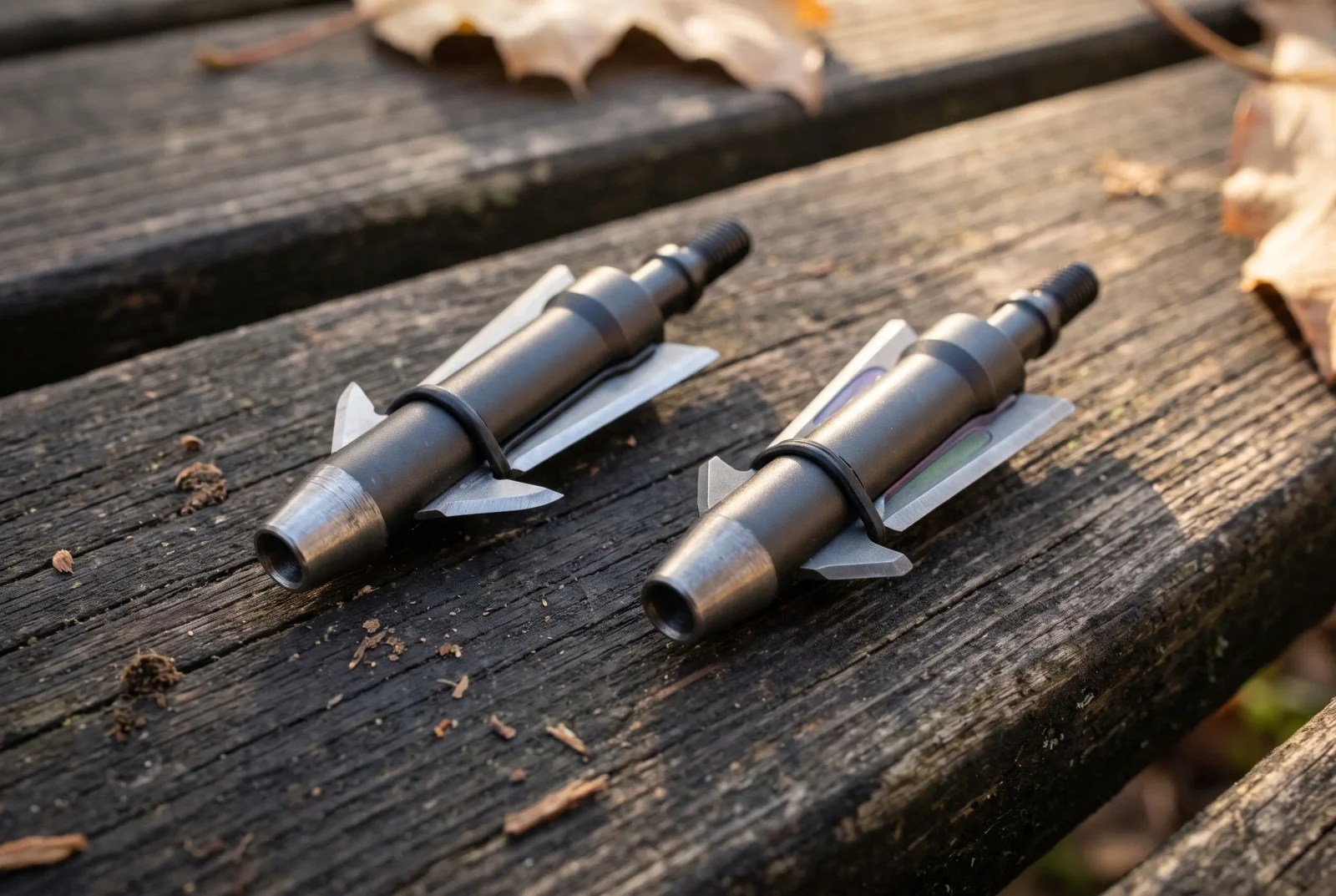 4.1
Swhacker #219 Crossbow Broadhead
A 100-grain 2-blade mechanical crossbow head, 1 inch wide in flight and 1.75 inches open, with band-held blades. Three per pack with a reusable case.
Read review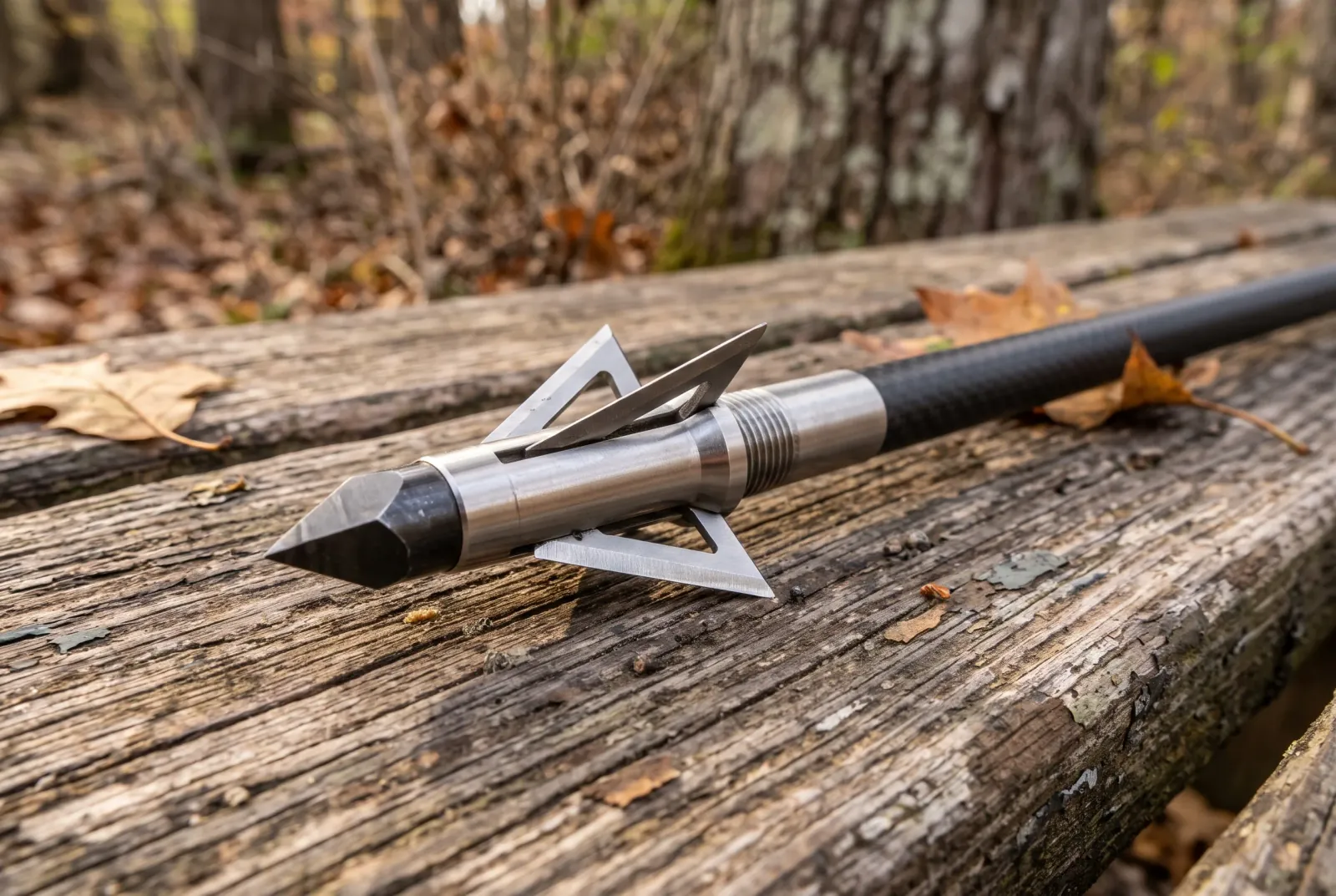 4.0
Muzzy Trocar HBX Crossbow Broadhead
A 100-grain hybrid crossbow broadhead with 2 fixed and 2 mechanical blades, a stainless steel ferrule and a 2 5/8-inch total cut. Three per pack.
Read review