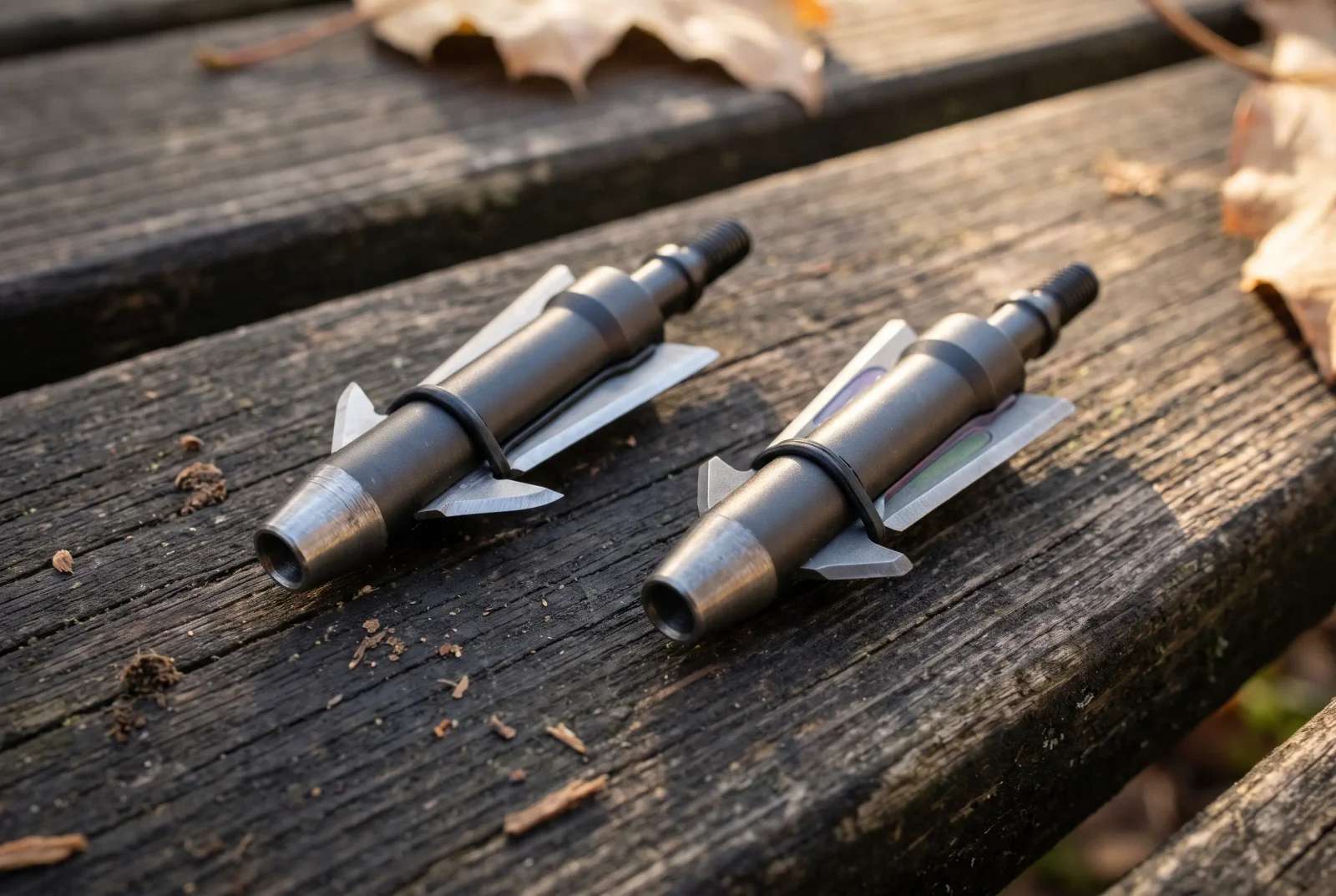
The Swhacker #219 is the Swhacker crossbow broadhead most hunters find on the store peg: a 100-grain, 2-blade expandable broadhead that is 1 inch wide in flight and opens to 1.75 inches after penetration. It comes three to a pack. Swhacker sells it through its own store, FL Outdoors, in its crossbow expandable collection.
The idea behind it is what Swhacker calls "slice-twice". Small wing blades cut on entry and push the larger main blades open, so the main blades reach the inside of the animal unused.
The score is 4.1 out of 5. It earns credit for a compact flight profile, a matching practice head and replaceable parts, and loses ground for the smallest total cut of the broadheads we review (1.75 inches against 2 to 3.75 inches) and for relying on bands instead of a published speed rating.
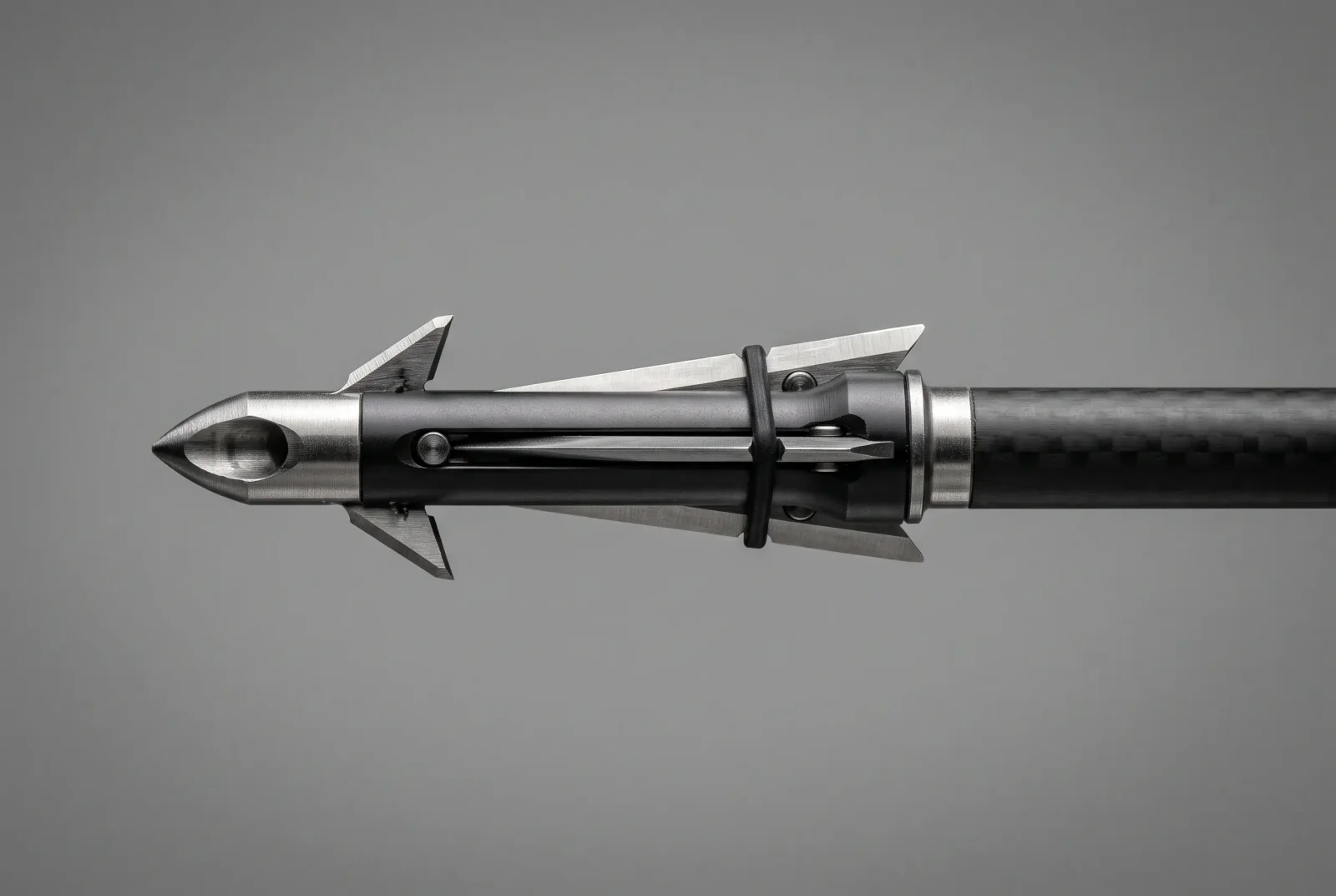
Swhacker #219 Specifications
These are the Swhacker #219 specs as Swhacker lists them on its product page.
| Specification | Details |
|---|---|
| Model / SKU | #219 Swhacker 100 Grain 1.75-inch Cut / SWH00219 |
| Type | Expandable 2-blade crossbow broadhead (mechanical) |
| Weight | 100 grains |
| In-flight diameter | 1 inch (closed) |
| Open cut | 1.75 inches after penetration |
| Blade | 0.031-inch thick stainless steel |
| Head length | 1.850 inches from insert to tip |
| Ferrule | Anodized aircraft aluminum |
| Point | Hardened high-carbon steel, hollow ground (threaded on) |
| Pack | 3 broadheads, reusable case, 6 replacement bands |
| Practice head | #220, not included |
| Replacement blades | #203 |
| Bands | #205 (crossbow under 420 FPS), #296 High Speed (crossbow over 420 FPS) |
| Speed rating | None published; band guidance at 420 FPS |
| Thread | Not stated on the #219 page |
At 100 grains it matches the most common crossbow head weight, so it should not change your total bolt weight from a 100-grain field point. The ferrule is the aluminum body that carries the blades and the threaded-on steel point.
What We Like
- A two-stage cut. The wing blades take the hide and the first ribs, and Swhacker says the main blades are not dulled on the way in. The main blades then open inside.
- A narrow flight profile. Closed, the head is 1 inch wide, which is a smaller profile in the air than an open fixed head of the same cut.
- A matching practice head. Swhacker sells the #220 in the same weight and says its 1-inch shape simulates the #219 in flight.
- Parts you can replace. Blades (#203), standard bands (#205) and high-speed bands (#296) are all sold separately, and the blades are fitted with a setscrew.
- Spares in the box. The pack includes a reusable case and 6 replacement bands with the three heads.
- Speed guidance. Swhacker tells you which band to use above and below 420 FPS.
Worth knowingA 100-grain 2-blade mechanical, 1 inch in flight and 1.75 inches open. Check which bands Swhacker lists for your crossbow's speed.
Potential Drawbacks
- The smallest total cut here. At 1.75 inches it trails the other broadheads we review, which list total cuts of 2 to 3.75 inches in the comparison table below.
- Bands to manage. The blades are held closed by bands that wear out, and you need the right band for your crossbow's speed.
- No speed rating as such. Swhacker gives band guidance at 420 FPS, not a top speed for the head.
- Practice head extra. The #220 is not in the pack.
- Moving parts. Like any mechanical, it has blades and pivots to inspect that a fixed head doesn't.
- Thread not stated. The #219 page doesn't list the thread, so confirm it fits your inserts before you buy.
How the Slice-Twice Design Works
What do the wing blades do?
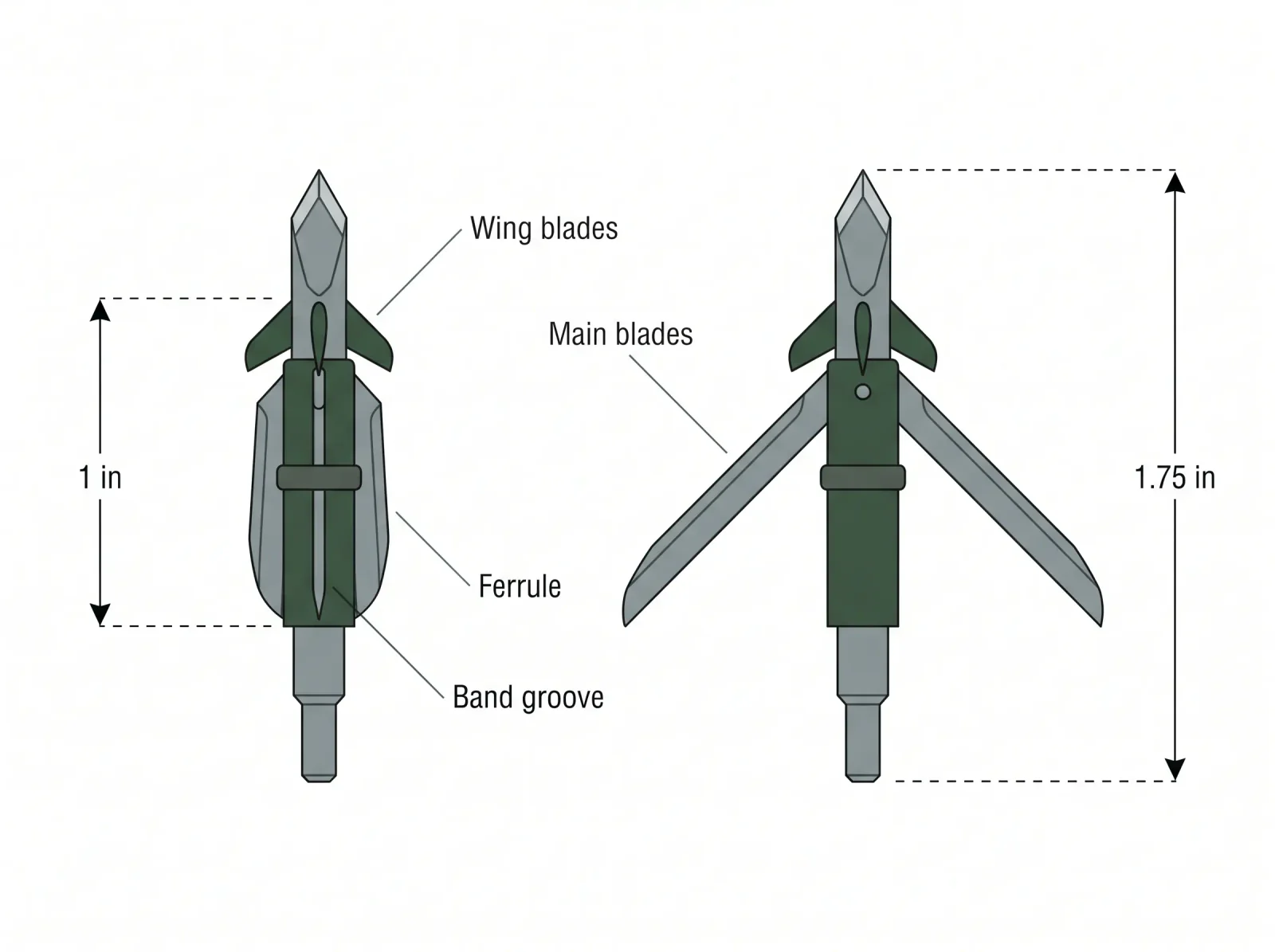
The #219 has two sets of edges. The first set, the wing blades, are much smaller than the main blades. Swhacker says they cut the hair, hide and first ribs on entry, open the head, and give the ferrule a load-bearing surface during impact.
Swhacker also claims the small wing blades need less energy to get in than a head that opens fully on impact. That is the maker's description, not an independent result.
When do the main blades open?
According to Swhacker's FAQ, the main blades deploy after the head enters the body cavity, wherever the head enters. The wing blades lead and the main blades swing out behind them to the full 1.75 inches. This is how a two-stage mechanical head is meant to work; it does not replace a good hit.
What holds the blades closed?
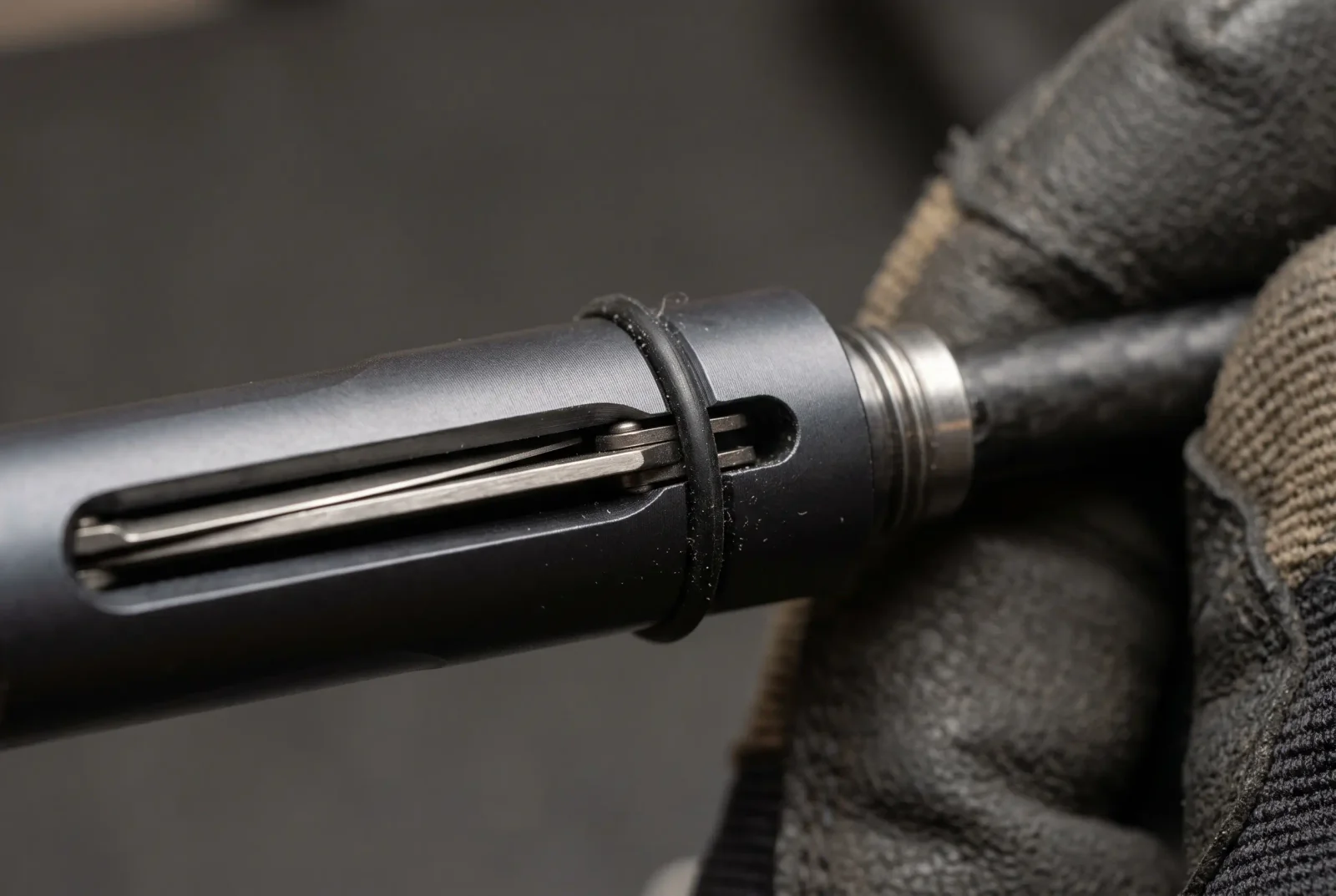
A retention band sits in a groove on the ferrule and holds the main blades folded in flight. Swhacker's fitting steps are:
- Place a single band over the tip with the blades fully enclosed in the slot.
- Slide the band down the ferrule into the retaining groove. The blades may move slightly.
- If the band will not stay in the groove, shrink it with a heat source such as a pocket lighter or a hair dryer, taking care not to overheat it.
Which Swhacker Crossbow Head? #219 vs #207 vs #243
Swhacker makes several 2-blade mechanicals. These are the ones a crossbow hunter is most likely to compare, with Swhacker's figures.
| Model | Weight | In flight | Open cut | Head length | Practice head | Sold as |
|---|---|---|---|---|---|---|
| Swhacker #219 Crossbow BroadheadCheck price on Amazon | 100 gr | 1 in | 1.75 in | 1.850 in | #220 | Crossbow broadhead |
| #207 | 100 gr | 1 in | 2 in | 2 in | #221 | Mechanical broadhead (compound or crossbow) |
| #243 | 150 gr | 1 in | 3 in | 2.5 in | #266 | Crossbow broadhead; replaces the discontinued #251 |
The #207 is the same weight with a wider cut and a longer head, and it uses the same band guidance as the #219. The #243 is a heavy option: Swhacker says it is compatible with any crossbow, and its pack includes both standard and high-speed bands, but 150 grains changes your total bolt weight. This review covers the #219 because it is the 100-grain head Swhacker files and names as a crossbow broadhead.
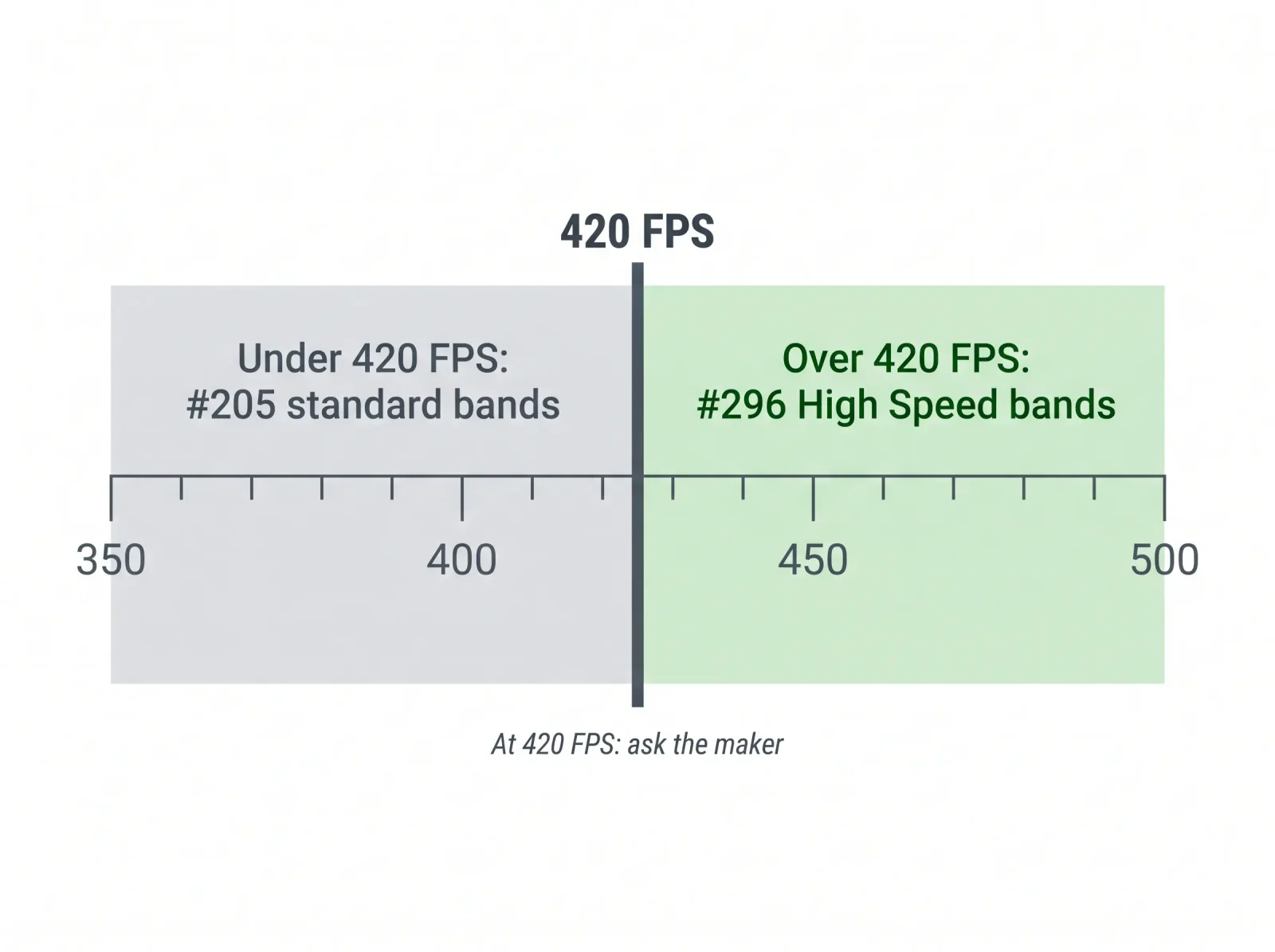
Bands and Crossbow Speed: Under or Over 420 FPS?
Swhacker gives its band guidance in two places, and they say slightly different things:
- The #219 product page: for a crossbow under 420 FPS, use #205 bands; for a crossbow over 420 FPS, use #296 High Speed bands.
- The Swhacker FAQ: any Swhacker mechanical can be used with a crossbow, and if it shoots more than 420fps, Swhacker recommends two retention bands to keep the blades closed until impact.
Neither is a speed rating for the head. They are band instructions. If your crossbow is over 420, follow Swhacker's current instruction for your setup and ask Swhacker if the two pages leave you unsure. Fit fresh bands before every hunt.
Your crossbow's rated speed is the figure to compare. Here is where the crossbows we review sit against the 420 line.
| Crossbow | Rated speed | Against 420 FPS | Band per the #219 page | Buy |
|---|---|---|---|---|
| Ravin R26X | 400 FPS | Under | #205 | Check price on Amazon |
| Barnett Hyper Whitetail 410 | 410 FPS | Under | #205 | Check price on Amazon |
| Ravin R10 Pro XK7 | 420 FPS | At the line | Ask Swhacker | Check price on Amazon |
| CenterPoint Wrath 430 | 430 FPS | Over | #296 | Check price on Amazon |
| Ravin R29X | 450 FPS | Over | #296 | Check price on Amazon |
| TenPoint Flatline 460 | 460 FPS | Over | #296 | Check price on Amazon |
| Ravin R470 | 470 FPS | Over | #296 | Check price on Amazon |
Rated speeds are the makers' figures with their own bolts. Your real speed depends on bolt weight, so a heavier bolt may put a crossbow on the other side of the line. To see what your setup delivers, enter your bolt weight and speed in the kinetic energy calculator, which shows kinetic energy in foot-pounds.
If you are still choosing a crossbow, our best crossbows for deer hunting roundup lists rated speeds for every pick, so you can see which band you will need.
Swhacker #219 vs TenPoint Nemesis vs Ravin R102
| Broadhead | Weight | In flight / entry | Open cut | Blade retention | Speed guidance | Score | Buy |
|---|---|---|---|---|---|---|---|
| Swhacker #219 Crossbow Broadhead | 100 gr | 1 in in flight | 1.75 in | Bands (#205 or #296) | Band guidance at 420 FPS | 4.1 | Check price on Amazon |
| TenPoint Nemesis Broadhead | 100 gr | 2 in entry cut | 3.75 in total (staged) | Not stated by TenPoint | Unlimited | 4.3 | Check price on Amazon |
| Ravin R102 Broadhead | 100 gr | Not stated by Ravin | 2 in | Internal spring clip | Up to 500 FPS with Ravin crossbows | 4.3 | Check price on Amazon |
| Muzzy Trocar HBX Crossbow Broadhead | 100 gr | 1 in fixed blades | 2 5/8 in total (1 in + 1 5/8 in) | Not named by Muzzy | Not published | 4.0 | Check price on Amazon |
The TenPoint Nemesis Broadhead is the pick for the widest cut: its staged blades total 3.75 inches against 1.75 for the #219. It also carries an unlimited speed rating, so band choice is not a question.
The Ravin R102 Broadhead suits a Ravin owner who wants nothing to replace: an internal spring holds the blades, and Ravin rates it to 500 FPS with its own crossbows.
The Muzzy Trocar HBX Crossbow Broadhead is a hybrid broadhead, with fixed blades that cut even if the mechanical pair stays shut.
The #219's case is simplicity and upkeep: a narrow head in flight, a matching practice head, and bands and blades you can swap at home.
What's in the Pack and What Else You Need
Each pack holds 3 broadheads, a reusable case and 6 replacement bands. Swhacker states that it does not include a practice head. Our crossbow bolts page covers the shafts, inserts and points the head threads onto, and the crossbow accessories page rounds up the targets, optics and other gear the rest of your hunting setup needs.
| Item | Swhacker part | What it is for |
|---|---|---|
| Practice heads | #220 (3-pack, sold separately) | 100 grains, 1 inch wide; Swhacker says it simulates the #219 closed in flight. Fits #201 and #219 |
| Standard bands | #205 (18-pack) | Compound bows and crossbows under 420 FPS; fits all Swhacker 100-grain models |
| High-speed bands | #296 (18-pack) | Crossbows over 420 FPS; 100-grain high-speed bands |
| Replacement blades | #203 | 0.031-inch stainless, set of 6 with extra shrink tubing; fits #201 and #219 |
| Bolts with matching inserts | Your choice | Total weight within your crossbow's rated range |
| Broadhead target | Your choice | A target rated for broadheads, for practice and final checks |
A practice head lets you check impact without opening or dulling a hunting head. The #220 shares the #219's blade, ferrule, point and head length on Swhacker's page.
For the shaft, our guide on how to choose crossbow bolts explains length, weight and insert types, so you can check the head will thread in and the total weight suits your crossbow.
Setup and First Practice Session
- Match the bolt. Use bolts your crossbow manual permits, and confirm the head threads fully into your inserts.
- Spin it. Thread the head on and do a spin test; a wobble at the tip means the head or insert is not straight.
- Fit the right band. Use #205 or #296 by your crossbow's speed, as above, seated in the groove.
- Zero with field points. Sight in with 100-grain field points first.
- Shoot the practice heads. Shoot #220 practice heads at the same distances and compare impact.
- Confirm with one hunting head. Shoot one #219 into a broadhead target, then adjust if it lands away from your zero.
- Re-band and inspect. Fit a fresh band, check the blades swing freely and keep the practice head out of your hunting quiver.
On blade orientation, Swhacker's FAQ says it is a matter of preference: most hunters line the blades up vertically, and if the bow is properly tuned it does not matter how the head lines up with the fletching. If your broadheads still group away from your points, our guide on crossbow broadhead tuning sequences the spin test, practice heads and re-zeroing.
Head weight also changes how front-heavy the bolt is. Our guide on FOC and crossbow accuracy explains how tip weight shifts a bolt's front of center balance and why that matters for flight.
Is 1.75 Inches Enough for Deer? Shot Placement
Cut size matters less than where the bolt goes. A smaller mechanical that passes through both lungs on a broadside shot does more than a wider head in the wrong place. A quartering shot away from you also opens a clear path to the vitals; quartering toward you puts the shoulder in the way.
The aim on every shot is the vital zone. Our guide to crossbow deer shot placement shows which angles to take and which to pass up.
A wider cut can help leave a better blood trail, and that is the honest trade with the #219: a compact head and simple upkeep against a smaller total cut than the R102, the HBX or the Nemesis. If you choose it, be strict about range and angle.
Legal Check
Some states restrict mechanical or expandable broadheads, and some set a minimum cutting width. Check how your state words its rule, and compare it with the #219's 1-inch closed and 1.75-inch open cutting diameter.
Our crossbow hunting laws by state page is the starting point. Confirm with your state wildlife agency before the season; this is not legal advice.
Care, Re-Use and Rattle
- Re-using blades. Swhacker says its mechanical blades are durable enough to re-use and that, depending on the impact, you could take several animals on one set. It recommends touching them up with a sharpener after every use. Replace bent or chipped blades with a #203 set.
- Blade rattle. Swhacker says the ferrule slot is machined with some clearance on purpose, so the blades open freely and are not trapped if the ferrule hits heavy bone. To stop the rattle, it suggests putting some bowstring wax on both blades, closing them and sliding the band on.
- Bands. Replace a band after every shot into a target or an animal, and any time it looks stretched or cracked.
- Storage. Keep heads banded and in the reusable case between hunts.
Who Should Skip the #219
- You want the widest wound channel. The Nemesis's staged 3.75-inch cut is far wider.
- You shoot a Ravin and want no bands. The R102's internal spring removes band upkeep.
- You want no moving parts. A fixed blade has nothing to open or fail.
- Your state limits mechanicals. Check the rules before you buy.
- Your crossbow sits right at 420 FPS and you don't want to ask Swhacker which band to use.
If a head with no moving parts appeals, our guide to fixed-blade hunting broadheads explains the trade-offs. Our best crossbow broadheads roundup ranks the heads we review side by side for deer.
The crossbow calculators cover energy, FOC, bolt drop and cocking effort if you want to check the numbers behind this setup. Every other model reviewed in this class is compared on the crossbow accessories page.
Where the Swhacker #219 Crossbow Broadhead ranks
The Swhacker #219 Crossbow Broadhead earned a place in Best Crossbow Broadheads for Deer 2026 (#3), where it is scored against every other model reviewed for that use. It also comes up in Crossbow Broadhead Tuning: Get Broadheads on Your Zero.
Swhacker #219 Crossbow Broadhead Review: Final Verdict
Swhacker #219 Crossbow Broadhead
4.1 / 5 — Is it worth buying?
The Swhacker #219 is a compact, easy-to-maintain mechanical with a modest cut. Deployment Reliability 4.0/5: wing blades open the head, but the bands wear. Flight Accuracy 4.0/5: a 1-inch closed profile and matching practice head. Penetration Performance 4.0/5: a hardened steel point, but the smallest total cut we review. Build Quality 4.0/5: an anodized aluminum ferrule with 0.031-inch stainless blades. Value for Money 4.3/5 and Ease of Maintenance 4.3/5: spare bands included and simple home blade swaps.
Best for
Deer hunters with a crossbow under or around 420 FPS who want a narrow-flying mechanical and a matching practice head
Skip if
You want the widest cut, no bands to manage or no moving parts
Score breakdown
- Deployment Reliability4.0/5
- Flight Accuracy4.0/5
- Penetration Performance4.0/5
- Build Quality4.0/5
- Value for Money4.3/5
- Ease of Maintenance4.3/5
- Weight
- 100 grains
Frequently Asked Questions
Is the Swhacker #219 good for crossbows?
Swhacker sells the #219 as a crossbow broadhead and files it in its crossbow expandable collection. It is a 100-grain 2-blade mechanical, 1 inch in flight and 1.75 inches open. Use the band Swhacker lists for your crossbow's speed.
Which bands should I use on a crossbow over 420 FPS?
The #219 product page says to use #296 High Speed bands over 420 FPS and #205 bands under it. Swhacker's FAQ says to use two retention bands over 420fps. Follow Swhacker's current guidance for your setup.
Do I need the #220 practice head?
It is not required, but it is sold separately to match the #219 in flight. Swhacker says it simulates the closed in-flight state, so you can practice without wearing out hunting heads. Still shoot one hunting head before the season.
What is the difference between the Swhacker #219 and #207?
Both are 100 grains and 1 inch in flight. The #219 opens to 1.75 inches with a 1.850-inch head length; the #207 opens to 2 inches with a 2-inch head length and uses the #221 practice head.
Do the blades open without hitting bone?
Swhacker says the main blades deploy after entering the body cavity, wherever the head enters. That is the maker's claim, so focus on a clean shot to the vitals.
Can I re-use the blades?
Swhacker says yes, depending on the impact. Replace damaged blades with the #203 set, and fit a fresh band each time.
Does the #219 fit standard inserts?
Swhacker's #219 page does not state the thread. Check with Swhacker or against your bolt's inserts before you buy.
Why do my Swhacker blades rattle?
Swhacker machines the ferrule slot with some clearance so the blades open freely. It suggests a little bowstring wax on both blades before you fit the band.
Related Reviews
 4.0
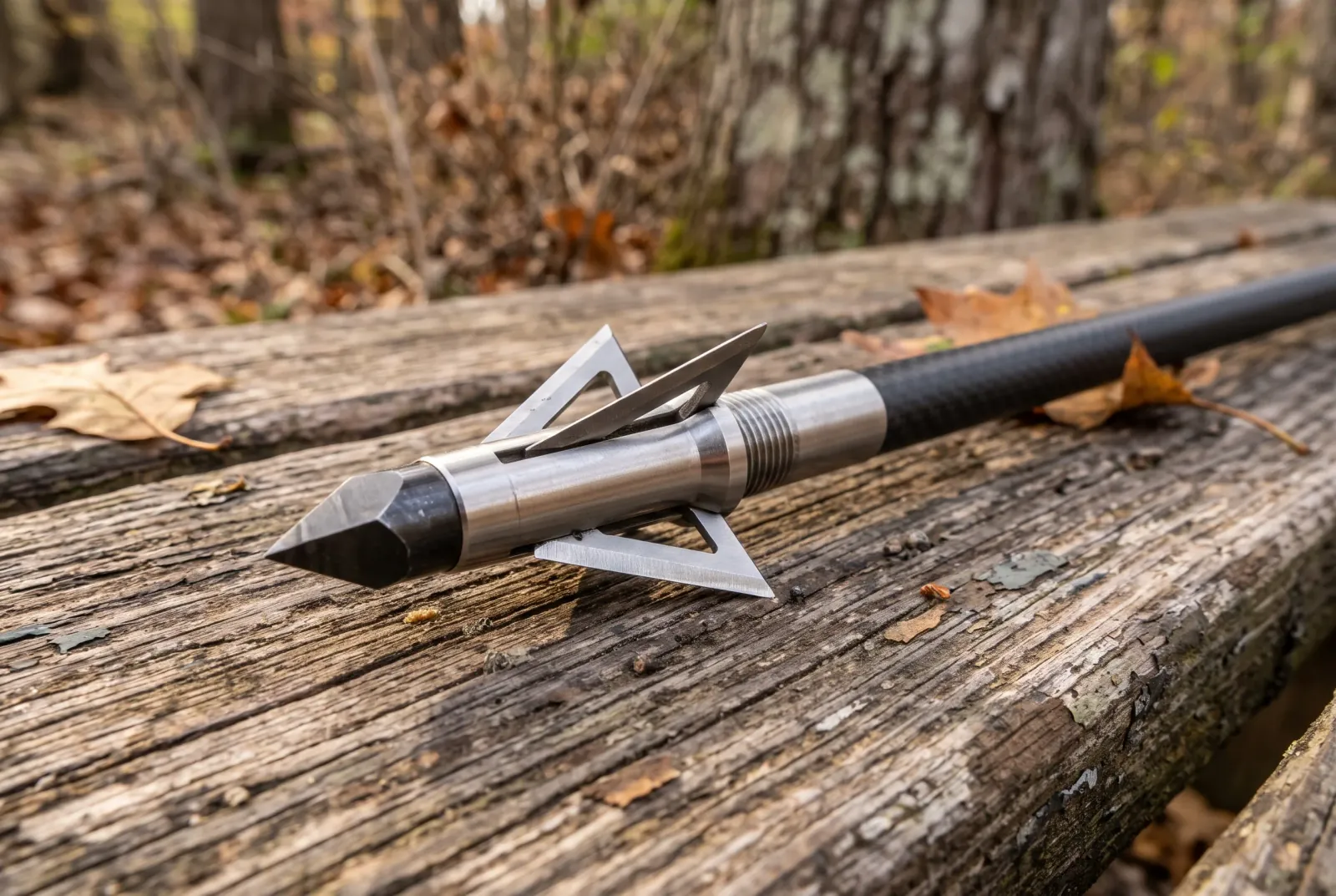
Muzzy Trocar HBX Crossbow Broadhead
A 100-grain hybrid crossbow broadhead with 2 fixed and 2 mechanical blades, a stainless steel ferrule and a 2 5/8-inch total cut. Three per pack.
Read review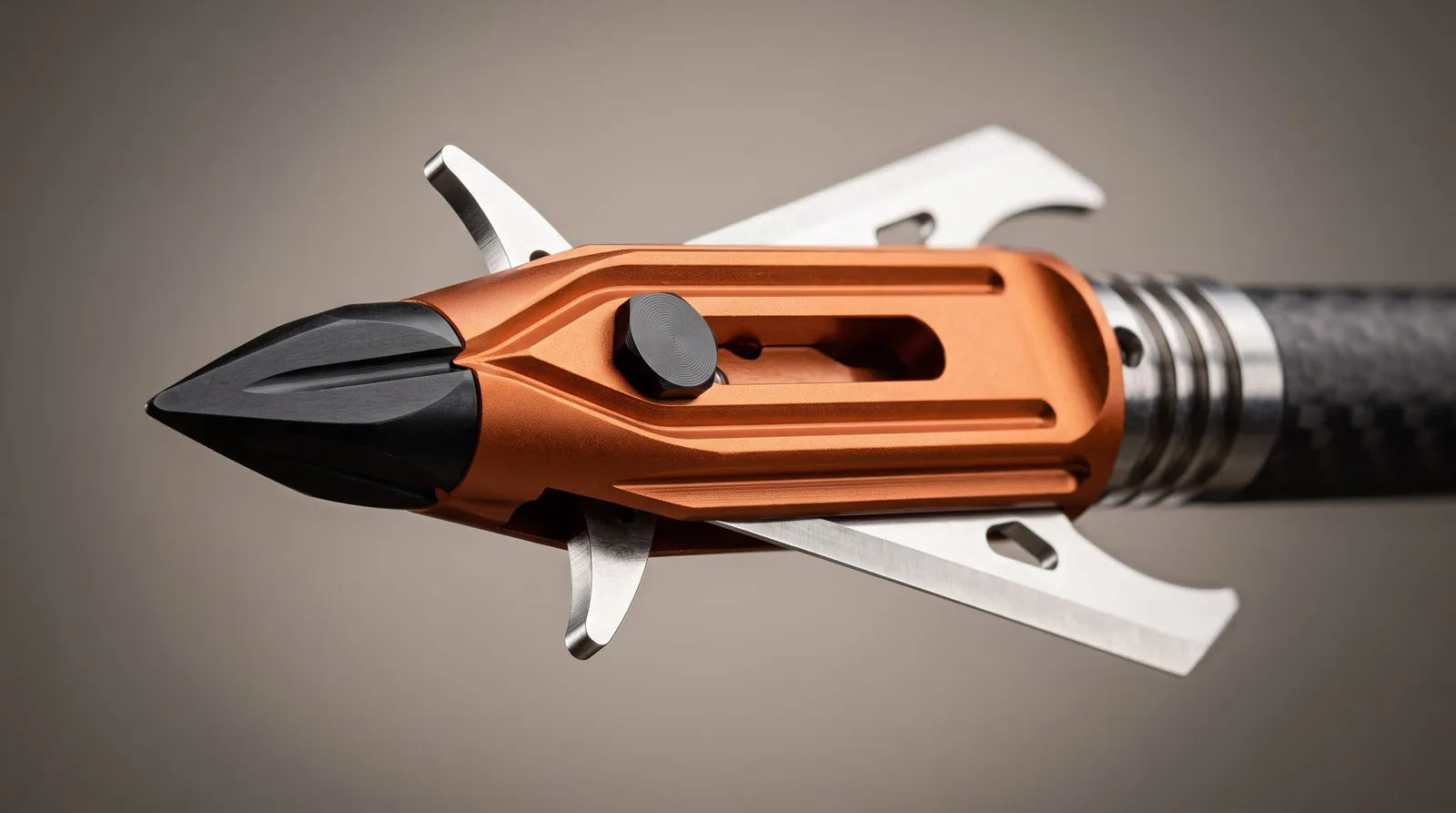 4.3
Ravin R102 Broadhead
A 100-grain mechanical head rated by Ravin to 500 FPS with Ravin crossbows. An internal spring holds the blades closed, so there are no O-rings to replace.
Read review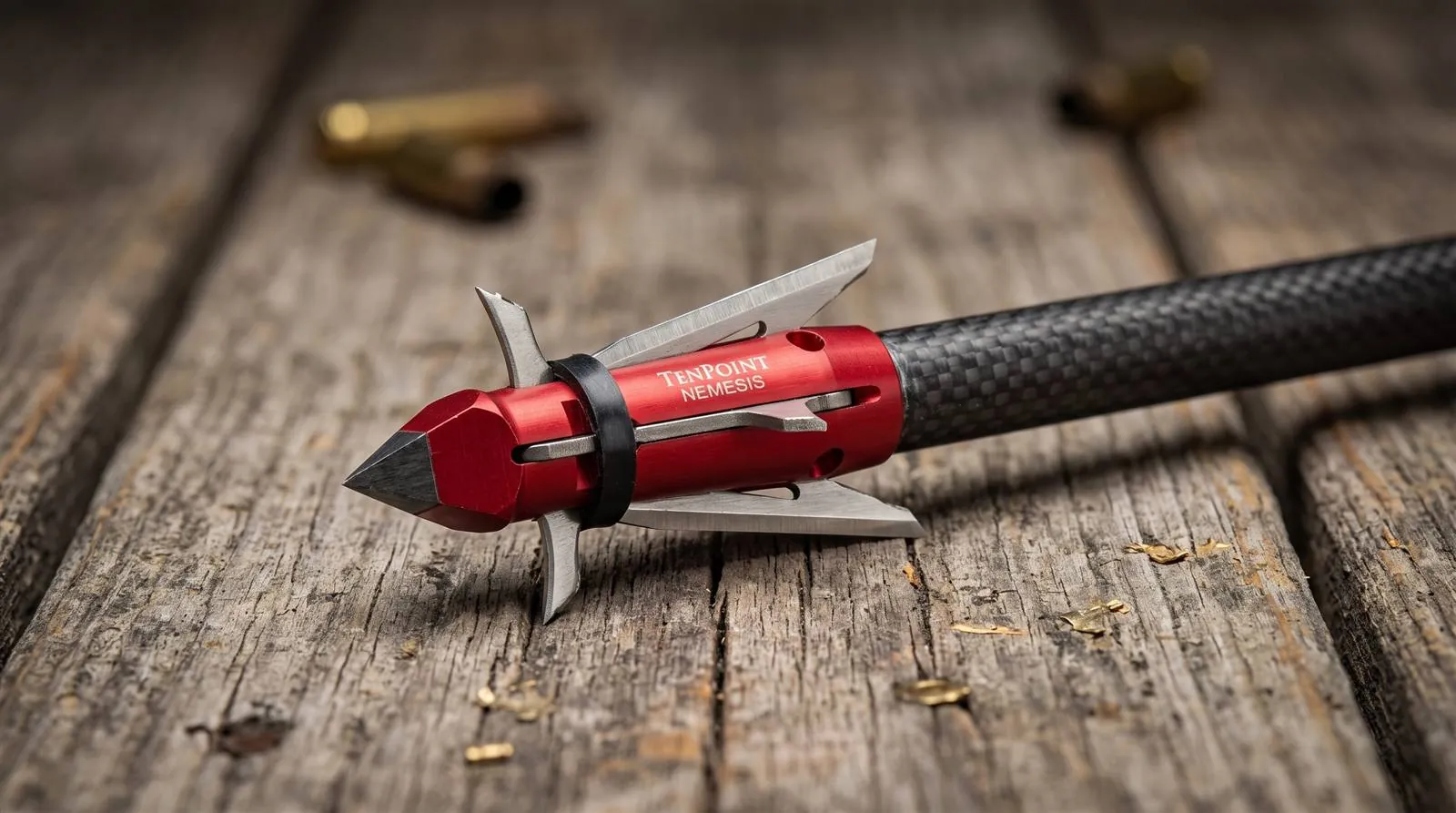 4.3
TenPoint Nemesis Broadhead
Staged mechanical crossbow broadhead with a 3.75-inch total cut and an unlimited speed rating. 100 grains, sold in packs of three.
Read review