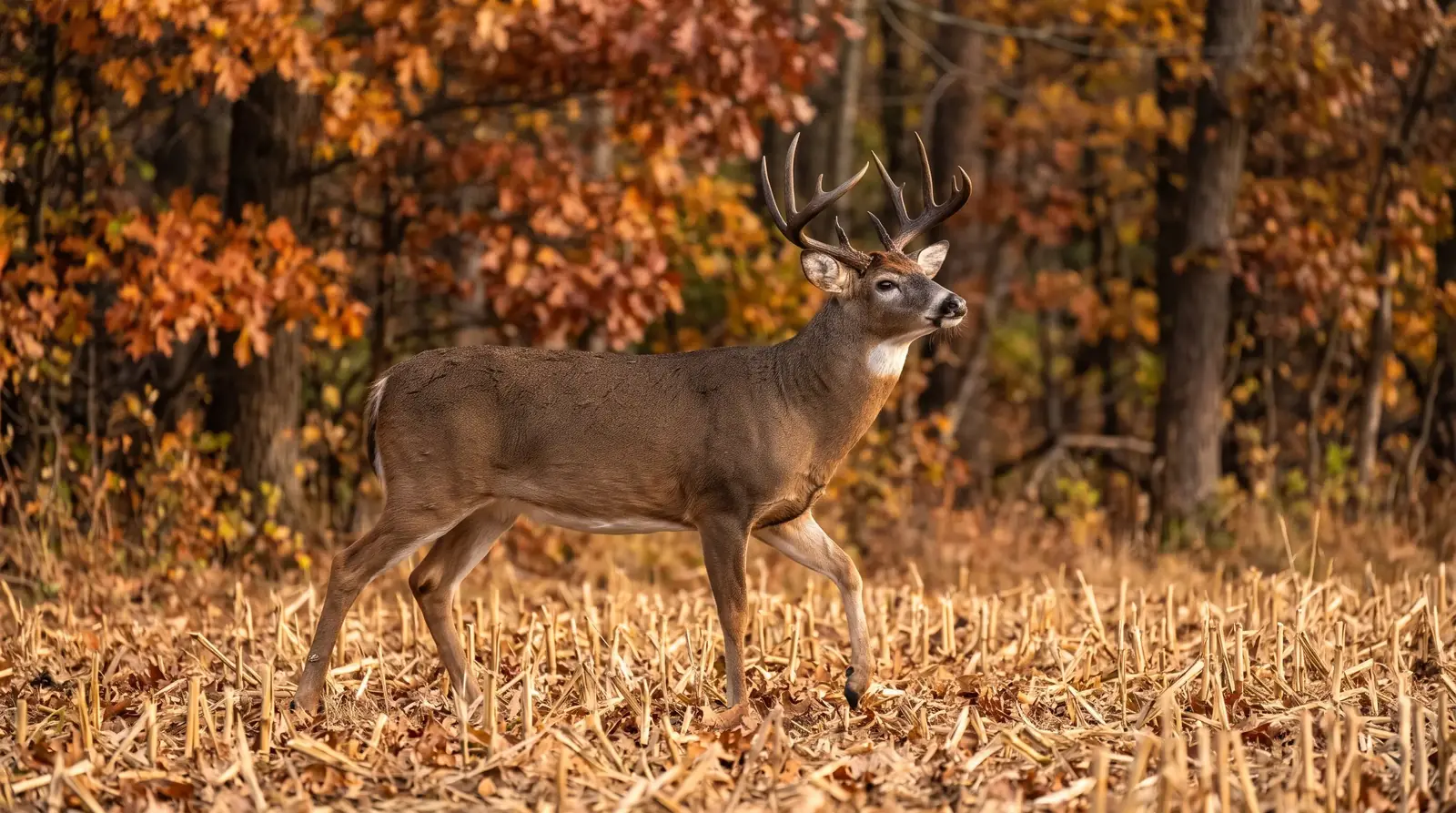
Good crossbow shot placement on deer comes down to two decisions: aim for the heart and lungs, and take only the angles that let a bolt reach both lungs. A crossbow kills by blood loss, not shock, so a bolt that misses the chest cavity leaves a wounded deer however fast it flew. This page covers where those organs sit, the aim point for every angle, how a stand changes it, and what to do once the bolt is gone.
It is the shot-placement chapter of our crossbow hunting guide, which covers stands, scouting and the season as a whole.
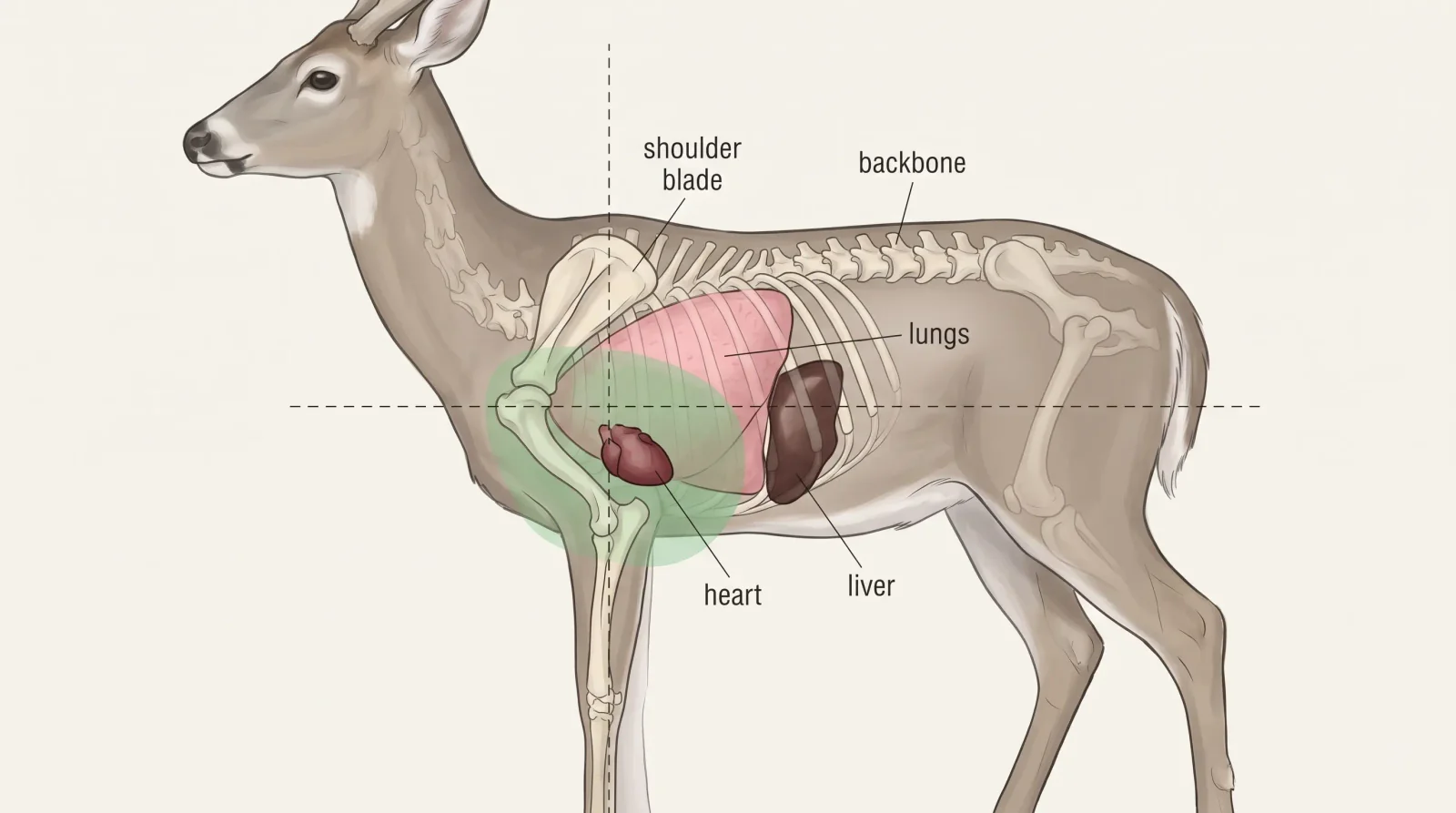
Deer Vital Zone Anatomy
The vital zone is the heart and the lungs, with the liver just behind them. The New Jersey hunter education manual names the best shot as a double-lung hit: both lungs punctured, a short run and a clear blood trail. Hunter-education material also stresses one detail rifle hunters often miss. You are not aiming at the deer; you are aiming at a spot smaller than a pie plate on it.
| Organ | Where it sits on a broadside deer | What a hit means |
|---|---|---|
| Lungs | Fill most of the chest, behind and above the front leg, from about the lower third of the body to below the backbone | Double-lung: the shot to aim for. One lung only: a deer can survive it |
| Heart | Low in the chest, in line with the front leg, behind the shoulder joint | Fatal and fast, but low; aim a little high and you still hit the lungs |
| Liver | Behind the lungs, against the diaphragm | Fatal but slower; never a deliberate aim point |
| Shoulder blade and leg bones | Cover the front of the chest when the leg is forward | Can stop or deflect a bolt |
| Backbone | Runs along the top of the chest | From a high angle it hides much of the lung area |
onX Hunt's published shot-placement guide adds a point worth remembering on a small doe or a yearling: their vital organs are roughly half the size of a mature buck's, so your margin for error is roughly halved too. Size your aim point to the deer, not to the chart.
Where to Aim at Every Angle
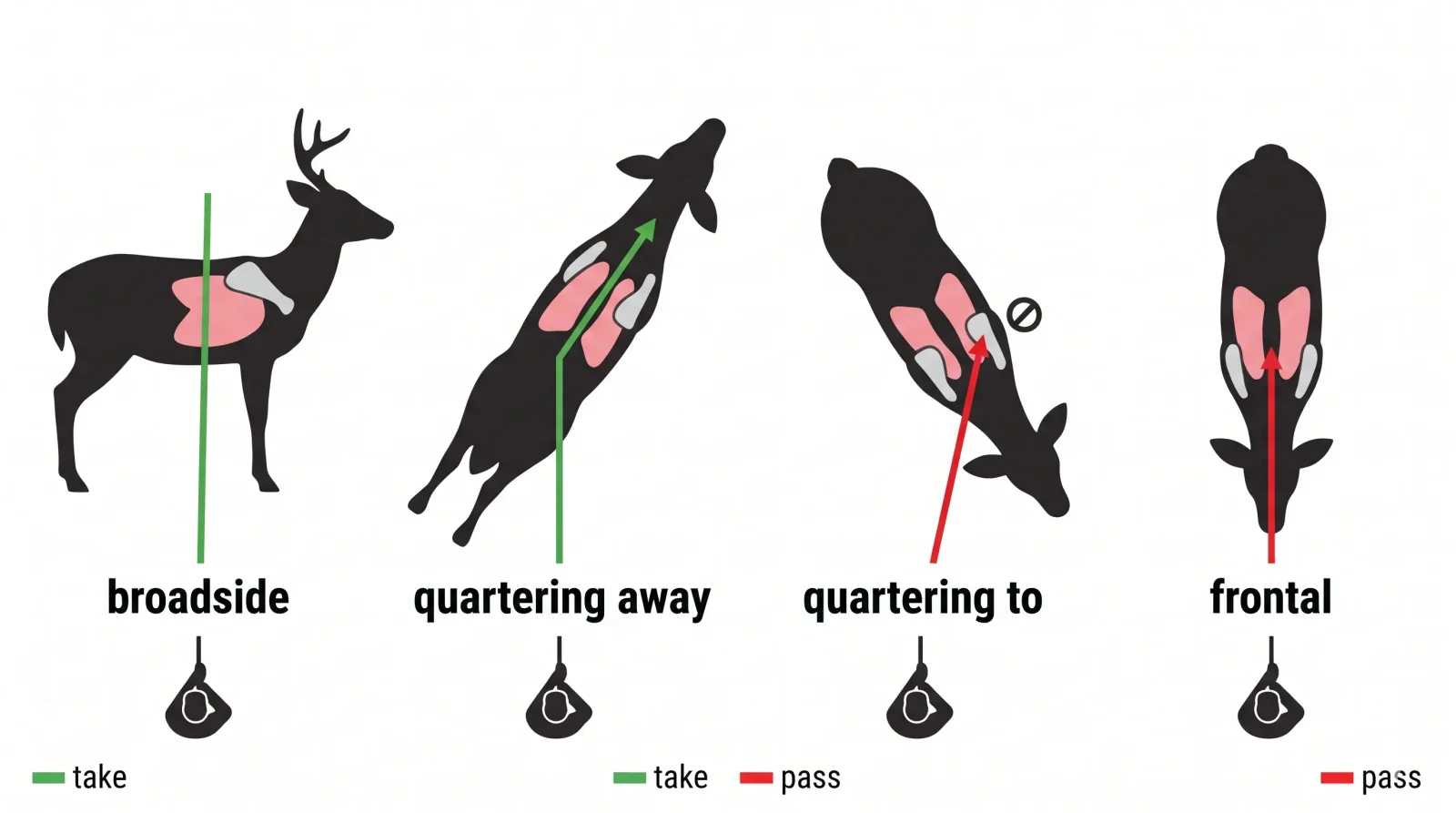
TenPoint, the crossbow maker, and the magazine Deer & Deer Hunting publish the same order of preference for crossbow hunters: broadside first, quartering away second, quartering to only rarely, and everything else passed. The New Jersey hunter education manual names broadside and quartering away as the two best shots with any weapon.
| Angle | Take or pass | Aim point | Why |
|---|---|---|---|
| Broadside | Take | Vertical crosshair on the front leg, one-third to one-half up the body | Widest view of both lungs and the heart |
| Slight quartering away | Take | Line up so the bolt exits at the far-side front leg or shoulder | Bolt enters behind the ribs and angles forward through both lungs |
| Steep quartering away (over about 45 degrees) | Pass | — | The lung window shrinks; the bolt can travel through the paunch and reach only one lung |
| Quartering to | Pass (rare exceptions) | Inside edge of the near-side front leg, if taken at all | Shoulder blade and leg bones guard the vitals |
| Frontal (facing you) | Pass | — | Narrow target between the shoulders, heavy bone |
| Straight away (rear end) | Pass | — | No clean path to the lungs |
| Straight down from a stand | Pass | — | Backbone covers the lungs; a one-lung hit is likely |
| Head or neck | Pass | — | Small, moving target; a near miss leaves a wounded deer |
Broadside
A broadside deer shows the most lung, and both TenPoint and Deer & Deer Hunting call it the most forgiving shot: an aim error of an inch or two still hits the vitals. Put the vertical line of your reticle on the front leg (TenPoint says its center, Deer & Deer Hunting its back edge) and the horizontal line one-third to one-half of the way up the body.
Quartering away
A deer angled away from you, with its rear end closer, is the second-best shot. The bolt enters behind the last ribs and travels forward, so aim at the point where you want it to come out: the far-side front leg or shoulder. The New Jersey manual puts it simply: aim at the opposite front shoulder to hit both lungs.
The steeper the angle, the smaller the window. TenPoint and Deer & Deer Hunting both put the limit at about 45 degrees; beyond that the bolt spends most of its energy in the stomach and may glance off or reach only one lung. A heavy, well-built fixed-blade head is the safer choice for this shot (see the broadhead section below).
Quartering to
A deer angled toward you puts its near-side shoulder blade and leg bones between you and the lungs. TenPoint advises taking it only when the angle is slight, you are confident in your accuracy and no better angle is likely to come. If you do take it, the aim point is the inside edge of the near-side front leg, one-third to one-half up the body. A bolt that strikes the shoulder blade, the brisket or the breastbone may deflect or stop short.
For most crossbow hunters the better answer is to wait for the deer to turn.
Frontal, straight away and straight down
All three are passes. A deer facing you offers a narrow chest between heavy shoulders; onX Hunt puts the frontal ribcage at only about 12 to 14 inches wide, with the heart a far smaller target inside it. A deer facing straight away offers no clean path to the lungs.
Heavy bone is the real problem with these angles. Deer & Deer Hunting points out that a carbon shaft can break on solid bone, so a shoulder hit can stop short of the lungs. Our guide to crossbow speed and energy for deer explains how much energy penetration needs.
Straight down from a stand is covered in the next section.
Head, neck and "disabling" shots
Pass on the head and neck. The brain is tiny, the head moves constantly, and the New Jersey manual calls the head a low-percentage shot that should never be attempted. Deer & Deer Hunting adds a warning about shooting to "anchor" a deer through the shoulder, backbone or hindquarters so you can shoot again: those hits often end in a wounded deer that is never recovered. A bolt is not a bullet, and even a strong carbon shaft can fail on heavy bone.
Shot Placement From a Tree Stand
A stand changes two things: the path the bolt takes through the deer, and where the bolt hits relative to your aim.
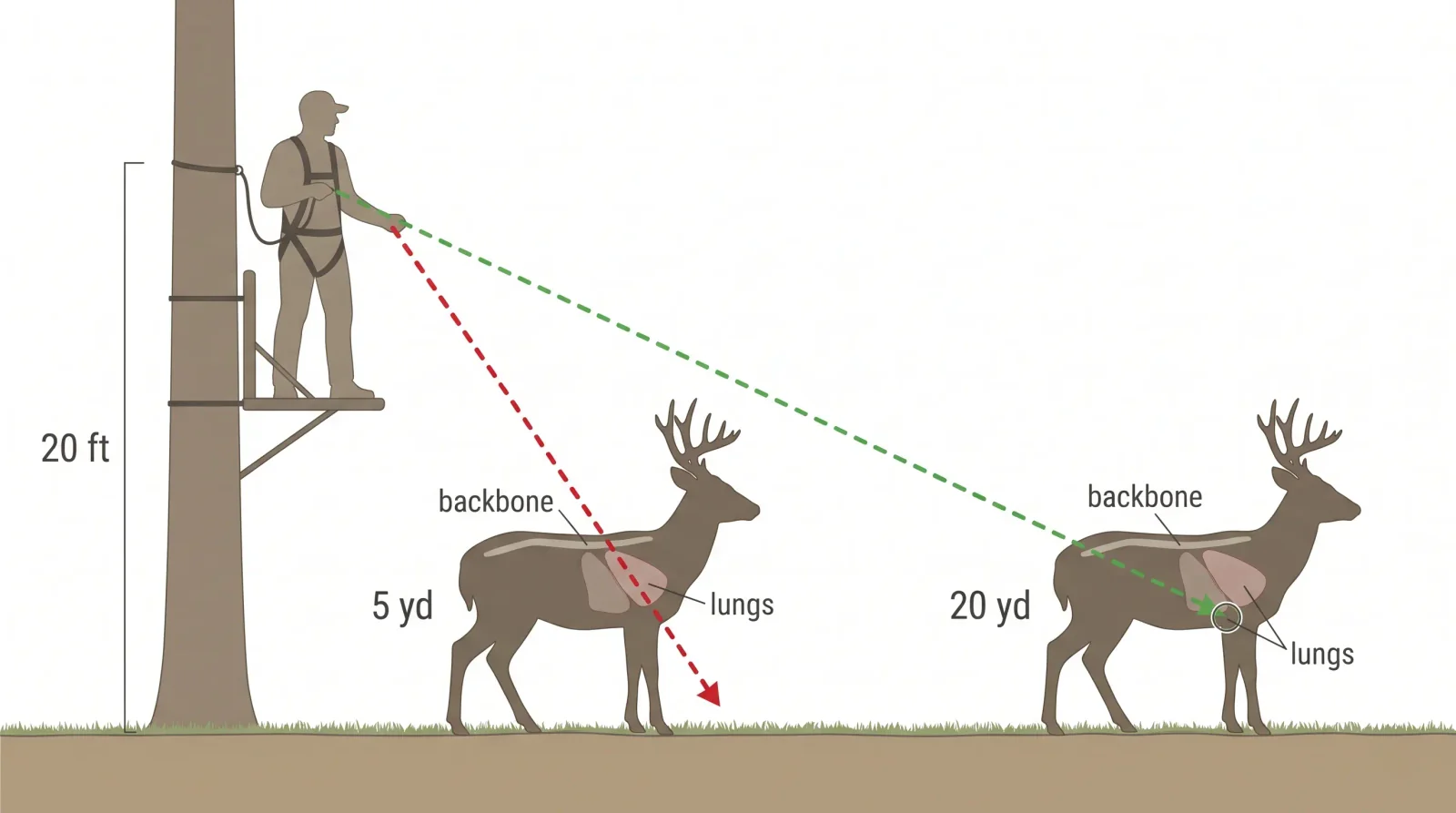
Think about the exit hole. From above, the bolt travels downward through the chest. If you aim at the usual broadside spot, the bolt can enter mid-chest and exit low, or slip under the far lung. onX Hunt's advice is to picture where you want the bolt to come out on the far side, low behind the far front leg, and work back to the entry point. On a quartering-away deer from a stand, that pushes the entry point further back; on a deer quartering to, further forward.
Height makes it harder. The higher the stand and the closer the deer, the steeper the angle and the more the backbone covers the lungs. onX Hunt notes this, and the New Jersey manual sets a firm rule: never shoot a deer straight down. With the backbone over the lungs it is near impossible to hit both, and a deer can live with one. If a deer is directly below you, wait until it walks out to at least 10 yards and turns broadside or quartering away.
The bolt hits higher than you expect. TenPoint notes that from an elevated position the point of impact may be higher than the point of aim, and the steeper the angle, the bigger the difference. Gravity acts over the horizontal distance to the deer, not the line-of-sight distance a basic rangefinder reads, so at 30 yards line-of-sight from a stand you should aim for the shorter horizontal distance. Our guide on shooting high from a tree stand shows the cosine math and a table by stand height, which is worth reading before you set any pins or holds for stand hunting. The same horizontal-distance rule applies to steep uphill or downhill shots taken from the ground.
A rangefinder with angle compensation does that calculation for you. onX Hunt also warns that hunters tend to overestimate slopes: an angle that looks like 30 degrees may be closer to 15.
How Far Is Too Far?
There is no single ethical distance for a crossbow. Your effective range is the farthest distance at which you can keep every bolt inside a pie-plate-sized vital area, from a hunting position, with the head you hunt with, on the first shot of the day. For many hunters that is well inside what the crossbow can reach. onX Hunt notes many bowhunters are comfortable to about 40 yards; treat that as a ceiling to earn, not a starting point.
Two numbers decide whether a longer shot is realistic:
- Drop. A crossbow bolt falls fast once it passes your zero. Our bolt drop chart shows how far your bolt falls at each distance for your speed and bolt weight, so you know how much a 5-yard ranging error moves impact at 40 yards.
- Energy. A bolt keeps less kinetic energy the farther it flies, and penetration on a quartering shot needs margin. The kinetic energy calculator turns your bolt weight and speed into foot-pounds so you can see what arrives at your longest shot.
Bolt trajectory also magnifies every ranging mistake, so range landmarks around your stand before the deer arrive. Some states set minimum broadhead widths or other equipment rules for crossbows; check our crossbow hunting laws by state page and your state wildlife agency before the season. This is not legal advice.
Bolt Speed and Deer Jumping the String
"Jumping the string" is a deer reacting to the sound of the shot and dropping, spinning or lunging before the bolt arrives. Outdoor Life's reporting says deer usually duck low rather than jump up. A deer that drops a few inches turns a heart shot into a lung shot, and a lung shot into a high hit or a miss.
Sound travels at about 1,125 feet per second, roughly three times faster than a crossbow bolt. Simple arithmetic shows why distance matters: at 30 yards (90 feet), the sound reaches the deer in about 0.08 seconds, while a bolt leaving at 400 FPS takes at least 0.23 seconds, and a little longer in practice because the bolt slows in flight. Every extra yard gives the deer more time to react.
What published sources report:
- Outdoor Life's 2026 article on string jumping says about 80 to 90 percent of whitetails react to the shot in some way, though the same deer may duck hard on one shot and barely move on another.
- It reports an estimate from deer biologist Grant Woods of about 2 inches of drop at 20 yards, 6 inches at 30 yards and more than 10 inches at 40 yards, for bows slower than most crossbows.
- For crossbows, the same article concludes that ducking could be an issue at 40 yards and beyond with typical 350 to 400 FPS crossbows, and that it would be nearly impossible for a deer to duck the fastest models even at 40 yards.
- The New Jersey manual makes the same point from the other end: an alert deer at close range has time to react to the shot.
What to do about it:
- Shoot relaxed deer. A deer that is feeding or walking calmly reacts less than one that is staring at your stand. Stopping a deer with a bleat or grunt puts it on alert; Outdoor Life's sources say stopping deer promotes ducking.
- Keep shots close. Inside about 20 yards the deer has little time to move, whatever your speed. Faster bolts help at longer range; our guide to how fast a crossbow bolt travels explains how rated speed compares with speed on a hunting-weight bolt.
- Aim low in the vitals, never below the deer. Holding on the lower third of the chest gives a ducking deer room to drop into the lungs. The hunters interviewed by Outdoor Life aim lower on alert deer, but none aim under them.
- Reduce noise. A quieter crossbow makes less shot noise for the deer to react to, though no crossbow is silent.
Broadhead Choice by Angle
The angle you plan to accept should shape the broadhead you carry. On a broadside double-lung shot almost any sharp, well-flying head works. The difference shows on angled shots, where the bolt has to drive through more tissue and sometimes a rib.
| Shot you expect to take | Head to favor | Why |
|---|---|---|
| Broadside inside about 30 yards | Either type | Short path through soft tissue |
| Quartering away | Fixed blade, or a mechanical your crossbow drives well | More tissue to pass through before the far lung |
| Frequent close stand shots on steep angles | Fixed blade | Blades are open from the start, no energy spent opening them |
| Longer broadside shots at the edge of your range | Mechanical | Usually flies closer to your practice points |
A fixed-blade broadhead has no blades to open, which is why many bowhunters prefer one for angled shots. The New Jersey manual warns that not all mechanical broadheads are capable of making quartering-away shots, so if you hunt with one, know its limits. Our guide to fixed-blade hunting broadheads explains blade count and cut for deer.
A mechanical broadhead opens on impact and cuts a wider hole when it gets through, as long as the bolt carries enough energy to drive it.
The TenPoint Nemesis Broadhead is a 100-grain, four-blade expandable that TenPoint rates at a 2-inch entry cut and a 3.75-inch total cut.
The Ravin R102 Broadhead is a mechanical whose blades deploy on impact, held closed by an internal spring, for a rated 2-inch cut. A wider cutting diameter adds margin on a slightly off shot, but it never fixes a bad angle.
The Muzzy Trocar HBX Crossbow Broadhead is a hybrid broadhead: two fixed blades cut a 1-inch path from the moment of contact, and two mechanical blades open to a 2 5/8-inch total cut, which suits a hunter who worries about a mechanical failing to open.
Whatever head you choose, make sure it flies with your field points before the season; our crossbow broadhead tuning guide walks through it step by step.
For side-by-side picks, our best crossbow broadheads for deer hunting roundup compares fixed and mechanical heads.
After the Shot: Hit Signs and How Long to Wait
What you do in the first minutes decides whether you recover the deer. This is a short summary; read the bolt and the sign, then give the deer time.
- Watch and listen. Follow the deer with your eyes as far as you can and listen for a crash. Mark the spot where it stood and the last place you saw it.
- Note the time. The New Jersey manual says to wait at least 20 minutes before leaving the stand even after a well-placed shot; American Hunter's guidance is 30 minutes for heart and lung hits.
- Read the bolt and the ground. Look for the bolt, blood, hair and scuffed ground at the impact site. A lighted nock makes the bolt easier to find and shows where it hit as it flies.
- Decide how long to wait using the table below, then follow the blood trail quietly.
| Sign on the bolt or trail | Likely hit | Wait before following |
|---|---|---|
| Bright red blood, deer crashes or goes down in sight | Heart or major artery | At least 20–30 minutes |
| Pink, frothy blood with small bubbles | Lungs | About 30 minutes |
| Dark red, slimy or watery blood, often sparse | Liver | At least 1 hour (NJ manual); 3–6 hours (American Hunter) |
| Brown or green stomach matter, foul smell | Gut (paunch) | At least 6–8 hours (NJ manual); 6–12 hours or overnight (American Hunter) |
| Little blood, hit high or in a leg | Muscle or bone, non-vital | Wait 30 minutes, then follow carefully |
Pushing a liver-hit or gut-hit deer is the most common way to lose one. If in doubt, wait longer. Stay to the side of the blood trail, mark it as you go, and keep the search party small, which the New Jersey manual puts at three people at most. Approach a downed deer from behind the head and confirm it is dead before you touch it. Tagging and reporting rules vary by state.
Practice Drills With a 3-D Target
A bag or block target teaches you to group; a life-size 3-D deer target teaches you where to aim. TenPoint recommends practicing on an anatomically correct 3-D deer from the same angles you expect from your stand.
Before you start, confirm your scope is sighted in at your hunting distances; our guide on sighting in a crossbow scope sets a 20-yard zero and the further marks.
- Learn the vitals on the target. Many 3-D deer have a removable vitals block. Study where the lungs sit relative to the front leg so the aim point becomes automatic.
- One shot, cold. Your first shot of the day is the one that counts in the woods. Take one shot at the start of each session and record where it lands.
- Rotate the target. Set it broadside, then slightly quartering away, then steeply quartering away and quartering to. Pick the aim point for each before you look at the vitals block, then check.
- Change the distance without ranging. Have a partner move the target between 15 and 40 yards. Guess, shoot, then range it. This shows how much a ranging error costs you.
- Shoot from height. If your range or property allows a safe elevated platform, shoot from the height of your stand with a full-body safety harness. Note how far impact moves at 10, 20 and 30 yards.
- Practice the pass. Set awkward angles on purpose and decide "take" or "pass" in under five seconds. The hunter who passes on a bad angle recovers more deer.
- Shoot from hunting positions. Seated, from a shooting rail, kneeling in a blind, wearing the clothes you hunt in.
Shoot broadheads only into a target rated for them, and use field points on 3-D foam unless the target maker says otherwise. Our crossbow safety rules page covers backstops and safe range setup.
Common Mistakes
- Aiming at the whole deer. Pick one hair, one spot, smaller than a pie plate.
- Aiming too high. A hit above the lungs and below the backbone is the classic lost deer. Holding in the lower half of the chest also allows for ducking.
- Aiming at the entry hole on angled shots. Aim at where the bolt should exit.
- Taking the shot because the season is ending. The New Jersey manual names rushed shots, long shots and bad angles as the cause of most wounded game, not poor marksmanship.
- Forgetting the stand angle. Aim for horizontal distance, and pass when the deer is right under you.
- Following too soon. A liver-hit or gut-hit deer that is pushed before it has had time to die is the one most often lost.
Frequently Asked Questions
Where is the best place to shoot a deer with a crossbow?
Broadside, in line with the front leg and one-third to one-half of the way up the body. That puts the bolt through both lungs and often the heart.
Is a quartering-away shot ethical with a crossbow?
Yes, at a slight angle. Aim so the bolt exits at the far front leg or shoulder. Pass if the angle is steeper than about 45 degrees.
Should I take a quartering-to shot?
Usually not. The shoulder blade and leg bones guard the vitals. Wait for the deer to turn broadside or away.
Where do I aim from a tree stand?
Picture the exit hole low behind the far front leg and aim to send the bolt there. Aim for the horizontal distance, not the line-of-sight distance, and let a deer directly below you walk out to 10 yards or more.
Do deer jump the string with a crossbow?
They can. Sound reaches the deer well before the bolt. Most published estimates say ducking matters most at 30 to 40 yards and beyond, and less with the fastest crossbows.
How far can I ethically shoot a deer with a crossbow?
As far as you can keep every shot inside a pie-plate-sized area from a hunting position, with broadheads, on a cold first shot. For most hunters that is 40 yards or less.
How long should I wait after shooting a deer with a crossbow?
At least 20 to 30 minutes after a heart or lung hit. Wait several hours for a liver hit and at least 6 to 8 hours, often overnight, for a gut hit.
What does dark blood mean after a crossbow shot?
Dark, slimy blood usually means a liver hit. Back out and wait several hours before following.
How far will a deer run after a crossbow shot?
It depends on the hit. A deer shot through the heart or both lungs usually goes down within sight or after a short run, while a liver or gut-shot deer can travel much farther, especially if it is pushed. That is why the wait times above matter more than how far you saw the deer go.
Is crossbow shot placement different from a rifle?
The vitals are the same, but a bolt kills by blood loss and cannot break heavy bone the way a bullet can. Skip the shoulder shots many rifle hunters use and aim just behind the shoulder at the heart and lungs.
Bottom Line
Aim for both lungs. Take broadside and slight quartering-away shots, pass on everything else, and from a stand aim for the exit hole and let close deer walk out. Keep shots inside the range you can hold on a cold first shot, shoot relaxed deer, and give every hit time before you follow. Practice all of it on a 3-D target at the angles you will see this season. Our guide on hunting whitetails with a crossbow covers the setup, stand choice and timing that bring a deer inside those distances in the first place.
Read nextBest crossbows for deer huntingCompare crossbows with the energy and accuracy these shots need.Gear mentioned in this guide
Reviews we link to above, highest rated first. Read the full review before you buy.
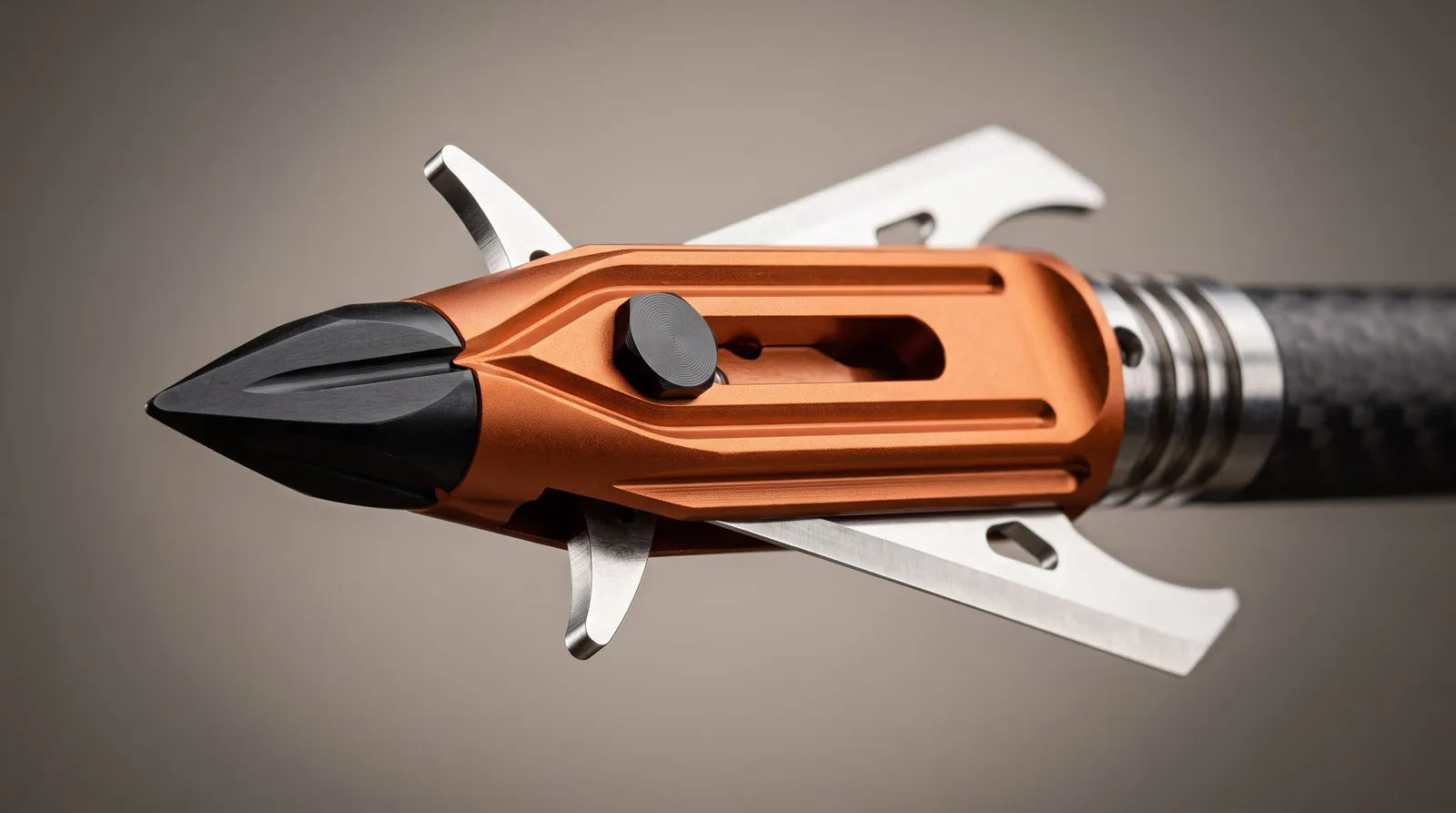
Ravin R102 Broadhead Review
A 100-grain mechanical head rated by Ravin to 500 FPS with Ravin crossbows. An internal spring holds the blades closed, so there are no O-rings to replace.
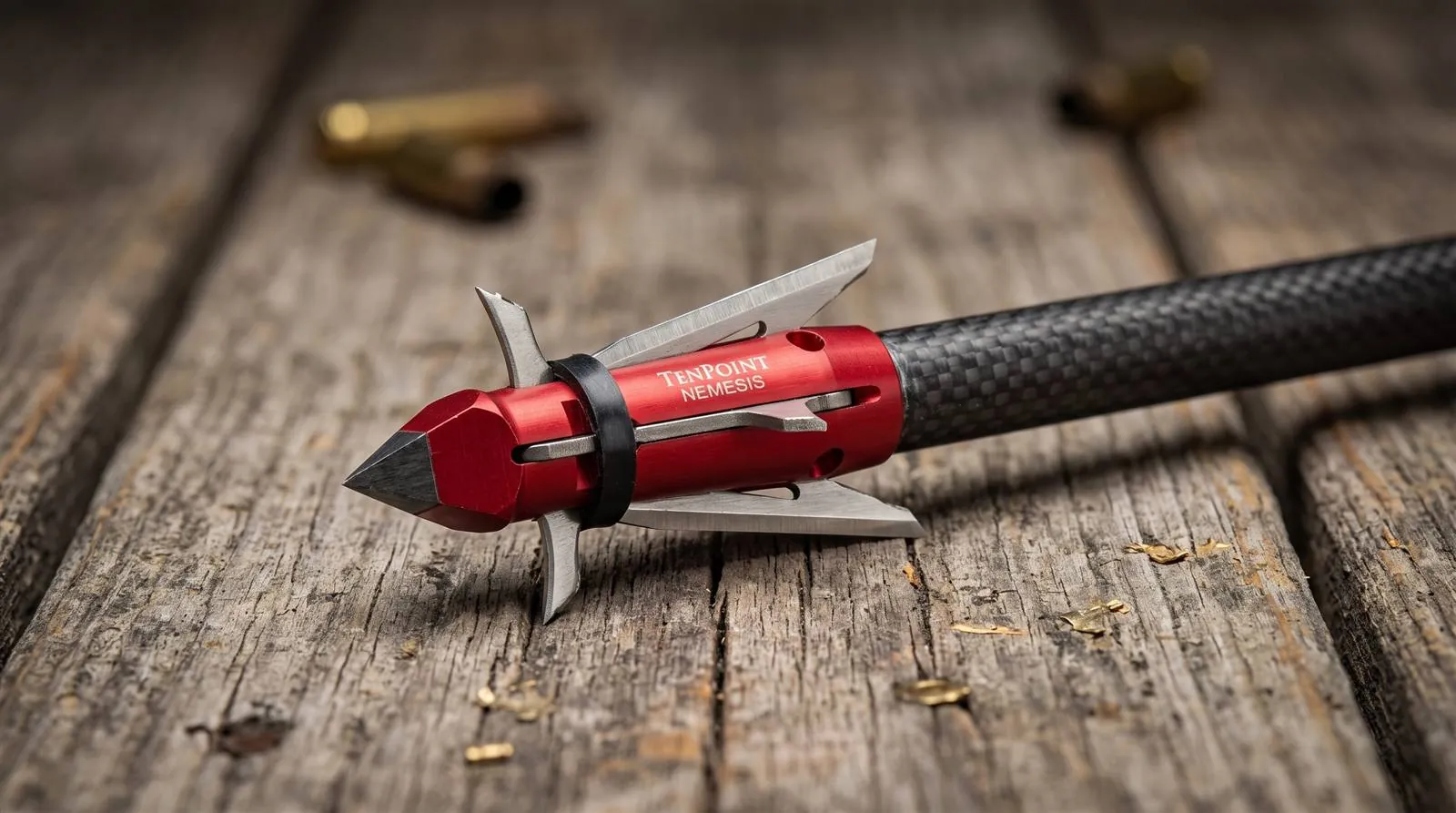
TenPoint Nemesis Broadhead Review
Staged mechanical crossbow broadhead with a 3.75-inch total cut and an unlimited speed rating. 100 grains, sold in packs of three.
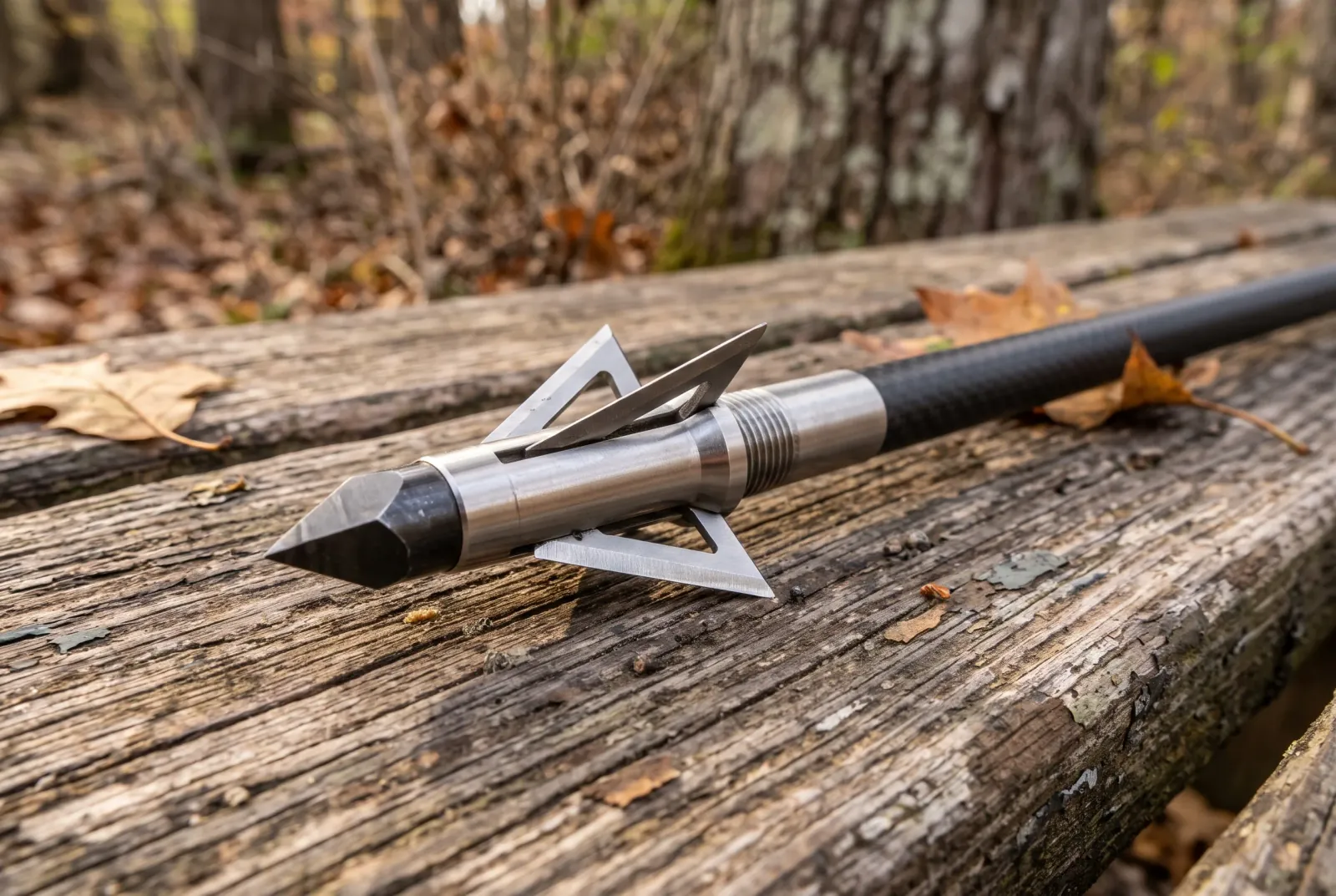
Muzzy Trocar HBX Crossbow Broadhead Review
A 100-grain hybrid crossbow broadhead with 2 fixed and 2 mechanical blades, a stainless steel ferrule and a 2 5/8-inch total cut. Three per pack.
Ready to compare models? Read our crossbow reviews to see how each one compares.
More in Hunting Laws & Field
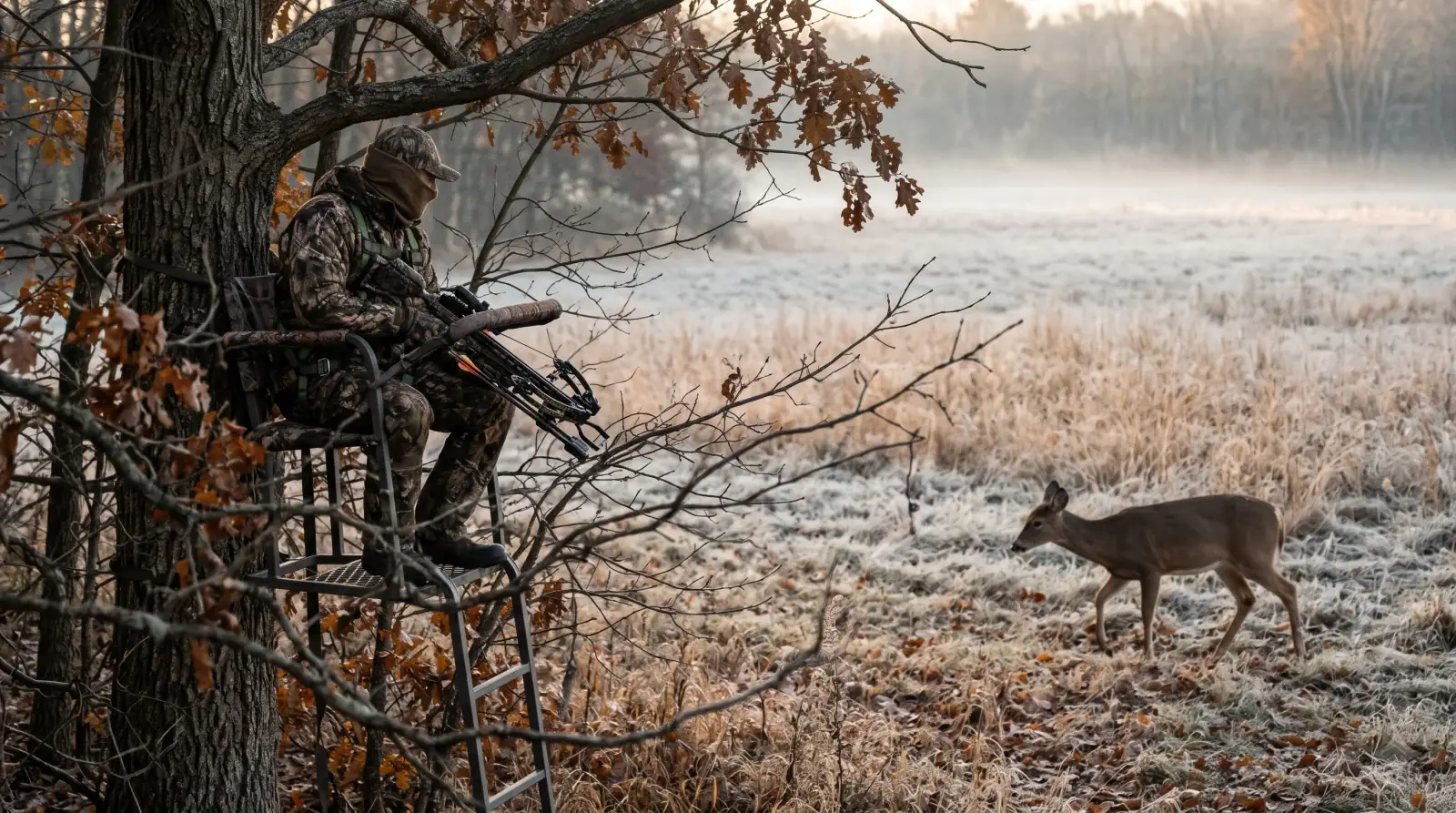
How to Hunt Deer With a Crossbow: A Season Plan
A step-by-step whitetail plan for crossbow hunters, from sight-in and stand or blind setup to season timing, the shot and the first minutes after it.
Read guide
Crossbow FPS Needed for Deer: Kinetic Energy Chart
Why no FPS minimum exists for deer, the published energy guidelines for deer and elk, and a kinetic energy chart by bolt weight and speed.
Read guide
Crossbow Hunting Guide: Game, Setup, Shot and Recovery
The crossbow hunting hub: game and energy guidance, legality, pre-season setup, stand or blind, shot placement, tracking, gear and safety.
Read guide