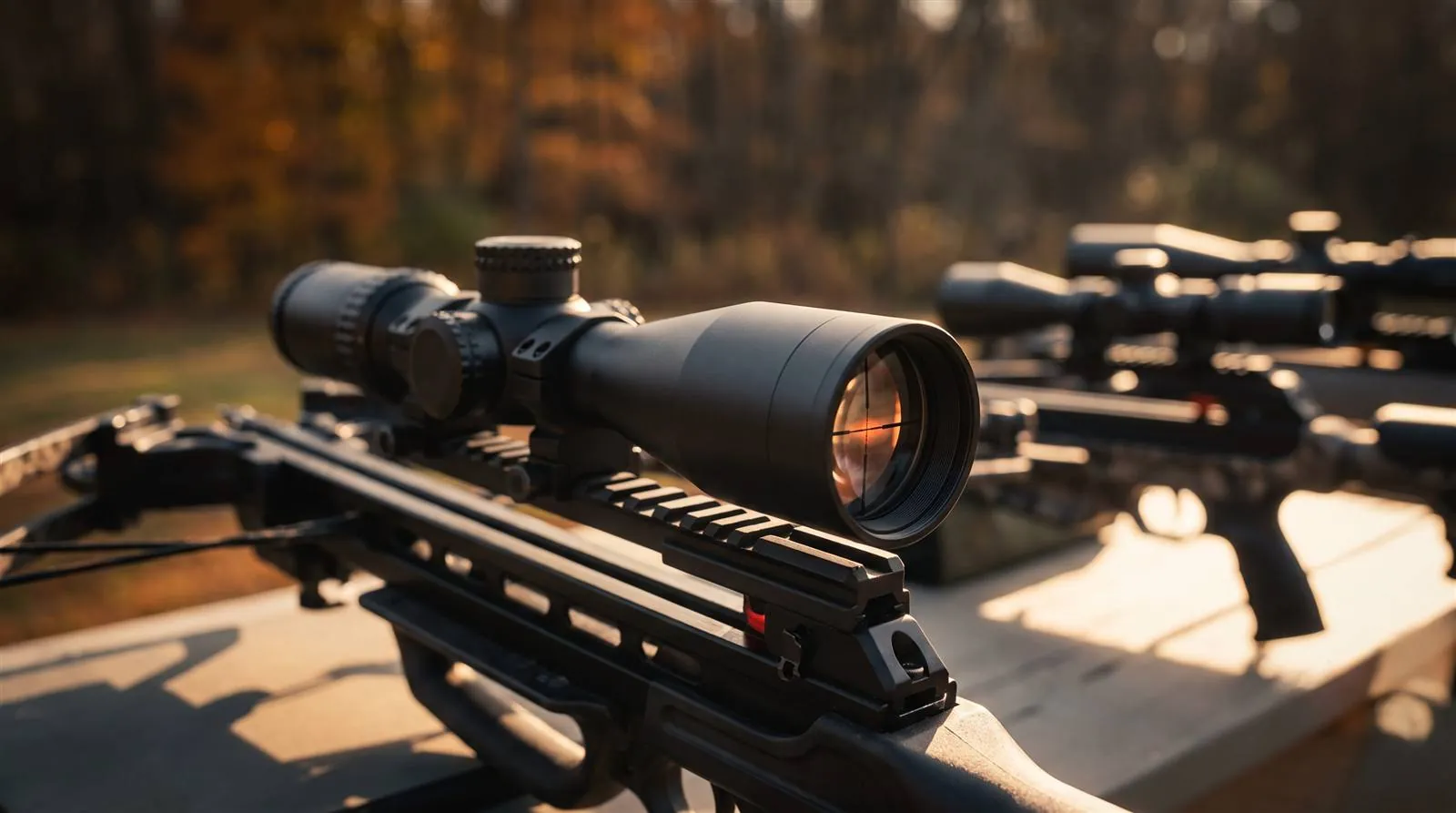
Crossbow Inclinometer in plain terms
Crossbow Inclinometer meaning: An inclinometer measures the up or down angle of a shot, so a rangefinding scope can show the horizontal distance and a corrected aim point.
Also called: angle compensation, angle-compensated distance, angle-compensated ranging
An inclinometer is a small electronic angle sensor. In a rangefinding scope or rangefinder it reads how far the shot points above or below level, and the device uses that angle to work out the horizontal distance to the target. That figure, often called the angle-compensated distance, is what the bolt actually has to fall over.
The reason it matters is gravity. Gravity pulls the bolt down across the horizontal distance, not along the straight line from your eye to the target. On a steep shot from a treestand the straight-line (line-of-sight) distance is longer than the horizontal one, so aiming for the laser's raw number tends to send the bolt high.
Some scopes go a step further than showing a corrected number. Burris says the Oracle X's integrated inclinometer factors the shot angle into the displayed aiming point, and Garmin lists angle-compensated distance among the Xero X1i's features alongside an electronic level.
Horizontal distance from a line-of-sight reading
Horizontal distance = line-of-sight distance x cos(shot angle)
A 30-yard line-of-sight reading at a 30-degree downward angle: 30 x cos(30°) = 30 x 0.866 = about 26 yards. Aim for 26, not 30.
Angle compensation on reviewed scopes
Facts below come from the manufacturers' product pages.
| Scope | Angle compensation | What the maker lists |
|---|---|---|
| Burris Oracle X | Yes, integrated inclinometer | Displays the range and an aiming point that factors in shot angle |
| Garmin Xero X1i | Yes, angle-compensated distance | Electronic level and aim points auto-calibrated to 80 yards |
| TenPoint Vision HD | Not listed | Laser ranging; no angle compensation stated |
Why it matters
Most crossbow deer are shot from height or across uneven ground. The steeper the angle, the bigger the gap between the laser's straight-line number and the horizontal distance, and the more a raw reading overstates how far the bolt drops.
At typical stand heights and close ranges the gap is a yard or two, which matters little with a flat-shooting crossbow. It grows quickly with steeper angles and longer shots, where a slower bolt's trajectory curves more.
An inclinometer removes one estimate from a moment that already has plenty: you range, read one number and hold one aim point.
How to read it on a spec sheet
- Look for the words "angle compensation", "angle-compensated distance" or "inclinometer" on the spec sheet. A plain rangefinder without them shows line-of-sight distance only.
- Check whether the scope corrects only the displayed distance or also moves the aim point. Burris states the Oracle X adjusts the aiming point for angle.
- An electronic level or bubble level is a different feature: it shows canting (side-to-side tilt), not the up or down shot angle.
- If a scope lists no angle feature, assume it reads line of sight and practise steep shots at known distances.
Common mistakes
- Holding for the line-of-sight number on a steep downward shot and sending the bolt over the animal's back.
- Confusing an inclinometer with a cant indicator; one reads shot angle, the other reads tilt of the crossbow.
- Assuming every rangefinding scope compensates for angle without checking the maker's spec sheet.
- Forgetting that angle compensation corrects distance only; it cannot fix a scope that is not zeroed for your bolts.
Practising angled shots before the season
- Set a target at a measured horizontal distance below a stand or a safe elevated platform.
- Range it from the stand and note both the line-of-sight and the angle-compensated readings if your device shows them.
- Shoot using the compensated number and check where the bolt lands.
- Repeat at two or three distances so you know how much the angle changes your hold.
- Always use a full-body harness and a haul line when practising from a stand.
See it in our reviews
- Burris Oracle X — rated 4.4/5
- Garmin Xero X1i — rated 4.3/5
- TenPoint Vision HD — rated 4.2/5
Frequently Asked Questions
What does an inclinometer do on a crossbow scope?
It measures the angle of the shot above or below level. The scope uses that angle to calculate the horizontal distance to the target and, on models like the Burris Oracle X, to move the displayed aiming point to match.
Do I need angle compensation for treestand hunting?
It helps most on steep shots and longer distances. From a typical stand at close range the difference is small, but the higher you sit and the farther you shoot, the more a line-of-sight reading overstates the distance that matters for drop.
Why do crossbow shots from a treestand hit high?
Because the bolt drops over the horizontal distance, which is shorter than the straight-line distance you range from height. Holding for the longer straight-line figure places the aim point too low on the reticle, so the bolt strikes high.
Is an inclinometer the same as a bubble level?
No. A bubble level or electronic level shows whether the crossbow is tilted to one side, called cant. An inclinometer measures the up or down angle of the shot. Some scopes, such as the Burris Oracle X, have both.
Which crossbow scopes have an inclinometer?
Among the scopes we review, Burris lists an integrated inclinometer on the Oracle X and Garmin lists angle-compensated distance on the Xero X1i. TenPoint does not list angle compensation for the Vision HD.
How do I work out the angle correction without an inclinometer?
Multiply the line-of-sight distance by the cosine of the shot angle. At 30 degrees the cosine is about 0.87, so a 30-yard reading becomes about 26 yards of horizontal distance. Practise from height to confirm it with your own crossbow.
Related guides
Guides where inclinometer shapes a real choice.
 GuideBest Crossbow Scopes of 2026 for Every Bolt SpeedCrossbow scopes compared from a budget variable-zoom scope to laser rangefinding and digital models, with reticle, magnification and speed range for each.Read the guide
 GuideHow to Choose a Crossbow ScopeSeven steps to choosing a crossbow scope: intended use, reticle type, magnification, eye relief, focal plane, parallax, and matching your bolt speed.Read the guide
 GuideHow to Sight In a Crossbow ScopeSighting in a crossbow scope step by step: safe lane setup, first zero, confirming each aiming point, and re-checking with your hunting tip.Read the guide
Definitions are general information. Manufacturer figures vary, so follow your crossbow's manual and verify local laws with the relevant authority.