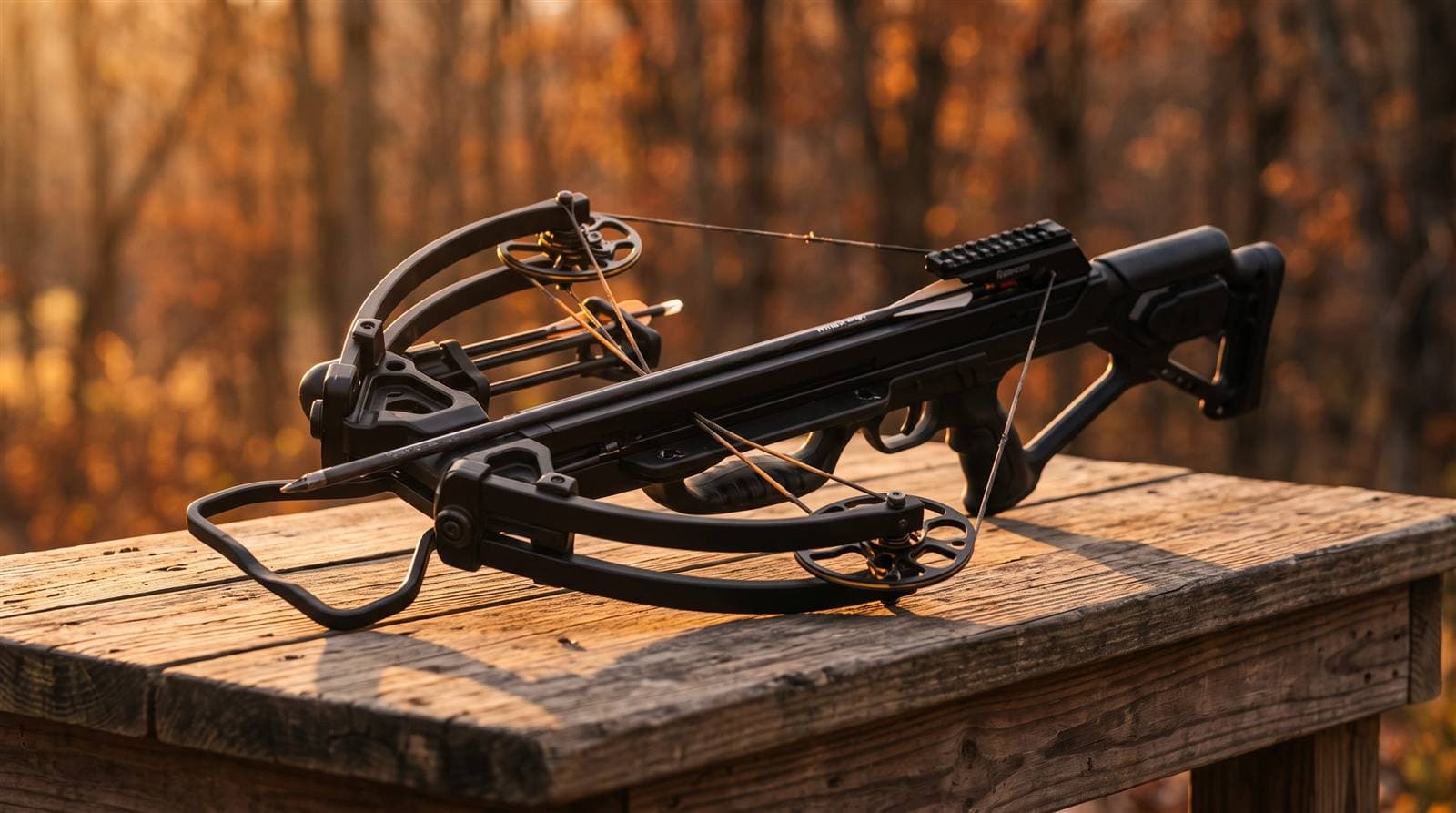
What Is Noise and Vibration?
The sound and hand shock a crossbow produces when it fires, shaped by limb damping, string silencers, mass and bolt weight.
Noise and Vibration: definition
Also called: shot noise, crossbow noise, vibration dampening, shot feel, hand shock
Noise is the sound a crossbow makes when it fires. Vibration is the energy that travels through the frame into your hands and cheek. They come from the same event: the limbs return to rest, the string stops, and any energy not given to the bolt has to go somewhere.
Designers manage it with limb dampeners, string suppressors, a string stop, heavier risers and well-tuned cams. A heavier bolt absorbs more energy, which can reduce noise. Firing without a bolt, a dry fire, sends the energy back into the crossbow and is dangerous.
Cocking is a separate cause of noise. A rope cocker, a crank and an integrated system all make different sounds, and the quietness of a cocking cycle matters in a blind. Ravin describes its R29X cocking system as silent, and the review recorded a measurably quieter cycle than the external crank device it was compared against.
Where shot noise and vibration come from
| Source | What happens | Common countermeasure |
|---|---|---|
| Limb return | Limbs snap back to rest | Limb dampeners and tuned cams |
| String stop | String reaches the end of its travel | Rubber or string suppressors |
| Cable and string slap | Cables and string vibrate against parts | String silencers and cable guards |
| Frame resonance | Riser and stock ring after the shot | Mass, damping inserts, stock design |
| Light bolt | Less energy absorbed by the bolt | Use a bolt in the rated weight range |
| Cocking mechanism | Rope slap, crank clicks, latch noise | Integrated or quiet cocking systems |
Why Noise and Vibration matters
Noise affects comfort and range etiquette, and vibration affects shot feel and wear on parts like the scope and its mount. A crossbow that shakes less is generally more pleasant to shoot, and a quieter one is easier on your ears.
Heavy vibration also loosens screws and can shift scope settings over time, so it ties into maintenance and the zeroing process. Hearing protection is a sensible habit at a range.
How to read it on a spec sheet
- Look for a stated noise figure in decibels, and ask how and where it was measured. Few manufacturers publish one.
- Read the reviews for notes on shot noise and vibration. Review files on this site include a noise score. TenPoint TRX Ultra and Ravin R29X scored 10, the TX Ultra 29.5 scored 9.5, and the Excalibur Mag Air scored 8.
- Check the damping features listed: limb dampeners, string suppressors and a string stop.
- Note whether the cocking system is described as quiet.
- Remember that scores are comparative within the review set, not decibel readings.
Common mistakes
- Assuming a crossbow is silent because it is called quiet.
- Comparing noise scores from different reviewers as if they used the same scale.
- Removing or modifying dampeners and silencers.
- Shooting without hearing protection at a range.
- Dry firing. It is not a way to test noise.
How to compare shot noise and vibration between crossbows
- List the damping features on each model.
- Read review notes and the noise scores from one consistent source.
- Look for separate remarks on cocking noise.
- Check for loosening screws and string wear as you maintain the crossbow.
- Use hearing protection whenever you shoot at a range.
See it in our reviews
- Ravin R29X — rated 4.8/5
- TenPoint TRX Ultra — rated 4.9/5
- Excalibur Mag Air — rated 3.4/5
Frequently Asked Questions
How loud is a crossbow?
It varies by model and is rarely published in decibels. Reviews describe shot noise relatively. Wear hearing protection at a range, and check the damping features listed for each model.
Are crossbows quieter than compound bows?
That depends on the models. Both can be tuned and damped to reduce noise. Compare reviews of specific products rather than assuming one type is quieter.
What reduces crossbow vibration?
Limb dampeners, string suppressors, a string stop, frame mass and a well-tuned cam system. A bolt within the rated weight range also helps by absorbing energy that would otherwise return to the frame.
Does bolt weight affect noise?
Often, yes. A heavier bolt tends to absorb more of the stored energy, leaving less to vibrate the frame. Stay within the manufacturer's rated bolt weight range, and never shoot without a bolt.
Does a quiet cocking system matter?
It can in a blind or stand, where sound carries. The Ravin R29X review recorded a measurably quieter cocking cycle than the external crank it was compared against.
Can vibration damage a scope?
Repeated vibration can loosen mounts and shift settings. Check mounting hardware as the manual directs, and confirm your zero after any maintenance. See the guide on sighting in a crossbow scope.
Can I add silencers to my crossbow?
Only parts approved for your model, fitted as the manual describes. Some accessories change string path or clearance, so follow your manual or ask the manufacturer.
Keep learning
Guides that use this term
- GuideHow to Maintain a CrossbowHow to maintain a crossbow: string waxing, rail and moving-part lubrication, bolt inspection, storage, and when to see a technician.Read the guide
- GuideHow to Sight In a Crossbow ScopeSight in a crossbow scope in six numbered steps: safe range setup, bore-sighting, a 20-yard zero, click math, longer-range checks and fixes.Read the guide
- GuideCrossbow Safety Rules for BeginnersCrossbow safety rules for beginners: finger placement, never dry-firing, safe cocking and de-cocking, range etiquette and storage habits that prevent injury.Read the guide
Related terms
- LimbThe flexible arm on each side of a crossbow that stores energy when the string is drawn and releases it to push the bolt forward.
- RiserThe rigid central block at the front of a crossbow where the limbs mount and the barrel or stock connects, forming the structural core of the front end.
- String and CablesThe bowstring that drives the bolt and the cables that link the cams on a compound crossbow, wear parts that need regular inspection, waxing and timely replacement.
- CamThe shaped wheel at each limb tip of a compound crossbow that the string and cables run over, creating let-off and a smoother, more efficient release of energy.
- Dry FireReleasing the string with no bolt on it, which sends the stored energy into the crossbow itself and can cause serious damage.
- Foot StirrupThe metal or composite loop at the front of a crossbow where you place your foot to hold the crossbow steady while cocking it.
Browse the gear
Definitions are general information. Manufacturer figures vary, so follow your crossbow's manual and verify local laws with the relevant authority.