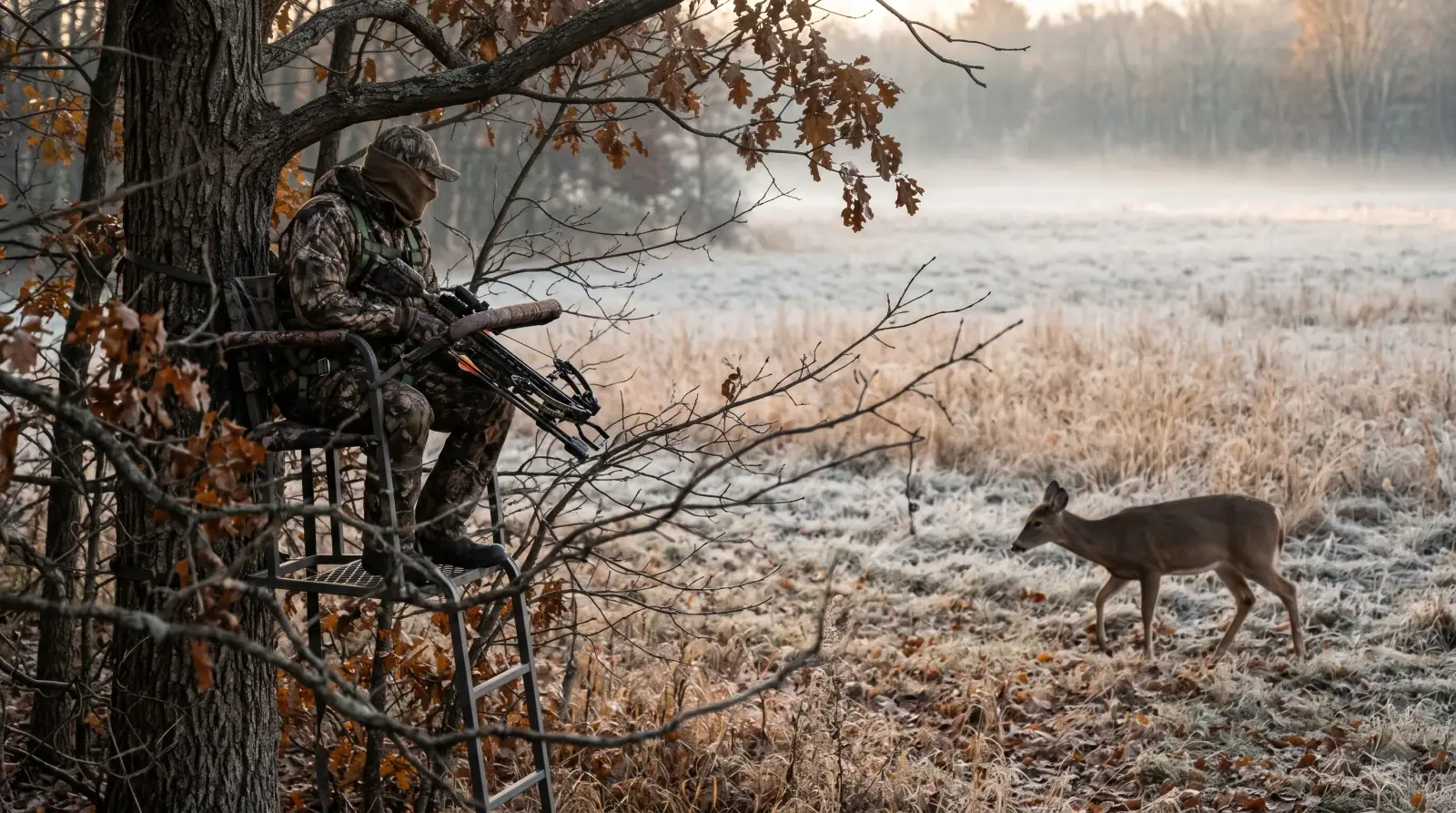
Hunting deer with a crossbow is closer to rifle hunting than most bowhunting, but it is still a short-range game. You get a scope, a stock and no draw at the moment the deer steps out. You give up distance, a quiet follow-up shot and some room in the stand or blind, because the limbs stick out to the sides. This page turns that into a plan for the season in front of you: the crossbow ready, the right seat for it, the right hunt for the time of year, a disciplined shot and a calm routine afterward.
It is the whitetail chapter of our crossbow hunting guide, which also covers other game, gear and energy.
Are Crossbows Good for Deer Hunting?
Yes. A modern hunting crossbow with a sharp broadhead has plenty of energy for a whitetail at normal bow distances, and the scope and stock make it easy to put the bolt where you aim. What it does not do is turn bow season into rifle season. Our guide to crossbow FPS and energy for deer explains how much a whitetail actually needs and why most hunting crossbows clear it.
If you come from a deer rifle, three things change. The bolt is slow next to a bullet, so its bolt drop gets steep past 30 yards and a deer has time to move at the sound of the shot. The crossbow is front-heavy, so a rest matters more than it does with a light rifle. And there is no fast second shot: re-cocking takes time and movement in the stand.
If you come from a compound or traditional bow, the big change is the opposite one. You never have to draw with a deer in front of you, so you can wait at full readiness for as long as it takes. The trade-off is weight, width and a louder shot. Our comparison of whether crossbow hunting is easier than bowhunting walks through where the crossbow helps and where it does not.
If you are still choosing the crossbow itself, start with our roundup of the best crossbows for deer hunting, linked at the end of this page, then come back to the plan.
Step 1: Get the Crossbow Deer-Ready
Most missed and wounded deer go back to something that could have been fixed before opening day. The checklist below turns the usual tips into jobs you can tick off.
| Job | Why it matters for deer | Where to learn it |
|---|---|---|
| Sight in with your hunting broadhead | Field points and broadheads can hit in different places | Sight-in guide, below |
| Tune or check each broadhead | A head that is off-center steers the bolt | Broadhead tuning guide, below |
| Range your shooting lanes | Bolt drop makes guessing distance costly | Know your range, below |
| Practice from a rest and a seat | Matches the shot you will actually take | Practice section, below |
| Learn to cock and de-cock it | You will do both in the dark, often tired | Cocking and de-cocking guides |
| Check zero during the season | Bumps and travel can move a scope | Mistakes section |
Sight in with your hunting broadhead
Sight the crossbow in with a field point first, then shoot the exact broadhead and bolt you will hunt with at the same target. If the broadheads group somewhere else, adjust the scope to the broadheads, because that is what the deer will see.
Our guide on how to sight in a crossbow scope covers zeroing at the first reticle line and setting the others.
Speed matters here. At the speeds modern crossbows are rated for, a broadhead blade that is slightly out of line can steer the bolt off course, so spin each one and shoot it before the season. The steps to tune your broadheads are in their own guide. A heavier bolt or broadhead also slows the bolt down, which changes where it hits at longer ranges, so sight in again whenever you change either. For head choice, our roundup of broadheads for deer compares fixed and mechanical options.
Know your range
Buy or borrow a rangefinder and use it twice: before the season to range trees, rocks and fence posts around your stand, and again when you sit down. A scope with speed-adjustable reticle lines only helps if you know which line to use, and that means knowing the distance.
Published guidance often puts 40 to 50 yards as the maximum for deer with a crossbow, and that is a ceiling, not a target. Your own effective range is the longest distance at which you can put every bolt into a paper plate from your hunting position, on the first shot of the day, in hunting clothes. Most hunters who do that honestly settle on a shorter number. The difference between how far a bolt flies and how far you should shoot is covered in our guide on how far a crossbow can shoot.
Shoot from a rest
A crossbow is heavy at the front, and holding it offhand while a deer walks is the fastest way to a bad hit. In a stand, rest the forend on the shooting rail or on a padded bar. On the ground, use shooting sticks or a bipod, or sit and rest your elbow on your knee. Keep your fingers and thumb below the flight deck every time you rest the crossbow, so nothing is in the string's path.
Practice from your hunting position
Shoot from a chair or a stand at home, wearing the jacket and gloves you will hunt in. Practice at uneven distances, not only 20, 30 and 40 yards, and finish each session with one cold shot at a distance you have not ranged. During the season, shoot a few practice bolts every week or two to confirm the zero is still where you left it. Our guide on how to cock a crossbow covers rope and crank cocking, which you should be able to do by feel before the first sit.
Step 2: Tree Stand or Ground? Set Up for a Crossbow
Most crossbow deer hunting happens from a fixed seat, a tree stand or a blind, because the crossbow is heavy to carry ready and slow to re-cock. The three ways to hunt each ask something different of it.
| Method | Best for | Crossbow issue | Fix |
|---|---|---|---|
| Tree stand | Field edges, funnels, rut travel routes | Getting it up safely; steep down-angles; limbs against the rail or trunk | Haul it up unloaded; set lanes so deer pass at a shallow angle; check limb clearance at full turn |
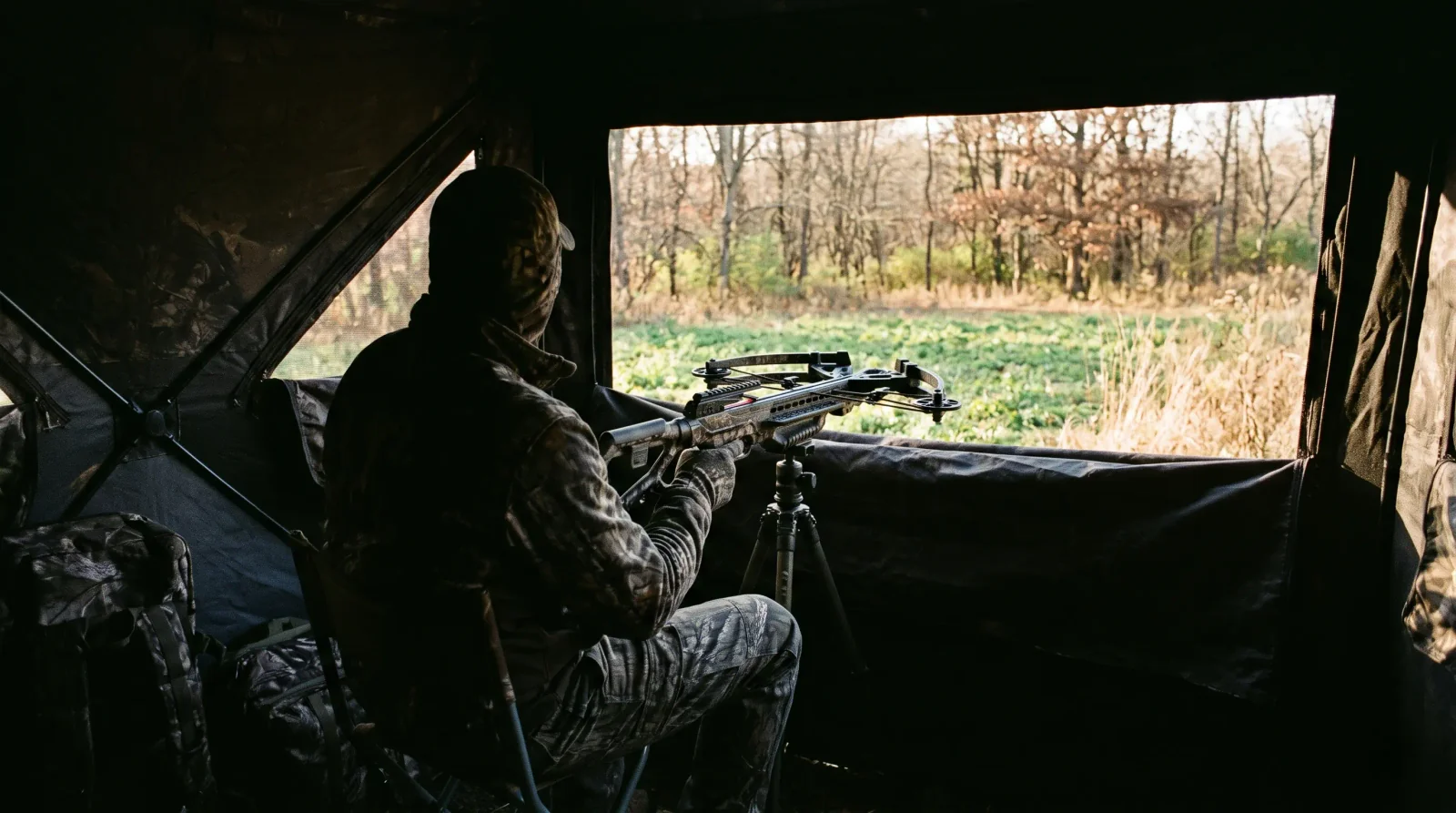
| Ground blind | Food plots, open fields, cold or wet days, hunters who cannot climb | Limbs and string hitting the window frame; seat height vs window height | Narrow crossbow, sticks at window height, sit back in the shadows |
| Still-hunting | Big woods, snow, mobile hunters | Carrying a cocked crossbow; noise of cocking; offhand shots | Light, short crossbow; cock only once you stop; sticks |
Still-hunting, slipping slowly through cover and stopping often, suits few crossbow hunters, because carrying a loaded crossbow through brush is unsafe and cocking one quietly next to a deer is hard. Most new crossbow hunters do better sitting.
Cocked and uncocked width
A crossbow's limbs are pulled in when it is cocked and spring outward when it fires. The cocked width is what you swing around the stand or blind; the uncocked width is how far the limbs reach the instant the string goes forward. Both have to clear the window frame, the trunk and the rail. Three crossbows we review show how wide that range runs.
| Crossbow | Cocked width | Uncocked width | Buy |
|---|---|---|---|
| TenPoint Flatline 460 | 7.5 in | 12 in | Check price on Amazon |
| TenPoint Titan 400 | 9.75 in | 13 in | Check price on Amazon |
| Killer Instinct Boss 405 | 14.75 in | 18.75 in | Check price on Amazon |
The spread between the narrowest and widest of these three is more than 7 inches cocked. Before the season, sit in your blind or stand with the crossbow uncocked, point it at every lane you plan to shoot, and look at the limb tips. If a limb tip touches anything, move the seat, open a wider window or change the lane.
From a tree stand
Height keeps your outline and much of your scent above the deer, and a stand rail gives you a ready-made rest. It also adds two jobs. First, getting the crossbow up: cock it on the ground, never load it, and pull it up on a haul line once you are clipped in. Wear a full-body harness from the moment your feet leave the ground.
Second, shooting down: a deer close to the base of the tree means a steep angle and a smaller target, so set your lanes where deer pass 15 yards or more out. The aim point from height belongs to our page on crossbow shot placement on deer, which shows how the exit hole changes with stand height.
From a ground blind
If you want to know how to hunt deer with a crossbow from the ground, a ground blind is the easiest place to start. It hides movement, keeps you dry and suits hunters who should not climb. Set your chair so the scope sits at window height with the crossbow on sticks, sit far enough back that you are in the shadows, and open only the windows you need. Check that the limbs and string clear the frame at every angle you might shoot, using the uncocked width above.
Brush the blind in a few days before you hunt it if you can, so deer have time to accept it. A blind dropped on a field edge the same morning is more likely to be noticed.
Wind and entry routes
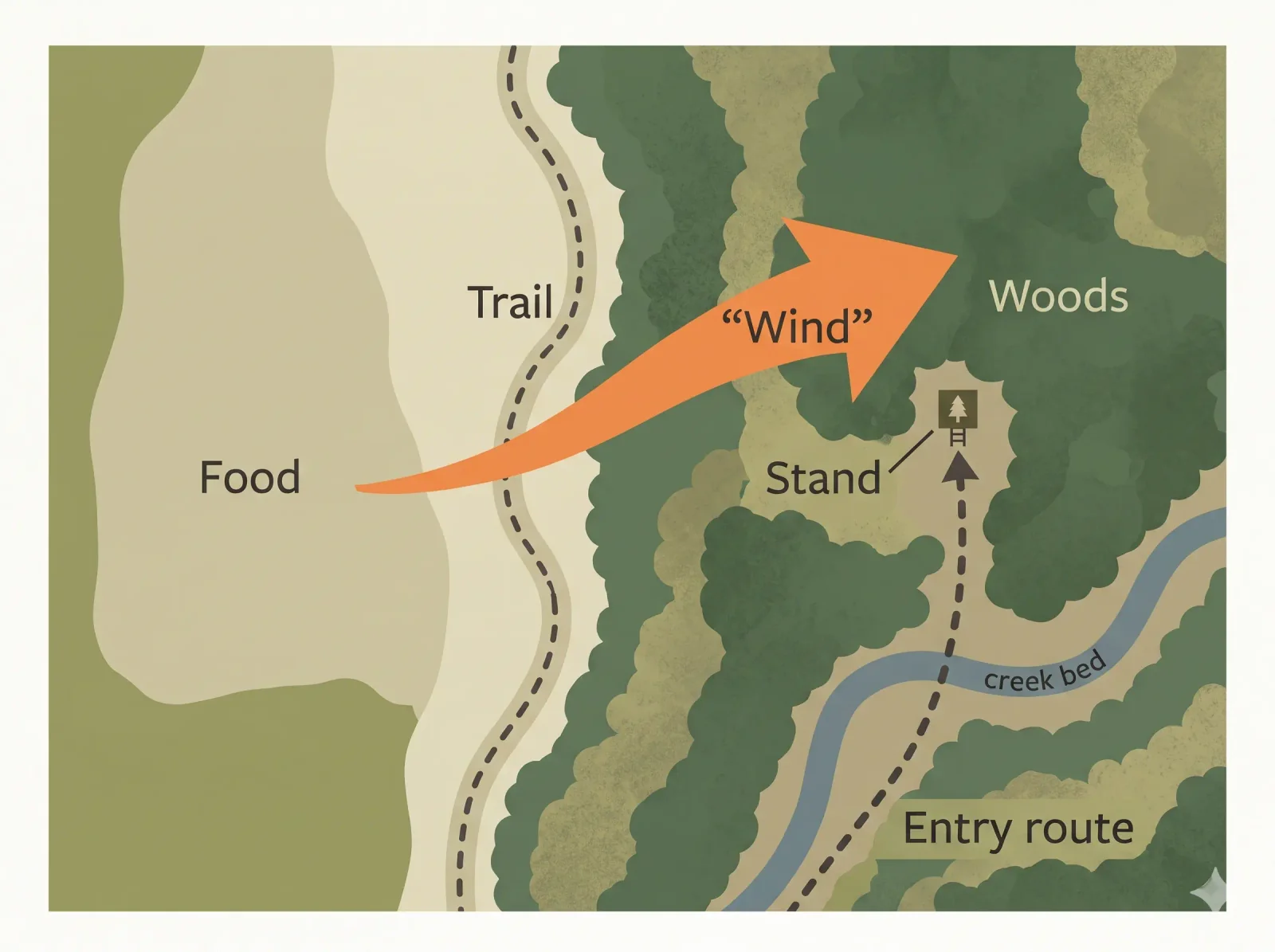
A whitetail trusts its nose over its eyes. Set up so the wind blows from where you expect deer toward you, or across the trail, and have a second seat for the opposite wind. Then plan how you walk in and out: a route that crosses the food plot or the trail the deer use will push them out before you sit down. Walk in on the downwind side, using ditches, creek beds or field edges to stay out of sight.
Step 3: Match the Hunt to the Season
Whitetails move differently through the fall, and the right seat in October can be the wrong seat in December. Use the table as a starting point, then adjust to what your cameras and scouting show.
| Season phase | Where deer tend to be | Where to sit | Crossbow note |
|---|---|---|---|
| Early season | Feeding on green food sources: crops, plots, soft mast | Edges of food sources, evening sits | Short, calm shots are common; mark distances to the field edge |
| Pre-rut | Bucks making scrapes and rubs, still on food patterns | Between bedding and food, near fresh scrapes | Hunt the wind carefully; deer are still in a pattern |
| Rut | Bucks traveling and chasing, does moving more | Funnels, pinch points, travel corridors; long sits | Deer move quickly, so pass on walking shots and wait for a stop |
| Late season | Back on food, often in groups, cold weather | Food sources in the afternoon, sheltered south-facing cover | Practice cocking in gloves; check limb clearance in bulky clothes |
Season dates, whether crossbows are allowed in archery season, and whether you can use one during the firearm season all vary by state and change from year to year. Check them on our crossbow hunting laws by state page before you plan around any phase.
Early season is the most predictable. Deer follow the same route from bed to food most evenings, so an afternoon sit near the feeding area with the wind right is often enough. Keep morning hunts away from fields, where you will push deer as you walk in.
The rut puts the most deer in front of you and the hardest shots. Bucks often move through at a trot, nose down, and stop only briefly. With a crossbow, this is the time to sit all day in a funnel and let poor angles walk past. A grunt or a soft voice call can stop a walking deer for the shot.
Late season brings cold, snow and deer that have been hunted for weeks. Food is the key again, and the afternoon is usually the best time. Cold slows you down: cocking with gloves, keeping the scope clear of fog and moving inside a heavy coat all take practice.
Step 4: Taking the Shot
The shot is where everything before it pays off, and where patience matters most.
Wait for the deer to stand broadside or slightly quartering away, relaxed, inside the limit you set in Step 1. Range it again if it has moved. Pass on head-on and quartering-to shots, walking deer and deer that have already looked at you. The aim point itself, including where the heart and lungs sit at each angle and how it shifts from a stand, is on the shot placement page linked above.
The target is the vital zone: the heart and both lungs, the area a broadhead must cross for a quick, clean kill.
Crossbows are loud enough that an alert deer can react to the sound before the bolt arrives, which hunters call jumping the string. The deer usually drops as it turns to run, so a bolt aimed high can go over. Calm deer and closer shots reduce the problem. Never shoot at a deer that is already tense and looking your way.
Keep your finger off the trigger until the crosshair is on the deer, and keep the safety on until then.
Step 5: After the Shot
What you do in the next minutes decides whether you find the deer. The tracking and recovery section of the crossbow hunting guide linked above goes further into reading sign; this is the short routine.
- Watch and listen. Note where the deer was standing when you shot, where it ran and the last place you saw or heard it.
- Note the time. It is easy to lose track of how long you waited.
- Wait. North Carolina's wildlife agency advises at least 15 to 30 minutes unless the deer goes down in sight, and an hour or more for a poor hit, especially a gut shot.
- De-cock before you climb down or move. If the crossbow is still cocked, unload it first (see the safety section).
- Start at the hit site. Look for blood, hair and the bolt. The color of the blood and what is on the bolt tell you where you hit.
- Follow the trail slowly. Follow the blood trail and mark it as you go with tissue or flagging and walk beside it, not on it. If the sign says gut or muscle, back out and wait longer.
Your First Crossbow Deer Hunt: Day Checklist
For your first crossbow deer hunt, or a first hunt from a new seat, run through this list in order.
- The night before: crossbow, bolts with broadheads in a quiver, a field-point bolt or discharge bolt, rangefinder, sticks, harness, haul line, headlamp, knife, flagging and your license and tags.
- At the truck: check the wind again. If it is wrong for your stand, go to the other seat.
- At the base of the tree or blind: cock the crossbow on the ground with the safety on. Do not load a bolt.
- In the seat: clip in, haul the crossbow up, then load a bolt with the muzzle pointed safely away. Range two or three landmarks.
- While you sit: keep the crossbow on the rail or sticks, pointed where deer will come from, so the only movement is your head.
- When a deer comes: let it settle, wait for the angle, range it, then shoot.
- At dark, with no shot: unload, then de-cock with a discharge bolt into a target or with a built-in crank, as your manual allows. Our guide on how to de-cock a crossbow safely covers each method.
- At home: check the broadhead edges and the scope, and write down what you saw and the wind.
Crossbow Deer Hunting Safety
A crossbow stores its full draw weight from the moment it is cocked, so most injuries come from handling it, not shooting it.
- Fingers and thumb below the rail. The string sweeps across the flight deck when it fires. On a rest, it is easy to let a thumb drift up.
- Never dry-fire. To dry-fire a crossbow means firing it without a bolt, which can damage the limbs and string and hurt you. Always have a bolt on the string when you pull the trigger.
- Never climb or cross obstacles loaded. Cocked and unloaded is the furthest you go when moving to or into a stand.
- Check limb clearance before every shot in a stand or blind. A limb that hits something can throw the bolt or break.
- Know what is behind the deer. A bolt that passes through can travel a long way.
Our crossbow safety rules for beginners cover each of these in more detail, including hauling into a stand.
Common Mistakes
- Shooting offhand. A heavy crossbow sways. Use the rail, sticks or your knee every time.
- Skipping in-season practice shots. A bump in the truck can move the scope. Shoot a few bolts every week or two.
- Forgetting the uncocked width. The limbs swing out at the shot. A limb tip that hits a blind window or tree trunk ruins the shot.
- Stretching the range. A buck at 55 yards when you practiced to 35 is a different shot. Stay inside your limit.
- Shooting at alert deer. A tense deer is the one that drops at the sound.
- Tracking too soon. Pushing a hit deer can send it a long way. Wait, then follow slowly.
- Hunting the wrong wind. One sit in a bad wind can educate the deer for the rest of the season.
- Sighting in with field points only. Broadheads can hit elsewhere; zero with what you hunt with.
Frequently Asked Questions
Are crossbows good for deer hunting?
Yes. A modern crossbow with a sharp broadhead is plenty for whitetails at normal bow distances. It also opens bow season to hunters who cannot draw a vertical bow, including many older hunters, younger hunters and hunters with shoulder injuries, where state rules allow.
How hard is it to shoot a deer with a crossbow?
Hitting a target is easy from a rest, because the scope and stock work like a rifle's. The hard parts are getting a deer inside your range, waiting for the right angle and staying steady when it arrives. Practice from your hunting seat makes the difference.
How far will a deer run after a crossbow shot?
It depends on the hit. A deer hit through both lungs often goes down within sight or a short distance away, while a gut or muscle hit can go much farther. Wait before you follow, and back out longer if the sign suggests a poor hit.
Where should I aim at a deer with a crossbow?
Aim for the heart and lungs, just behind the front leg on a broadside deer, and adjust for the angle and stand height. Our shot placement guide shows the aim point for each angle.
What draw weight or speed do I need for deer?
Most hunting crossbows sold today are well above what a whitetail needs, and some states set minimum draw weights. Our energy guide, linked near the top of this page, explains how much a whitetail needs, and the laws page lists state minimums.
Can I use a crossbow during rifle or archery season?
It depends on your state. Many states allow crossbows in archery season and in firearm seasons, but the rules differ, so check your state on our laws page before you hunt.
Bottom Line
Hunting deer with a crossbow comes down to a short list: zero with your broadheads, know your range, shoot from a rest, sit where the wind and the limbs both work, match the seat to the time of season, take only good angles on calm deer and wait before you track. If you are still choosing a crossbow for it, our deer roundup compares models on the features that matter for these shots.
Read nextBest crossbows for deer huntingCompare crossbows built for the close, steady shots this plan sets up.Gear mentioned in this guide
Reviews we link to above, highest rated first. Read the full review before you buy.
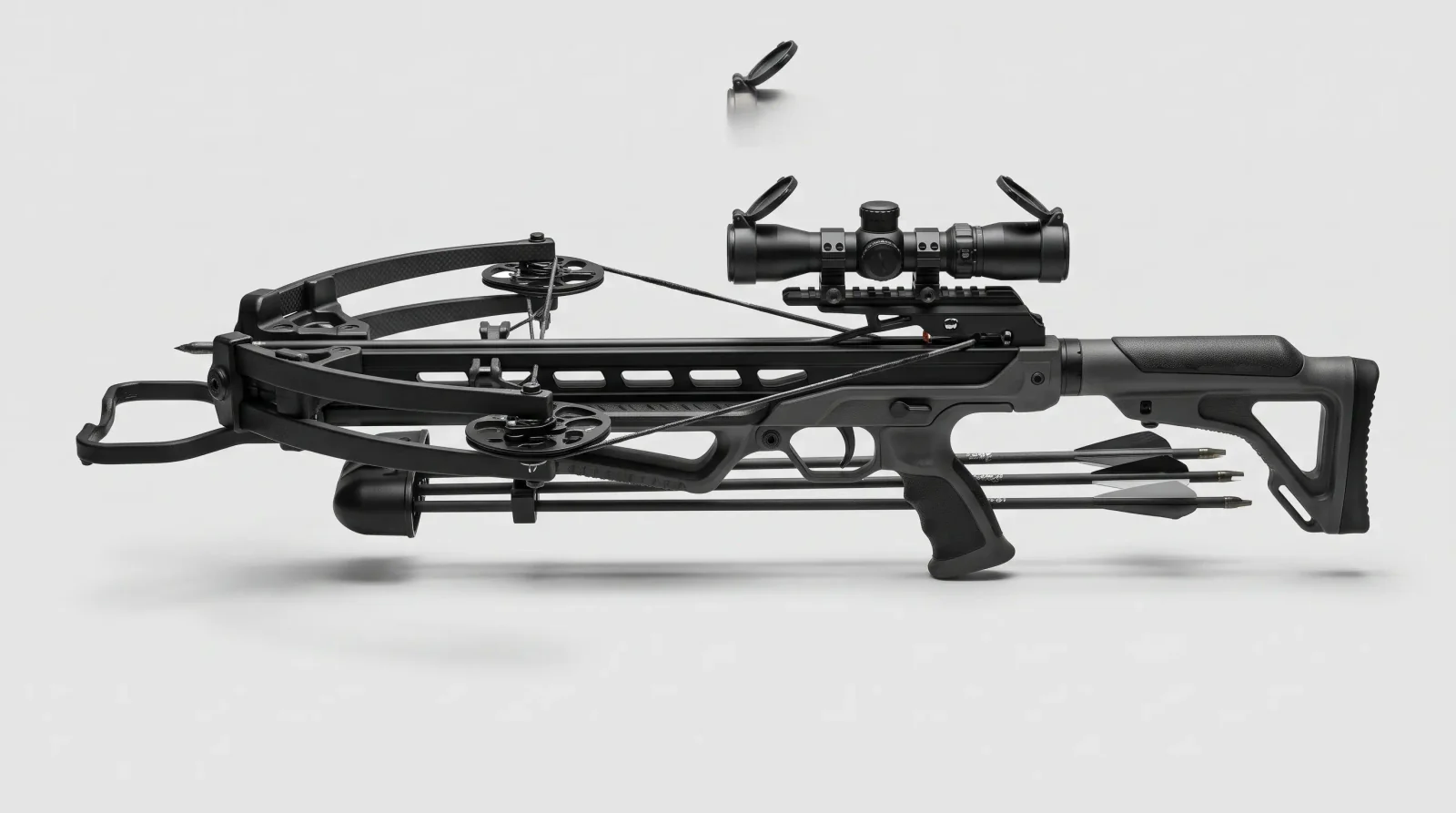
TenPoint Titan 400 Review
A 6 lb, 400 FPS forward-draw TenPoint that ships ready to hunt, with a built-in ACUdraw Silent crank and a 70-yard scope.
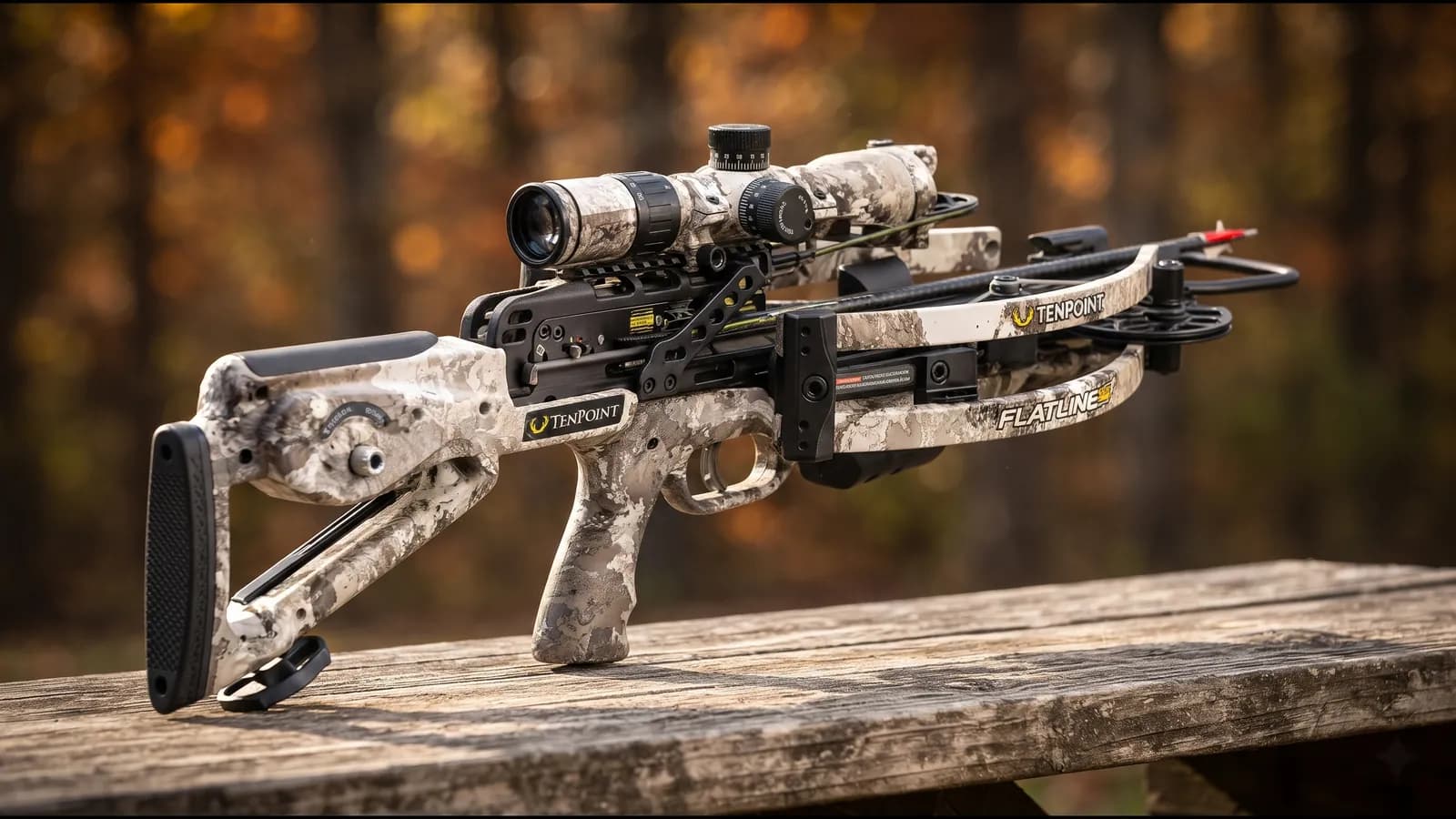
TenPoint Flatline 460 Review
Reverse-draw crossbow rated at 460 FPS and 193 ft-lbs with short 16-inch bolts, a 3.5-lb two-stage S1 trigger and a 7.5-inch cocked width.
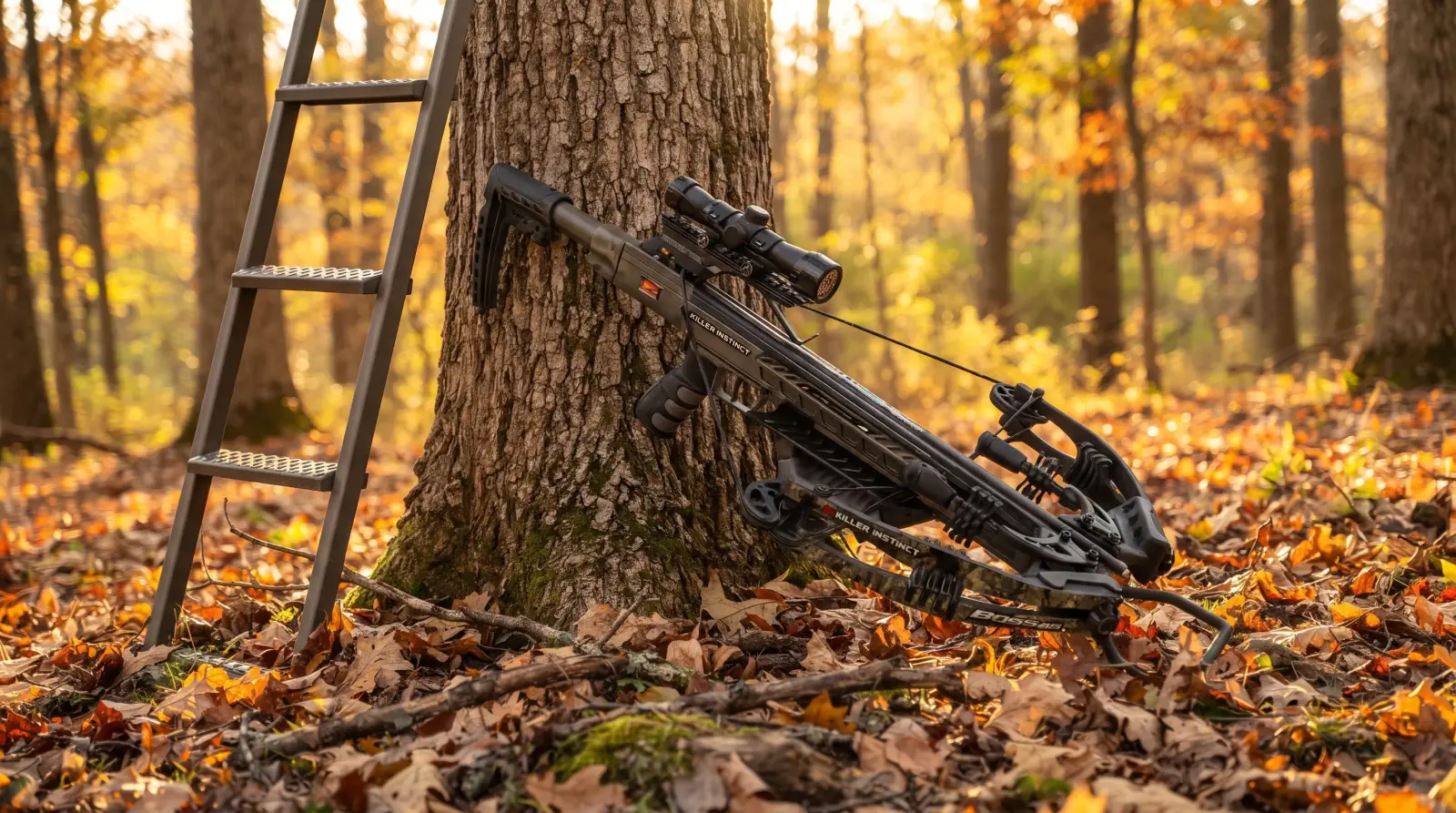
Killer Instinct Boss 405 Review
A 405 FPS budget compound crossbow at 6.7 lb with an adjustable stock and full package. Its 14.75-inch cocked width is the main trade-off.
Ready to compare models? Read our crossbow reviews to see how each one compares.
More in Hunting Laws & Field
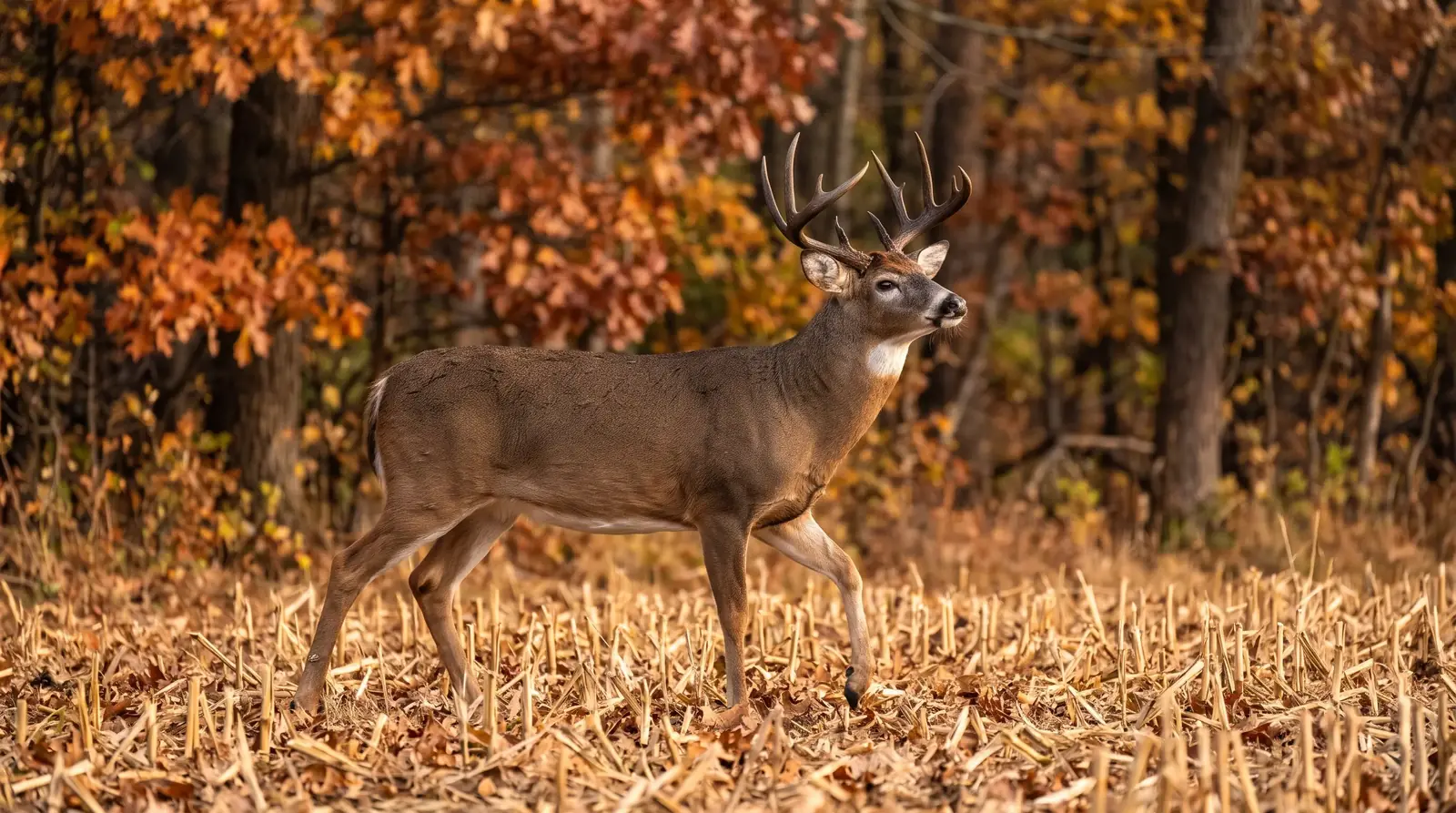
Crossbow Shot Placement on Deer: Every Angle Explained
The vital zone, the take-or-pass call for every angle, tree stand aim points, string jumping, and how long to wait after the shot.
Read guide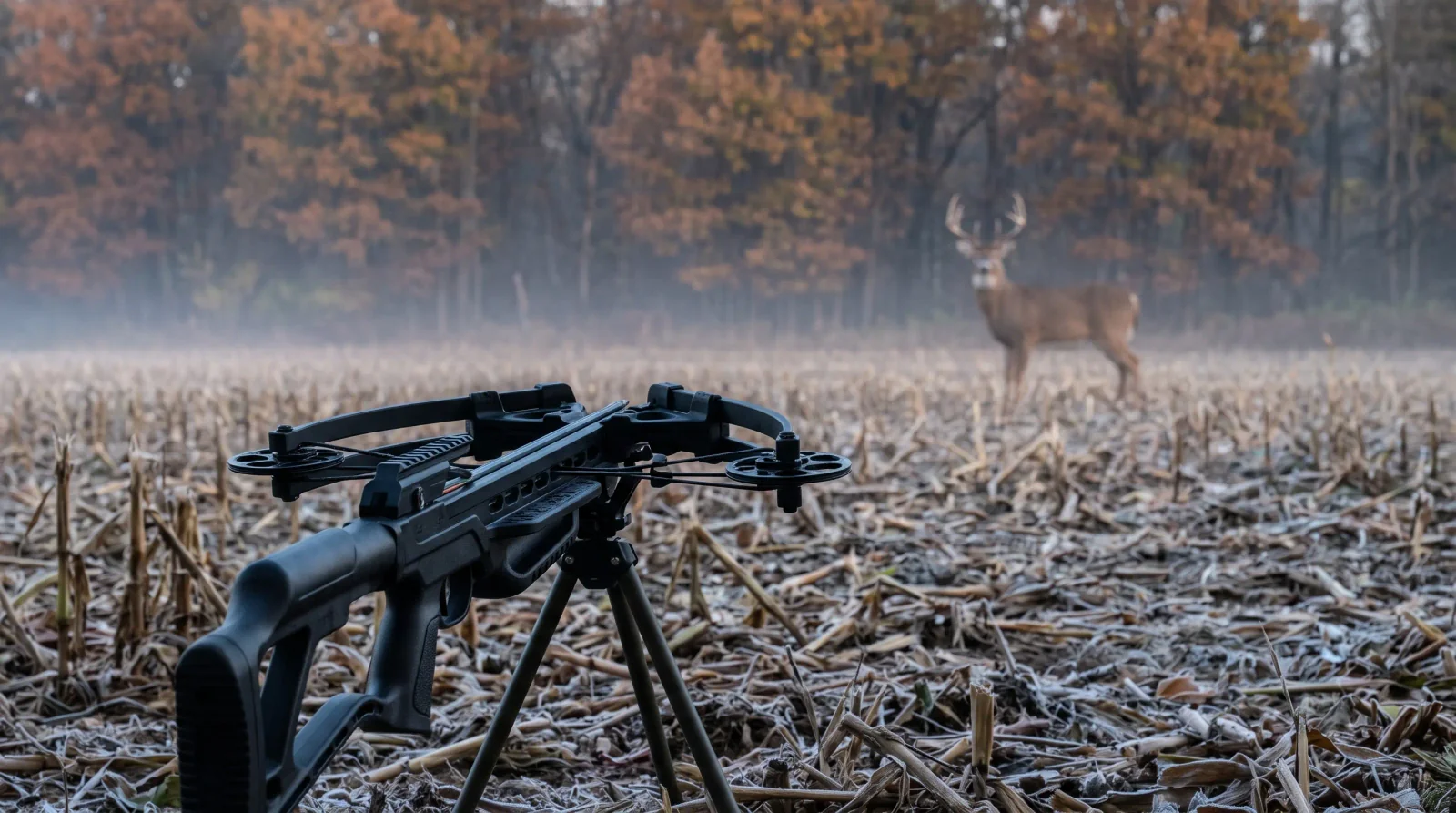
Crossbow FPS Needed for Deer: Kinetic Energy Chart
Why no FPS minimum exists for deer, the published energy guidelines for deer and elk, and a kinetic energy chart by bolt weight and speed.
Read guide
Crossbow Hunting Guide: Game, Setup, Shot and Recovery
The crossbow hunting hub: game and energy guidance, legality, pre-season setup, stand or blind, shot placement, tracking, gear and safety.
Read guide