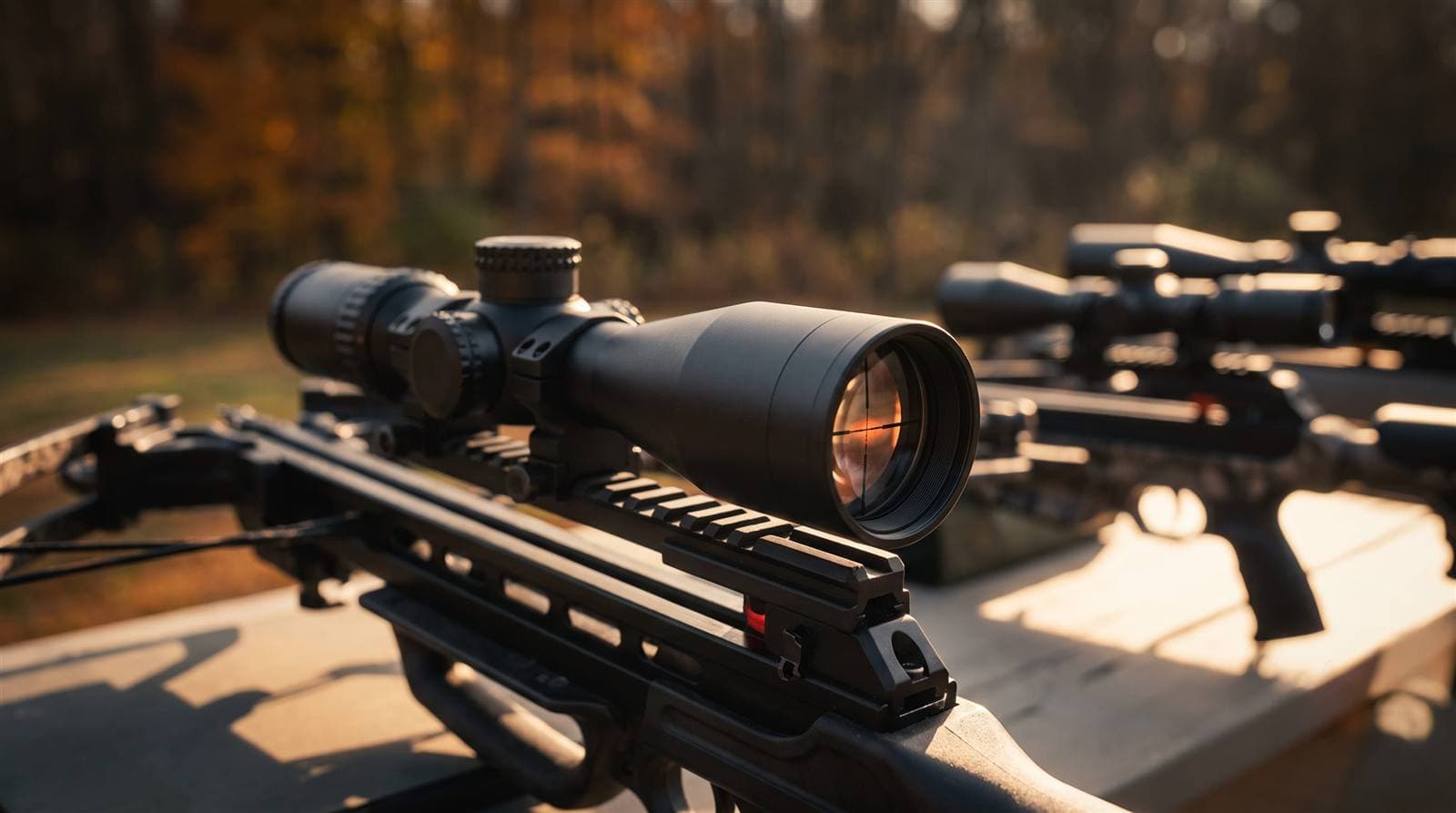
What Is Illuminated Reticle?
An illuminated reticle lights its aiming marks, usually in red or green with adjustable brightness, so they stay visible in low light and against dark backgrounds.
Illuminated Reticle: definition
Also called: lit reticle, red/green reticle, rheostat illumination, illuminated aim point
An illuminated reticle uses a small light source, typically a battery-powered LED, to make part or all of the reticle glow. The colour is usually red, green or switchable between the two, and brightness is set with a dial or buttons. Without illumination a black reticle can disappear against dark brush, shadow or a dim sky at dawn and dusk.
Not every mark is always lit. On the TenPoint EVO-X Marksman Elite, the three duplex crosshairs and two dots are illuminated while the four chevrons for 70–100 yards are not, and the review found those harder to pick out in low light. In contrast, the TenPoint RangeMaster 100 lights every aiming point and uses an infinite-position rheostat for brightness.
Illumination does not change where the bolt lands, and it is separate from magnification or zeroing. It only helps you see the aim point, so it should be set bright enough to see and no brighter, since an overly bright reticle can bloom and hide fine detail on the target.
Illumination features in reviewed scopes
| Scope | Colours | Brightness control | Notes |
|---|---|---|---|
| TruGlo 4x32 Compact | Red and green | Dual-colour switch | Battery is a separate item to track |
| Vortex Crossfire II 2-7x32 | Red and green | Illuminated XBR-2 | Complete kit with rings |
| TenPoint RangeMaster 100 | Red and green | Infinite-position rheostat | All nine marks lit |
| TenPoint EVO-X Marksman Elite | Red or green | Adjustable | Four longest chevrons not lit |
| Garmin Xero X1i | Illuminated aim point | Auto-brightness | Adapts to changing light |
| Ravin illuminated scope | Red and green | Model dependent | Check your exact model |
Why Illuminated Reticle matters
Legal shooting light is often limited to a window around dawn and dusk, which is exactly when a black reticle can be hardest to see. A lit reticle keeps the aim point readable.
Colour matters. Red tends to stand out against green foliage, while green can be easier on the eye on some backgrounds. Switchable colour gives you the choice.
The trade-off is a battery to maintain. Dead illumination leaves you with a black reticle, which still works but is harder in low light.
How to read it on a spec sheet
- Check whether all marks on the BDC reticle are lit or only some. The detail is in the spec table.
- Look at the brightness control type: stepped settings or a continuous dial.
- Note the battery type and whether it is user replaceable. The TruGlo’s battery is a separate component.
- Confirm colours available. Single-colour options limit adaptation.
- Auto-brightness on digital models adjusts to light without manual dimming.
Common mistakes
- Turning brightness up too far. The reticle glows and covers the target.
- Leaving illumination on between trips and draining the battery.
- Expecting illumination to fix a poor-quality image. Glass and coatings matter for low light.
- Zeroing in bright daylight and not testing marks in dim light.
- Carrying no spare battery.
Setting illumination for the light you have
- Turn illumination on and start at the lowest setting.
- Raise brightness until the aim point is clearly visible against the target background, then stop.
- Try both colours if available and pick the one that contrasts best with the background.
- Check any unlit marks in dim light so you know their limits.
- Switch the reticle off when not in use and keep a spare battery with the crossbow.
In my testing
I checked illuminated reticles at dawn and dusk. On the TenPoint RangeMaster 100 the fact that every aiming point is lit meant the full 100-yard range was usable at dusk, and on the Garmin Xero X1i the auto-brightness kept the aim point visible across changing light without manual dimming. How I test.
See it in our reviews
- TenPoint RangeMaster 100 — rated 4.6/5
- EVO-X Marksman Elite — rated 4.7/5
- TruGlo 4x32 Compact Scope — rated 4.3/5
- Garmin Xero X1i — rated 4.4/5
Frequently Asked Questions
What is an illuminated reticle?
It is a scope reticle that glows, usually red or green, with adjustable brightness. The light helps you see the aim point in dim conditions or against dark backgrounds without changing where the bolt lands.
Is red or green better for a reticle?
Neither is universally better. Red often contrasts well against foliage, while green can be easier on the eyes and visible on some backgrounds. Scopes with both let you choose for the conditions.
Do I need an illuminated reticle on a crossbow?
It is not essential, but it helps when light is low or the background is dark. If you only shoot in bright conditions, a plain reticle can serve well.
Does illumination affect accuracy?
No. Illumination only makes the reticle visible. Keep it dim enough that the reticle does not bloom and obscure the target, which can make precise aiming harder.
What happens if the illumination battery dies?
On a glass-reticle scope the etched reticle remains visible in good light. In low light it can be hard to see, so carry a spare battery, especially if you hunt near dawn and dusk.
Why are some reticle marks not illuminated?
Designers sometimes light only the central marks to limit clutter. The reviewed EVO-X Marksman Elite leaves its longest chevrons unlit, which can be harder to see in low light, so check which marks are lit.
What is a rheostat on a scope?
A rheostat is a variable control for brightness. An infinite-position rheostat lets you set any brightness along its range, rather than choosing from a few fixed levels.
Keep learning
Guides that use this term
- GuideBest Crossbow Scopes of 2026Best crossbow scopes of 2026: eight reviewed picks from budget optics to laser rangefinding models, plus how to choose magnification, reticle and eye relief.Read the guide
- GuideHow to Sight In a Crossbow ScopeSight in a crossbow scope in six numbered steps: safe range setup, bore-sighting, a 20-yard zero, click math, longer-range checks and fixes.Read the guide
Related terms
- ReticleThe reticle is the pattern of lines, dots or marks inside a scope that you place on the target, and its design decides how you account for bolt drop.
- ScopeAn optical sight mounted on a crossbow rail that magnifies the target and places a reticle on it so you can aim with repeatable precision.
- BDC ReticleA BDC reticle prints extra aiming marks below the centre, each matched to a distance for a stated bolt speed, so you hold the matching mark instead of guessing holdover.
- MagnificationMagnification is how many times closer the target appears through the scope, written as a number like 4x or a range like 2-7x, and it trades zoom for field of view.
- Rangefinding ScopeA rangefinding scope measures the distance to the target with a built-in laser and shows an aim point matched to that distance and, on some models, the shot angle.
Browse the gear
Definitions are general information. Manufacturer figures vary, so follow your crossbow's manual and verify local laws with the relevant authority.