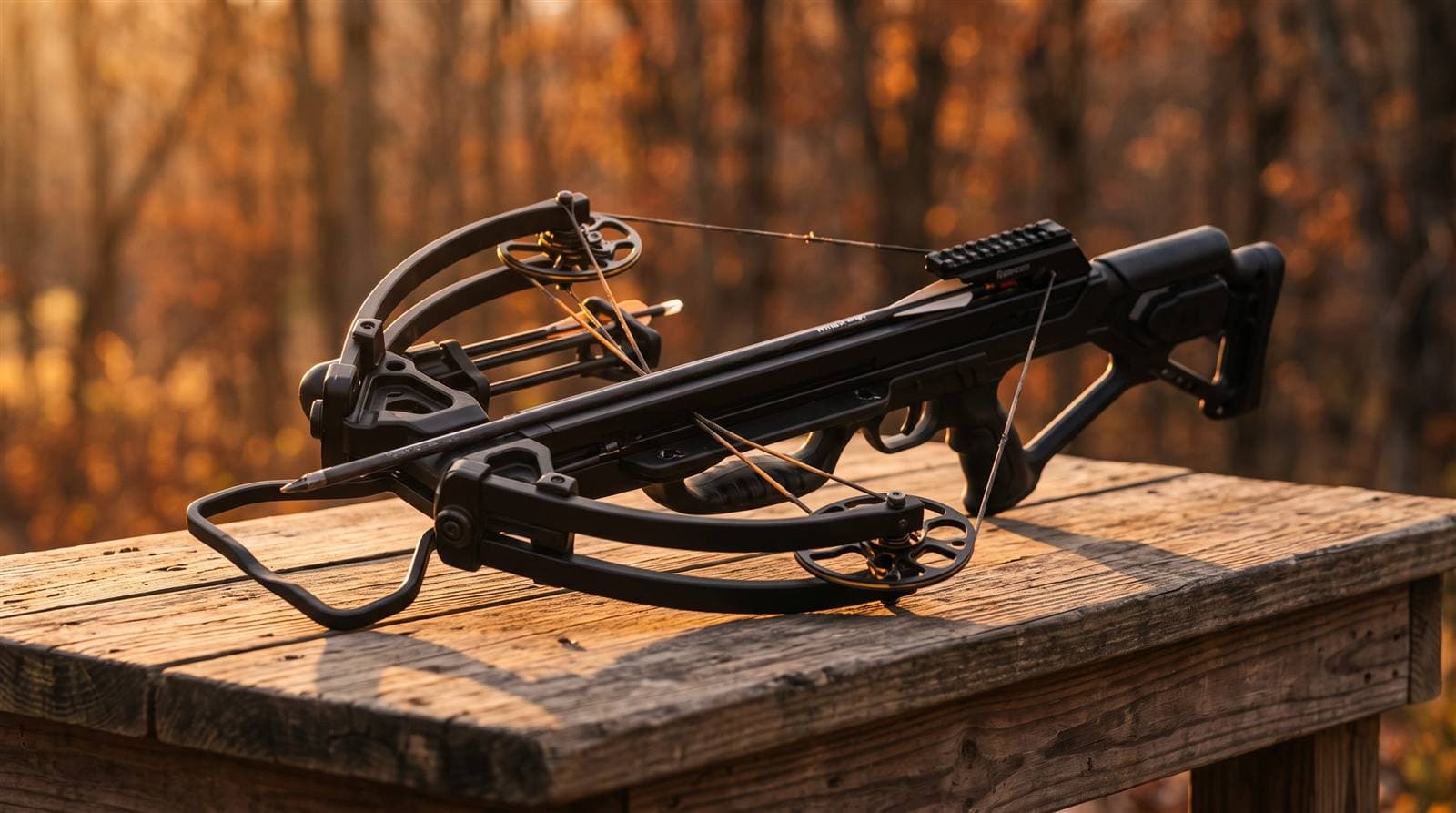
What Is Trigger Pull?
The force, in pounds, needed to release the trigger, along with how crisp and consistent it feels through take-up, break and reset.
Trigger Pull: definition
Also called: trigger weight, trigger break, pull weight, trigger feel
Trigger pull describes what the trigger does under your finger. The headline figure is pull weight: the force in pounds needed to release the string latch and fire the crossbow. The feel matters just as much as the number, including how smoothly it moves and how cleanly it breaks.
A light, crisp trigger makes it easier to fire without disturbing your aim. A heavy or gritty trigger can pull the crossbow off target as you squeeze. Pull weight is not the whole story, because a lighter trigger is not automatically better or safer.
Trigger pull sits inside the wider trigger system, which also includes the latch and the safety switch. The two work together, and a light trigger demands careful finger discipline.
Trigger vocabulary
| Term | What it means | What good looks like |
|---|---|---|
| Take-up | Movement before resistance builds | Short and smooth |
| Creep | Movement felt during the pull | Little or none |
| Break | The moment the trigger releases | Crisp, like a snapped glass rod |
| Overtravel | Movement after the break | Minimal |
| Reset | Return of the trigger after the shot | Smooth and consistent |
| Stacking | Resistance rising before the break | None |
Why Trigger Pull matters
Consistency is what makes a trigger useful. If the break weight changes from shot to shot, your point of impact can change with it. A repeatable trigger helps a scope and a zeroing process give honest results.
It is also a safety matter. A very light trigger leaves less margin for an accidental release, so the safety, finger placement and handling rules matter more, not less. Keep your finger off the trigger until you are ready to shoot, and keep the safety on until then.
How to read it on a spec sheet
- Look for a stated pull weight in pounds and whether it is a nominal or a measured value.
- Check whether the trigger is a branded unit. The TenPoint TX Ultra 29.5 and the TRX Ultra both list a custom TriggerTech trigger.
- Read reviews for creep, stacking and consistency, not only the number. The TRX Ultra review records a break of about 3.5 lbs across 20 sampled shots, with no creep and no stacking.
- Check the safety style, such as an AR-style ambidextrous thumb safety, and whether it suits your hand.
- Look at warranty terms for the trigger mechanism. The TRX Ultra lists a lifetime warranty on the trigger mechanism.
Common mistakes
- Chasing the lightest possible pull weight.
- Adjusting or modifying a trigger yourself. Follow your manual and use a qualified technician.
- Ignoring consistency and focusing only on the number.
- Resting a finger on the trigger while handling or cocking.
- Relying on the safety instead of safe handling habits.
How to evaluate a trigger in a shop or review
- Confirm the crossbow is unloaded and uncocked before handling it, and follow the shop's rules.
- Read the manual for the trigger and safety layout.
- Look for reviews that describe take-up, creep, break and reset.
- Check whether the pull weight is stated and how it was measured.
- Ask whether trigger adjustment is allowed, and who may do it.
See it in our reviews
- TenPoint TRX Ultra — rated 4.9/5
- TenPoint TX Ultra 29.5 — rated 4.8/5
Frequently Asked Questions
What is trigger pull on a crossbow?
Trigger pull is the force needed to release the trigger, normally measured in pounds, along with the feel of the pull through take-up, break and reset. A crisp, consistent trigger helps accuracy.
What is a good trigger pull weight?
There is no single figure. Reviewers value a crisp, repeatable break more than a number. The TenPoint TRX Ultra review records about 3.5 lbs, with no creep and no stacking across sampled shots.
Is a lighter trigger better?
Not always. A light trigger can help aim but leaves less margin for an accidental release. Consistency and a clean break matter more, and safe handling matters regardless of weight.
What is the difference between creep and take-up?
Take-up is the initial slack before resistance. Creep is movement felt while the pull is building toward the break. A good trigger has short take-up and little or no creep.
Can I adjust my crossbow trigger?
Only if the manufacturer's manual says you can. Trigger work affects safety, so follow your manual closely or have a qualified technician make any adjustment on your behalf.
Does trigger pull affect accuracy?
Yes, because a rough or inconsistent trigger can disturb your aim as you squeeze. A smooth, repeatable break supports tighter groups, though bolts, sights and technique also matter.
Does the safety change trigger pull?
The safety blocks the trigger from releasing, but it does not change pull weight. Keep the safety on until you are ready to shoot, and follow the manual's instructions for your model.
Keep learning
Guides that use this term
- GuideCrossbow Safety Rules for BeginnersCrossbow safety rules for beginners: finger placement, never dry-firing, safe cocking and de-cocking, range etiquette and storage habits that prevent injury.Read the guide
- GuideHow to Sight In a Crossbow ScopeSight in a crossbow scope in six numbered steps: safe range setup, bore-sighting, a 20-yard zero, click math, longer-range checks and fixes.Read the guide
- GuideBest Crossbows of 2026: Tested PicksBest crossbows for 2026: seven tested picks from $95 to $3,500, sorted by who each suits, with a comparison table and a decision list.Read the guide
Related terms
- Trigger SystemThe mechanism that holds the cocked string, releases it when you press the trigger, and includes safeties that help prevent accidental release.
- Safety SwitchA manual control that blocks the trigger from releasing the string, and which many crossbows engage automatically when cocked.
- String LatchThe catch in the rail that holds the drawn string at full draw and releases it when the trigger is pulled, and one of the most safety-critical parts.
- Zeroing (Sighting In)Zeroing is adjusting a scope so the bolt lands where the reticle points at a chosen distance, and it is the foundation of every other aiming mark.
- ScopeAn optical sight mounted on a crossbow rail that magnifies the target and places a reticle on it so you can aim with repeatable precision.
- Dry FireReleasing the string with no bolt on it, which sends the stored energy into the crossbow itself and can cause serious damage.
Browse the gear
Definitions are general information. Manufacturer figures vary, so follow your crossbow's manual and verify local laws with the relevant authority.