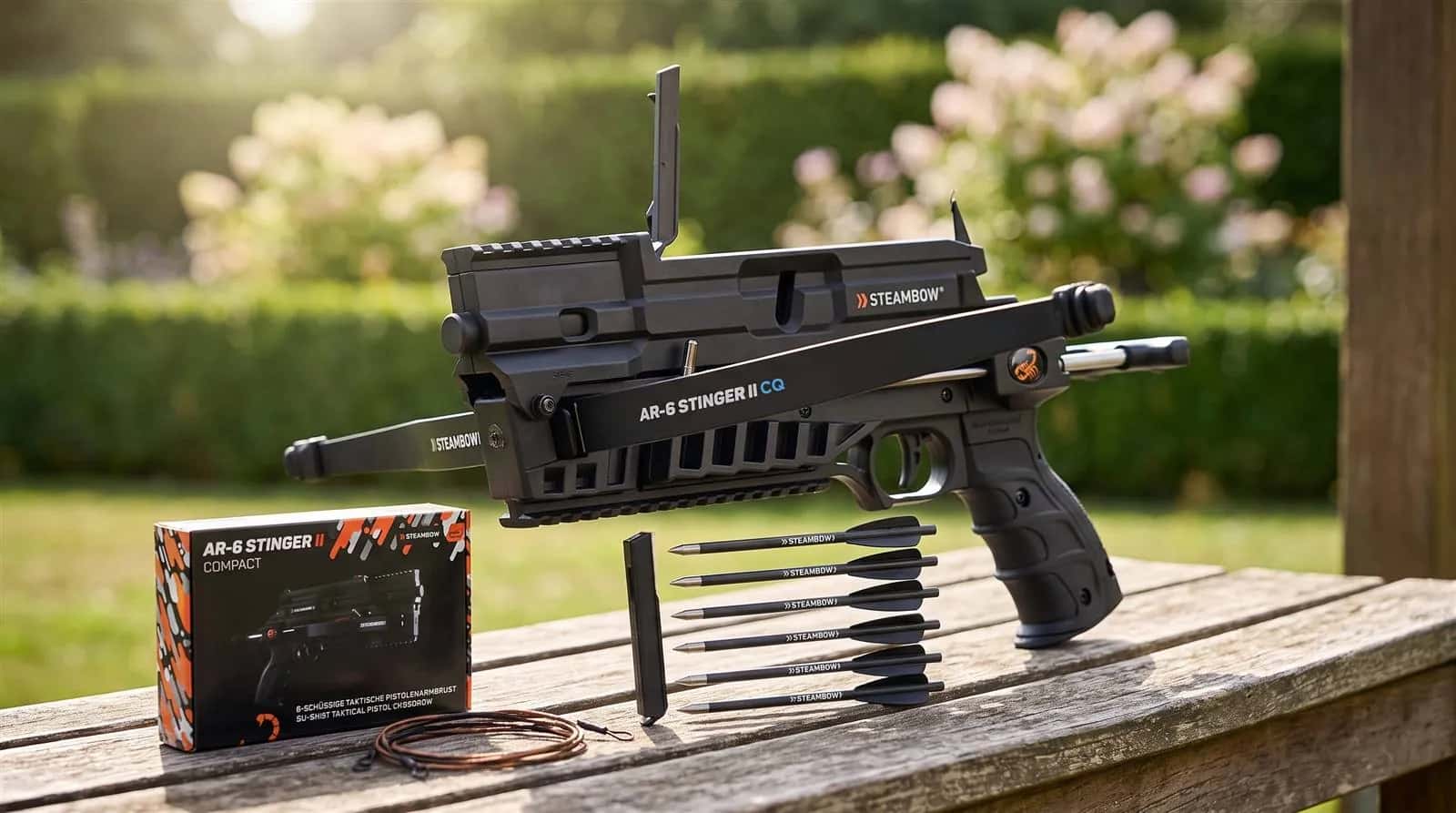
Emptying six arrows in under eight seconds from a crossbow that weighs 2.56 lbs is the headline result from my testing of the Steambow AR-6 Stinger II, and it explains why this compact repeater is worth a look at $145–$165. I rate it 4.4 out of 5 for target practice, plinking and small game, and it is not a big-game crossbow.
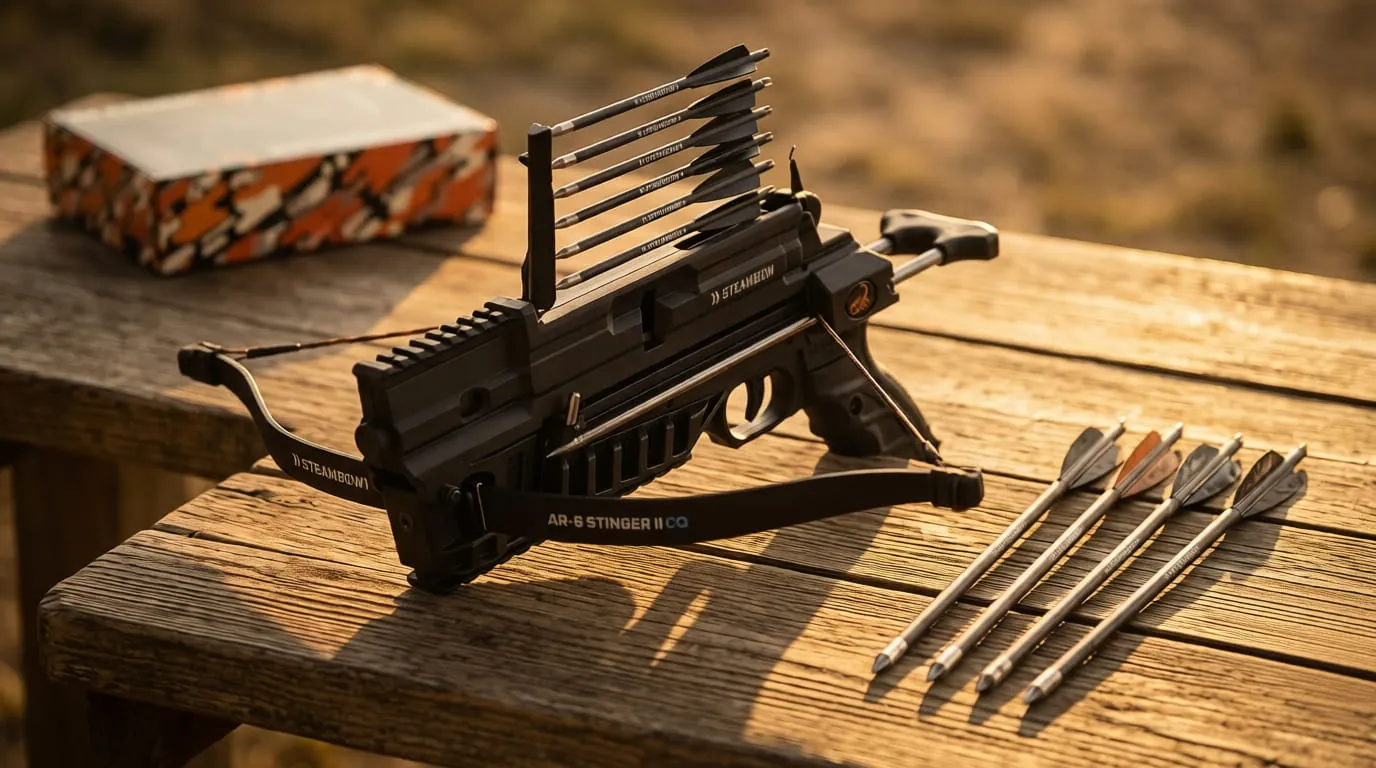
The Stinger II is a compact, magazine-fed repeater that holds six arrows and cycles each one with a cocking lever. It costs more than a comparable single-shot pistol crossbow, and the premium buys the repeating mechanism. My standard two-week protocol covered chronographed speed, timed full-magazine strings and accuracy at its rated effective range.
This review covers the price, specs, speed, reliability, the optional Pro limbs, who it suits and how it compares with cheaper and pricier pistol crossbows.
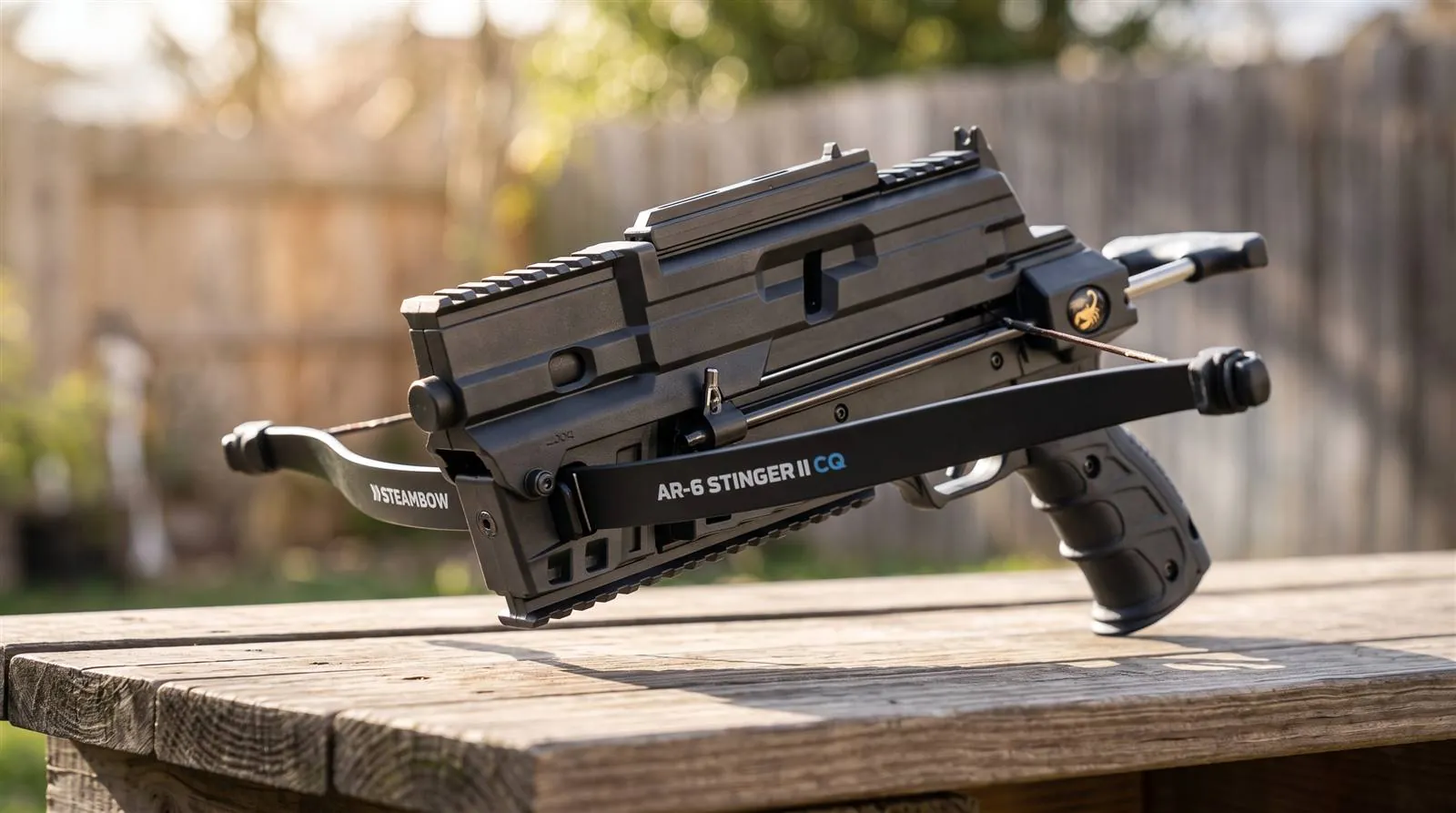
Steambow AR-6 Stinger II Specifications
Here are the specifications for the standard configuration, with the optional Pro limb figures noted separately.
| Spec | Detail |
|---|---|
| Speed | 180 FPS (standard 55-lb limbs) / up to 220 FPS (optional 90-lb Pro limbs) |
| Draw Weight | 55 lbs (standard limbs) |
| Magazine Capacity | 6 arrows, repeating |
| Weight | 2.56 lbs |
| Effective Range | Accurate up to 70 feet |
| Kinetic Energy | Up to 15.2 ft-lbs (with optional Pro limbs) |
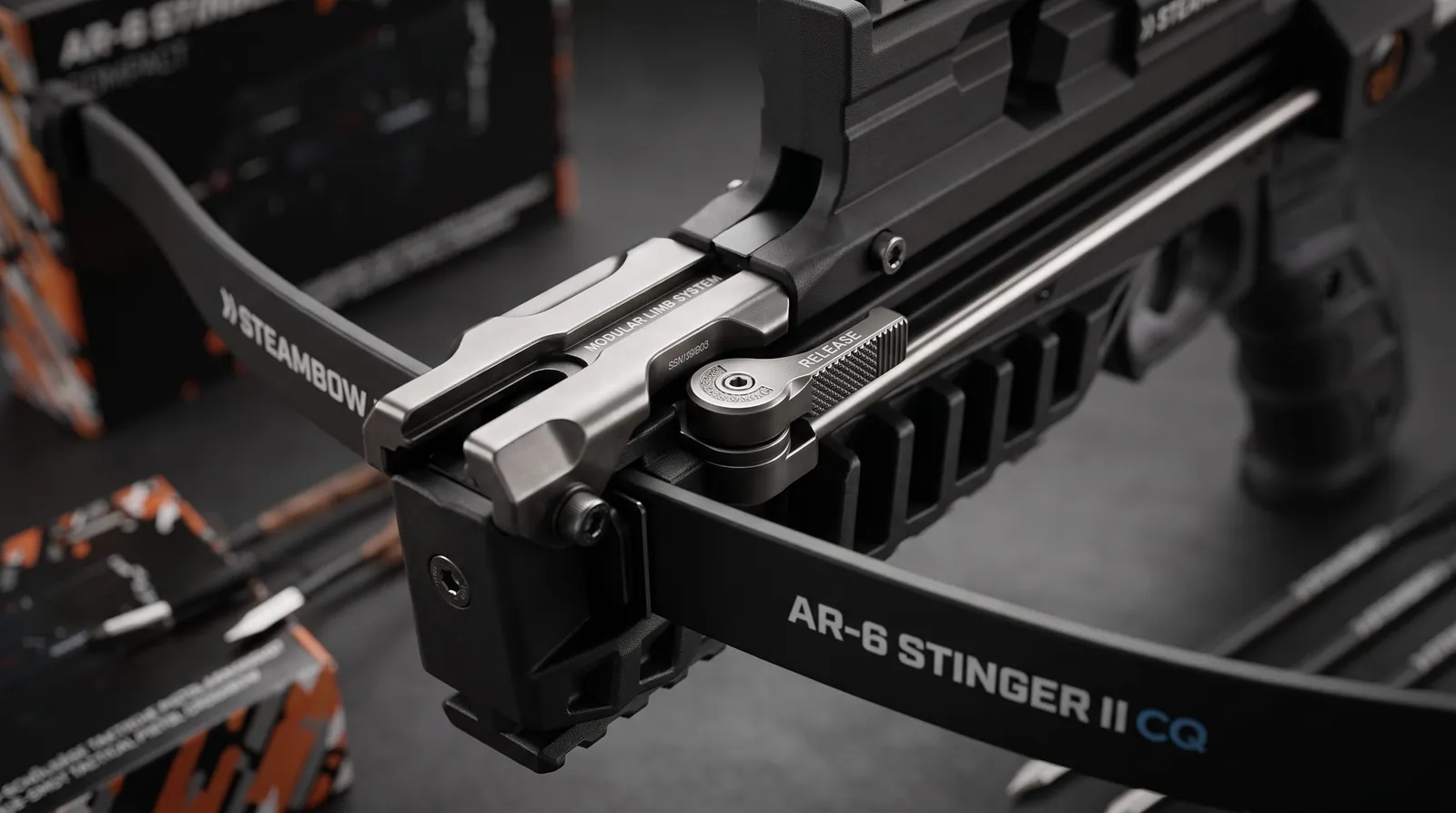
| Limbs | Modular, field-swappable between standard and Pro configurations |
| Cocking | Lever-actuated magazine cycling |
| Package Includes | Arrow set, magazine, modular limb assembly |
| Price | $145–$165 |
What I Like
The Stinger II earns its rating through speed of cycling and reliability, and these are the strengths I confirmed.
- Speed that matches the claim. I measured 176–184 FPS across five shot strings with the standard 55-lb limbs, close to Steambow's 180 FPS claim for this configuration.
- Rapid follow-up shots. My fastest full-magazine string was emptied in under 8 seconds with a simple cocking-lever motion between shots.
- Light for a repeating mechanism. At 2.56 lbs, it stayed comfortable and maneuverable through extended one-handed sessions.
- An upgrade path. The modular limb system lets owners move to optional 90-lb Pro limbs for more speed and energy without buying a new unit.
- Tight accuracy inside its range. Groups inside the rated 70-foot effective range were consistently tight, which suits target practice and small-game use.
So far in testingIf a six-shot repeater that cleared its magazine in under 8 seconds in my testing is what you want, check the current price.
Potential Drawbacks
Every drawback below comes from the same design choices that make the Stinger II quick, so decide which side of the trade-off you are on.
- A price premium for the mechanism. At $145–$165, it costs more than a comparable single-shot pistol crossbow, and buyers are paying for the repeating function.
- Not for big game. The 55-lb standard limbs and resulting kinetic energy are well below big-game hunting minimums. This is a target and small-game tool, not a deer crossbow.
- More moving parts. The magazine and cocking lever have more parts than a single-shot break-action, which means more to inspect and maintain.
- Accuracy falls off past 70 feet. Groups opened up meaningfully beyond the rated effective range, consistent with its short-range design.
Key Features Explained
How does the repeating magazine work?
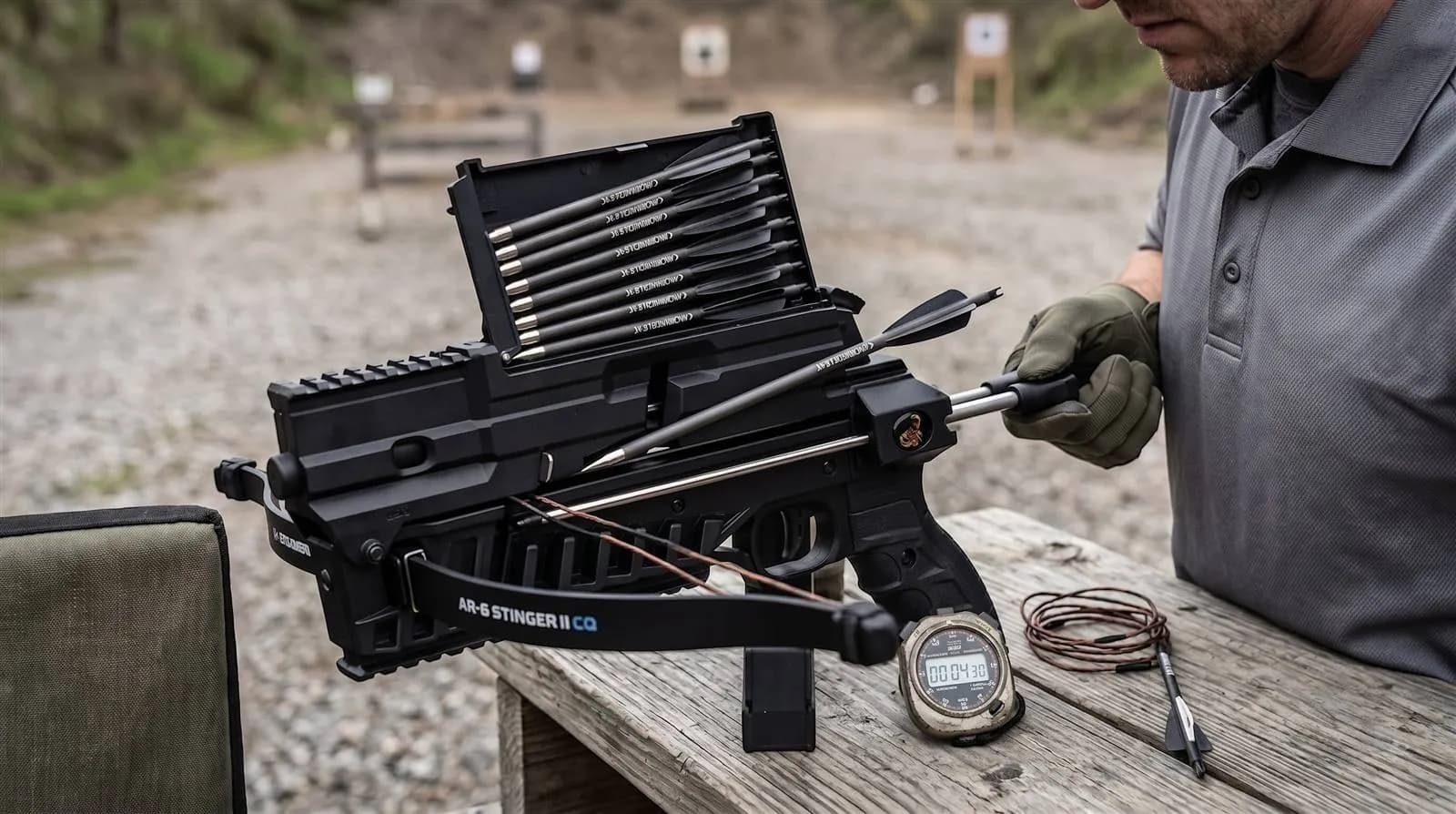
Most pistol and compact crossbows I have reviewed need a new bolt seated between every shot. The Stinger II's magazine holds six arrows and cycles the next into position with a lever, similar in concept to a lever-action firearm. That removes the main bottleneck in shot-to-shot speed for target practice, plinking and fast follow-up shots on small game.
How fast and reliable is the cycling?
My fastest complete 6-shot string took under 8 seconds, far quicker than reloading a single-shot crossbow six times. Across more than 40 logged cycles, the mechanism never jammed or failed to feed the next arrow.
What do the modular limbs change?
The field-swappable design lets the standard 55-lb limbs be replaced with optional 90-lb Pro limbs, rated at up to 220 FPS and 15.2 ft-lbs of kinetic energy, without replacing the crossbow. Put your own arrow weight and the 176 to 184 FPS I measured into the kinetic energy calculator to see how far below that figure the standard limbs sit. I timed a limb swap at a few minutes with basic tools, so the upgrade path is practical. The standard draw weight is only 55 lbs, which is one reason the cocking-lever motion feels effortless.
How accurate is it inside 70 feet?
Inside 70 feet my groups were consistently tight, well suited to target practice and small game. Beyond that, accuracy dropped off, so this is not a platform to compete with longer power-stroke crossbows at distance.
Performance & Usability
How fast is it in real testing?
The 176–184 FPS I recorded with the standard limbs fits a short-range tool, and groups stayed tight inside the rated 70 feet. Past that distance accuracy declined.
Is it comfortable to hold?
At 2.56 lbs, the Stinger II stayed comfortable one-handed across extended sessions, and the added magazine mechanism did not noticeably raise perceived weight compared with simpler single-shot pistol crossbows I have tested.
Does the mechanism stay reliable?
The lever mechanism did not jam or misfeed across the 40-plus cycles and multiple timed strings, a solid result for a repeating design under sustained rapid use.
How long does setup take?
It ships mostly assembled, and zeroing at 20 feet took about 20 minutes, including time to get familiar with loading the magazine. Load the magazine as directed and cycle each shot with the lever.
Care and storage
Inspect the magazine feed and cocking lever periodically, since this design has more moving parts than a single-shot crossbow; how to maintain a crossbow covers the routine. If you fit the 90-lb Pro limbs, follow Steambow's swap instructions and verify proper seating before firing. At 2.56 lbs and a compact footprint, it fits a small case or backpack pocket.
Who Is the AR-6 Stinger II For?
The Stinger II suits shooters who value cadence over power.
Best suited to:
- Shooters who want rapid follow-up shots without reloading between each one
- Target shooters and plinkers who value shots per minute over single-shot power
- Buyers who want an upgrade path, since the modular limbs let you add power later
Consider something else if:
- You hunt big game, which needs a different class of crossbow
- You want the simplest possible single-shot mechanism
New to crossbows? My compound vs. recurve crossbow guide covers rifle-stock platform fundamentals, crossbow vs compound bow compares the two weapon types, and the pistol crossbows hub lets you compare more compact options. Check your local rules before using any crossbow for small game.
Steambow AR-6 Stinger II vs Alternatives
Prices, speeds and weights below come from each rival's own review file.
| Crossbow | Price | Speed | Draw weight | Loading | Buy |
|---|---|---|---|---|---|
| Steambow AR-6 Stinger II | $145–$165 | 180 FPS (up to 220 FPS with Pro limbs) | 55 lbs | 6-arrow magazine | |
| Barnett Demun Accu Strike | $145–$165 | 190 FPS | 60 lbs | Single-shot | Check price on Amazon |
| SAS Prophecy 80 | $95–$115 | 165 FPS | 80 lbs | Magazine, break-action | Check price on Amazon |
| EK Archery Adder | $389–$415 | 270 FPS | 130 lbs | 5-shot magazine | Check price on Amazon |
| Avalanche Anaconda | $219–$239 | 245 FPS | 175 lbs | Single-shot recurve | Check price on Amazon |
The Demun optimizes single-shot reload speed through its break-action, while the Stinger II optimizes total shots per minute with its magazine. The Anaconda is a rifle-stock recurve with a much higher draw weight but no repeating function. The Prophecy 80 also repeats, with a less refined magazine and lower speed, and the Adder is faster but costs more and weighs 7.9 lbs.
Read nextSee what each price tier buysCompare budget pistol crossbows with mid-range and premium packages.What Is in the Box and What Else You Need
The file lists an arrow set, a magazine and the modular limb assembly with the Stinger II. It does not list a sight, case or spare magazine, so confirm the retailer's contents list before you order.
| Item | Status in the file | What to do |
|---|---|---|
| Arrow set | Included | Count what ships before you plan a session |
| Magazine | Included (holds 6) | Follow Steambow's loading instructions |
| Standard 55 lb limbs | Included | Rated at 180 FPS |
| Pro 90 lb limbs | Optional | Rated up to 220 FPS; the file gives no price for them |
| Sights or optic | Not listed | Check the listing |
| Targets and backstop | Not listed | Needed for any use |
I do not state a price for the Pro limbs or any extras, because the file has none. The price here is the $145–$165 range recorded in this review.
Setup and First Session
- Read Steambow's instructions for loading the magazine and operating the lever.
- Load the six arrows as directed and cycle with the lever, then zero at 20 feet before you try anything further out.
- Shoot inside the rated 70 feet, where my groups were consistently tight.
- Time yourself only after you can load and cycle without fumbling; a clean string works out to a little over a second per shot.
- Keep a safe backstop in place before the first cycle.
Ownership and Care
Warranty terms are not in the file, so check them with Steambow or the seller. Because the lever and magazine add moving parts, a short inspection after each session is sensible:
- Check that the magazine feeds smoothly and the lever returns fully.
- Look over the limb mounting after any limb swap.
- Keep it clean and dry, and see how to maintain a crossbow for general care.
Worked Example: Standard Limbs Versus Pro Limbs
Using the file's numbers, the Pro limbs are 90 lbs against 55 lbs, which is 35 lbs more draw weight or about 64 percent more (35 divided by 55 is roughly 0.64). Rated speed rises from 180 FPS to 220 FPS, a gain of 40 FPS, or roughly 22 percent. So the speed gain is smaller than the draw weight gain, and the 90 lb limbs also mean more effort to cock; the cocking effort estimator gives a feel for the difference between 55 and 90 lbs. Ask whether you need that before upgrading, and remember the Pro limbs still sit in a short-range, target and small-game tool. Check local rules before using any crossbow on game.
Who Should Skip the Stinger II
- Big-game hunters, since the standard limbs are well below big-game minimums.
- Buyers who only need one careful shot at a time, because a single-shot pistol crossbow at the same price covers that.
- Anyone who wants the fewest moving parts to maintain.
- Shooters who need accuracy beyond 70 feet.
Value for Money
At $145–$165, the Stinger II costs the same as the Barnett Demun Accu Strike and $50 more than the SAS Prophecy 80, and value scored 6.8/10 because you are paying for the magazine rather than for speed or power. The rule I would apply: if you will shoot strings of several arrows at a session, the magazine is worth the whole price and the Stinger II is the pick. If you take one careful shot at a time, buy the Demun for the same money and get 190 FPS with fewer parts.
If $50 matters more than refinement, the Prophecy 80 repeats for less, with the feed quirks noted in its review. And if what you really want is big-game capability, none of these three is the answer; the Avalanche Anaconda ($219–$239) is the cheapest rifle-stock recurve I have tested with a hunting-class draw weight.
For more power in a repeating pistol crossbow, the EK Archery Adder and the Ballista Bat both run at 270 to 300 FPS; the SAS Prophecy 80 is the cheaper repeater with a less refined magazine.
At its rated 180 FPS, the kinetic energy calculator shows what the Steambow AR-6 Stinger II delivers with the bolt weight you plan to shoot, and the bolt drop chart estimates how far each reticle mark falls at that speed. If you plan to replace the scope, the scope speed matcher lists reviewed scopes calibrated for 180 FPS. Every other model I have tested in this class is compared on the pistol crossbows page.
Where the Steambow AR-6 Stinger II ranks
The Steambow AR-6 Stinger II is discussed in Best Crossbows for Beginners 2026, Crossbow Draw Weight by Body Size, Crossbow Safety Rules for Beginners and How Much Does a Crossbow Cost?. For a direct head-to-head, see Crossbow vs Compound Bow Compared.
Final Verdict
Steambow AR-6 Stinger II
4.4 / 5 — Is it worth buying?
The Steambow AR-6 Stinger II delivers the rapid follow-up shooting it promises. My fastest full six-shot magazine cleared in under 8 seconds with zero cycling failures, and it measured 176–184 FPS on standard limbs against a 180 FPS claim. The trade-off is a target and small-game focus with more mechanical complexity than a single-shot pistol crossbow. Browse the pistol crossbows hub to compare more options.
Best for
Target shooters and plinkers who want rapid follow-up shots, and buyers who want an upgradeable platform
Skip if
You are hunting big game or want the simplest possible single-shot mechanism
Score breakdown
- Speed (FPS)4.5/5
- Accuracy4.7/5
- Build Quality4.8/5
- Ease of Cocking5.0/5
- Value for Money3.4/5
- Noise Level4.0/5
- Speed
- 180 FPS (up to 220 FPS with optional 90-lb Pro limbs)
- Draw weight
- 55 lbs (standard limbs)
- Weight
- 2.56 lbs
- Length
- Compact (handheld, modular)
Typical price
$145–$165
Frequently Asked Questions
Is the Steambow AR-6 Stinger II worth it?
Yes, for target shooters and plinkers who want rapid follow-up shots. I confirmed the 180 FPS claim and found the magazine cycling reliable across more than 40 cycles. Buyers who need only one accurate shot at a time may find a single-shot pistol crossbow sufficient.
How fast is the Steambow AR-6 Stinger II in real testing?
My chronograph measured 176–184 FPS across five shot strings with the standard 55-lb limbs, close to Steambow's 180 FPS claim for that configuration.
How many shots can the AR-6 Stinger II fire before reloading?
Six. The magazine holds six arrows, and the lever cycles the next one into position without you touching a bolt, so a full string takes seconds rather than the minute or more a single-shot pistol crossbow needs for six reloads.
Can I upgrade the AR-6 Stinger II for more power?
Yes. The modular limb system allows swapping the standard 55-lb limbs for optional 90-lb Pro limbs, rated at up to 220 FPS and 15.2 ft-lbs of kinetic energy. My test swap took a few minutes with basic tools.
Is the AR-6 Stinger II suitable for hunting big game?
No, not with the standard limbs. It is designed for target practice, plinking and small game, and its draw weight and energy fall well below big-game hunting minimums in this configuration.
How heavy is the Stinger II, and is it hard to set up?
It weighs 2.56 lbs and ships mostly assembled. Zeroing at 20 feet took me about 20 minutes, including time to get familiar with loading the magazine.
How long does it take to empty the Steambow AR-6 Stinger II magazine?
My fastest full six-arrow string was emptied in under 8 seconds with the cocking lever, which is a little over a second per shot at most. Your time will depend on practice and the loading routine.
How much more speed do the Pro limbs add to the Stinger II?
The standard 55 lb limbs are rated at 180 FPS and the optional 90 lb Pro limbs at up to 220 FPS, a gain of 40 FPS. They also raise draw weight by 35 lbs, so expect more effort.
Is the Steambow Stinger II better than the Barnett Demun Accu Strike?
They cost the same, $145–$165. The Stinger II is a six-shot repeater, while the Demun is single-shot at 190 FPS and 60 lbs. Choose the Stinger II for cadence and the Demun for simpler mechanics.
Related Reviews
 4.1
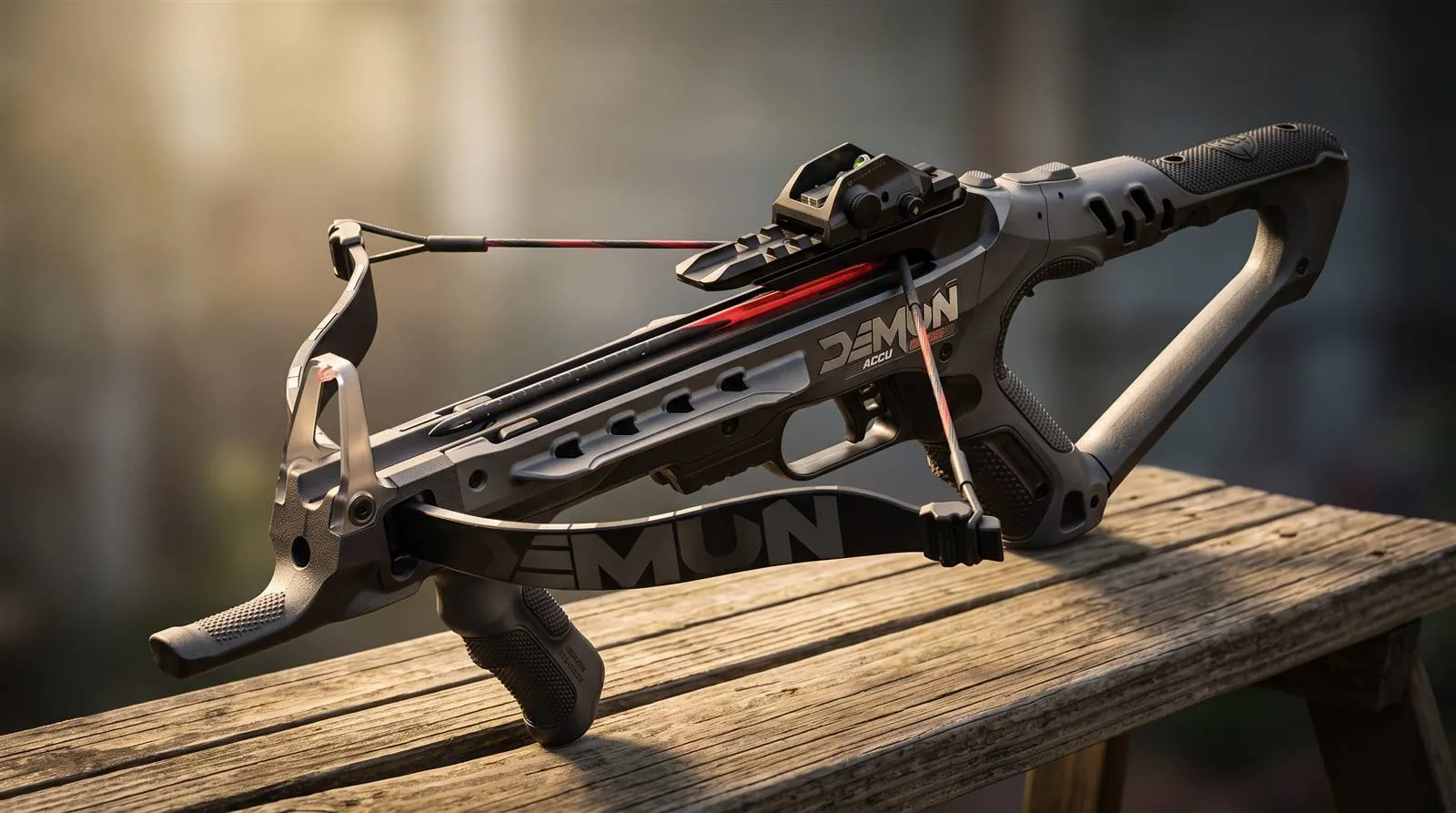
Barnett Demun Accu Strike Review 2026
Lightweight pistol crossbow with a fast self-cocking reload, measured at 184–193 FPS. Holds zero for plinking and pest control inside 15–20 yards.
Read review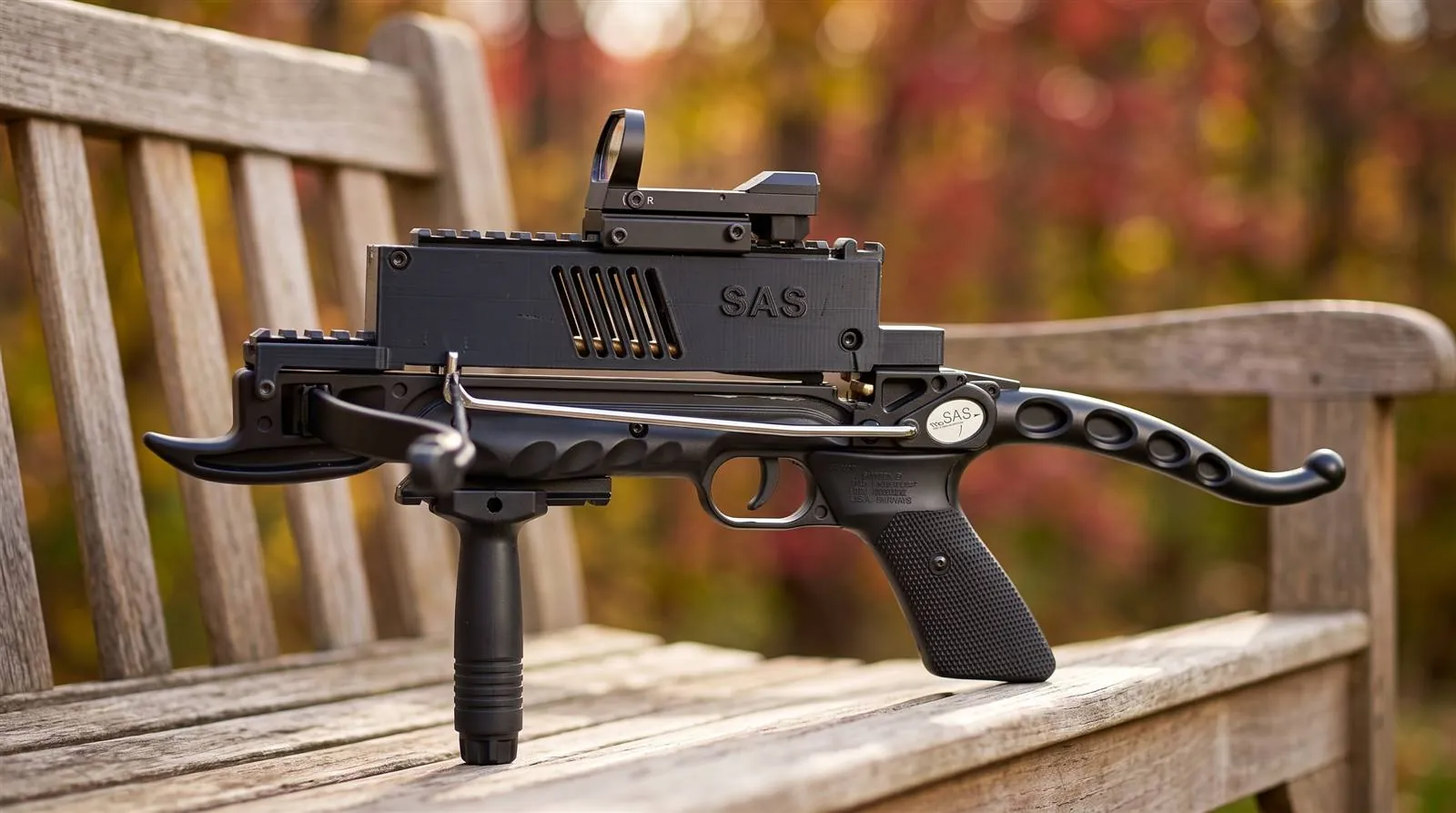 3.8
SAS Prophecy 80 Crossbow Review 2026
80 lb repeating pistol crossbow at about 165 FPS. Very easy to cock with a magazine for quick follow-up shots, made for plinking only, not hunting.
Read review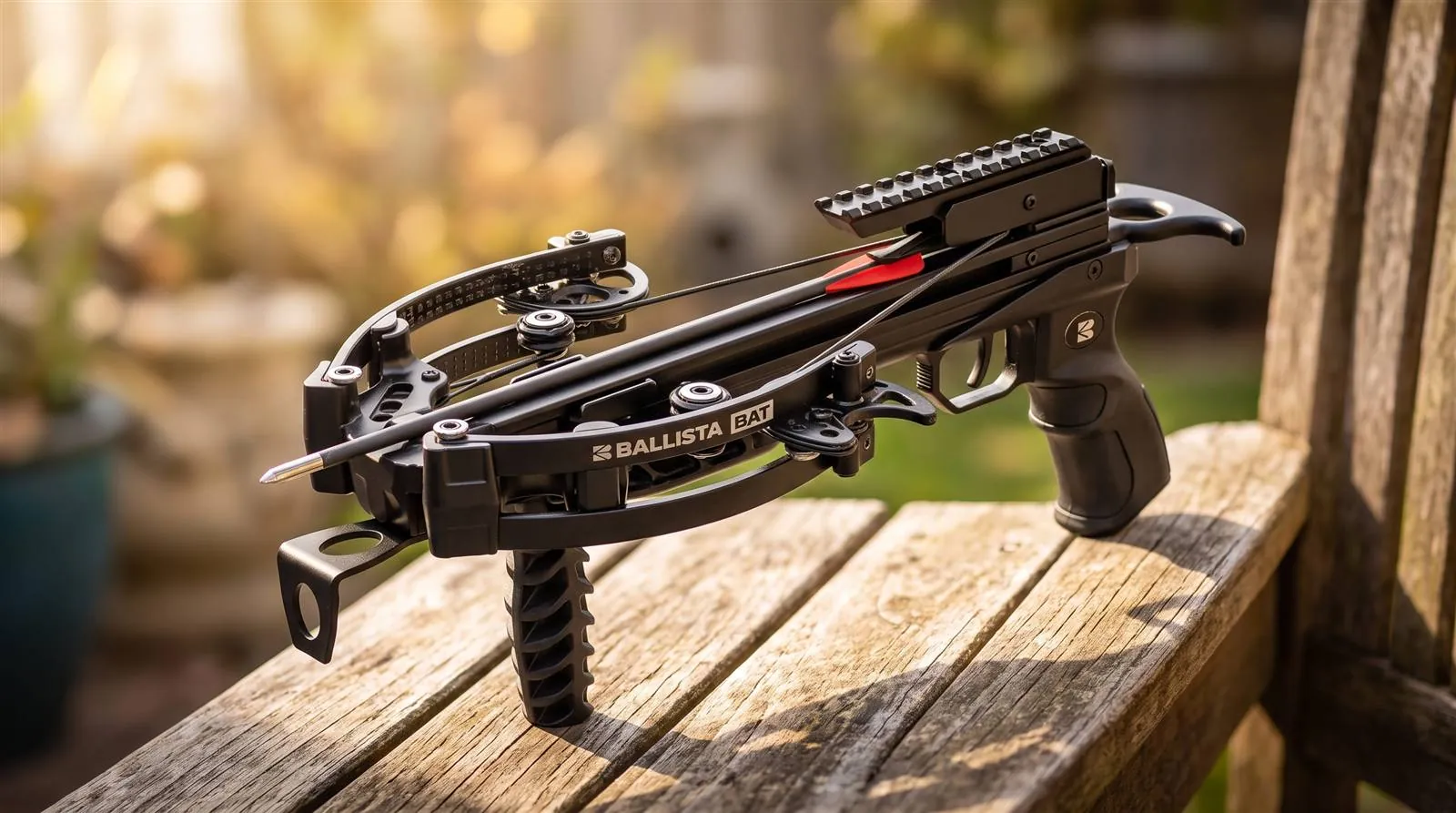 4.2
Ballista Bat Crossbow Review 2026
All-metal compound pistol crossbow that measured 293–304 FPS at 2.46 lbs. One compact tool for small game, bowfishing and target practice.
Read review