What Is Cocking Rope?
A rope-and-handle accessory that uses pulleys to cut the pull needed to draw a crossbow string by roughly half.
Cocking Rope: definition
Also called: rope cocker, rope cocking device, cocking rope device, crossbow cocking rope
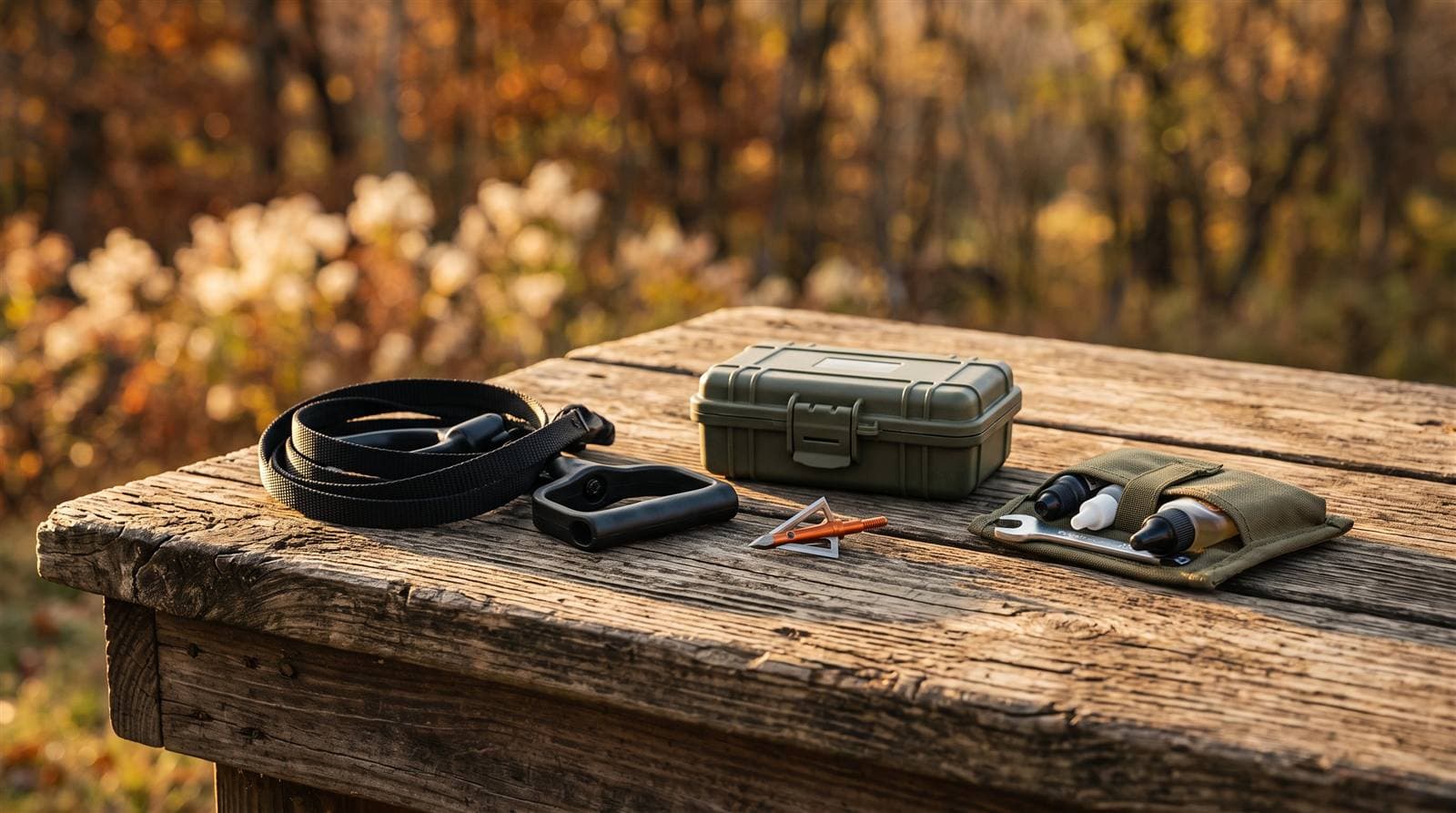
A cocking rope is a short rope with two handles and a pair of small pulleys or hooks. The hooks catch the string either side of centre, and the pulleys give you a mechanical advantage so you pull a smaller force over a longer distance. It is the simplest type of cocking aid.
The usual rating is about a 50 percent reduction in effort, which fits a 2:1 pulley arrangement. The Barnett Premium Rope Cocking Device, for example, is a 50-inch ambidextrous rope with a magnet lock, listed at $19 to $29 in our review.
A rope is light and cheap, and works on many standard-draw designs. It still needs real arm and back strength, and the rope has to match your crossbow. Some models are excluded by their maker, including certain reverse draw designs, so check the compatibility list before buying.
Pull force with a 2:1 rope
Pull force ≈ Draw weight / 2 + friction losses
For a 165 lb crossbow, the ideal pull is about 82 lb. A real rope adds some friction, so expect slightly more, and always compare with the manufacturer rating.
Rope cocker features to compare
| Feature | What to look for | Why it matters |
|---|---|---|
| Rope length | Matches your reach; the Barnett is 50 in | Too short strains the draw, too long wastes stroke |
| Handles | Ambidextrous, textured grip | Even, comfortable pull for left and right hands |
| Lock or keeper | Magnet lock or strap | Keeps the rope tidy and secure when stowed |
| Compatibility | Listed models and exclusions | Wrong rope can load the string unevenly |
| Weight | Under a pound in the Barnett review | Easy to carry in a pack or pocket |
Why Cocking Rope matters
A rope is the lowest-cost way to make a heavy draw weight manageable. For many owners it turns hand cocking from a struggle into a routine task.
It also helps the string travel evenly, which keeps the string latch engaged square. Even travel is a quiet contributor to consistent point of impact.
Its weakness is that it is detachable. A rope left in the truck or a drawer is no help when you need it, and it offers no controlled way to lower the string.
How to read it on a spec sheet
- Check the compatibility list on the product page; look for named exclusions as well as supported models.
- Read the claimed effort reduction as an ideal figure, and expect real effort to be a little higher.
- Check rope length and handle design against your size and handedness.
- Look for a lock or keeper so the rope stays tidy when stowed.
- Confirm the maximum rated draw weight, since a rope rated for lighter crossbows can fail under a heavier load.
Common mistakes
- Using a rope on a crossbow its maker lists as incompatible, such as a reverse-draw or other excluded model.
- Hooking only one side of the string or letting a hook slip while drawing.
- Jerking the rope instead of drawing smoothly and evenly.
- Treating the rope as a de-cocking tool. A rope is for drawing the string back, not for lowering it.
- Using worn rope or damaged hooks past their useful life.
Checking a rope before you use it
- Read the manual section for your rope and your crossbow.
- Inspect the rope for fraying, the hooks for bends and the handles for cracks.
- Put the safety on and point the muzzle in a safe direction.
- Seat the foot in the foot stirrup, attach the hooks to both sides of the string equally, and keep fingers off the rail.
- Pull both handles smoothly and evenly until the string clicks into the latch.
- Remove the rope before loading a bolt and stow it so it cannot catch on the string.
In my testing
In the Barnett Premium Rope Cocking Device review I measured effective pull force against hand cocking and found it cut effective effort by roughly half on a compatible standard-draw crossbow. The magnet lock held without slipping. As a separate accessory it can be left behind, and it still takes more effort and time than a crank such as the TenPoint ACUdraw. How I test.
See it in our reviews
- Barnett Rope Cocking — rated 4.3/5
- TenPoint ACUdraw — rated 4.5/5
Frequently Asked Questions
How does a cocking rope work?
The hooks catch the string either side of centre and pulleys multiply your pull. You apply a smaller force over a longer distance, so a 2:1 arrangement needs about half the effort, minus friction.
How much easier is a rope than hand cocking?
Most ropes are rated at roughly a 50 percent reduction in effort. Our Barnett rope review found it cut effective effort by about half on a compatible crossbow, though a real rope always adds a bit of friction.
Can I use any rope on my crossbow?
No. Ropes are rated for specific models and draw weights. The Barnett rope, for instance, lists reverse draw cam models and Hyper RAPTOR crossbows as incompatible. Check the compatibility list and your manual.
Is a rope cocker or a crank better?
A rope is cheaper, lighter and faster, but still needs strength. A crank has a lower, steadier effort but is slower, heavier and model-specific. The right choice depends on your strength and how often you cock.
Can a cocking rope be used to de-cock?
No. A rope draws the string back; it is not a controlled way to lower it. Use a built-in de-cock system or the discharge method your manual approves, as described in our guide on how to de-cock a crossbow safely.
How long should a cocking rope be?
Length should let you reach comfortably through the full draw. The Barnett rope is 50 inches. Very tall or very short shooters should read the product page and check the stroke length of the crossbow.
How do I look after a cocking rope?
Keep it dry, check it for fraying and bent hooks before each outing, and store it coiled so it cannot snag the string. Replace worn parts with the manufacturer specified ones, not general hardware.
Does a rope help with accuracy?
It helps the string seat evenly, which removes one source of left-right error. It does not replace a good zero or consistent shooting form, so keep practising your hold and anchor point.
Keep learning
Guides that use this term
- GuideHow to Cock a Crossbow: Rope vs CrankHow to cock a crossbow step by step with a rope or crank, why hand cocking rarely works, and the mistakes that cause uneven strings and injuries.Read the guide
- GuideCrossbow Draw Weight by Body SizeHow much crossbow draw weight suits your frame and strength: true vs felt draw weight, cocking aids, power stroke and reviewed examples.Read the guide
- GuideHow to Maintain a CrossbowHow to maintain a crossbow: string waxing, rail and moving-part lubrication, bolt inspection, storage, and when to see a technician.Read the guide
Related terms
- Cocking AidA rope or crank device that reduces the effort needed to draw the string and helps it seat evenly in the latch.
- Crank Cocking DeviceA geared, hand-turned mechanism that winds the string back to the latch with low, steady effort, built in or detachable.
- Draw WeightThe peak force, in pounds, needed to draw the string to the latch, which sets cocking effort and is one input to speed and energy.
- String LatchThe catch in the rail that holds the drawn string at full draw and releases it when the trigger is pulled, and one of the most safety-critical parts.
- Foot StirrupThe metal or composite loop at the front of a crossbow where you place your foot to hold the crossbow steady while cocking it.
- Reverse-DrawA crossbow layout where the limbs angle back toward the shooter, shifting weight rearward and allowing a longer power stroke within a compact frame.
Browse the gear
Definitions are general information. Manufacturer figures vary, so follow your crossbow's manual and verify local laws with the relevant authority.