What exit pupil means on a crossbow scope in plain terms
What exit pupil means on a crossbow scope meaning: Exit pupil is the width of the beam of light leaving a scope eyepiece: objective diameter divided by magnification. Wider beams look brighter in dim light.
Also called: exit pupil diameter, exit pupil size
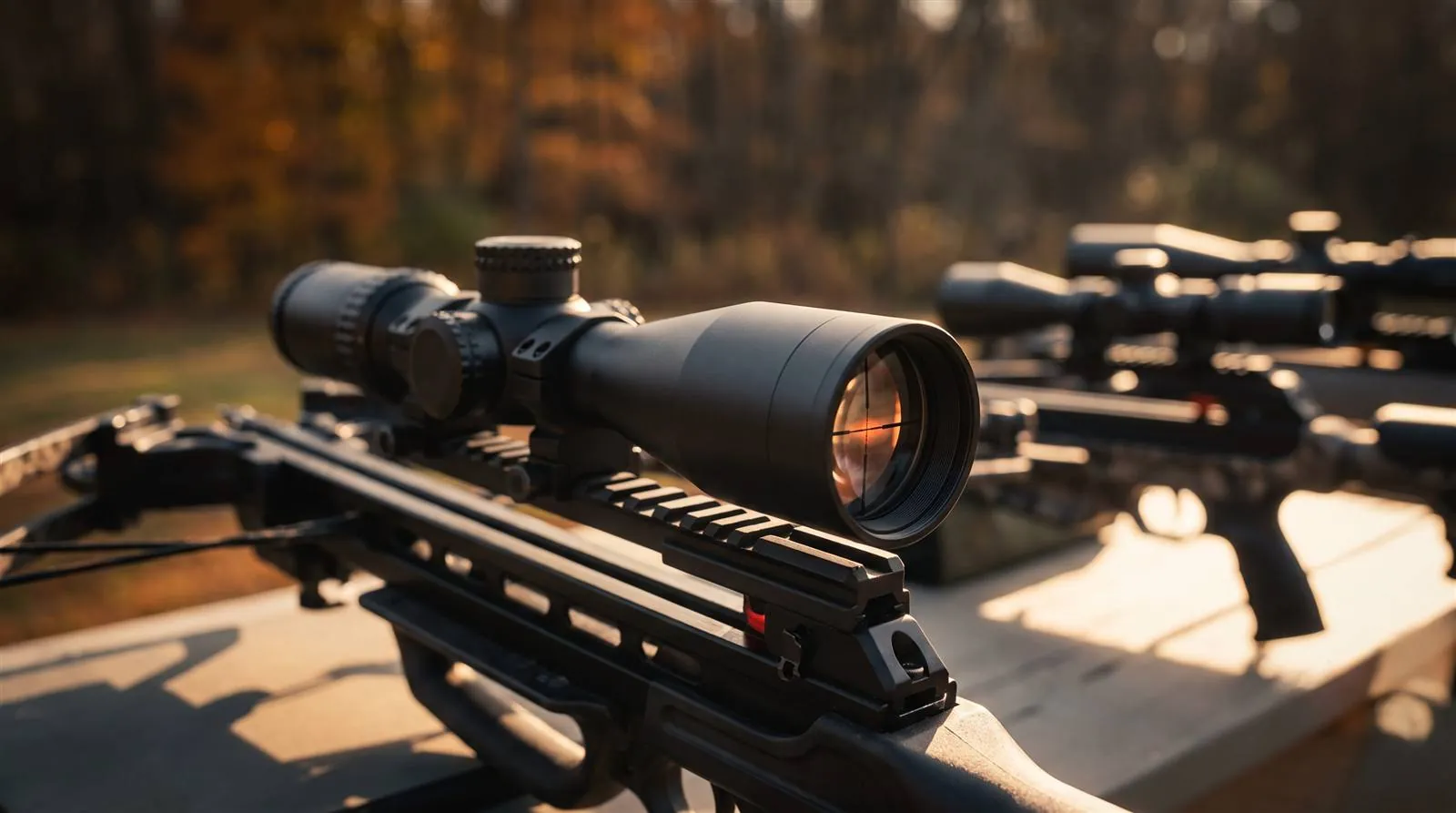
The exit pupil is the small circle of light you see floating in the eyepiece when you hold a scope at arm's length. It is the beam of light the scope delivers to your eye, and its width in millimetres is the objective lens diameter divided by the magnification. Vortex gives the example of a 50 mm objective at 10x producing a 5 mm exit pupil.
On a variable scope the exit pupil changes as you turn the power ring. Burris lists the exit pupil of its Scout 2-7x32 as 16 mm at 2x and 4.6 mm at 7x. Turning the power down widens the beam, which is why a scope looks brighter on a low setting in fading light.
Your eye sets the useful limit. Vortex notes that adult pupils may only dilate to about 4 to 6 mm in darkness, and less with age, so an exit pupil wider than your own pupil adds no brightness you can use.
Exit pupil
exit pupil (mm) = objective diameter (mm) ÷ magnification
A 4x32 gives 32 ÷ 4 = 8 mm. A 2-7x32 at 7x gives 32 ÷ 7 = about 4.6 mm.
Why it matters
Deer often move in the last minutes of legal light. Knowing the exit pupil tells you which magnification gives the brightest usable picture at that moment: usually a low one at crossbow ranges.
It also explains why a modest crossbow scope can look as bright at dusk as a bigger rifle scope at high power. Lens quality and coatings still matter, so exit pupil is a guide, not a ranking.
How to read it on a spec sheet
- Look for an exit pupil line in the spec table, often given as a range from low to high power.
- If it is missing, divide the objective by the magnification yourself.
- Compare scopes at the power you will actually use, not the top number.
- Read anything above about 7 mm as more than the eye can use in the dark.
Common mistakes
- Hunting at dusk on the highest magnification and finding the image too dark.
- Paying for a huge exit pupil your eye cannot use.
- Confusing exit pupil with eye relief, which is the distance from the eye to the eyepiece.
- Judging brightness by exit pupil alone and ignoring glass and coatings.
See it in our reviews
- Vortex Crossfire II 2-7x32 — rated 4.5/5
- TenPoint RangeMaster 100 — rated 4.5/5
Frequently Asked Questions
What is exit pupil on a scope?
It is the diameter of the beam of light leaving the eyepiece, found by dividing the objective lens diameter by the magnification. A wider exit pupil usually means a brighter image in dim light, up to the size of your own pupil.
How do I calculate exit pupil?
Divide the objective diameter in millimetres by the magnification. A 3-9x40 at 3x gives about 13.3 mm; at 9x it gives about 4.4 mm.
What exit pupil is best for low light?
One at least as wide as your dilated pupil, roughly 5 to 7 mm for many people and less with age. At crossbow ranges that usually means a low magnification setting at dawn and dusk.
Is exit pupil the same as eye relief?
No. Exit pupil is the width of the light beam; eye relief is how far your eye sits behind the eyepiece to see the full picture. Both affect how easy a scope is to look through.
Why does my scope get darker when I zoom in?
Because the exit pupil shrinks as magnification rises. The same objective lens spreads its light over a narrower beam, so less light reaches your eye at high power.
Related guides
Guides where exit pupil shapes a real choice.
 GuideHow to Choose a Crossbow ScopeChoose a crossbow scope in eight steps, from intended use, reticle and magnification to eye relief, illumination, glass and mounting matched to your bolt speed.Read the guide
 GuideBest Crossbow Scopes of 2026 for Every Bolt SpeedCrossbow scopes compared from a budget variable-zoom scope to laser rangefinding and digital models, with reticle, magnification and speed range for each.Read the guide
Definitions are general information. Manufacturer figures vary, so follow your crossbow's manual and verify local laws with the relevant authority.