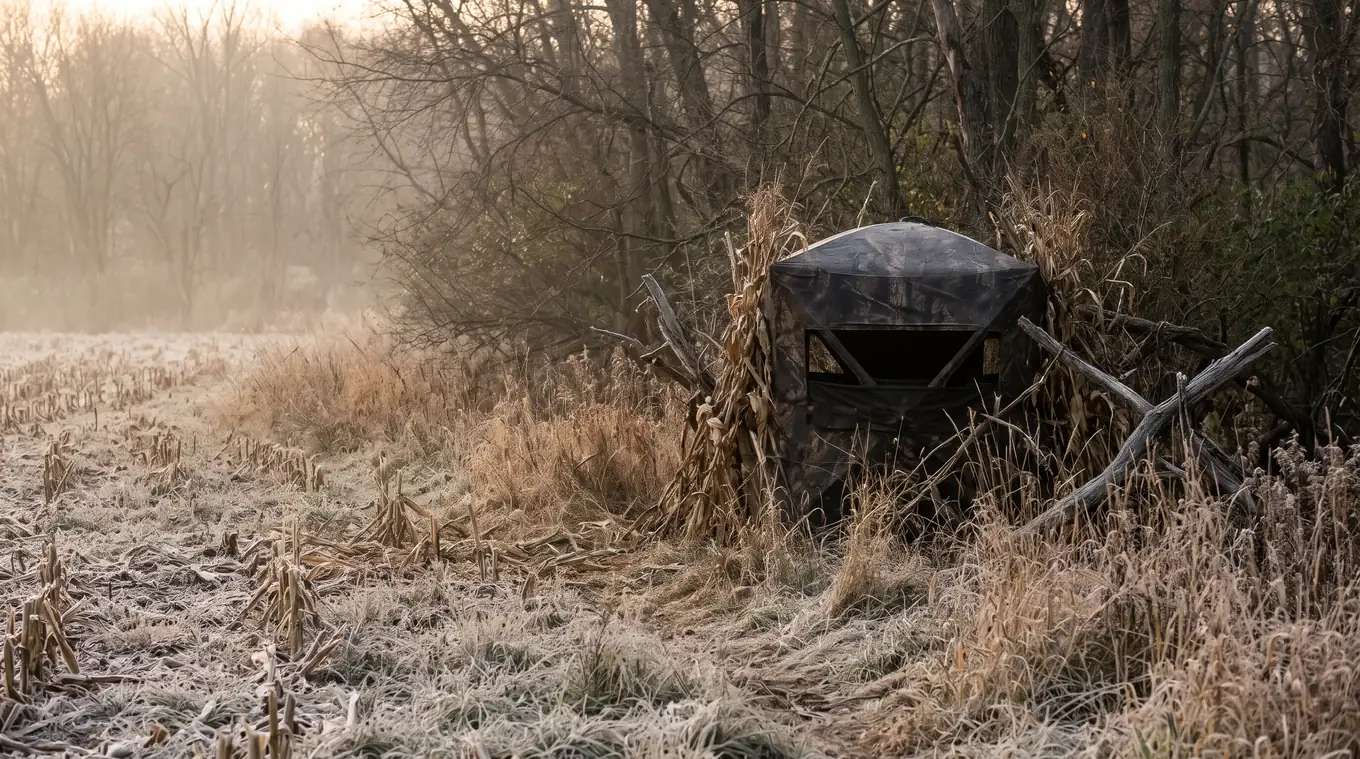
A crossbow and a ground blind are a good match. You never draw with a deer in front of you, the bow sits on a rest instead of in your arms, and the blind hides the small movements a seated hunter makes. What the blind takes away is room: the limbs sit close to the walls, the window is a fixed size, and you shoot from a chair. This page sets the blind up around your crossbow, from the spot and the seat to the rest, the window and the lanes.
Why a Crossbow Works From a Ground Blind
Hunting out of a blind with a crossbow solves problems that a tree stand or a vertical bow cannot. It is one of the setups our crossbow hunting guide covers alongside stands, stalking and other game, and it is often the best one for hunters who cannot or would rather not climb.
| What the blind gives you | What to watch for |
|---|---|
| No climb and no harness: a good fit for older hunters, hunters with an injury and young hunters sitting with an adult | The view is lower and shorter, so you see deer later and at closer range |
| The crossbow rests on a tripod or sticks, so you hold no weight while you wait | The window is fixed: the bow has to fit it at every angle you might shoot |
| Dark interior hides hand and head movement | The limbs sit close to walls and window frames |
| Room for a chair, a heater and gear within reach on a long late-season sit | Scent stays at ground level, so the wind matters as much as it does from a stand |
The crossbow's big advantage is that it is already drawn. A vertical bow needs room overhead to draw and a moment of movement with the deer in view. With a crossbow you wait in shooting position, take the safety off and shoot. The trade-off is width: a compound crossbow's limbs stick out sideways, and in a blind those limbs are the part that hits things.
Before the season, check what your state allows from a blind (blaze orange on the blind, crossbow seasons and who may use one). Our page on crossbow hunting laws by state links each state's agency.
Will Your Crossbow Fit the Blind?
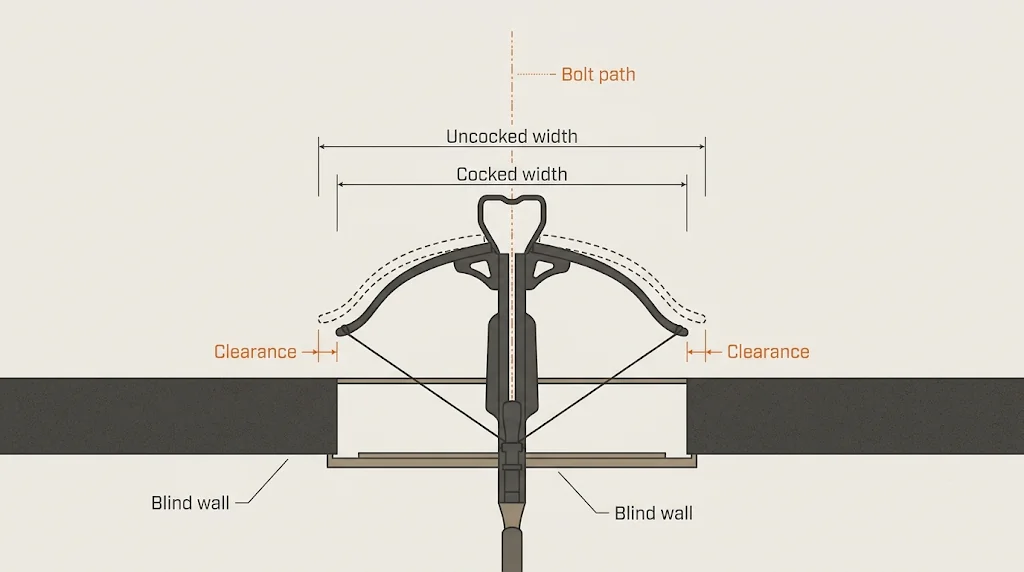
The figure that decides fit is the cocked axle-to-axle width: the distance between the cam axles when the bow is drawn and ready to shoot. That is the width you swing inside the blind.
The uncocked width is wider, because the limbs move outward as the string goes forward at the shot, so the space they need at the moment of release is closer to the uncocked figure. The third number is overall length, which decides whether the stock or the front of the bow hits the back wall or the roof when you turn.
Here are the widths and lengths of 12 crossbows we review, sorted from the smallest cocked width.
| Crossbow | Cocked width | Uncocked width | Overall length | Buy |
|---|---|---|---|---|
| Ravin R26X | 5.75 in | n/p | 26 in | Check price on Amazon |
| TenPoint TRX Ultra | 6 in | 11.75 in | 29.5 in (without stirrup) | Check price on Amazon |
| Killer Instinct Logix 435 | 6.75 in | 10.75 in | 32.25–33.75 in | Check price on Amazon |
| TenPoint TX Ultra 26.5 | 7 in | 10.75 in | 26.5 in | Check price on Amazon |
| Barnett Hyper Raptor T-Rex | 7.25 in | n/p | 32 in | Check price on Amazon |
| Barnett XPX 410 | 7.5 in (spec list); 7 in (product description) | n/p | 32.5 in | Check price on Amazon |
| TenPoint Flatline 460 | 7.5 in | 12 in | 26.5 in | Check price on Amazon |
| Barnett HyperTac 420 | 9.2 in | n/p | 32 in | Check price on Amazon |
| TenPoint Titan 400 | 9.75 in | 13 in | 33 in (without stirrup) | Check price on Amazon |
| Wicked Ridge Commander 400 | 11 in | 14.5 in | 35.75 in (without stirrup) | Check price on Amazon |
| Barnett Recruit XP | 13 in | n/p | 35.5–38 in | Check price on Amazon |
| Killer Instinct Boss 405 | 14.75 in (overall width; axle-to-axle not published) | 18.75 in (overall width) | 33.5–36 in | Check price on Amazon |
n/p = not published by the maker. Barnett gives two cocked widths for the XPX 410: 7.5 inches in its spec list and 7 inches in its product description, so plan on the larger figure.
How to read the table for your own blind:
- Up to about 7.5 inches cocked (the first seven rows) is the small end of this table. These bows leave the most room between the limbs and the window edges.
- 9.2 to 9.75 inches (the HyperTac 420 and Titan 400) is mid-width. Both work from a blind, but check the swing to each edge of the window before opening day.
- 11 inches and up (Commander 400, Recruit XP, Boss 405) is wide. Plan on a larger blind and a wider window, and rehearse every angle.
- Length matters too. The Commander 400 and Recruit XP are both over 35 inches long, and our review of the Ravin LR notes that its 34-inch length makes it less suited to tight ground blinds.
If your crossbow is not in the table, the cocked and uncocked widths and the overall length are in its manual or on the maker's spec page. Some makers publish only the cocked width; in that case leave extra room beyond it for the limbs at the shot.
Skip a blind-first purchase if you already own a wide or long crossbow and hunt from a small blind only now and then: a larger blind or a different window is cheaper than a new bow. If you are buying a crossbow mainly for blind hunting, our best compact crossbows roundup compares short, small-width models. And if a long sit means carrying the bow a long way in, our guide on how much a crossbow weighs compares carry weights.
Choose a Blind for a Seated Crossbow Shot
Any pop-up hub blind can work with a crossbow, but a few features make the seated shot easier. We do not recommend blind brands here; these are the things to check on any blind you look at.
- Interior width and height. You need room for the chair, the rest, your elbows and the crossbow's length when you turn toward a side window. Compare the blind's inside dimensions (not the footprint at the base, which is wider on hub blinds with sloped walls) with your bow's length plus your arm room, and with the uncocked limb span when you aim at the edge of a window.
- Window height. The bottom edge of the shooting window should sit at or a little below the crossbow's rail when you are seated. Blinds list window heights from the floor; compare that with your chair's seat height plus the height of your rest at shooting position.
- Window shape. Wide horizontal windows suit a crossbow, because they leave room for the limb span and let you swing across a lane. Tall narrow vertical windows suit vertical bows and can pinch a crossbow's limbs.
- Window covers. Look for covers that open quietly, with hooks or magnets rather than loud hook-and-loop strips, and zippers that slide without a rasp.
- See-through walls. Some blinds use fabric you can see out of but deer cannot see into. They widen your view, which matters because a blind already limits how early you see deer.
- A frame that holds its shape. A stiff hub frame stands up to wind and snow load. A wall that flaps or sags in the wind can swing into the window and into the limbs.
- A dark interior. Black inner walls hide movement. Keep the back windows closed so you are not silhouetted against light.
Set Chair, Window and Rest Height
Most blind setups fail on height, not on width: the hunter has to hunch to see over the sill or lift the bow off the rest to clear it. Fix the setup, not your posture. Do this at home or at the blind before the season, with the crossbow uncocked.
- Wear your hunting clothes. A late-season coat changes how you sit and how far your arms reach.
- Sit in the chair you will hunt from. A chair with a back and no squeaky joints is easier to sit still in for hours. A swivel seat helps you turn toward a side window.
- Shoulder the uncocked crossbow in a relaxed seated position, elbows down, and note where the rail sits.
- Set the rest at that height, so the crossbow sits on it without you leaning forward or lifting your shoulders.
- Match the window to the rail. The rail should be level with the bottom edge of the opening or slightly above it. If it is not, change the chair, the rest or the window you shoot from.
- Swing to every lane you plan to shoot and check that both limb tips stay inside the window frame and the front of the bow stays clear of the wall at each angle.
- Look through the scope at each lane. You should see the lane through the open window with the whole limb span inside the opening.
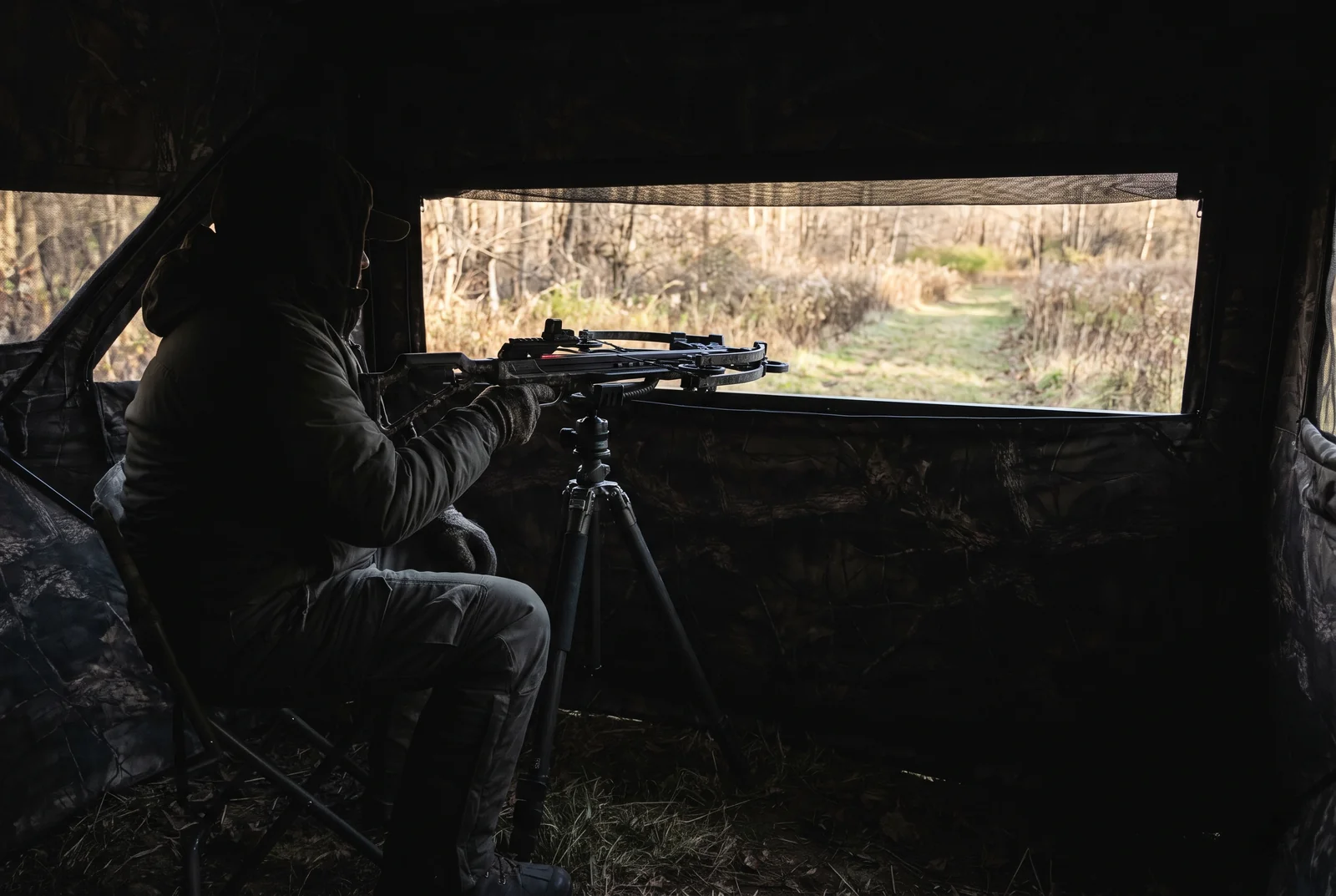
Two Hunters in One Blind
A second hunter, often an adult with a young hunter, takes room you planned for the limbs. Seat the shooter at the window with the clearest lanes, keep the other person behind and away from the limbs and the string, and keep both people's hands and feet clear of the bow before it is cocked. The safety guide linked in the limb clearance section below covers bystanders near a cocked crossbow.
Rests: Tripod, Shooting Sticks or Chair-Mounted
A crossbow is front-heavy, and on a long sit you cannot hold it at the window. A rest lets you wait in shooting position with your hands free. The blind wall is never a rest: fabric moves, and the hub frame transmits every tremor and flap of the wall into the bow.
The common choices are a tripod rest, shooting sticks and a rest that mounts to the chair.
| Rest type | Stability | Footprint in the blind | Noise and movement | Two-person blind |
|---|---|---|---|---|
| Tripod with a yoke or cradle | Most stable; holds the bow on its own | Largest; three legs take floor space | Quiet once set; little movement to aim | Takes room; set it before the second hunter sits |
| Shooting sticks (two or three legs) | Good; you keep a hand on the bow | Small; folds away | Some movement to raise and settle | Fits best |
| Chair-mounted arm | Good; moves with you as you turn | None on the floor | Can creak at the joints; check before the season | Fits well |
Set the rest so the yoke sits where the fore-end balances, and check that the yoke or cradle does not touch the string, the limbs or the flight track. Whatever you choose, it stands on the blind floor or the chair, never against the wall. A rest also matters for hunters who cannot hold a crossbow up for long: with the bow on a tripod, the only thing to lift is the stock to your cheek.
Limb Clearance and Cocking in the Blind
The scope looks out of the window, but the bolt and the limbs need their own clear path. Check these before every sit:
- The sight line is not the bolt path. The scope sits above the bolt, so a clear view does not mean a clear flight. Make sure the bottom edge of the window and any fabric are below the bolt's path, not only below the scope.
- The limb span at the shot. The limbs move outward when the string goes forward. Use the uncocked width, where your maker publishes it, to judge clearance at the window edges.
- Every angle. Check both limb tips at each edge of the window, at each lane, from your seated position.
- Accessories. A crank handle, quiver or sling stud can hit a wall when you swing the bow.
Cocking and de-cocking are where most blind problems start. Cock outside the blind or before you settle, and never dry-fire to unload.
Our crossbow safety rules set out the full ground-blind procedure, including cocking in tight spaces, and our guide on how to de-cock a crossbow covers each method at the end of the day.
Can You Shoot Through Blind Mesh?
Some blind makers call their window mesh shoot-through. Even so, mesh can affect bolt flight and the fletching, and a broadhead can catch on it. The open window is the safer default: drop the mesh, or open the window, before deer arrive, and keep the cover lowered just enough to stay hidden.
If you must shoot through mesh:
- Check what both the blind maker and the crossbow maker say about it.
- Practise through the same mesh, with the same broadhead, at the same distances before you hunt, and look at where the bolts land.
- Stop if the bolts hit off your point of aim, or if the fletching or broadhead shows damage.
Pick the Spot, Brush It In and Cut Shooting Lanes
A ground blind can go where a tree stand cannot: field edges, waterways, CRP and other grass strips, fence lines and cut corn, with no tree needed. Pick the spot for the deer first and the blind second.
- Set the blind on the deer, not the view. Use a field corner, a pinch point between cover and food, or the edge of a waterway that deer cross. Our guide to hunting deer with a crossbow explains where deer move through each part of the season.
- Set up days or weeks ahead. Deer notice a new shape. A blind left in place before the season looks like part of the landscape by opening day.
- Brush it in. Pull local grass, branches or cornstalks around the sides and over the roof line to break up the outline. Keep the windows you shoot from clear.
- Mind the wind. Put the blind downwind of where you expect deer, and plan an entry route that does not cross their trail.
- Keep the trail inside your range. The blind should sit close enough that the trail, the food and every lane are inside the distance you practise at. Our guide to how far a crossbow can shoot explains why that limit is shorter than the maximum range.
- Cut lanes. Trim the grass, saplings and low branches in each lane, at window height from a seated shooter, so a bolt has a clear path to the deer. Cut them when you set the blind, not on the day you hunt.
- Range-mark each lane. Use a rangefinder from the window and mark a stake, a stump or a tuft of grass at known distances, so you know the yardage without moving when a deer steps in.
Sight the crossbow in at those distances, from a seated position, before the season. Our guide to sighting in a crossbow scope walks through it.
Sitting All Day: Cold, Scent and Staying Ready
Blinds shine late in the season, when the sits are long and the wind is cold. A few habits keep you hidden and ready.
- Keep it dark. Close the back and side windows you are not shooting from, and wear dark clothes so you do not stand out against the walls.
- Play the wind. A blind hides movement, not scent. Keep the blind downwind of the deer and accept that some days the wind rules a blind out.
- Stay warm. Dress in layers, keep your feet off the cold ground with a mat, and use a heater only if it is made for use in enclosed blinds and you follow its ventilation instructions.
- Keep gear in reach. Rangefinder, calls and water within arm's reach, so you do not dig through a pack with a deer in view.
- Stay ready, safely. Keep the crossbow on its rest with the safety on and fingers away from the trigger until you have picked your shot.
- Keep the noise down. Close shots from a blind mean the deer hears the shot quickly. Our review scores rate noise for each crossbow, and string suppressors help on louder bows.
After the Shot From a Blind
Stay in the blind. From a seated position you see less of where the deer went than you would from a stand, so make what you saw count:
- Watch and listen until the deer is out of sight and sound.
- Mark where it stood when you shot, using the range markers and a fixed object in the lane, and where you last saw it, from your eye level in the blind.
- Note the time and how the deer reacted.
Our guide to crossbow shot placement on deer explains what the reaction tells you about the hit. Then wait. Our guide on how to track deer after a crossbow shot sets out the waiting times and blood signs.
Troubleshooting a Ground Blind Setup
| Symptom | Likely cause | Fix |
|---|---|---|
| A limb touches the window frame or wall when you swing | Window too narrow for the limb span, or you are seated too close to it | Move the chair back, shoot from a wider window, or narrow your lanes to the angles that clear |
| You cannot see over the sill without hunching | Chair or rest too low for the window | Raise the seat or rest, or use a window that sits lower |
| The bolt or broadhead brushes the fabric or mesh | Bottom edge of the window above the bolt path, even though the scope sees clear | Lower the cover further or raise the rest; open the mesh |
| The bow drifts or wobbles on the rest | Rest touching the wall, or yoke not at the balance point | Stand the rest on the floor, away from the fabric; move the yoke |
| Deer spot movement in the blind | Back windows open, so you are silhouetted | Close the windows behind you; wear dark clothes |
| The crank handle or quiver hits the wall | Accessory sticks out at the angle you swing | Remove the handle or quiver before the sit, or set the rest farther from the wall |
| Deer stop outside the lanes | Lanes cut in the wrong place or too few | Cut another lane where deer stop, before the next sit |
Frequently Asked Questions
Can you crossbow hunt from a ground blind?
Yes. A crossbow is one of the easiest weapons to use from a ground blind, because it is already drawn and can wait on a rest. Check the blind fits the bow's length and limb span, set the window at rail height and shoot through an open window.
Can you shoot a crossbow through blind mesh?
Some makers say their mesh is shoot-through, but it can affect bolt flight and fletching. Shoot through an open window by default. If you must use mesh, check what the blind and crossbow makers say and practise through the same mesh first.
Do I need a tripod in a ground blind?
Not a tripod in particular, but you need a rest of some kind. A tripod, shooting sticks or a chair-mounted arm holds the crossbow's weight on a long sit. Do not rest the crossbow on the blind wall.
Is a small crossbow better for a ground blind?
A small cocked width and a short overall length leave more room in the blind, but any crossbow can work if the blind and window are big enough for it. In the table above, cocked widths run from 5.75 inches to 14.75 inches.
Do ground blinds work for bowhunting with a vertical bow?
Yes, but a vertical bow needs headroom to draw and movement at the shot. A crossbow needs neither, so it is easier to use from a seated position in a blind.
Gear mentioned in this guide
Reviews we link to above, highest rated first. Read the full review before you buy.
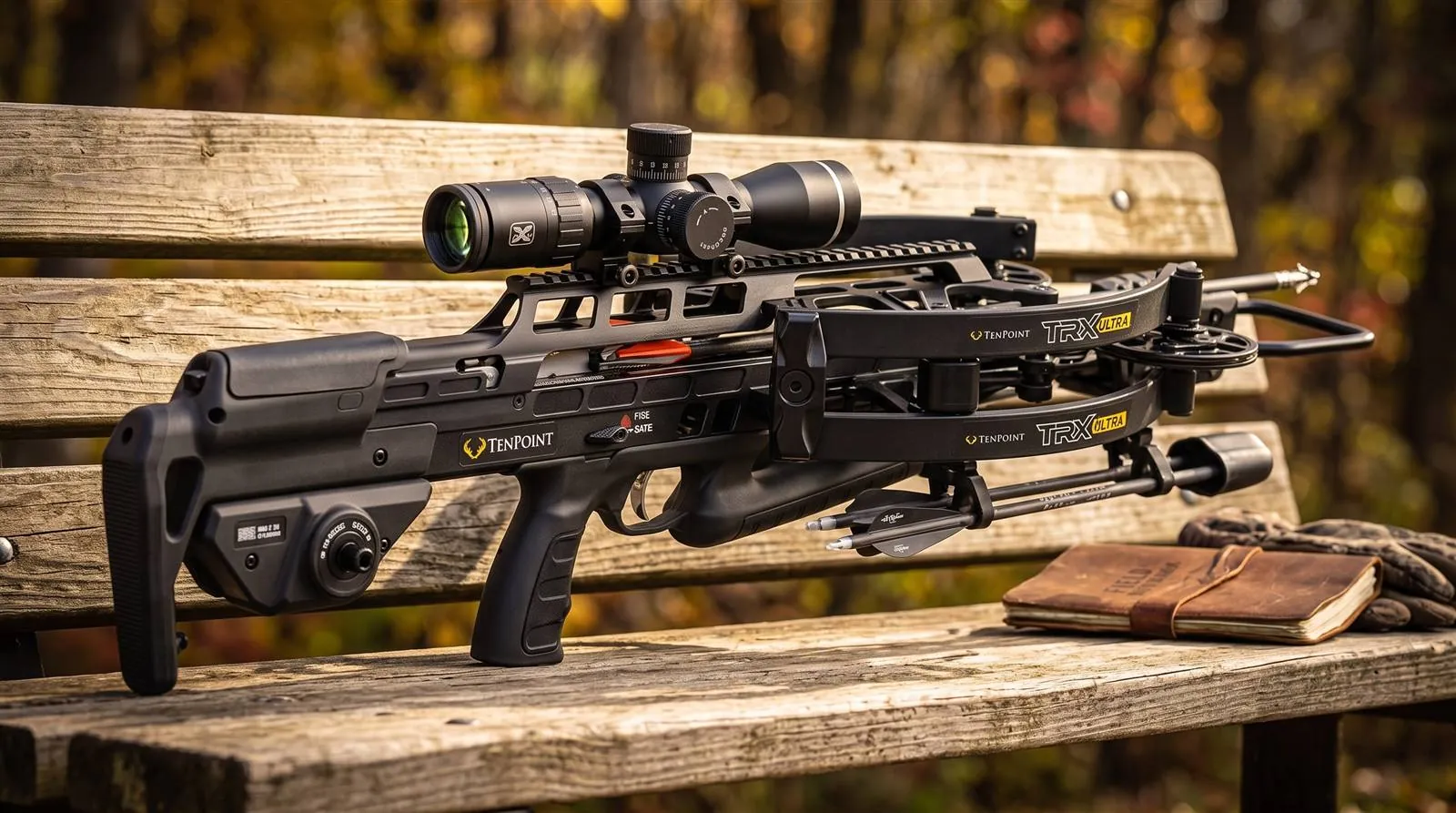
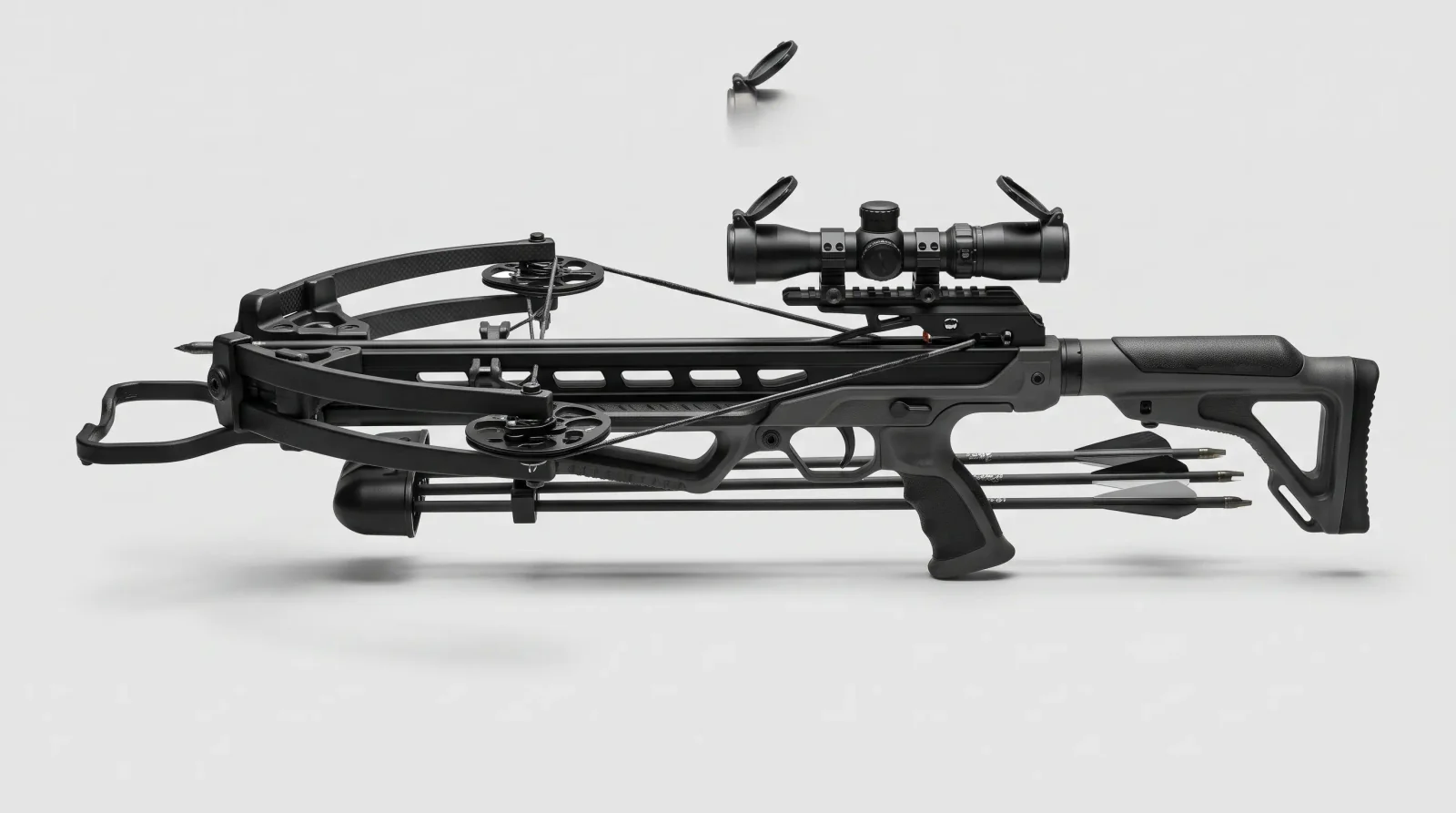
TenPoint TRX Ultra Review
TenPoint rates it at 515 FPS and claims 70% tighter groups at 100 yards. A flagship price that suits a narrow group of long-range buyers.
TenPoint Titan 400 Review
A 6 lb, 400 FPS forward-draw TenPoint that ships ready to hunt, with a built-in ACUdraw Silent crank and a 70-yard scope.
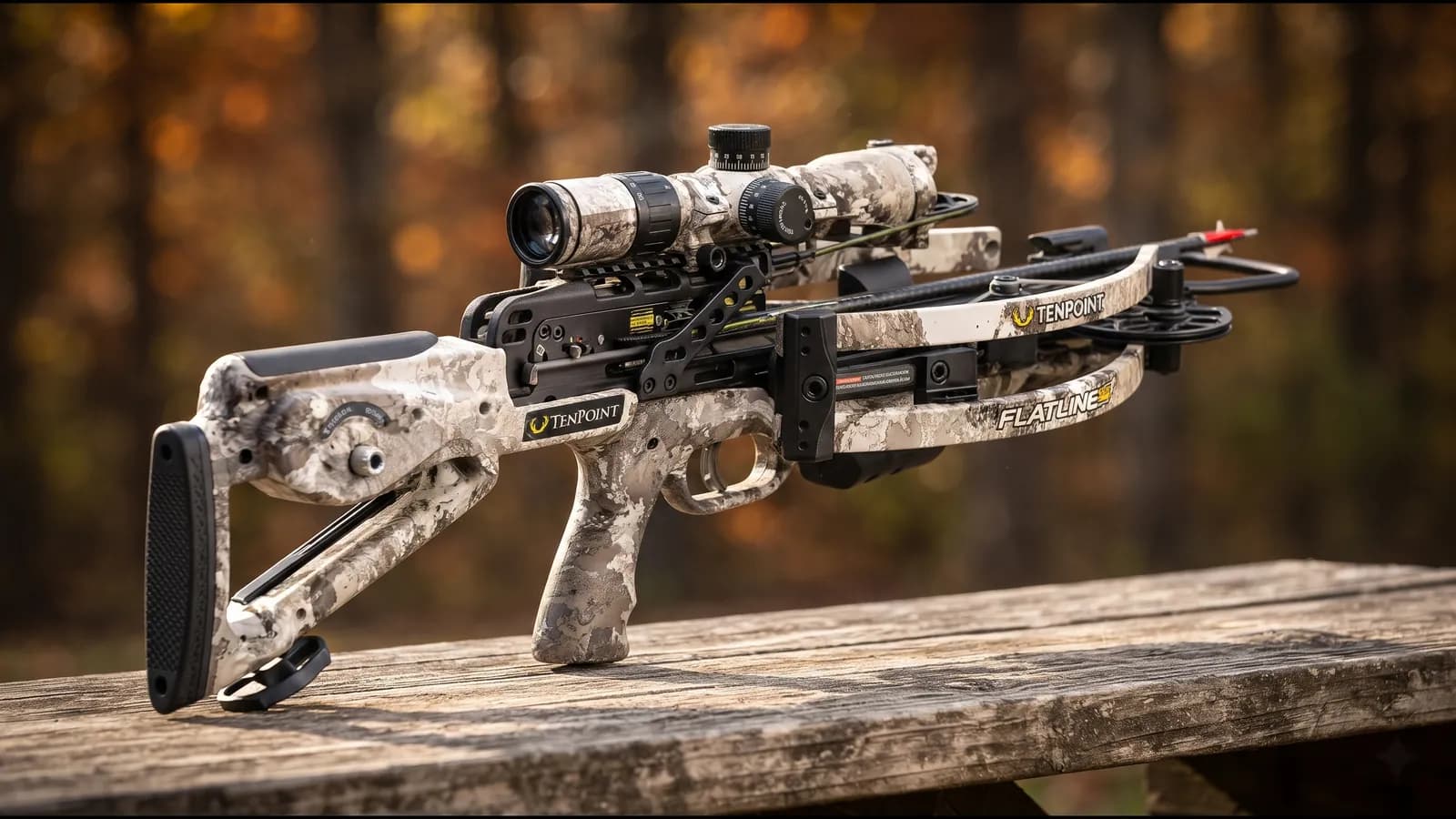
TenPoint Flatline 460 Review
Reverse-draw crossbow rated at 460 FPS and 193 ft-lbs with short 16-inch bolts, a 3.5-lb two-stage S1 trigger and a 7.5-inch cocked width.
Ready to compare models? Read our crossbow reviews to see how each one compares.
More in Hunting Laws & Field
Crossbow Hunting Guide: Game, Setup, Shot and Recovery
The crossbow hunting hub: game and energy guidance, legality, pre-season setup, stand or blind, shot placement, tracking, gear and safety.
Read guide
Crossbow Hunting Laws by State (2026)
Crossbow hunting rules by state for the current season: who may use a crossbow and when, licensing, equipment limits, and the official sources to verify.
Read guide
Crossbow Small Game Hunting: Rabbits and Squirrels
How to hunt rabbits and squirrels with a crossbow: judo and blunt heads, full-size vs pistol crossbows, shot distance, backstops and bolt recovery.
Read guide